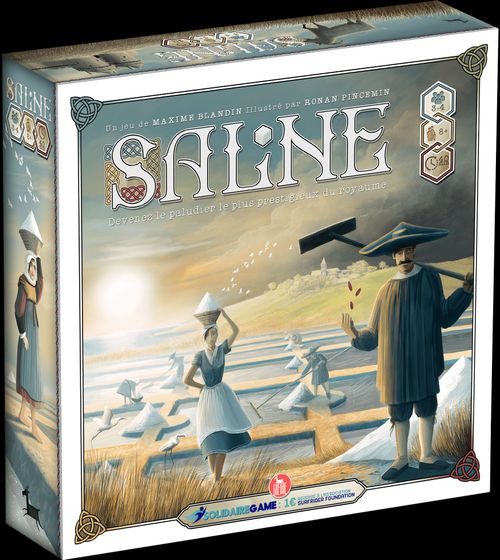
Saline
Saline Rulebook
Table of Contents
Table of Contents
Principle
We are in the 1770s, in the middle of the summer, in the village of Selak, on the edge of the Atlantic Ocean.
The salt season is at its height, and you are going to work hard to become the most prestigious paludier (salt-marsh worker) in the kingdom.
To do so, you must create your saline (salt marsh) by buying œillets (evaporation basins) at the market and placing them wisely around your mulon (salt heap) to achieve objectives.
Like a magician, the paludier transforms sea water into white gold with the help of the sun and the wind... But beware of the storms that prevent production!
Manage your salt production and sell it at the right moment to earn as many liards (coins) as possible. Beware of the gabelle (salt tax), which fluctuates throughout the game!
Finally, play event cards to improve your strategies. SALINE is a sometimes sneaky game, where all low blows are allowed.
Components
Material
- 32 œillet cards
- 4 mulon cards
- 18 objective cards
- 1 gabelle die
- 49 event cards
- 2 weather dice (météo dice)
- 80 white wooden cubes (salt resource)
- 30 coins (liards: 21 of value 1 and 9 of value 5)
- 1 village square board
- 1 first-player token, double-sided (day / night)
- 4 favour cards
- 1 rulebook
- 4 player aids
Game Elements
The village square board ("Place du village")
The village square is the place where all purchases of œillets and objectives are available. It is also here that you can see the amount of the gabelle and the level of the rain scale (échelle de pluie).
The board also makes setup easier. It facilitates reading the market track and the available objectives according to the number of players.
The mulon cards
These cards represent your personal starting reserve. They represent the place where you will store your harvest of salt (maximum 10) before being able to sell it on the village square.
The œillet cards
These cards represent the evaporation basins where the salt will form according to the weather.
There are 4 different colours of œillets, each with a maximum production capacity:
- 8 green œillets: production capacity of 2 salt
- 10 red œillets: production capacity of 3 salt
- 8 yellow œillets: production capacity of 4 salt
- 6 blue œillets: production capacity of 5 salt
The objective cards
These cards are placement objectives for œillets around the mulon. Each objective validated at the end of the game scores 2 prestige points. Each player reads them in their own direction. The secret objective received at the start of the game may be read in either direction.
The event cards
These cards offer two different effects. When you play a card, you must choose which effect to apply.
Icon key on the event cards:
- Day / night icons: the phase in which the card may be played.
- Triangle icon: this card may be played at any time.
- Coin-in-reserve icon: cost to pay to the reserve (the sovereign).
- Coin-targeting icon: cost to pay to the targeted opponent.
- Target icon: opponent.
- "-1" gabelle icon: modification of the gabelle.
The favour cards
These cards are jokers, usable only once during the game. If they are not used, they score you 3 prestige points at the end of the game.
The météo dice
These 2 dice determine the weather and therefore the quantity of salt produced for that day.
The gabelle die
This die represents the gabelle: the tax to be paid after selling your salt.
The liard coins
This is the currency of the game. There are 2 types of liards: copper liards worth 1, and silver liards worth 5.
The white sel cubes
These are the only resource in the game. They represent sea salt.
The first player token
This token shows who is the first player and which phase of the game you are in. It is double-sided: a day side and a night side.
Setup
(The setup diagram on page 7 of the rulebook numbers the steps 1 to 9 below.)
- Place the liards and the sel cubes beside the board to form a reserve.
- Place the gabelle die on the value 1 in the space provided on the board.
- Place a sel cube on the 0 of the rain scale (échelle de pluie).
- Shuffle the objectives, then place face up, in any direction, on the board the number of objectives corresponding to the number of players.
- Deal each player one objective face down. The remaining objectives are not used in this game.
- Give each player:
- 1 favour card,
- 3 liards,
- 1 mulon card with 3 sel cubes on it,
- 1 green œillet, which they place as they wish (according to their secret objective and/or the available objectives).
- Shuffle the œillet cards and place them face down on their space. Then reveal 4 of them on the market purchase track.
- Shuffle the event cards. Each player receives 2. Place the rest of the face-down deck beside the board.
- Determine a first player at random and give them the first-player token, day side up.
Playing the Game
The game is played over several turns. Each turn represents one day and comprises the following phases:
- Morning: production for everyone.
- Day: in turn order, each player takes 1 action of their choice (buy / harvest / sell / do nothing).
- Night: in turn order, each player draws 1 event card.
A) Turn Structure
1) Morning
Replenish the market if necessary by sliding the remaining œillets toward the lowest price.
Then the first player rolls the 2 météo dice, and all players benefit from the result:
- At least 1 rain: no production. Add +1 on the rain scale. When the marker reaches level 3, return it to 0 and make a new roll of the dice.
- At least 1 wind or 1 sun: simple production (1 salt per œillet).
- Wind + sun: double production (2 salt per œillet).
- +1 or -1 on a die: this affects the gabelle die. The rulebook diagram shows that +1 moves the gabelle die up one value and -1 moves it down one value.
2) Day
In turn order, starting with the first player, all players each take one action from the following 4:
Buy
Buy an œillet available on the market at the price indicated at its location. The market is not actually replenished immediately (see the morning phase, page 8 of the rulebook).
Harvest
Choose a colour of œillet. Harvest all the salt on the œillets of that colour that you own and store it on your mulon. If there are more than 10 salt on your mulon, remove the excess.
Sell
Sell the salt on your mulon (1 salt = 1 liard), then pay the gabelle to the sovereign (shown by the crown icon in the diagram). The diagram example reads: selling 9 salt with the gabelle die showing 4 gives 5 liards (9 − 4 = 5).
Do nothing
Take 1 liard from the reserve.
Nota bene: Playing one or more event cards is not considered an action. Event cards may be played before or after your day action, provided they respect the phase in which they can be played.
3) Night
In turn order, starting with the first player, all players take a second round of the table in which it is only possible to play one or more night event cards.
To indicate the end of their turn, each player draws 1 event card, with a hand limit of 2 cards. Discard the excess if necessary.
Nota bene: It is possible to play cards bearing the triangle symbol even after drawing your end-of-turn card.
Once the 2 rounds of the table have been completed, pass the first-player token to your left-hand neighbour and begin a new day:
- Morning: production for everyone.
- Day: in turn order, 1 action of your choice (buy / harvest / sell / do nothing).
- Night: in turn order, draw 1 event card.
B) Play a Card and Claim an Objective
1) Play an Event Card
During the game turn, you may play one, or even two, event cards. They are not considered an action, and they give you a strategic advantage over your opponents.
- Day cards (sun icon) may be played before or after your chosen action during the day phase.
- Night cards (moon icon) must be played before drawing a new card, at the start of the night phase.
- Cards bearing the triangle symbol may be played at any time.
Anatomy of an event card, as labelled in the rulebook:
- A: Title of the card.
- B: Day or night phase.
- C: Modification of the gabelle.
- D: Cost of the card.
- E: Effect of the card.
Icons used in the rulebook:
- Phase of play: day / night icons.
- Playable at any moment: triangle icon.
- Sovereign: cost paid to the general reserve.
- Opponent: cost paid to the targeted opponent.
- Modification of the gabelle: "-1" and "+1" icons.
Nota bene: Event cards are resolved in this order: A, modification of the gabelle die; B, any card cost; C, the card's effect.
2) Play a Favour
The favour card is a joker, to be used at any moment during the game. Once used, return this card to the box. It can be used only once during the game.
Transcriber's note: the individual effect text printed on each of the four favour cards (Faveur du Seigneur and the three others pictured on this page) is too small to read reliably in the source scan, so it is not transcribed here. Consult the card itself.
3) Claim an Objective
As soon as your saline meets the placement criteria of an objective (in your line of sight), you must immediately take the corresponding objective and place it beside your saline. Each objective scores 2 prestige points. Only one may be validated per turn.
End of Game and Scoring
The game ends if either of the following conditions is met:
- A player has completed their saline, with 8 œillets around their mulon.
- A player has 20 liards or more at the end of a turn.
The turn is then completed normally, and the final scoring takes place. Add up the points from sets of the same colour, sets of different colours, the liards, the objectives, and the favour card if it has not been used.
Liard points: each liard scores 1 point.
Objective points: each objective scores 2 points.
Favour points: your favour card scores 3 points (if it has not been used).
Collection of the same colour: the number of cards counts, not their colour (4 blue cards are worth as many points as 4 green cards).
| Cards of the same colour | Points |
|---|---|
| 1 | 1 |
| 2 | 2 |
| 3 | 4 |
| 4 | 8 |
Collection of different colours: the number of cards counts, not their colours (1 green + 1 red œillet are worth as many points as 1 yellow + 1 blue œillet; the rulebook writes "orange" for this colour in this note, and "yellow" elsewhere).
| Cards of different colours | Points |
|---|---|
| 1 | 0 |
| 2 | 3 |
| 3 | 7 |
| 4 | 12 |
The player with the most prestige points wins the game.
Foire Aux Questions (FAQ)
Why is there no 2-player variant? It is entirely possible to play with 2 players, but it is not much fun: there is very little interaction between players.
Does the Microclimat card give extra production to all players? No, only to the player who plays it.
How is a card copied with Courtisane resolved? The effect of Courtisane applies immediately after the card that has just been copied. The costs and gabelle modifications are applied again.
How is a card cancelled with Souverain resolved? The Souverain cancels the effect of the card, but also its possible cost and, where applicable, the modification of the gabelle.
When do I play Gabelou, and when must the player pay me the gabelle? Play Gabelou just after the Faux-saunier is placed. The gabelle is paid to you after the result of the sale.
Can I play event cards drawn in the night phase, or after having played Retour du pardon? No. Drawing event cards indicates the end of the player's turn.
What happens if I cannot pay the gabelle? In this rare case, sacrifice 1 œillet of your choice, but keep your liards.
What happens if there are no more sel cubes? If there are no more cubes, take anything to replace the missing sel.
What happens if a player reaches 20 liards or more but loses them with Pot-de-vin? The game ends only if a player has 20 liards or more at the end of a turn.
Can I end the game with 9 œillets or more by using Marché noir? No. The maximum number of œillets per player is 8.
What happens if I have more than 4 œillets of the same colour? If you have more than 4 œillets of the same colour, a new collection is started.
Card List and Name Explanations
The rulebook lists the card titles (with the number of copies of each card, shown as ×N) and explains the names used in the game. Card titles are kept in French, as printed. The groups below follow the layout of the two pages.
×5 (page 14, top left)
- Sel menu: name given to the fleur de sel or "white salt".
- Vent solaire: small particles of matter that the sun constantly expels into its environment.
×5 (page 14, right)
- Prise: harvest of coarse salt from an œillet.
- Sourceux: the bottom of the œillet (clay) containing water sources that are not saturated with salt, which prevent crystallisation.
×5 (page 14, left)
- Orage de mer: storm coming from the ocean.
- Brise de mer: favourable wind for the crystallisation of salt.
×3 (page 14, right)
- Malandrin: thief, a doubtful vagabond who seems dangerous.
- Larcin: petty thief, whether with regard to the loot harvested or the methods used.
×1 (page 14, left)
- Pot-de-vin: sum of money given illegally to someone in exchange for a service rendered.
- "Avoir le Bec salé": to always be thirsty; a drunkard.
×4 (page 14, right)
- Pays de salines: one of the 6 countries where the gabelles were different.
- Pays rédimés: one of the 6 countries where the gabelles were different.
×4 (page 14, bottom left)
- Franc-salé: total or partial gabelle exemption granted to certain people. Also the 6th country, which was exempt from the gabelle.
- Marché noir: clandestine market.
×2 (page 15, top left)
- Devoir pour le pot "et la salière": in "grande gabelle" countries, the taxpayer is not free to buy the quantity of salt of their choice. This minimum quantity is called the "Sel de devoir pour le pot et la salière".
- Orage isolé: storm limited to a very small geographical area.
×5 (page 15, right)
- Effondrement du mulon: collapse of the salt heap.
- Quart bouillon: one of the 6 countries where the gabelles were different.
×4 (page 15, left)
- Brigandage: theft under threat.
- Retour du pardon: religious ceremony.
×3 (page 15, right)
- Faux-saunier: person who smuggled salt between the different countries of France and sold it fraudulently, without paying the gabelle.
- Grande Gabelle: one of the 6 countries where the gabelles were different.
×3 (page 15, left)
- Gabelou: under the Ancien Régime, the customs officer responsible for collecting the gabelle.
- Petite Gabelle: one of the 6 countries where the gabelles were different.
×4 (page 15, right)
- Souverain: person who holds supreme authority.
- Courtisane: the self-interested mistress of the sovereign.
×1 (page 15, left)
- Grenier à sel: building where salt was stored and sold under public authority.
- Microclimat: climatic conditions limited to a very small geographical area.