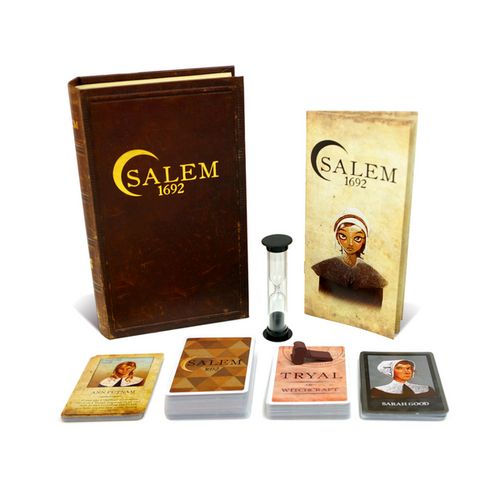
Salem 1692
Salem 1692 Rulebook
Table of Contents
Table of Contents
Components
- 15 Town Hall Cards
- 59 Salem Playing Cards
- 30-Second Timer
- 15 Frame Cards
- 39 Tryal Cards
- Gavel Token
Set Up
-
Select the most experienced Salem player to be the town crier. The town crier will direct the opening and closing of eyes during night rounds. If your group is new to Salem or you have a large group, it is recommended that you use a moderator instead of a town crier. The moderator will facilitate the game and is not considered a player. There is also a free "Salem 1692 Moderator" app for iOS.
-
Use the table below to assemble a deck of tryal cards. Based on the number of players, gather the appropriate number of not a witch, witch, and constable tryal cards.
Players 2-3* 4 5 6 7 8 9 10 11 12 Not a Witch 18 18 23 27 32 29 33 27
If Using A Moderator
The moderator will direct players' actions using the dawn section of the Moderator Script on page 10.
If Using A Town Crier
The town crier places the black cat card perpendicular and face-up on top of the playing deck so it's easy for the witch(es) to grab, and directs all players to close their eyes. Then they instruct anyone with a witch card to open their eyes and place the black cat card next to any player (the town crier should keep their eyes closed, unless they are also a witch). The town crier will count down slowly from ten, instruct the witches to close their eyes, and then ask all players to open their eyes.
The player given the black cat must keep it in front of them. Once in play, the black cat card should be treated like any other blue card. It may be discarded or moved by certain cards and may be re-drawn and played later in the game if it is discarded. See Advanced Tips on page 15 for ideas about masking noise.
Playing the Game
The player who was given the black cat goes first. Proceed clockwise.
During Your Turn
You must choose to do one of two things:
DRAW TWO CARDS AND END YOUR TURN if a BLACK card is drawn it must be revealed and played immediately
OR
PLAY AT LEAST ONE CARD you may play any number of cards on any other players
GREEN cards are discarded after use.
BLUE cards stay in front of a player until that player is eliminated or the card is moved or discarded by another card (such as scapegoat or curse).
RED cards remain in front of a player until that player has seven total accusations. The person playing the 7th accusation chooses a tryal card belonging to the accused player and reveals it. All red cards in front of the accused player are then discarded.
A Player Is Eliminated When
ALL OF THEIR TRYAL CARDS HAVE BEEN REVEALED
OR
ONE OF THEIR REVEALED TRYAL CARDS SAYS "WITCH"
OR
WITCHES ELIMINATE THE PLAYER DURING THE NIGHT
When a player is eliminated, they place all cards in their hand and all blue cards currently in front of them into the discard pile. They must reveal the rest of their tryal cards, but they are not required to tell the group if they ever had a "witch" card during the game.
Ending & Winning the Game
TOWNSPEOPLE WIN when they reveal the final "witch" tryal card. They don't necessarily need to eliminate all of the witches, they only need to reveal all the "witch" tryal cards.
WITCHES WIN when they eliminate all townspeople OR the final remaining townsperson becomes a witch (in which case that player loses).
Black Cards
When a black card is drawn, it must be revealed and enacted immediately.
Conspiracy
Conspiracy causes tryal cards to shift to new players, potentially increasing the number of witches in the game!
When Conspiracy Is Drawn:
- The person who drew conspiracy reveals one tryal card belonging to the player with the black cat card in front of them. If no player currently has the black cat, this step is skipped.
- All players simultaneously choose a face-down (unrevealed) tryal card from the player on their left and add it to their own set of tryal cards. All players view their new set of tryal cards, shuffle them, and place them back in a face-down row in front of them. Previously-revealed tryals are not moved or affected by conspiracy.
- If you receive a "witch" card, you are now a witch, aligned with the team of witches. If you lose a "witch" card, you remain a witch during the night and you remain aligned with the team of witches.
If you receive the constable card, you are now the constable and may place the gavel token during the night. If you lose the constable card, you are no longer the constable, and you should not open your eyes as the constable during the night.
Night
In the night, the witches will attempt to eliminate another player (or the witches may stage elimination of one of their own to throw off suspicion), and the constable will attempt to save another player from being eliminated. If the constable is also a witch, they may intentionally save the wrong player.
Unlike the dawn, the black cat is not involved in the night. If someone nearby is not playing or a player has already been eliminated, it is recommended that you use them to act as the moderator instead of using a town crier.
If Using A Moderator
The moderator will direct players' actions using the night section of the Moderator Script on page 11.
If Using A Town Crier
-
Place the frame cards (corresponding with the town hall characters still in the game) face-up in a stack. Place this stack perpendicular on top of the playing deck. This will make it easier for the witches to pick them up quietly during the night.
-
The town crier will instruct all players to close their eyes.
-
The town crier will instruct the witches to open their eyes and place any frame card face-down away from the other frame cards (indicating the player they wish to eliminate) and place the remaining frame cards in a face-down stack. The town crier will count down from 20, and then instruct the witches to close their eyes (the town crier should keep their eyes closed, unless they are a witch).
-
The town crier will instruct the constable to open their eyes and place the gavel token next to any player, indicating the player they wish to save. The constable may not give the token to themself. The town crier will count down from ten, and then instruct the constable to close their eyes (the town crier should keep their eyes closed, unless they are the constable).
-
The town crier will instruct all players to open their eyes. Any player choosing to "confess" may reveal one of their own chosen tryal cards in exchange for immunity from the frame cards. Players must choose to confess before one length of the hourglass.
-
Reveal the frame card that was placed away from the others. The player with the matching town hall card is eliminated, and flips over all of their remaining tryal cards, unless:
THAT PLAYER WAS GIVEN THE GAVEL TOKEN BY THE CONSTABLE
OR
THAT PLAYER CHOSE TO "CONFESS" BEFORE THE FRAME CARD WAS REVEALED
OR
THAT PLAYER HAS THE ASYLUM CARD IN FRONT OF THEM
After night is over, set the night card aside and shuffle all remaining cards from the deck (if any) and the discard pile. Cut the shuffled deck in half and shuffle the night card into the bottom half of the deck. Place the completed deck in the center of the table and continue playing where you left off.
The 5 Laws of Salem
-
Unless otherwise stated, you may never play a card or the gavel token on yourself. You can never play a card in a way that would directly affect you (such as giving yourself alibi, forcing someone to give you cards from robbery, or moving cards to yourself with scapegoat).
-
When playing a card, once it has been let go of, it cannot be taken back. If a player forgets to use their special ability during the applicable turn...too bad!
-
If a player delays, flip the hourglass. When the sand runs out, they must end their turn. If they didn't play any cards, they must draw two cards to end their turn.
-
Players may view their own tryal cards at any time. Tryal cards must be shuffled after each conspiracy.
-
When a player is eliminated, they may have three "last words" before becoming silent. Eliminated players who speak by word or action shall be shunned.
You are now ready to play!
Moderator Script — Dawn
"All players close your eyes." Make sure everyone's eyes are closed.
"Witches, please open your eyes and point to any player to give the black cat card. You may point to yourself." Make sure that you see who the witches point to.
"Witches, please close your eyes." Make sure witches eyes are closed.
"Everyone, please open your eyes." Place the black cat card in front of the player who the witches pointed to.
Moderator Script — Night
"All players close your eyes." Make sure everyone's eyes are closed.
"If you have a witch card, or ever had a witch card, please open your eyes and point to any player to eliminate. You may select yourself." Make sure that you see and remember who the witches pointed to.
"Witches, please close your eyes." Make sure witches' eyes are closed.
"Constable, please open your eyes and point to any player to give the gavel token. You may not select yourself." Put the gavel token in front of the player who the constable points to.
"Constable, please close your eyes." Make sure the constable closes their eyes.
"Everyone, open your eyes. Before I reveal who has been eliminated, any player may choose to 'confess.' This means that you can flip over one of your own tryal cards in exchange for immunity from elimination for this night. Your decision to 'confess' ends with the sands of the hourglass." Flip the hourglass. Once time has run out, tell everyone who the witches eliminated. That player is eliminated unless they were given the gavel token, they chose to confess, or the asylum card is in front of them, in which case no player is eliminated. Set the night card aside and shuffle all remaining cards from the deck (if any) and the discard pile. Cut the shuffled deck in half and shuffle the night card into the bottom half of the deck. Place the completed deck in the center of the table and continue playing where you left off.
Nitty Gritties (Refer to as Needed)
Black Cards
If a black card is drawn, it counts as one of the two cards allowed to be drawn on your turn. If it is drawn out of turn (because of a character's ability), immediately resolve the black card and then continue play where you left off. If you draw when the deck only has one card remaining you may draw a second card after night is over. Because night is shuffled into the bottom half of the deck, in some rounds conspiracy will not occur (if it is below the night card in the deck), since the deck is re-formed after each night.
Black Cat
Contrary to the 1st Law of Salem, witches may give themselves the black cat during dawn to throw off suspicion. After dawn, the black cat becomes just like any other blue card. It can be discarded by a curse card or moved by scapegoat. If the owner of the black cat draws conspiracy, they may choose which of their tryal cards is revealed. In 2-3 player games, if conspiracy is discarded by a ghost or by viewing a ghost, the player to the right of the black cat's owner chooses which tryal to reveal.
Constable
The constable may never give themself the gavel token. If the constable is also a witch, they are an "evil" constable, and may use their power to help the witches. If the constable card is revealed, that player is not necessarily eliminated, but the constable role is no longer used in the game.
Martha Corey
If Martha has inherited John Proctor's special ability, Martha and John look at the cards they will receive from the eliminated player and take turns picking their 3 cards, starting with John. If Martha had been using Cotton Mather's ability and Cotton Mather is eliminated, evidence cards immediately count as three against Martha even if they are already in front of her.
Matchmaker
A player cannot be given a second matchmaker card if they already have one. If one of the matchmaker owners is eliminated during the night, both are eliminated, even if the other person "confessed" or was saved during the night. If a player is matched with Mary Warren when she is eliminated, that player is still eliminated, even though Mary is unaffected by matchmaker. If matchmaker would cause both teams to lose simultaneously, only the intended target is eliminated (not the matched player).
Piety
If a player loses piety and already has seven or more accusations they immediately lose a tryal. The player who removed piety chooses which tryal to reveal.
Red Cards
Red cards are placed on a player, not in front of a certain tryal card. If the number of accusations placed on a player exceeds the required amount to reveal a tryal (for example, if you played an evidence card on someone with six accusations), they do not carry over to the next tryal. If you have enough accusations to reveal two tryal cards on the same player, reveal one tryal card at a time.
Scapegoat & Robbery
As implied by the 1st Law of Salem, a player may never use a robbery card to move their own cards or to receive extra cards. They may only involve two other players, (i.e. take cards from one player and give to another). Therefore, when only two players remain, robbery and scapegoat may not be played. In 2-3 player games, robbed cards may be given to a ghost.
Stocks
When played, the stocks card should remain in front of the player until they have been skipped. It should then be discarded. If a player is given two stocks cards, they will be skipped twice in a row.
Thomas Danforth & George Burroughs
If Thomas is playing accusations on George, Thomas needs to place 7 accusations to reveal one of George's tryal cards (or 14 if George has piety). Against other players, if George has the piety card, he needs 16 accusations to lose a tryal. If attacking someone with the piety card, Thomas only needs to play 12 accusations to reveal a tryal.
Tituba
When using her ability, Tituba is allowed to move any cards in the deck, including conspiracy and night. When night is drawn, carry out the night phase and re-form the deck like normal. Tituba may rearrange the deck and draw cards in the same turn.
Witch Cards
A player may have more than one witch card. If one of their witch cards is revealed, the player informs the group that they own at least one other witch card and play continues (per the rules, a player with only one witch card is eliminated when it is revealed).
Advanced Rules & Tips
To Mask Movement During Dawn and Night
Make noise while the witches are doing their dirty work. Some good ways to do this: stomp your feet, pat the table with one hand, turn on creepy music, hum, etc. It also helps if everyone stands up before the night begins so that everyone has easy access to the black cat card or frame cards.
After the first player is eliminated, let them become the moderator, taking over the town crier's duties. This keeps the eliminated player involved, and better hides movement.
To Make The Game More Difficult
When conspiracy is drawn, tryal cards are usually taken from the player to your left. To increase difficulty, take a tryal card from the player to your left, place this card in the middle, have the town crier/moderator shuffle the cards, and deal a tryal card to each player. This will make it harder to track down the spreading of witches.
You may also use two witch cards in 4-5 player games, and three witch cards in 6-12 player games.
To Avoid Extra-Short Games
When a player has four or five tryal cards remaining, point to two of them when you would normally reveal a tryal. The player being accused may select which tryal card to flip over. Their reaction and concentration may give something away!
To Make The Game Easier For The Townspeople
When a player is eliminated they must truthfully reveal if they ever had a witch card during the game.
2-3 Player Rules
For the most part, 2-3 player games are played like a normal game so please read all standard set up and rules first. Then apply the following adjustments.
Set Up
If there are two players, add two "ghosts", placed to the left of each player. If there are three players, add one "ghost" to the left of the youngest player. Ghosts and players each start the game with five tryal cards (see the table on page 3) and a town hall card. Character abilities are not active in 2-3 player games. Remove the two matchmaker cards from the game.
On Your Turn
In addition to the two standard actions available to you (drawing two cards or playing any number of cards), players may instead do the following for their turn action:
View one tryal card belonging to a ghost, then shuffle that ghost's unrevealed tryal cards and put them back. Each time you take this action discard two cards from the top of the deck. Perform conspiracy or night if they are discarded.
On a Ghost's Turn
Ghosts do not have hands of cards, but each time the ghost has a turn simply place one card from the top of the deck into the discard pile. If it is a black card, immediately carry it out.
Conspiracy
Conspiracy happens as normal, but if you are passing to a ghost the player on your right chooses which one you will pass. Be sure to shuffle the ghost's new set of tryal cards.
Dawn & Night
Before dawn and before each night, shuffle the four frame cards that match the four town hall cards and place them face-down on the table. The town crier should instruct all players to close their eyes and then have the witch(es) place the frame card that matches their intended target face-down at the bottom of the deck. If a ghost happens to be the only witch, then the target will be chosen at random based on which card is at the bottom of the deck. Before players open their eyes the town crier should move the frame deck slightly while keeping their eyes closed (to mask deck movement from the witches).
Confessions, asylum, and the constable are available to protect players from the night. Unlike the normal rules, the constable has the option of not placing the gavel on anyone (perhaps to imply that a ghost is the constable). The constable may place the gavel on themselves in a 2- or 3-player game.
Instead of being eliminated (as in a normal game), players and ghosts who are framed during the night phase lose two tryal cards. The player to their left chooses which two tryal cards are revealed.
Winning The Game (2-3 Players)
TOWNSPEOPLE WIN when the witch card is revealed.
WITCHES WIN when any player or ghost is eliminated (including someone who formerly had a witch card) OR all players become witches (in which case the final player to become a witch loses).
History
After a few young girls began to have fits blamed on the devil, the town of Salem was quickly engulfed in tryals (note the olde spelling) and "confessions" of witchcraft. Once all was said and done, more than 150 people were accused of witchcraft. Nineteen people were hanged as witches, one was pressed to death, and at least five of the accused died in prison.
Abigail Williams - Child (11) Abigail, the niece of Samuel Parris, was one of the first young girls to accuse others of witchcraft. She claimed to have epileptic fits and pinching pains inflicted upon her by witches. Two of the first people to be accused by Abigail were Sarah Good and Tituba.
Ann Putnam - School Girl (13) Ann belonged to the powerful Putnam family and was one of the first accusers in the town. Some believe that her parents, Thomas and Ann, forced her to accuse people who they were feuding with. In 1706 Ann publicly apologized for her role in the Witch Trials.
Cotton Mather - Minister (29) Cotton was one of the most prominent ministers in New England at the time of the Witch Trials. Many blame him for laying the groundwork of extremism, and for allowing "spectral evidence" to be used against defendants. Cotton went on to become an important author and scientist.
Giles Corey - Landowner (71) Giles was accused of witchcraft along with his wife Martha Corey. Giles refused to confess or deny his guilt, and was therefore subjected to the punishment of pressing. Instead of speaking, Giles died after two days of being pressed by a large stone.
George Burroughs - Strongman (40) George, a clergyman, was charged with witchcraft partially because his feats of strength (lifting a musket with a finger) were hard to justify without the devil's assistance. While being hanged, he recited the Lord's Prayer, something that was supposedly impossible for witches to do.
John Proctor - Farmer (60) John was a man of high reputation. Originally, his wife Elizabeth was accused. John defended her and expressed disbelief in the girls' accusations. Because of this, Abigail Williams accused him of violence and forcing her to touch the Devil's Book. John was hanged in August 1692.
Martha Corey - Seamstress (72) Martha, married to Giles, was a pious member of the church and was critically outspoken against the trials. In court, children mimicked her movements and claimed Martha was controlling them. Because of this, Martha was hanged in September 1692.
Mary Warren - Servant (17) Mary was a servant to John and Elizabeth Proctor. She was one of the first in the town to accuse others of witchcraft, claiming to have seen visions of the ghost of Giles Corey. She was eventually arrested for practicing witchcraft herself, and confessed, but was never hanged.
Rebecca Nurse - Housewife (71) Rebecca was one of the oldest, most respected people to be accused of witchcraft. 39 members of the community signed a petition for her release from prison. Rebecca was eventually hanged, and was known for having impressively dignified behavior on the gallows.
Samuel Parris - Pastor (39) Samuel Parris was the main pastor in the town of Salem. Before the Witch Trials, he sought out "iniquitous behavior" in his congregation and made church members in good standing suffer. His attitude contributed to the suspicious, tense atmosphere in the town.
Sarah Good - Beggar (39) Sarah was a homeless beggar, and was perhaps accused of witchcraft because of her poor reputation. Among other things she was accused of rejecting many of the "Puritan expectations" of the town. Sarah was hanged in July 1692.
Thomas Danforth - Judge (69) Thomas was one of the judges during many of the trials that were held in Salem. Thomas disapproved of the trials, and may have had a hand in putting an end to them.
Tituba - Storyteller (35) Tituba was a slave of Samuel Parris and the first person to be accused of witchcraft since she had enchanted the young girls of the town with mythical tales. Despite her confession, Tituba was never hanged and was eventually released from prison.
Will Griggs - Physician (47) Griggs was in charge of diagnosing witches, and determining how "big" of a witch someone was. After his diagnosis, he'd send his patients to be tried, where they were often found guilty, and executed.
William Phips - Governor (42) Sir William Phips was a Boston shipbuilder before finding treasure in a sunken Spanish galleon. Phips used his money & connections to become the first royally-appointed Governor of the Massachusetts Bay. Phips established, and later disbanded the Salem Witches Court.