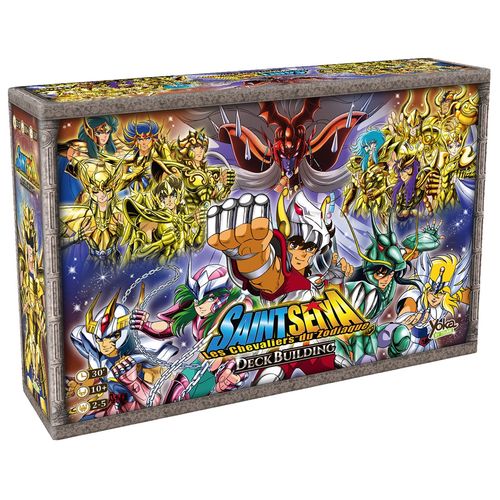
Saint Seiya: Deckbuilding
Saint Seiya: Deckbuilding Rulebook
Table of Contents
Table of Contents
Objective
Athena is threatened by the Grand Pope, and the Knights under his power are ready to fight!
5 Bronze Knights (Seiya, Shiryu, Hyoga, Shun and Ikki) must end this threat before the last flame of the Clock goes out.
During the game, the players each take the role of one of the five available Heroes. They must face the other Knights, who they will have to fight or rally to their cause.
Contents
- 1 Rulebook
- 200 Cards
- 1 Play mat
- 1 Clock and its 12 magnetic Flames
- 5 Hero markers
- 25 Wound tokens
Hero
Each player starts the game with a Hero marker and a deck of 15 cards bearing the image of the chosen Hero:
- 9 Hero Cards
- 1 Bronze Armor Card
- 5 Hero Cards - Bronze Knight (set aside at the start of the game)
Example of the material tied to Seiya of Pegasus: Hero marker, 9 Hero cards, 1 Bronze Armor card, 5 Hero - Bronze Knight cards.
Personal Area
During the game, each player keeps a personal area in front of them, which holds:
- Their Draw deck (face down)
- Their Discard pile
- Their Hero marker, under which destroyed cards are placed
- Their Armor in play
- Their wounded Characters (each with a Wound token)
Layout of the personal area: Armor in play, wounded Characters, Discard pile, Draw deck, destroyed cards.
Setup
Player
Each player chooses a Hero marker and takes the 15 cards associated with it.
- The 5 Hero - Bronze Knight cards are set aside, away from the play area (these cards will be used later in the game).
- The remaining 10 cards (9 Hero + 1 Bronze Armor) are shuffled to form their personal draw deck, face down.
The cards associated with the Heroes that were not chosen can be put back in the box; they will not be used during the game.
Each player draws 5 cards, called "the hand".
The first active player, chosen however you like, turns their Hero marker over (side 1), then begins their turn.
Play Area
- Unroll the play mat in the middle of the play area.
- Place the Clock near the play mat and arrange the 12 magnetic Flames as shown in the illustration.
- Place the Wound tokens near the play mat.
- Shuffle the remaining cards to form a Reserve, face down, on the space provided on the play mat.
- Reveal the first 6 cards of the Reserve, placing them face up on the field.
Note: during setup, card effects are not applied.
The play mat holds, from left to right: the card Reserve, the 1st field space through the 6th field space, and the common discard pile for cards removed during the game. The Wound tokens and the Clock with its 12 Flames sit alongside the mat.
Characters
Characters are the most numerous cards in the game. The cards show the following information:
- Name
- Class
- Acquisition cost in Strength
- Acquisition cost in Cosmos
- Values and Effects of the card
- Rank (colour)
- Flame of the Clock
- Number
- Victory Points (VP)
Armors
Armors are told apart from Characters by their horizontal reading direction. The cards show the following information:
- Name
- Class
- Acquisition cost in Cosmos
- Rank (colour)
- Value and Effect of the card
- Victory Points (VP)
- Number
Note:
- Not all information is present on all cards. Some Characters give no VP, have no effect, or cannot be acquired with Cosmos or with Strength...
- Not every character in the game is a Knight. A character counts as a Knight only if its Class says so.
Card Ranks
The colour of the card border tells you its Rank. Some game effects target specific cards according to their Rank.
There are 5 different Ranks:
- Very Common
- Common
- Uncommon
- Rare
- Very Rare
Turn
A turn takes place as a succession of 2 phases.
1 - Main Phase
This is the phase in which the active player plays the cards from their hand and tries to acquire new cards.
Different actions are possible during this phase:
- Play Characters.
- Play Armors.
- Acquire cards from the field by accumulating Strength or Cosmos.
- Activate the effects of certain Characters and Armors played.
- Heal wounded Characters.
Details of the actions on the following page.
2 - Upkeep Phase
This phase ends the player's turn. It consists of a succession of steps that let them rebuild their hand and prepare the field for the next player.
- Discard all cards played this turn (wounded Characters and the Armor in play are not discarded), as well as the cards in hand that you do not wish to keep for the next turn.
- Draw until you have 5 cards in hand.
- Remove from the game the card on the 6th field space (A). Note: the Flame effect of the removed card applies at that moment.
- Slide all the remaining cards to the right of the field (B).
- Refill the field by revealing new cards from the Reserve into the empty spaces, from right to left (C). Note: the Arrival effect of a card applies at that moment.
- The player to their left becomes the active player and begins their turn.
End of the Game
The game ends when the last Flame is removed from the Clock. The players finish the round so that everyone has played the same number of turns (upkeep phase included).
Some cards carry a Flame (in the bottom left corner of the card).
This effect removes 1 Flame from the Clock, at the moment a player acquires the card from the field OR if the card is removed from the field (by the upkeep phase or by a card effect).
Examples of Flame removal:
- A player acquires a Gold Knight from the field (all Gold Knights carry a Flame).
- A Gold Knight is removed from the field during the upkeep phase.
- If Aiolos of Sagittarius is revealed on the field and another Gold Knight is present on the field (see the card).
- If Ptolemy of Sagitta is revealed on the field (see the card).
Actions
Play a Character
Characters are used mainly to acquire cards from the field by using their Strength or Cosmos values.
On your turn, you may play as many Character cards from your hand as you wish. A played Character is always placed face up near the field, under the card the player is trying to acquire.
Some Characters have additional effects that may or may not be used, depending on your strategy.
Acquire a Card from the Field
Acquiring new cards is the main goal of the game. The cards you acquire round out your deck to make it more powerful and, above all, to score VP at the end of the game.
There are 2 ways to acquire cards:
- Acquisition by Strength (combat)
- Acquisition by Cosmos (allegiance)
A card on the field is acquired when its cost in Strength or in Cosmos is reached. The player may use several cards and so add up their Strength or Cosmos values.
- A card acquired by Strength is immediately discarded. Note: its Defeated and Flame effects apply at that moment.
- A card acquired by Cosmos immediately joins the player's hand and may therefore be played this turn. Note: its Defeated and Flame effects apply at that moment.
- Each card used for the acquisition is discarded; a played card can therefore only be used once per turn (unless it is drawn again).
Note: as shown on the play mat, the card in 6th position on the field costs -1 Strength and -1 Cosmos.
Example (acquisition by Strength): the 3 cards played add up to 6 Strength. Aghora, cost 6, is acquired and goes to the discard pile, triggering his Defeated effect. Leda, having no Cosmos, is wounded by Aghora's Defeated effect.
Example (acquisition by Cosmos): each Seiya card benefits from Marin of the Eagle's effect and gains +1 Cosmos. The 4 cards played add up to 6 Cosmos. In 6th position the card's cost is reduced by 1 Cosmos, so Mu of Aries, cost 6, is acquired and goes directly to the player's hand.
Play an Armor
On your turn, you may only play a single Armor at a time. Playing a new Armor discards the one already played. A played Armor is placed face up in its personal area.
An Armor may be used for a single action among:
- Acquire a card from the field (uses its Cosmos value)
- Activate the Activation effect shown
The Armor stays in play as long as it is not used. It is not discarded at the end of the turn and may therefore be kept for the following turns.
Effects
Many cards have effects. Two different types of effect are distinguished:
Field effect, taken into account when the card is on the field (white text on a dark background).
- Arrival: This effect triggers only once, at the moment the card is revealed on the field.
- Defeated: This effect triggers only once, at the moment a player acquires the card from the field, before it joins their discard pile or their hand.
Play effect, taken into account when the card is played from a player's hand (black text on a light background).
- When Played: This effect is optional and can only trigger once, at the moment the card is played from a player's hand. The player may decide not to trigger the when-played effect, in which case the effect is lost for that turn.
- Activation (Discard, Wound or Destroy): This effect is optional and can only trigger once. If the player decides to apply the effect, then the card suffers the consequences and ends up discarded, wounded or destroyed. In that case its Strength and Cosmos values are lost for that turn.
Note: the text on the cards takes precedence over the application of the rules.
Keywords
Details of some keywords present in the game:
- Acquire: A card acquired from the field joins the discard pile if it is acquired via its Strength cost, or the player's hand if it is acquired via its Cosmos cost.
- Wound: A wounded Character is placed in play face up in front of its owner with a Wound token on it. As long as a Character is wounded, it cannot be used, nor discarded by the player.
- Refill the field: Consists of revealing new cards from the Reserve into the empty spaces of the field, from right to left. Arrival effects apply at that moment.
- Discard: A discarded card joins its owner's discard pile.
- Destroy: A destroyed card is placed under its owner's Hero marker. The card is no longer considered in play until the end of the game.
- Remove: A removed card joins the common discard pile on the play mat.
- Heal: A healed Character has its Wound token removed and joins its owner's discard pile.
Heal a Character
Cards that show a Heal value let you heal as many wounded Characters as indicated.
Just like the other actions of the game, a card using its Heal value is immediately discarded after its use.
Healing 1 wounded Character consists of removing its Wound token (A). The Character healed in this way immediately joins the player's discard pile (B).
Draw
A card is drawn from the top of its owner's personal draw deck and joins its owner's hand.
When a player has to draw and their draw deck is empty, they immediately rebuild it by shuffling their discard pile.
Example: the player must draw 5 cards, so they start by drawing the 2 remaining cards of their draw deck (A), then shuffle the 14 cards of their discard pile to draw the 3 missing cards from it (B). Before: discard pile 14, draw deck 2. After: discard pile 0, draw deck 14.
Winner
Once the game is over, each player gathers all of their cards (hand, draw deck, discard pile, wounded Characters and the Armor still in play), then adds up the Victory Points (VP) each of them gives.
Careful: the cards under your Hero marker are not counted in this total.
The winner is the player with the highest total of VP.
Conditional Victory Points
Cards marked with the "*" icon give VP under conditions (as opposed to the flat 2 VP and 5 VP values):
- Athena gives 1 additional VP per group of 10 cards in your deck. Example: with 37 cards in your deck, Athena gives 3 VP.
- Marin of the Eagle gives 3 VP, or 4 VP if you are the player with the most Hero cards in your deck. You start the game with 9 Hero cards.
- Shaina of Ophiuchus gives 3 VP, or 4 VP if you are the player with the most Silver Knight cards in your deck. There are 42 Silver Knight cards in the game.
- Leda gives 2 VP if you own at least one Spica card in your deck. There are 2 Spica cards in the game.
- Spica gives 2 VP if you own at least one Leda card in your deck. There are 2 Leda cards in the game. Example: owning one Leda card and one Spica card therefore gives 4 VP.
- Jango gives 1 additional VP for each Black Knight card with a different name in your deck. There are 12 Black Knight cards in the game, of which 6 are different. Jango is a Black Knight, so he gives at least 1 VP and can give up to 6 VP if you own all 6 Black Knights.
- Jaki gives 1 additional VP per group of 5 cards under your Hero marker (your cards destroyed during the game). Example: with 12 cards under your Hero marker, Jaki gives 2 VP.
Once the VP count is finished, sort the cards by separating the 15 cards associated with each Hero, then shuffle the remaining 125 cards. The game is ready for a new play.
Player Aid
- Main Phase:
- Play cards from your hand.
- Acquire cards from the field.
- Activate the effects of the cards played.
- Upkeep Phase:
- Discard all the cards played.
- Draw until you have 5 cards in hand.
- Remove the 6th card of the field, then slide and refill the field.