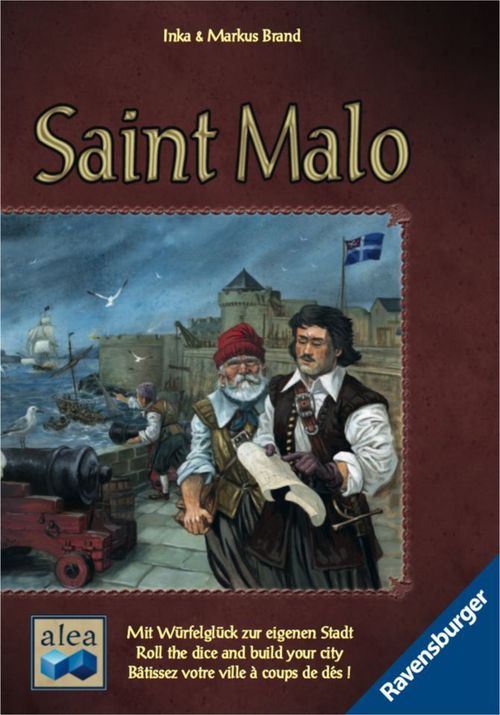
Saint Malo
Saint Malo Rulebook
Table of Contents
Table of Contents
Game Components
- 1 main board (erasable)
- 5 city boards (erasable)
- 5 markers ("non-permanent")
- 5 dice (each with 6 different symbols)
(Note: Removing marks from the game boards requires only a dry cloth. Please make sure to only ever use "non permanent" markers!)
Game Setup
Place the main board in the middle of the table. Pirates get marked here during the game. It also shows how the different person types can be used after being rolled.
Give each player a city board, which they place in front of themselves, along with a marker. Return any unused materials to the box.
Give the 5 dice to the youngest player.
City Board Details and Hints
- The city wall = victory point track is where all the victory points that a player scores get recorded.
- The "bank" is where all new coins get added – and where all the coins used to rotate dice or deliver logs get crossed off from. Each player has 3 coins at the start of the game.
- This player is the start player because he has shaded these roofs in at the start of the game.
- This indicates that rotating dice costs 2 coins each – and that crossed swords symbols may not be rotated.
- Each player has 4 goods crates in his city at the start of the game.
- Anything that can be added during the game can be added to the 4 x 5 outer spaces (dark) – people, walls, crates, churches or houses. The same is true for the 5 x 5 inner spaces (light) with one important exception: never walls!
- This summary indicates what players can score victory points from.
- The illustration in a tower indicates the bonus that a player receives when he builds only walls on the five spaces the arrow is pointing at. (Bonus here: 2 coins.)
- This summary indicates how players can increase their defence strength (against the pirates): each soldier is worth 1, each complete wall is worth 2. If a player cannot withstand a pirate attack, then he must cross off one of these cannons (= -5 points at the end of the game).
- The "lumber storage" is where all new logs get added (cost of 2 coins per delivery) and where logs get used from when building houses. Each player has 2 logs at the start of the game.
Gameplay
The youngest player is the start player. To mark this, he should shade the roofs of the three buildings above his lumber storage (see also figure on the previous page).
The game is played in clockwise order until at least one player has filled in all 45 spaces of his city.
On your turn, you must roll the dice at least once and at most three times. Roll all five dice the first time, after which you can "secure" as many dice as you want; that is, set 0 to 5 dice aside without rolling them again. Roll the remaining dice a second time, after which you can again secure some or all of them. Finally, roll the dice a third time.
Note: You are absolutely permitted to reroll dice in the third roll that had previously been secured after the first roll. While rolling, the "crossed swords" (see below) are no different from the other dice and may be rerolled or secured as usual!
Once you are finished rolling, score the five dice. It is then the next player's turn to roll up to three times, etc.
Scoring Dice
After you are finished rolling, score the five dice. When doing so, you must choose only one of these five symbols — log, goods crate, wall, cross, head — to use. Additionally you must always score all of the "crossed swords" that you rolled (more details under "The Pirates" below).
Before scoring your dice, you may choose to rotate one or more of the non-matching dice to the symbol you chose to score. Each die you choose to rotate costs you two coins, which you cross off in your "bank".
Important: Crossed swords are completely taboo when rotating dice; you may not change any die to or from the crossed swords symbol!
Example: Anke has rolled three times and ended up with these dice: crossed swords, goods crate, wall, goods crate, head. She decides to use the two goods crates and could now also rotate the wall or the head to the goods crate symbol for 2 coins each. She may not rotate the die with the crossed swords! After she has finished scoring her goods crates, she must also cross out one box on the main board for the crossed swords die (see below).
Other Things To Note
- You do not have to use all of dice that match the symbol you chose to score. So, for example, you could choose to use only 2 of 4 heads rolled if you would rather enlist a soldier instead of a juggler (see below). Exception: You must always use all of the crossed swords dice you roll.
- You may never split the symbols you rolled over more than one action. If you rolled 3 crosses, for example, then you could build one church of either size 1, size 2 or size 3, but not a size 1 plus a size 2 church! A similar rule applies to heads: four heads, for example, can never result in both a citizen and an architect; you must choose either a citizen or an architect.
- Everything you score always gets added to empty spaces. Once a space has been filled, it is no longer useable for anything else.
- Anything can be added to the 20 darker-coloured outer spaces, while anything but walls can be added to the 25 lighter-coloured inner spaces. As soon as something other than a wall is added to an outer space, then the wall between the two towers at either end of that section is considered irreparably „destroyed" for both the corresponding bonus (see below) as well as for its defence strength of 2 (see below). This remains the case even if all of the remaining spaces are filled with walls.
The Individual Actions / Die Symbols
Log (brown)
If you choose this symbol, add one log to your lumber storage for each matching symbol rolled. This costs 2 coins per delivery (not per log!), regardless of how many logs were stored. Logs are used to build houses for victory points via the architect (see below).
Goods Crate (orange)
If you choose this symbol, add one goods crate to your city for each matching symbol rolled. All crates from a single turn must be connected to each other either vertically and/or horizontally (not diagonally!). They are allowed to be next to previously-added crates but do not have to be.
Goods crates are used to gain money via the merchant (see below).
Example: Stefan rolled four dice with goods crates.
Wall (grey)
If you choose this symbol, add one wall section to the empty outer space of your choice for each matching symbol rolled. They are allowed to be next to each other or next to previously-added walls but do not have to be.
As soon as you complete an uninterrupted line of walls on the five outer spaces between two corner towers, you immediately receive the bonus indicated by the arrow in the tower. This bonus will be either 2 coins in the bank, 3 victory points or one level 1-3 person of your choice in an empty space. If you receive the person, then you add him exactly as if you had rolled a maximum of 3 heads (see below). That means that you cannot add a juggler or noble, but can add any other person, complete with their usual effects (such as gaining money from the merchant or building houses with the architect).
In addition to this bonus, each uninterrupted wall between two towers increases your defence strength by 2 (more under „The Pirates").
Cross (purple)
If you choose this symbol, add one church to one empty space of your choice. Write the number of dice used for the church in the church outline, either 1, 2, 3, 4 or 5. (Remember: You can use a smaller number than the number of symbols you rolled!)
The larger the church, the more victory points it is worth at the end of the game. To be worth anything, however, a church must be part of an ascending, gap-free „series" of churches, starting with size 1 and increasing through size 2, etc. So a size 5 church is worth 7 victory points at the end of the game (an increase from 13 to 20 for the series) as long as there are also one each size 4, 3, 2 and 1 churches in the city. You can add churches anywhere in the city; they do not need to be next to each other to score points.
To clarify: Building churches only requires crosses – not also architects and/or logs.
Church size-to-value reference: size 1 = 1 VP, size 2 = 4 VP, size 3 = 8 VP, size 4 = 13 VP, size 5 = 20 VP (these are cumulative totals for a complete ascending series through that size).
Example: Michaela has the following churches in various locations around her city: three 1s, two 2s, one 3, one 4 and two 5s. She scores 25 victory points for them at the end of the game; 20 victory points for a full series, 4 victory points for the 1-2 series and 1 victory point for the third size 1 church. The second size 5 church is worth nothing as the second size 3 and size 4 churches are missing.
Head (green)
If you choose this symbol, add one person to your city (as a circle with a letter in it). Which person you add depends on how many matching symbols you use.
-
1 green head: you can add a "Citizen". This immediately scores you 1 victory point.
-
2 green heads: you can add either a "Soldier" or a "Priest".
- Each soldier increases your defence strength by 1 during pirate attacks (see below).
- Each priest immediately scores you 1 victory point for each church adjacent to him (including diagonally!) at the time you add him. This does not also work in reverse, which means that adding more churches next to such a priest will not gain you any more victory points from the priest.
-
3 green heads: you can add either an "Architect" or a "Merchant".
-
When you add an architect, you can immediately use up to three not yet used logs from your lumber storage to build houses. Cross off as many logs as you are using and then add the corresponding number of houses to your city. All houses you build during a single turn must be connected to each other either vertically and/or horizontally (similar to goods crates) and at least one of the houses must be directly adjacent to the just-added architect (here diagonally is also allowed!). The new houses may be next to previously-added houses and/or architects but do not have to be. Finally, score victory points for the added houses (3, 6 or 9) on the victory point track.
Example: Steffen rolled 4 heads but would like to use only three of them to add an architect. He crosses the last two logs in his lumber storage off and adds an A in a circle for the architect as well as two houses (diagonally adjacent to the architect and vertically adjacent to each other). Finally, he scores 6 victory points on the victory point track.
To clarify: Using logs (unlike their delivery) does not cost any more money!
-
When you add a merchant, you should try and make sure to add him to a space next to as many goods crates as possible, since the merchant gains you 1 coin (added to the bank) for each crate adjacent to him (including diagonally!).
Note: Crates are not „used up" by a merchant. This means that they can be used to gain more money by placing another merchant next to them. However, adding more crates next to a previously-added merchant will not gain you any more money from the merchant!
Example: Anke adds a merchant. She gains 7 coins and adds them to her bank. If she were to later add another merchant in the indicated space, she would gain another 4 coins.
-
-
4 green heads: you can add a "Juggler". Each juggler immediately scores you 2 victory points for person (including another juggler) (including diagonally!) at the time you add him.
The Pirates
The „crossed swords" symbol has a special function. If, when you are finished rolling for your turn, one or more of these symbols are present, then you must mark off one box on the main board for each crossed swords symbol in addition to scoring your turn as normal. When marking off the boxes, fill each subsequent row in from left to right. Whenever the last box in a row is filled (note that this varies with player number!), the pirates attack. In a 3 player game, for example, this occurs after 6 boxes. Each player must now defend himself, not only the player who caused the attack to take place.
The first pirate attack (row 1) has a strength of 1, the second (row 2) has a strength of 3, the third (row 3) has a strength of 6, etc.
During an attack, each player adds the defence strengths of his soldiers (1 each) and uninterrupted walls (2 each) together. If a player's defence strength is not at least as high as the pirates' strength, then he must cross off a cannon on his city wall. Each crossed-off cannon is worth -5 victory points at the end of the game.
Notes: With fewer than 5 players, cross the appropriate columns on the main board off; they are not used (see figure). All crossed swords symbols from each turn must be noted, which means that boxes in the next row down must sometimes also get crossed off. After the sixth pirate attack (strength 12), you can ignore the crossed swords symbols. You may still not rotate them, however! Players may always finish their regular turn first before crossing off boxes for rolled crossed swords symbols (and potentially causing a pirate attack).
Example: After Michaela rotated the head symbol (paying 2 coins) and added two wall sections to her city, she crosses three boxes off on the main board. This results in a strength 6 pirate attack. Each of the four players, whose strengths range from 0 to 5, must now cross off one of their cannons.
Game End
If you fill in the last empty space in your city, then the current round is played through to the end, so that each player ends up with the same number of turns. The game is then over.
Players now mark the rest of the victory points on the victory point track:
- each player to have filled in all 45 spaces scores 5 VP;
- per 2 coins that you have left over you score 1 VP;
- per log that you have left over you score 1 VP;
- per ascending „church series" you have you score between 1-20 VP;
- per crossed off cannon you have you lose 5 VP.
The player with the most victory points in the winner. In the case of a tie, the winner is the tied player who has more empty spaces left in his city. If there is still a tie then there are multiple winners.
The authors and the publisher thank the many playtesters for their assistance, especially Ines Glöckner, Michaela and Stefan Hein, Conny Hönicke, Frauke Küßner, Anke and Steffen Müller, Michaela and Jochen Schellenberger, Kai Stübben as well as the groups from Bad Aibling, Bernau, Gengenbach, Grassau, Reutte and Siegsdorf.
If you have questions, issues or criticisms about this game, please contact us at:
alea | Postfach 1150 | 83233 Bernau Phone: 0049 8051 - 970720 | Fax: 0049 8051 – 970722 E-Mail: [email protected] | www.aleaspiele.de
© 2011 Inka & Markus Brand. © 2012 Ravensburger Spieleverlag.