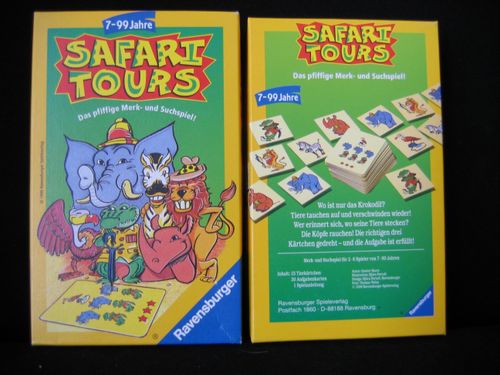
Safari Tours
Safari Tours Rulebook
Table of Contents
Table of Contents
Components
- 15 animal tiles (printed on both sides)
- 30 task cards (in 4 difficulty levels)
- 1 rules booklet
Setup
Animal Tiles
First, lay out the 15 double-sided animal tiles face up in a random mix on the table. Six different animals are each represented five times across these tiles.
Task Cards
The individual task cards have different difficulty levels, shown by stars. The easiest cards have one star and the hardest have four stars.
Set the cards with four stars aside (they are used in the variant for experts, see Variants). Shuffle the remaining 24 task cards and place them as a face-down draw pile on the table.
Goal of the Game
The goal is to solve as many task cards as possible. The player who has collected the most stars at the end wins the game.
Rules of Play
Each player draws one task card from the pile. They look at the animal combination shown on it but keep it hidden from the other players.
Now the game can begin! Play proceeds in turn. The youngest player starts.
On each turn, exactly three different animal tiles must be turned face up in the middle of the table. The player then checks whether the animal combination shown on their task card is present among all the tiles now visible.
Important: a task is only solved if each animal is visible exactly as many times as the task card specifies.
Example: A player's task is to find two zebras. They turn over three tiles and find that more than two zebras are among the face-up tiles. The task is not solved, because exactly two zebras must be found — not more and not fewer.
If the player has not solved the task, they keep their card and try their luck again in the next round.
If the player has achieved exactly the specified animal combination, the task is solved. They place the task card in front of them and draw a new card from the pile.
On each turn, the player may instead choose not to turn over the three tiles and take a new task card. Some cards are "tough nuts" and hard to crack! If they choose this, they return their current task card face down to the bottom of the card pile. Their turn then ends.
End of the Game
The game ends when a player can no longer draw a task card. The task cards that the other players still hold at that moment expire and are not scored.
Now it is time to count points! Each player adds up the stars on their solved task cards. The player with the most stars is the "Safari King" of the round!
Variants
1. For Beginners
To simplify the game and shorten its length, only the task cards with one and two stars are used (18 cards in total). This variant is especially suitable for newcomers to Safari Tours who want to warm up first.
2. For Experts
Here the cards with four stars are shuffled in with the other task cards. This variant is for players who are looking for a special challenge!
3. For Players with a Good Memory
After a player has solved a task card and drawn a new one, they may rearrange the tiles on the table. The player chooses an animal of which two or more tiles are face up in the middle of the table. They swap these tiles among themselves without turning them over.