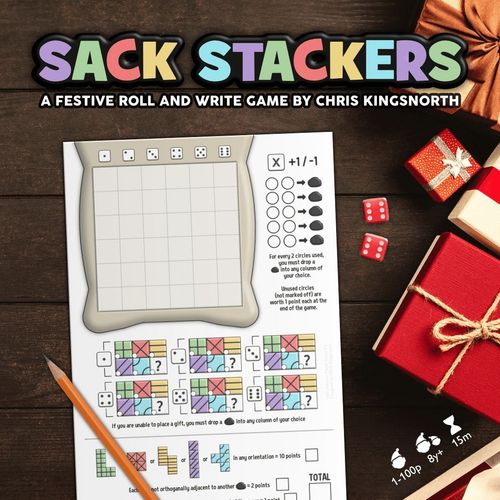
Sack Stackers
Sack Stackers Rulebook
Table of Contents
Table of Contents
Aim of the Game
Collect gifts, drop them into Santa's sack and create patterns to earn points, but watch out for lumps of coal that might interfere with your plans... Earn the most points (see 'Scoring' below) to be crowned Head Elf!
Setting Up
Each player will need a printed player sheet and a pen or pencil. You will also need 2 six-sided dice that can be seen by all of the players (if you are playing via video call, you can share your screen and use a pair of virtual dice like these).
Playing the Game
In Sack Stackers, all players take their turns at the same time. On every turn, one player rolls both of the dice once (any player can do this) and then every player must:
- Use one dice result to collect a gift, and
- Use the other dice result to select a sack column to drop the gift into
In addition, players can alter dice results and might be forced to drop coal into the sack.
Collecting Gifts
There are 5 gift types in the game (light blue, green, purple, red and yellow), each with distinctive wrapping. By arranging these gifts in specific patterns inside Santa's sack, players will earn points. To collect a gift, players choose one dice result and mark off a gift of their choice from the matching section on the player sheet. Once a gift is marked off, it cannot be collected again. When a player marks off the wild gift (marked with a question mark, "?" on the player sheet), they may collect a gift of any other type.
For example, two dice are rolled (their faces are shown in the diagram on the rules page). A player uses one dice result to collect a light blue gift from the matching dice section by marking off the corresponding gift. The player sheet diagram shows the marked-off gift with an arrow.
Selecting a Sack Column and Dropping a Gift
Players use the remaining dice result to determine the sack column into which their collected gift will be dropped. Gifts drop to the bottom-most unoccupied square of the column, and this is where the player draws the gift.
For example, the player uses the remaining dice result to drop the light blue gift collected earlier into the sack column (A), drawing the corresponding symbol into the bottom-most unoccupied square of that column (B).
Altering Dice Results
Players may alter dice results by marking off circles in the '+1/-1' section of the player sheet. These alterations only affect them. For each circle marked off, they may add or subtract 1 from a dice result. They may mark off multiple circles in the same turn and may alter the result of both dice so long as they mark off a circle for each individual alteration made. A maximum of 10 alterations can be made per game. For every 2 circles marked off on their sheet, a player must add a lump of coal to the sack (see below). The player can decide whether to add the coal before or after adding their gift to the sack.
For example, the player above could have chosen to mark off one circle to alter a die result of 2 to a 3 (+1), or to a 1 (-1).
Coal
Coal must be added to a player's sack every time (1) that they mark off two '+1/-1' circles (see above) or (2) that they are unable to place a gift into the sack. The player may add the coal to any column with an empty square; it drops to the bottom-most unoccupied square of the chosen column and this is where it is drawn.
End of the Game
The game ends when any player fills the final empty square in their sack. All other players finish their turn and then scoring takes place (see below).
Scoring
Players earn 10 points for every completed group of gifts matching the gift type and pattern (in any orientation) shown on the scoring diagrams. The rules page shows five patterns, one per gift type: a green L-shaped group, a red square group, a yellow stepped group, a vertical purple column, and a light blue S-shaped group. The shapes are pictorial on the rules page.
They also earn 2 points for every coal not orthogonally adjacent to another coal, and 1 point for every unused '+1/-1' circle. The player with the highest score is crowned Head Elf! If there is a tie, the youngest player wins.
Source note: the printed rules read "not orthoganally adjacent"; the spelling has been corrected to "orthogonally" here.