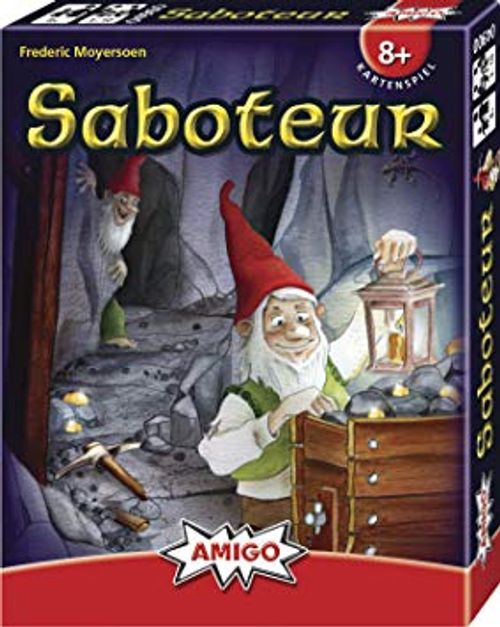
Saboteur
Saboteur Rulebook
Table of Contents
Table of Contents
Game Pieces
- 44 Path cards
- 27 Action cards
- 28 Gold Nugget cards
- 7 Gold Miner (dwarf) cards
- 4 Saboteur (dwarf) cards
Object of the Game
The players are secretly divided into two teams: gold miners and saboteurs. The gold miners want to build an unbroken tunnel of path cards from the start card to the goal card that holds the treasure. The saboteurs want to stop them. At the end of each round the winning team is rewarded with gold nugget cards. The game lasts three rounds, and the dwarf who has collected the most gold nuggets overall wins.
Preparation
Separate the cards into path, action, gold nugget, and dwarf cards.
The number of gold miner and saboteur cards used depends on the number of players (put the remaining dwarf cards back in the box — they will not be needed for the rest of the game):
- 3 players: 1 saboteur and 3 gold miners
- 4 players: 1 saboteur and 4 gold miners
- 5 players: 2 saboteurs and 4 gold miners
- 6 players: 2 saboteurs and 5 gold miners
- 7 players: 3 saboteurs and 5 gold miners
- 8 players: 3 saboteurs and 6 gold miners
- 9 players: 3 saboteurs and 7 gold miners
- 10 players: all dwarf cards
Shuffle the required number of gold miner and saboteur cards together. Deal one card to each player, who looks at it and puts it face down in front of him without revealing his role to the other players. The last (undealt) card is set aside, also face down, until the end of the round.
Find the one start card (showing a ladder) and three goal cards (one with the gold treasure and two with mere stones) from among the 44 path cards. Shuffle the three goal cards and place them face down on the table, together with the start card (face up), as shown in the game's setup diagram. The goal cards are placed a distance of seven card widths away from the start card, and one card length apart from each other. Over the course of the game a maze of pathways will be created between the start card and the goal cards. These pathways may extend beyond the borders of the 5-by-9 card pattern indicated in the diagram.
Quick game setup: use the scale printed on the right side of the game rules to measure the distance between start and goal cards.
Add all the action cards to the remaining 40 path cards and shuffle to create one draw pile. Deal out a starting hand to each player, again depending on the number of players in the game:
- 3 to 5 players: each player is dealt 6 cards.
- 6 to 7 players: each player is dealt 5 cards.
- 8 to 10 players: each player is dealt 4 cards.
Put the rest of the deck (the draw pile) next to the goal cards. Shuffle the gold nugget cards and place them face down next to the leftover dwarf card.
The youngest player takes the first turn, with play passing to the left.
How to Play
On his turn, a player must first play 1 card. This means either:
- Add 1 path card to the maze; or
- Place 1 action card in front of any player; or
- Pass, by putting 1 card face down on the discard pile.
Then the player must draw the top card off the draw deck and add it to his hand. This ends his turn, and play passes to the next player.
Note: When the draw deck is used up, the players do not draw cards anymore — a turn then consists only of playing a card.
Playing a Path Card
The path cards are used to build a path from the start card to the goal cards. A path card can only ever be played by connecting to a path card that is already on the table (including the start card). All paths on the sides of the new card must fit with the other cards already in play, and cards can never be played crosswise.
Important: Newly placed path cards must always have an uninterrupted connection back to the start card.
Playing Hint: The gold miners will try to build an uninterrupted path from the start card to one of the goal cards, while the saboteurs will try to prevent just that. However, you should not be too obvious, or your identity will be guessed very easily!
Playing an Action Card
Action cards are always played face up in front of a player (yourself or another player). Action cards can be used to hinder or help the players, remove a card from the pathway maze, or gain information about the goal cards.
Broken Tools: If one of these cards is in front of a player, he may not play any path cards — of course he may still play other cards. At any time, only one card of each type can be in front of a given player. A player can only add a path card to the maze if there is no broken tool card in front of him at the beginning of his turn.
Fix Tools: These cards are used to repair broken tools — in other words, to remove one of the broken tool cards from in front of a player. They can be played on oneself or on another player. Either way, both the repair card and the broken tool card are placed in the discard pile. The repair card must match the type of broken tool. For example, if there is a broken mine cart in front of a player, it can only be repaired by an (unbroken) cart, not by a lantern or pick card. Some repair cards show 2 tools; if one of these is played, it can be used to repair either one of the tools shown, not both.
Important: All repair cards can only be played if the matching broken tool card already lies in front of the player.
Rockfall: This card is always played in front of the player who plays it, who may then take 1 path card of his choice (except the start and goal cards) out of the maze of pathways and put it in the discard pile, together with the rockfall card. Gaps created in this way can be filled with an appropriate path card during a later turn.
Playing Hint: A saboteur can use this card to interrupt a path from the start card, or a gold miner can remove a dead end, providing a new route for the path.
Map: When a player plays this card, he carefully picks up one of the three goal cards, looks at it, then puts it back in its place and places the map on the discard pile. He now knows whether or not it is worth digging a path to that goal card (since only one of the three shows the treasure).
Passing
If a player cannot or does not want to play a card, he must pass by putting 1 card from his hand face down on the discard pile without showing it to the other players. If players pass, there will be both face-up and face-down cards in the discard pile — that's okay.
Note: Towards the end of a round, there is a chance that some players will have no cards left in hand — in which case they must pass (without discarding, of course).
The End of a Round
If a player plays a path card that touches a goal card and creates an uninterrupted path from the start card to that goal card, he must turn that goal card over:
- If it is the treasure card, the round is over.
- If it is a stone, the round continues. The face-up goal card is placed next to the last path card played so that the paths fit.
Note: In rare cases, it is possible that the goal card cannot be played in such a way that all the paths fit the adjacent path cards. As an exception to the general rule, this is legal — but only for the goal card.
The round also ends if the draw deck runs out of cards and no player has any playable cards left in hand.
When the round ends, all dwarf cards are turned over: who was a gold miner, and who was a saboteur?
Handing Out the Gold
The gold miners win the round if there is an uninterrupted path from the start card to the goal card that shows the treasure. If they do, the player who played the last path card (that connected to the treasure) draws a number of gold nugget cards face down equal to the number of gold miners (e.g., 5 cards if there were 5 gold-diggers), looks at them in secret, and chooses 1 card to keep. Then he passes the rest of the gold nugget cards counter-clockwise to the next gold miner (not a saboteur!), who also chooses 1 card and passes the rest — and so on until each gold miner gets 1 card.
The saboteurs have won the round if the goal card with the treasure wasn't reached. If there was only 1 saboteur, he gets gold nugget cards from the deck worth a total of four nuggets. If there were 2 or 3 saboteurs, they each get 3 nuggets worth of gold. If there were 4 saboteurs, each gets 2 nuggets.
All players keep their gold nugget cards secret until the end of the game.
Note: In a game with 3 or 4 players, it is possible that there will be no saboteur during a round. In this case, if the treasure is not reached, none of the dwarves get any gold nuggets.
A New Round Begins
After the gold nuggets are handed out, it's time for the next round. Place the start card and goal cards on the table, just like at the beginning of the game. Shuffle the same dwarf cards as before (including the one that was set aside) and deal them out again. Shuffle the path and action cards, creating a new draw deck, and deal the starting hands.
The players keep their gold nuggets from the earlier rounds. The rest of the gold nugget cards are shuffled again and placed next to the extra dwarf card.
The player to the left of the one who played the last path card in the previous round starts the next round.
End of the Game
The game ends after 3 rounds. Each player counts the gold nuggets on all of his gold nugget cards. The player with the most nuggets wins the game. If there is a tie, they share the win.