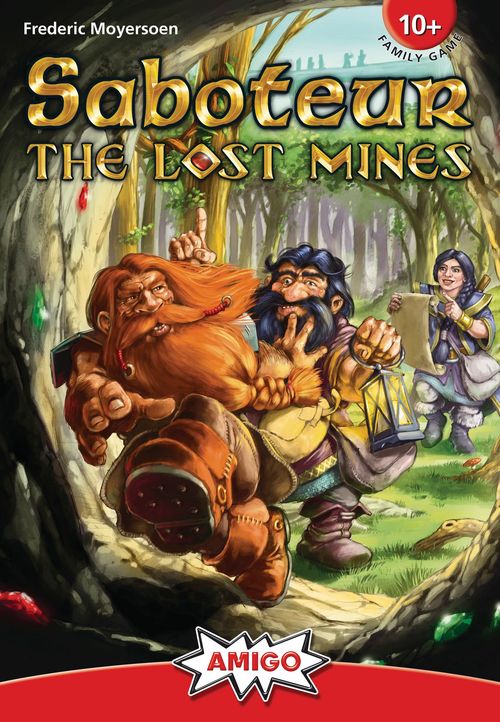
Saboteur: The Lost Mines
Saboteur: The Lost Mines Rulebook
Table of Contents
Table of Contents
Contents
- 40 path cards
- 23 action cards
- 2 starting cards
- 4 mines
- 12 treasures
- 10 dwarf cards
- 10 dwarves (with bases)
- 10 dwarf tokens
- 1 dragon token
- 32 victory point tokens
- 14 forest tokens
- 1 game board
The Dwarf Clans
In Saboteur – The Lost Mines, you are all members of two rival dwarf clans: the blue dwarves and the yellow dwarves. Up to five dwarves from each clan go looking for treasures, but not all of them work loyally for the benefit of their own team.
Loyal Dwarves From Both Clans: Up to three loyal dwarves will work for each clan unconditionally. Every treasure they find goes into the same pool at the end of the round and they rely on their companions for help.
Selfish Dwarves: Each team also has one selfish dwarf. They work only for themselves, and keep any treasure they find at the end of the round. However, they don't get a share of the treasures the other members of their clan collect.
Saboteurs: There is also a saboteur on each team. They only pretend to work for their own clan, while secretly furthering the aims of the rival clan! Any treasures they find go into the other clan's pool—and they get their share from the other clan, too.
Preparation
- Place the game board on the table.
- Shuffle the 4 mines and put them on the mine spaces on the board, face down.
- Put the two starting cards on the start spaces on the board.
- Shuffle the treasures and place a number of them equal to the number of players next to the edge of the game board, face down. Put the remaining treasures aside without looking at them: You won't need them for the rest of the round.
- Shuffle the dwarf cards and give one to each player. Take a good look at your card without revealing it to the other players, then put it face down in front of you. The other players are allowed to know which clan you belong to at all times (this is shown on the back of your card), but your true identity (the front of your card) has to stay secret until the end of the round. Put any remaining dwarf cards aside without looking at them.
Note: Prepare the dwarf cards. In a game with seven or more players you will use all of them, but in smaller games you need to remove certain dwarf cards before the game:
-
If there are 5 or 6 players, remove 1 loyal dwarf card from each clan.
-
If there are 3 or 4 players, remove 2 loyal dwarf cards from each clan.
-
Pick a dwarf from your clan and take the corresponding dwarf token. Place your dwarf on your clan's starting card and put the token in front of you where everyone can see it, so they'll know which dwarf is yours.
-
Shuffle all the path and action cards together. Take 10 cards from this pile and put them aside without looking at them: You won't use them in the current round. If there are 3–6 players, deal 5 face-down cards to each player for their starting hands, or 4 cards if there are 7–9 players. Put the remaining cards in a face-down draw pile next to the game board. Make sure to leave enough space for a (face-down) discard pile you're going to create over the course of the round.
-
Set the forest tokens, the dragon token, and the victory point tokens within easy reach.
How to Play
The most adventurous player goes first, then play passes to the left. On your turn, you must carry out the following steps in this order:
- Play 1 card or discard 1–2 cards (required)
- Move your dwarf up to 3 cards (optional)
- Draw 1 or 2 cards from the draw pile (required)
Then your turn is over and the next player's turn begins.
Important: If the draw pile runs out, skip over step 3 and don't draw any more cards. If you don't have any cards in your hand at the start of your turn, you must skip your turns for the rest of the round.
Step 1. Play Cards
At the start of your turn, you have to play 1 card or discard 1 or 2 cards from your hand. Choose one of the following options:
- A – Play 1 path card on the game board
- B – Play 1 action card
- C – or discard 1 or 2 cards
A – Play 1 Path Card on the Game Board
The path cards are used to build pathways from the starting cards to the mines on the game board. If you choose to play a path card, you have to place it next to one of the starting cards, a previously played path card, or a face-up mine (see "Mines and Treasures"). All paths shown on the sides of the new card have to connect to any paths on previously played path cards on all sides where they touch. Also, every card you play has to extend an already existing path.
Note: The card you play does not necessarily have to connect to your own starting card or your own dwarf, as long as you follow the rules above.
Examples of incorrectly placed path cards: one has not been placed next to an existing card; one does not connect on all sides; one does not extend an existing path.
Special Path Cards
Obstacles: Obstacles block the way. Dwarves can only move onto or past these path cards after someone has played the matching tool in order to overcome the obstacle. There are three types of obstacles: tree trunks, lakes, and ditches.
Rocks: Rocks are bottlenecks. Only 1 dwarf may stand on a card with a rock at any time, and an occupied rock cannot be passed by any other dwarf.
Campfire: If a dwarf starts their movement for the turn from a campfire card, they can move up to 5 cards that turn (instead of up to 3 cards—see "Step 2. Move Your Dwarf").
B – Play 1 Action Card
Action cards allow you to overcome obstacles, gain secret information, set traps, attract trolls, or remove path cards and forest tokens from the game board.
Action Cards With Tools
Each of the three kinds of obstacles can be overcome with its own special tool. You can only play a tool if the corresponding obstacle has already been placed on the game board. When you play a tool, show the card to the other players then put it face down on the discard pile. Take the matching forest token from the supply and put it on top of the obstacle. That obstacle has been overcome, and the path card can be used by all dwarves from now on.
The three tools and the obstacles they overcome: axe (tree trunk), boat (lake), rope (ditch).
Note: After an obstacle has been overcome, only 1 dwarf at a time can occupy that card, and an occupied obstacle card cannot be passed by any other dwarves (just like a rock card).
Action Cards That Gain Information
These action cards allow you to gain information about the mines, the treasures, or the other players. When you play one of these cards, show it to the other players then put it face down on the discard pile. Each card gives you two options: Pick one and carry it out. Keep the information you've gained to yourself and don't reveal it to the other players!
- Secretly look at a mine that hasn't been revealed yet. Then put the mine back in its place, face down.
- Secretly look at a treasure that hasn't been collected yet. Then put the treasure back in its place, face down.
- Secretly look at another player's dwarf card. Then put the dwarf card back in its place, face down.
Action Cards With Events
When you play a "trap" action card, show it to the other players then put it face down on the discard pile. Take the corresponding "trap" forest token and place it on a path connecting two cards already on the game board, or on the open end of a path (i.e., the path connecting a path card to the unused area of the game board).
Whenever a dwarf passes a trap, he immediately loses one card from his hand. His neighbor to the left draws a random card from his hand and puts it on the discard pile, face down, without looking at it. The player who lost a card has to get by with one less card for the rest of the round.
When you play a "troll" action card, place it in front of you, face up. Take the corresponding "troll" forest token and place it on a path connecting two cards already on the game board, or on the open end of a path (i.e., the path connecting a path card to the unused area of the game board).
The troll blocks this section of the path for all dwarves until it's your turn again. At the start of your next turn, remove the troll and put the action card face down on the discard pile.
Some examples of the correct placement of traps and trolls are shown in the rulebook diagrams.
Note: If a trap or a troll covers the open end of a path, you may still add path cards there in order to extend the path.
When you play a "thunderstorm" action card, show it to the other players then put it face down on the discard pile. Then, remove any one path card that does not have a dwarf on it from the game board. If there is a tool (axe, boat, or rope) on the card, remove it as well. Put the card you've removed on the discard pile, face down.
A trap or a troll token is removed as well, but only if it is now lying on two empty spaces of the game board (after you remove the path card).
Important: You cannot use a thunderstorm to remove a starting card or mine.
C – Discard 1 or 2 Cards
If you can't play a card for action A or B, or if you choose not to, you have to discard 1 or 2 cards from your hand instead. Put the discarded cards on the discard pile, face down.
Step 2. Move Your Dwarf
After you have played or discarded cards, you may move your dwarf up to 3 cards. You can only move your dwarf along existing pathways.
Example: After she has played a card, the player moves her blue dwarf 3 cards along the path.
These special cases can affect how you move your dwarf:
- If your dwarf begins their movement at a campfire, you may move them up to 5 cards.
- You can't land on or cross path cards with an obstacle that has not yet been overcome (with a tool).
- Rocks or obstacles that have been overcome can be occupied by only 1 dwarf at a time. A second dwarf may neither land on this card nor pass through it.
- A troll blocks the path it is on. You can't move onto or off of a card through the path connection the troll is on.
- If you move your dwarf over a trap, you immediately lose 1 card from your hand. The player to your left takes a random card from your hand and discards it without looking at it.
Note: If you don't have any cards in your hand at the start of your turn, you also can't move your dwarf, and you lose your entire turn.
Mines and Treasures
If you're the first player to move their dwarf onto a mine, turn over the card. Adjust it so it fits the existing network of paths at its location. Stop moving and put your dwarf on the mine.
Note: Sometimes, when you turn over a mine, it won't fit in the network of paths on all sides. In this case, adjust it so that it can be reached through the pathway you used to get there.
There are four different mines: three containing treasures and one that's guarded by the dragon. The symbols on the three treasure-filled mines match the symbols on the back of the treasure cards: gemstones, gold, and silver.
If you end your movement on a mine, take one matching treasure card, if there are still any available. Place the treasure in front of you, face down. If you are still on the mine at the end of your next turn (because you haven't moved your dwarf) take another card with this type of treasure if there are any left. If another player moves his dwarf onto the now face-up mine in the meantime, he also gets to help himself to the treasure.
Example: One player moves his yellow dwarf onto a face-down mine. He turns it over and puts it back in its space. It's the gold mine, so he takes one golden treasure card and places it in front of him, face down.
The Dragon Mine
If you turn over the mine guarded by the dragon (because you were the first to get there) you have to take the dragon token and put it in front of you. At the end of the round, this will cost you 2 victory points.
After that, treat this mine card just like a regular path card: From now on, all players can move through this card without taking further damage.
Step 3. Draw Cards
At the end of your turn, you have to draw cards if there are any left in the draw pile. If you played a path or action card this turn, draw 1 card from the draw pile. If you have discarded cards, draw as many cards as you discarded (1 or 2).
Note: If the draw pile runs out, don't draw any more cards for the rest of the round.
The End of a Round
The round ends immediately when one of the following occurs:
- The draw pile has run out and none of the players have any cards left; or
- All the treasures have been collected.
Note: As a group, you can all decide together that a round is finished if one or more mines can no longer be reached and its treasures can no longer be collected.
Handing Out the Gold
Once the round is over, turn over your dwarf cards and reveal your identities. Then, turn over your treasures, and divide them as follows:
- Selfish dwarves get the value of any treasure they have collected themselves as victory points.
- All other players get together with their clans. If there are saboteurs, they join the opposing clan for the final tally. Add up the values of your clan's treasures and convert them into victory points.
- Divide the clan's victory points evenly between all (non-selfish) dwarves in that clan. If there are any victory points left over, give them to the player who collected the single most valuable treasure. If more than one player has collected the most valuable treasure, split the remaining victory points between those players evenly. If you still have victory points left over, no one gets them.
- Finally, the player who has the dragon token has to hand in two of his victory points from this round. If he only won one victory point or none at all this round, he only has to hand in one or none, respectively.
Example:
- The two loyal yellow dwarves have collected 8 victory points, which they now split evenly between themselves.
- The two loyal blue dwarves and the yellow saboteur have also collected 8 victory points that they split between themselves as evenly as possible (2 each). The 2 remaining victory points go to the yellow saboteur, because she contributed the single most valuable treasure, worth 4 points. However, one of the two loyal blue dwarves has also picked up the dragon token. He has to give his two victory points back.
- The blue clan's selfish dwarf keeps all of her treasures for herself, and wins 3 victory points.
A New Round Begins
Set up the second round just like the first: Re-shuffle the mines, redistribute the treasures, re-shuffle and deal out new dwarf cards and, if necessary, give a new dwarf to each player. Shuffle all the path and action cards together, set 10 of them aside, and finally deal 5 cards to each player (4 if there are 7–9 players).
The new round starts with the player to the left of the last player to play a card in the first round.
The End Of The Game
The game ends after the second round. The player who has collected the most victory points wins the game. If there is a tie, all tied players are winners.
Note: Of course, you may decide to play three or more rounds if you like, in order to determine a clear winner. Each round extends the duration of the game by about 20 minutes.
Publisher Information
You have purchased a quality product. Should you have any reason for complaint, please do not hesitate to contact us. Do you have any questions? We will be glad to be of help:
AMIGO Spiel + Freizeit GmbH, Waldstraße 23-D5, D-63128 Dietzenbach www.amigo-spiele.de, E-Mail: [email protected]
© AMIGO Spiel + Freizeit GmbH, D-63128 Dietzenbach