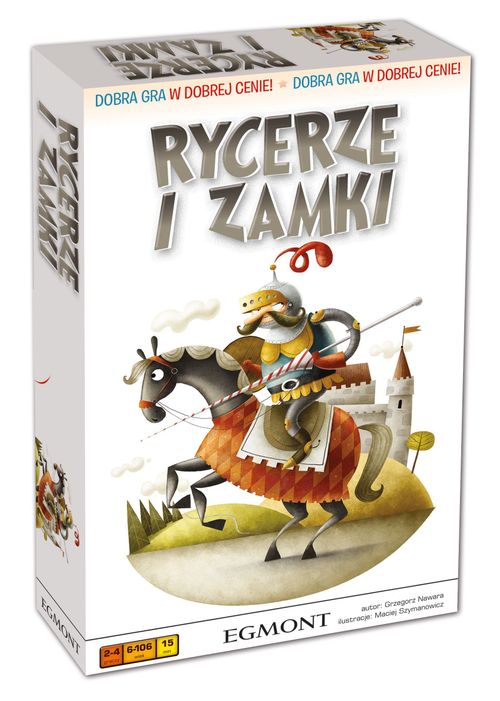
Rycerze i Zamki
Rycerze i Zamki Rulebook
Table of Contents
Table of Contents
Game Components
- 32 army cards (8 for each player, in four colours)
- 8 tiles: castle tiles and recruitment tiles
- 1 sword token
Army cards. The strength of the knight on the left side of the card depends on the type of castle being conquered:
- 6 if conquering a stone castle
- 3 if conquering a brick castle
- 2 if conquering a wooden castle
Army cards are used to conquer castles.
Shepherd cards. A shepherd is a blank card that always returns to the player's hand. A player plays a shepherd card when they want to bluff, keeping their more valuable cards for later.
Camp. Used army cards are placed in a face-down pile next to each other, called the camp. Cards in the camp cannot be used to conquer castles. One card from the camp can be recovered when a recruitment tile is revealed.
Castle tiles. There are three types of castles: wooden, brick and stone. Each type has a small and a large castle, worth 1 or 2 points at the end of the game. Each castle tile shows the castle type symbol and the points it is worth at the end of the game.
Recruitment tiles. A recruitment tile lets a player recover one previously used army card.
Sword token. The sword helps in conquering castles. At the start of the game the youngest player has it. During the game, the sword passes to the player with the fewest points.
Setup
- Shuffle the tiles and place them face down on the table as a stack. Without looking at it, remove one tile from the top of the stack and return it to the box.
- Sort the army cards by the colour of their backs. Each player takes the set of eight cards in their chosen colour and holds them in hand. Players hold their cards so that the others cannot see what is on them.
- Give the sword token to the youngest player.
Goal of the Game
Players earn points for the castles they conquer during the game. The player who earns the most points wins.
Playing the Game
The game lasts 7 rounds. Each round is played as follows:
Take one tile from the top of the stack and place it face up in the middle of the table. Depending on what the tile shows, the players carry out the corresponding action:
- If the tile shows a castle, the players conquer the castle.
- If the tile shows a drum, the players recruit.
After the action is resolved, play the next round by taking the next tile from the stack.
Conquering a Castle
- Each player places two chosen cards from their hand face down on the table.
- Then each player reveals their placed cards, and the following actions are carried out in this order:
- All shepherd cards return to their owners' hands.
- All identical (duplicate) cards are placed in the players' camps.
- The player who has the strongest card on the table conquers the castle and places it face up in front of them. If no card remains on the table (all were discarded because they were duplicates), the player who holds the sword token conquers the castle.
- All cards still on the table are placed in the players' camps.
- The player with the fewest points takes the sword token and places it in front of them. If several players have the same lowest number of points, the sword goes to the youngest of those players.
Recruitment
Players choose one card from their camp and add it to the cards they hold in hand. If a player has no cards in their camp, recruitment brings them no benefit.
End of the Game
The game ends after the seventh round. Players add up the points shown on the castles they have conquered. The player with the most points wins. In the event of a tie, the player with more cards in hand wins. If there is still a tie, the youngest player wins.
Longer Variant
The game consists of as many games as there are players. After each game, players record the points they earned. After all the games have been played, the player with the most points in total wins.
Examples of Conquering a Castle
Example 1. A large brick castle is up for conquest. The players reveal their cards. All shepherd cards return to hand. The knight on horseback cards were duplicates, so the players place them in their camps. Two cards remain on the table: Hania's dragon and Antek's foot soldier. Hania conquers the castle, because her dragon is stronger for conquering a brick castle.
Example 2. A small wooden castle is up for conquest. The players reveal their cards. All shepherd cards return to hand. The archer and peasant cards were duplicates, so the players place them in their camps. No cards remain on the table, so Antek conquers the castle, because he holds the sword token.