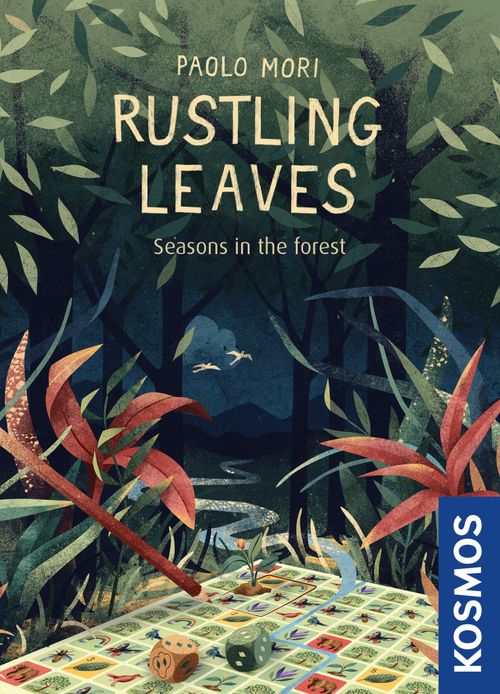
Rustling Leaves
Rustling Leaves Rulebook
Table of Contents
Table of Contents
Game Idea and Objective
For 2-6 players, age 8 and up. Playing time: approx. 20 minutes.
The dice are rolled. Depending on the roll, you all draw an area on your own game sheet. Then, within your area, you each choose a symbol and cross off every space showing it. This earns different numbers of points at the end of the game. Whoever has gathered the most points wins the game.
Components
- 1 game pad (contains 200 game sheets, 50 sheets for each season)
- 2 dice with special faces
- You will also each need a pen
On each game sheet:
- Field: a single space on the grid.
- Symbol: the picture printed in a field, which you can cross off.
- Start field: 6 start fields per game sheet are highlighted in yellow and numbered. They all show a leaf as their symbol.
- Cloud: a special face that can appear on a die.
- Scoring and river areas are also marked on each sheet.
The four game sheets: Spring, Summer, Autumn, Winter.
Setup
- Each of you takes a Spring game sheet and places it in front of you (in later games, you can agree together on any season to play instead).
- Each of you takes a pen.
- Set the two dice aside, ready to use.
- Whoever was last in the forest becomes the start player and chooses a start field. Then, in clockwise order, everyone else chooses a different start field.
- The start player takes the dice and begins the game.
How to Play
The game is played over several rounds. Each round consists of 4 phases.
- Roll the dice
- Draw an area
- Cross off space(s)
- Record the score
You carry out these phases one after another each round. Afterward, the dice are passed clockwise to the next player, and a new round begins.
1. Roll the Dice
The player with the dice rolls them. When a cloud is rolled, different things happen depending on the game sheet. Read the rules for the relevant game sheet to find out (see the season sections below).
2. Draw an Area
Now you all draw an area on your game sheet. You draw this area as a rectangle that encloses a certain number of fields on your game sheet.
The side lengths of the area — that is, how many fields long and wide it is — depend on the two numbers (depicted as leaves) shown on the dice.
For example, if a 2 and a 4 are rolled, you must draw an area with side lengths of 2 fields and 4 fields. You may decide for yourself how to orient this area (whether 2 fields long and 4 fields wide, or 2 fields wide and 4 fields long).
In the first round, your respective start field must lie within the area you draw. The other start fields on your game sheet have no significance.
For areas you draw from round 2 onward, the following rules apply:
- New areas must border an already-drawn area with at least one field, horizontally or vertically.
- An area may not border existing areas only diagonally.
- Areas may not overlap.
(The rulebook illustrates this with two examples: a new area that touches an existing area along one edge is allowed; a new area that touches an existing area only at a corner, diagonally, is not allowed.)
If you cannot or do not want to draw an area with the numbers rolled, you must record a misthrow. Each misthrow gives you 3 minus points at the end of the game. You may record a maximum of 6 misthrows. After your 6th misthrow, the game ends for you. You determine your score later.
3. Cross Off Space(s)
After everyone has drawn an area on their game sheet, you each choose a symbol within the area you just drew. Then cross off every field with that symbol within that area. Start fields cannot be crossed off or scored.
4. Record the Score
Next, you record the fields you just crossed off in your scoring area. To do this, for every field you just crossed off, mark a circle next to the corresponding symbol in the scoring area. Each symbol states how many circles you can mark for it, at most, over the whole course of the game.
Tip: Afterward, you can also strike through the area you drew this round. This makes it easier to keep track of your free fields.
Before the New Round
Before a new round begins, you can each decide whether you want to keep playing or drop out.
Whoever drops out may not draw any more areas or cross off any more fields for the rest of the game. This means you also cannot record any more scores (you also no longer cross off any clouds). The others continue playing without you.
Whoever keeps playing must also act on the next roll of the dice, i.e. try to draw an area and cross off fields.
Attention: If you cannot draw an area with the next roll — for example, because you do not have enough free fields available — you must record a misthrow.
Joker
You may each use your joker once per game sheet. This means that after the roll of the dice, you may choose the number shown on the joker die yourself. Which die counts as the joker die depends on the season you are playing (see the scoring area of your sheet). You may use your joker even if you were not the one who rolled the dice.
If you have used your joker, you must cross off the joker symbol on your game sheet. You may only choose a number that actually appears on the die. A cloud symbol that was rolled cannot be changed — it still counts as rolled, and you are only changing the number for yourself.
If you have not used your joker, this has no effect at the end of the game.
End of the Game
The game is played for as many rounds as it takes until nobody wants to or is able to keep playing. This is the case once everyone has either dropped out or recorded 6 misthrows.
Final Scoring
At the end of the game, the points are evaluated. To do this, you record your points for each individual scoring category according to the rules (see the season sections below) and then add them all together.
Whoever has gathered the most points at the end wins the game. In case of a tie, whoever recorded the fewest misthrows wins.
Before you start playing, read the scoring rules for Spring below, and then work through the detailed examples that follow.
Detailed Example
The First Round
You start at start field 1.
- 1 Roll the dice: The dice are rolled.
- 2 Draw an area: You now draw an area that is 4 fields long and 2 fields wide.
- 3 Cross off space(s): Then you choose a symbol in this area and cross off every field with that symbol in the area. In this case, you choose the tree as the symbol, and cross off the 2 fields with the tree symbol.
- 4 Record the score: Then you record the fields you just crossed off into the scoring area.
Once everyone has drawn an area, crossed off their fields, and recorded the score, a new round begins.
The Second Round
- 1 Roll the dice: The following dice are rolled.
- 2 Draw an area: Now you draw an area that is 3 fields wide and 1 field long. The newly drawn area must border an already-drawn area with at least one field.
- 3 Cross off space(s): Then you choose a symbol in this area and cross off every field with that symbol in the area. In this case, you have chosen the bird pair. For this scoring category, you must have 2 different birds in the same area and cross them off at the same time — one blue and one red bird.
- 4a Record the score: Afterward, you record the pair you just crossed off into the scoring.
- 4b River crossing: Since drawing this area crossed the river, you must also record a river crossing in the scoring.
River crossing (different for each game sheet!): If you draw an area across the river, that counts as a river crossing. Attention: all game sheets have different rules regarding the river (see the season sections below). An area may border the river; that does not count as a river crossing.
After a Few Rounds
- 1 Roll the dice: The dice are rolled.
- 2 Draw an area: The area you draw must enclose 2 by 3 fields. However, you do not have enough free fields available in that arrangement!
- 2a Use the joker: You use your joker and thereby change, for yourself, the number the green die shows, from 2 to 1. The cloud is still counted regardless!
- 2b Draw an area: Now you draw an area that is 3 fields wide and 1 field long.
- 3 Cross off space(s): Then you choose a symbol in this area and cross off every field with that symbol in the area. In this case, the butterfly.
- 4a Record the score: You record the fields you just crossed off into the scoring.
- 4b Record the cloud: Since a cloud was rolled on this turn, it also counts toward your scoring.
At the end of the round, you consider whether you want to drop out, because you only have a few free fields left. However, you decide to keep playing, and a new round begins.
At the End of the Game
- 1 Roll the dice: The dice are rolled.
- 2 Draw an area: The area you draw must enclose 2 by 2 fields. However, you have neither enough free fields available in a suitable arrangement, nor your joker available!
- 3 Cross off space(s): Since you do not have enough free fields available and therefore cannot draw an area, you are also not allowed to cross off any fields.
- 4a Record a misthrow: You must record a misthrow.
- 4b Record the cloud: Since 2 clouds were rolled, you must still record them in the scoring.
At the end of this round you decide to drop out. However, you could still keep playing until you have recorded 6 misthrows. Once everyone has either dropped out or recorded all 6 misthrows, the game ends and the final scoring follows.
Example Scoring
This worked example shows a completed Spring scoring area totaling 54 points.
- You crossed off 12 trees = 12 points. You also receive 5 bonus points for having 10 or more trees. Total: 17 points
- You crossed off 4 flowers. Since you only have one row completely filled, each bee is worth 3 points. You crossed off 3 bees. Total: 9 points
- You crossed off 8 butterflies (an even number!). Total: 16 points
- You crossed off 1 bird pair. Total: 5 points
- You did not cross off any rainbow. No points
- 3 clouds were rolled over the course of the game. That makes each seedling worth 2 points. You crossed off 1 seedling. Total: 2 points
- 3 bears are outside your areas. Total: 9 points
- You crossed the river 1 time. Total: -1 point
- You made 1 misthrow. Total: -3 points
17 + 9 + 16 + 5 + 0 + 2 + 9 − 1 − 3 = 54. Final score: 54 points.
Spring
Joker die: the green die.
- Tree: Each tree is worth 1 point. If you have crossed off 10 or more trees, you receive 5 bonus points. Add the bonus points at the final scoring.
- Bee & Flower: The value of a bee depends on the number of flowers you have crossed off. If you have crossed off 1-2 flowers, a bee is worth no points. If you have crossed off 3-5 flowers, each bee is worth 3 points. If you have crossed off 6-8 flowers, each bee is worth 4 points. If you have crossed off 9, each bee is worth 5 points.
- Butterfly: Each butterfly is worth 2 points. However, you only receive points for butterflies if you have collected an even number of them. Otherwise, you receive no points.
- Bird Pair: For each pair consisting of one red and one blue bird, you receive 5 points. Attention: you must cross off this bird pair within one and the same area.
- Rainbow: Only if you have crossed off all 7 rainbows do you receive 30 points.
- Cloud & Seedling: Every cloud symbol that is rolled during the game must be crossed off in the scoring area. The point value of a seedling depends on the number of clouds rolled. If 3-5 clouds were rolled, each seedling is worth 2 points. If 6 (or more) clouds were rolled, each seedling is worth 4 points. If fewer than 3 clouds were rolled, there are no points for crossed-off seedlings.
- Bear: Each bear that is not inside one of your areas at the end is worth 3 points.
- River — River Crossing (minus points): If you draw an area that crosses the river, you must cross off a river crossing. Each river crossing is worth -1 point.
Summer
Joker die: the green die.
- Tree: Each tree is worth 2 points. However, you may only cross off a tree if at least one cloud was rolled this round.
- Daisy: Each daisy is worth 2 points. However, you only receive points for daisies if you have collected an odd number of them. Otherwise, you receive no points.
- Clovers: The player who is first to cross off all 4 clovers receives 20 points (if several players cross off all 4 clovers first, in the same round, they all receive 20 points). Everyone else who crosses off all 4 clovers afterward receives only 10 points each.
- Apple, Cherry, Peach: Multiply the number of your crosses at the three symbols apple, cherry, and peach.
- Example 1: You have 2 apples = 2 points.
- Example 2: You have 2 apples and 3 cherries = 2 x 3 = 6 points.
- Example 3: You have 2 apples, 3 cherries, and 4 peaches = 2 x 3 x 4 = 24 points.
- Firefly: Each firefly is worth 3 points. However, you may only cross off fireflies if no cloud was rolled this round.
- Mosquito: Only if all mosquitoes are outside your areas at the end do you receive 15 points. If even 1 mosquito is inside one of your areas, you receive no points for the mosquitoes.
- Snake: Each snake that is not inside one of your areas at the end is worth 3 points.
- River Crossing (neutral): In summer it is hot and the river has dried up. The river is therefore not an obstacle and is neutral (neither minus nor plus points).
Autumn
Joker die: the natural-wood die.
- Mushrooms: In the area where you cross off the brown porcini, you must, at the same time, also cross off all the red fly agarics, if there are any there. Each brown porcini is worth 3 points; each red fly agaric counts as -2 points.
- Pinecones: Each row of 4 pinecones is worth 12 points. Only complete rows score points! You can achieve two complete rows.
- Conifer: You must commit to one row of conifers and may only cross off that row! Only one complete row scores points. 3/6/9 conifers = 10/20/30 points.
- Acorns & Squirrels: At scoring, acorns are multiplied with squirrels. If you have not made a cross at one of these two symbol types, you receive no points.
- Deciduous Tree & Leaf: For each pair consisting of a deciduous tree and a leaf, you receive 5 points. Only complete pairs are worth 5 points each.
- Storm: If a cloud is rolled, you may only draw an area if it contains at least one storm symbol. Then you choose a symbol as usual and cross off fields. If you cannot draw an area containing a storm symbol, you must record a misthrow.
- River — No River Crossing Possible: In autumn it rains heavily. You therefore cannot cross the river, i.e. no area may be drawn across the river. Areas that border the river are still allowed.
Winter
Joker die: the natural-wood die.
- Snowflake and Tree: Each tree is worth 1 point. However, you may only cross off trees if there is at least one snowflake in the area where you want to cross off trees. The snowflake itself is worth no points.
- Snow Fox: Each snow fox is worth 3 points. However, you may only cross off a snow fox if there is no more than exactly one snow fox in the area.
- Bird & Berry: Only if you have an equal number of birds and berries is each pair of a bird and a berry worth 5 points. If, at the final scoring, you have not crossed off exactly as many birds as berries, there are no points.
- Moose: Moose are not crossed off. Only if all moose are inside your areas at the end do you receive 12 points. If even 1 moose is outside, you receive no points.
- Icicle: Only if you have crossed off exactly 5 icicles at the end do you receive 15 points.
- Holly: The points for holly are diced for. To do this, at the end you all roll one die. The number rolled gives every player the point value of each holly.
- Cloud & Snowdrop: You cross off every cloud symbol that is rolled on your game sheet. Only if you have at the end at least as many snowdrops as clouds is each snowdrop worth 3 points. The clouds themselves are worth no points.
- River — River Crossing (plus points): If you draw an area that crosses the river, you must record a river crossing. Each river crossing is worth 1 point.
Game Variants
A Whole Year: Instead of just one game sheet, you can play all 4 seasons one after another and add up all the points at the end. Whoever then has the most points overall wins.
Alone in the Forest: Rustling Leaves is an exciting challenge on your own too. Simply try to improve your result from game to game.
The Author
Paolo Mori, born in 1977, lives with his wife and their two children on the edge of a forest near Parma. Since 2006 he has published more than 30 board games and is a firm fixture of the game design scene. After the card game "Memento", the author now publishes his first roll-and-write game with KOSMOS.
The author and publisher thank everyone who took part in playtesting, reading the rules, and the development of the game, and who helped make "Blätterrauschen" what you now hold in your hands. The author especially thanks: Alice Mori, Francesco Sirocchi, Carlo A. Rossi, Alfredo Berni, Giovanni Melandri, Francesco Pelagatti, Danilo Bersani, Luca Chiapponi.
Illustration & Graphics: Elli Jäger Technical Product Development: Monika Schall Editing: Felix Noe, Wolfgang Lüdtke
© 2020 Franckh-Kosmos Verlags-GmbH & Co KG