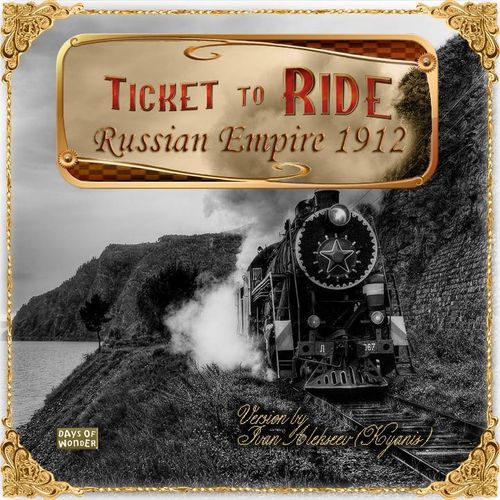
Russian Empire 1912 (fan expansion for Ticket to Ride)
Russian Empire 1912 (fan expansion for Ticket to Ride) Rulebook
Table of Contents
Table of Contents
Contents of the Expansion
The expansion contains 28 event cards in the following kinds:
- 4 × Double Move
- 4 × Speed-Up
- 3 × Derailment
- 2 × Train Collision
- 1 × Snowdrifts
- 3 × Breakdown
- 2 × Landslide
- 1 × Rockslide
- 1 × Flood
- 1 × Tsunami
- 2 × Earthquake
- 2 × Strike
- 2 × Sabotage
General Notes
- Points lost because of an event effect do not extend to the bonus that the targeted player received from a Speed-Up card.
- At the end of the game, each event card left in a player's hand is a 5-point penalty.
Changes to the Base Rules
- At the start of the game, in addition to the 4 train cards and the 3–4 destination tickets, each player receives one event card. The remaining event cards are placed face down next to the board.
- During the game, two new actions become available to players: Play an event card and Draw an event card.
- On their turn, each player performs one and only one of the following six actions (the effect of a Double Move card is not counted):
- Play an event card. The effect of the event is determined by a roll of the six-sided die, by drawing a card from the train-card deck, or by the choice of the player who plays the event.
- Draw an event card. On their turn, as an action, any player may draw an event card.
- Draw train cards (base rules).
- Build a route (base rules).
- Draw additional destination tickets (base rules).
- Build a station (base rules).
Event Card Effects
Double Move
The player who plays this card may immediately perform any 2 actions, including two of the same action.
- A player may play only one Double Move card per turn.
- Example: the player draws 2 train cards and 1 event card, or draws 4 train cards instead of two.
Speed-Up
This card lets a player earn points faster by increasing the value of the route they build, according to the scoring table below. It is played at the same time as building a route.
- A Speed-Up card played together with building a route counts as one action.
- A Speed-Up card cannot be played together with a Breakdown card.
Scoring table with a Speed-Up card
| Normal route length | Points | Tunnel length | Points |
|---|---|---|---|
| 1 | 2 | 1 | 3 |
| 2 | 3 | 2 | 4 |
| 3 | 6 | 3 | 7 |
| 4 | 11 | 4 | 12 |
| 5 | 15 | 5 | 16 |
| 7 | 27 | 6 | 24 |
Derailment
Each player passes all of their train cards to the player on their left.
Train Collision
The player who plays this card chooses two opponents. The chosen players each roll the die and let the player who activated the event blindly draw that number of train cards from their hand. The drawn cards are placed in the discard pile.
- Note: if a player has fewer cards in hand than they would have to discard, they lose 2 points for each missing card.
Snowdrifts
The player who plays this card chooses an opponent who has built at least one route in Siberia (beyond the Urals, east of Yekaterinburg). That player skips their turn, clearing the snow from their railway tracks.
Breakdown
The player who plays this card chooses one and only one route occupied by an opponent and replaces the opponent's trains on it with their own. The player who plays the card immediately scores points according to the table printed on the game board.
The player who lost the route removes their trains from the board, returns them to their supply, and then loses the points that the route was worth.
- If none of the routes of the player who played the card is of interest, or if the opponents have not built anything yet, the card has no effect.
- If the player who played the card does not have enough trains to build a route, they may destroy one of their own already-built sections, losing points according to the base scoring table.
- Sections affected by a Landslide, a Rockslide or an Earthquake may be built only after the corresponding blocking effect has ended.
Landslide and Rockslide
Effect: one or more routes are unavailable for the next two turns. There are two cases:
- The route(s) are free. No one may build on those sections for the next two turns relative to the player who played the card. Place 2 Construction Works markers on the blocked routes.
- The route(s) are occupied. The affected player loses half of the trains on those routes, and the points for those trains according to the table, rounded down. No one may build on those sections for the next two turns relative to the player who played the card. Place 2 Construction Works markers on the blocked routes.
Example: the Saint Petersburg–Warsaw route (3 sections) is occupied by a player and is hit by a landslide. The player loses one of the three built trains (3 / 2 = 1.5, rounded down to 1) and 2 points (4 / 2 = 2). On their next turn, the player may repair the destroyed section: they need 1 missing train, and they score only 1 point for it (according to the table). As a result, 1 point is lost as a penalty.
Activation. When playing a Landslide or a Rockslide, the player draws a card from the train-card deck to determine the colour of the affected route(s). Then they roll the die to determine the maximum number of affected routes:
- 1 or 2: 1 route
- 3 or 4: 2 routes
- 5 or 6: 3 routes
Notes:
- The player who plays the card chooses a number of affected routes that does not exceed the number rolled on the die.
- If the player is not interested in any route, the card has no effect.
- If, on their next turn, a player whose route was damaged by the card does not repair the destroyed section, they lose the remaining trains on that route and the points for them.
- A player affected by the card may try to restore their section by playing Breakdown, Earthquake or Tsunami cards.
Flood
The player who plays this card may choose one of the double routes and block one of its lines until the end of the game. If the route was built by someone, the trains placed on it are removed from the board and returned to that player's supply, and the corresponding points are subtracted.
Tsunami
The player who activates this card rolls the die. On a success (a roll of 4, 5 or 6), a giant wave destroys one of the opponents' routes on the Pacific coast (any route leaving Gizhiga, Petropavlovsk, Nikolayevsk, Khabarovsk or Vladivostok). The player who lost the route gets their trains back into their supply and loses the corresponding number of points.
Earthquake
Only the edge routes (those running around the board along the south and east) are affected by an Earthquake, from Vladikavkaz to Verkhne-Kolymsk, 12 routes in total. The player who activates the card rolls the die:
- First roll: which two sections are affected.
- 1: Vladikavkaz–Ashkhabad
- 2: Ashkhabad–Semipalatinsk
- 3: Semipalatinsk–Harbin
- 4: Harbin–Khabarovsk
- 5: Khabarovsk–Petropavlovsk
- 6: Petropavlovsk–Nizhne-Kolymsk
- Second roll: the strength of the earthquake.
- 1 or 2: a weak tremor. No effect.
- 3 or 4: a noticeable shake. The route becomes unavailable for 1 turn (1 Construction Works marker). The trains built on it stay in place.
- 5: a strong earthquake. The route is blocked for 2 turns (2 Construction Works markers). The trains already built on it are removed from the board and returned to their owners' supply. The affected player loses the required number of points.
- 6: a catastrophic earthquake. The route is blocked for 3 turns (3 Construction Works markers). The owner of the built route not only loses the route and its points, but must also discard 3 random train cards from their hand. For each card they cannot discard, they lose 2 points.
Notes:
- Place the required number of Construction Works markers on the affected route(s).
- All points are always subtracted according to the table printed on the game board.
Strike
The player who plays this card chooses an opponent, who skips their turn because of a railway workers' strike. The player who played the card receives 7 bonus points.
Sabotage
The effect of this card is similar to Breakdown, but to activate it the player must roll a success on the die (a 4, 5 or 6). Instead of seizing a railway route, the effect of the card may be directed at an opponent's station.
Translator's Notes
These notes record the points where the source is internally inconsistent or unclear. The text above follows the source as printed, and no rule has been added or corrected.
- The source header gives the expansion as "28 cards – 12 events", but the list of kinds names 13 event types (4 + 4 + 3 + 2 + 1 + 3 + 2 + 1 + 1 + 1 + 2 + 2 + 2 = 28 cards). This file lists the 13 kinds.
- The general rule on actions refers to the "Double Move" card as «Двойное действие» (Double Action) once; the card itself is named «Двойной ход». This file uses "Double Move" throughout.
- The Earthquake introduction describes the affected routes as running "from Vladikavkaz to Verkhne-Kolymsk" and says there are 12 of them. The first-roll table lists six city pairs and ends at Nizhne-Kolymsk, not Verkhne-Kolymsk.
- The Earthquake first roll is described as determining "which two sections" are affected. Each table entry names one city pair, which this file transcribes as printed.
- Translation choices, not source errors: «Оползень» is rendered "Landslide", «Обвал» "Rockslide", «Сход с рельсов» "Derailment", «Поломка» "Breakdown", «Диверсия» "Sabotage", and «Забастовка» "Strike".