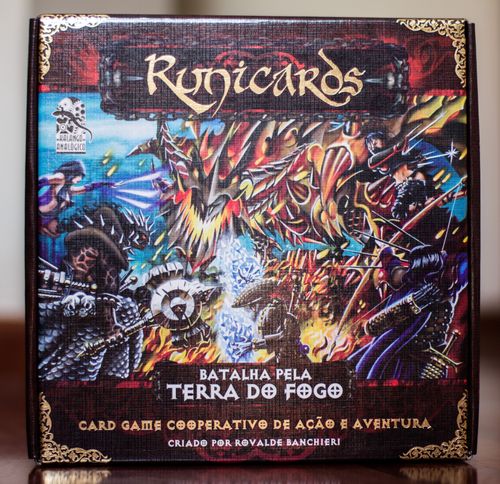
Runicards
Runicards Rulebook
Table of Contents
Table of Contents
1: The Basics of the Game
The Runicards®: Battle for the Land of Fire card game invites participants to play cooperatively as heroes against the monsters of the deck, following a story told through adventure cards. It is a reinterpretation of the RPG in card-game form.
In Runicards, everyone plays against the board and wins or loses together. Each participant plays a hero who came to the Black Forest answering a desperate plea for help from its inhabitants. Choose between the noble Paladin, the powerful Sorceress, the determined Ranger, the stealthy Thief, the disciplined Monk, the versatile Druid, or the skilled Weapon Master. These heroes will explore the lands of the Kingdom, solve its mysteries, face monsters, and find runes and magic items.
Runicards® will challenge you with traps, events, curses and rune chaos pulses, in addition to the infamous monsters and villains waiting in terrible lairs, threatening the peace of the world with their nefarious plans.
Are you ready for the challenge? Embark on this adventure with your friends!
Number of Players
Runicards® can be played with any number of players from 1 to 7. Each player controls a hero and the game does the rest!
Winning and Losing the Game
Victory is achieved by defeating the monster described on the Lair card of the Adventure being played. For example, you may have to defeat a fierce dragon in one adventure, or face a cursed mummy in another. Everyone loses the game if, at the end of any turn, a hero has a number of damage markers equal to that hero's PV (Pontos de Vida, Hit Points).
2: Preparing the Table
Components
Runicards®: Battle for the Land of Fire contains:
- 165 Hero cards
- 54 Challenge cards
- 55 Treasure cards
- 54 Adventure cards
- 55 Monster cards
- 52 Empire cards
- 1 Card Map
- 27 Damage markers
- 54 Resource markers
- 1 rulebook
Assembling the Card Map
- Choose an adventure from the Adventure Deck and set aside the 3 corresponding cards (Adventure, Conquest and Lair). Place these cards on the Card Map in the indicated spot and read them aloud to all players. If this is your first time playing Runicards®, start with Adventure 1: Poisonous Trap.
- Set aside the monster(s) indicated on the Lair card. These will be the villain(s) of the game.
- Shuffle the remaining Monster cards and place 4 of them on the Battlefield.
- From the remaining Monster cards, set aside 4 monsters chosen at random for each player taking part in the game. If you are playing alone, set aside 8 cards. This will be the Monster Deck used in this adventure. Remove the other monsters; they will not be used in this game.
- Select one of the monsters from the Lair and shuffle it with the last 3 cards of the Monster Deck. This way the villain of the game will always be among the last 4 cards. Place this Monster Deck in the indicated spot on the Card Map.
- Shuffle the Challenge Deck and the Treasure Deck. Place these decks in the indicated spots on the Card Map.
- Done! Your Card Map is complete!
The cards of the adventure set are:
- The Adventure card tells the story of the game being played.
- The Conquest card represents an optional objective that lets you unlock an important Treasure for the battle against the adventure's villain.
- The Lair card describes the encounter with the villain and its special powers!
Choosing Your Hero
Each player must choose a hero from the options: Druid, Sorceress, Thief, Weapon Master, Monk, Paladin or Ranger. Each hero has 3 cards of different levels. You start as the level 1 hero and may advance in level during the game. Set aside all the cards bearing your hero's image and keep them at your side.
Building the Hero Deck and Your First Hand
Runicards® uses a Deck-Building system. This means you start with a reduced number of cards in your deck, but will add new cards during the game.
The cards of the Hero Deck are called Abilities. There are 2 types of Ability cards: Basic (Speed, Damage and Hit Points) and Power (which bear your hero's image on the left side).
You start the game with 11 cards in your Hero Deck: 3 Speed, 3 Damage, 3 Hit Points and 2 Power cards of your choice. Shuffle the 9 Basic cards together with the 2 class Power cards you chose. This is your Hero Deck. Draw 3 cards from this deck. These 3 cards are the ones you will use in the first round of the adventure.
- Each hero has 3 cards of different levels.
- The Basic cards are: Speed, Damage or Hit Points.
- Each hero has 10 Power cards.
Treasure
Treasures are Permanent Personal Effect cards. This means they are not shuffled into your Hero Deck; they stay on your table and can be activated during the adventure. Generally, Treasures give a fixed bonus to your hero or carry out an effect by discarding some Ability cards from your hand.
There are two types of Treasure: Items and Runes.
Items represent powerful objects built by smiths, mages, alchemists or artisans, and imbued with supernatural power. Unless an Item says otherwise on its own card, Items can only be used during their owner's turn.
Runes are words of power engraved on objects. Runes grant power over one of the aspects of the creation of the world: luck, chaos, fire and sacrifice, among others. Unless a Rune says otherwise on its own card, Runes can be used at any time in the game, both during your turn and during another player's turn. In addition, removing a Rune from play (placing it on the Treasure Discard Pile) allows you to remove a Curse card affecting any hero.
Each hero starts the game with one Treasure card bought from the top of the Treasure Deck.
At the moment it is bought, any Treasure may be immediately offered to other players; this is the only moment a Treasure can be transferred. A hero may hold up to three Treasure cards at the same time. However, they may buy new Treasure cards and offer them to a companion adventurer normally. Treasures refused by all players are moved to the Treasure Discard Pile.
REMEMBER: Runicards® is a cooperative game. Sometimes a Treasure of little importance to you can be essential to another hero!
Summary of Setup
The Card Map should now contain: 3 piles of cards (Challenges, Monsters and Treasures), 4 Monster cards on the Battlefield and 3 Adventure cards (Adventure, Conquest and Lair).
In addition, each player must have a Hero Deck made up of 11 cards (9 Basic and 2 Power, of which the 3 already drawn are in the starting hand) and 1 Treasure card.
Example of a hero's table on the first round.
3: The Hero's Turn
Who Starts?
Shuffle the monsters that were not placed in the Monster Deck and will not be used in the game. Each player draws and reveals one of these cards. The player who draws the monster with the highest XP value starts the game. In case of a tie, compare the PV values of the tied monsters. If the tie persists, compare SPEED (VEL) and, if necessary, DAMAGE. If there are still tied players, each of them draws another monster card and repeats the procedure. Once the starting player is decided, play proceeds clockwise, with each player completing all their Hero's Turn Phases.
Phases of the Hero's Turn
Start of Turn: Challenge Phase
Before playing any card or taking any other action, draw a card from the Challenge Deck and read it aloud to all participants. Challenge cards can be Traps, Scenarios, Curses or Rune Chaos Pulses.
- Traps are Personal Effect cards, meaning they affect only the player who drew them. In general, Traps force the player to discard one or more cards or suffer a negative effect. After the effect of a Trap card is applied, discard it next to the Challenge Deck.
- Curses are Permanent Effect cards, meaning they are not discarded; they remain on the table, affecting the hero who drew them until the end of the game. Any Curse can be destroyed if a hero removes a Rune card from play. Whenever a Curse is drawn, remove any other Curse afflicting that hero.
- Scenarios are Permanent Global Effect cards, and therefore affect all the heroes and/or monsters indicated on the card, remaining in play until the end of the game. Players may spend 6 XP or more, individually or collectively, to remove a Scenario card. If any hero draws a Scenario card, remove any Scenario card that is already in play.
- Rune Chaos Pulses are Effect cards and can affect your hero or the monsters, or even change one or more rules during your turn. Immediately after drawing a Rune Chaos Pulse card, draw a card from your Hero Deck and reveal it to all players. Depending on the type of card drawn (Power, Speed, Damage or Hit Points), apply the effect listed on the Rune Chaos Pulse. Once this effect is resolved, discard the Rune Chaos Pulse card to the Challenge Discard Pile, but keep the Ability card drawn in your hand and continue the turn normally.
The four types of Challenge in Runicards®.
Combat Phase
During your Combat Phase, you MUST attack one of the monsters on the Battlefield. However, before the attack, you may use all the resources at your disposal (on your table and in your hand) to obtain the best result. You may:
- Use the Hit Points card to heal your hero;
- Use a Treasure card to activate some effect;
- Use Ability cards to increase your hero's Damage or Speed.
Remember that every hero has a Special Ability described on its Level card, and some of these abilities can directly affect the Combat Phase. The Sorceress, for example, can use her Magic Missiles to wound the monster she intends to attack; the Monk can unleash his Flurry of Blows to increase his Damage or Speed, and so on.
After all the desired effects have been applied, it is time to attack!
- Initiative: Calculate who deals Damage first by comparing the hero's Speed (VEL) with the monster's Speed. If there is a tie, hero and monster deal damage to each other at the same time.
- Damage: The winner of Initiative deals its Damage value to the opponent. If the target of an attack suffers more Damage than its Hit Points (PV), it is defeated. Otherwise, it deals Damage to its attacker. Whenever a hero or monster suffers Damage, place Damage markers on it. These markers remain in play until removed by effects or abilities.
- Graveyard: Apply the effects that happen "at the end of combat", "if a monster is defeated" or "graveyard", next. In addition, when a monster is defeated, place it on the XP Pile (Graveyard) of the hero who defeated it. Its XP value is the currency used in the Purchase Phase.
- Battlefield: The spaces left by defeated monsters must be filled with new monsters bought from the Monster Deck, until the Battlefield again has 4 monsters in play.
Example of combat, with the card labels:
- Hero name and hero level.
- XP (Experience Points): the currency for levelling up and buying Treasures.
- PV (Hit Points): how much Damage the character can withstand before being defeated.
- VEL (Speed): who deals Damage first.
- DAMAGE: how much Damage is subtracted from the opponent's PV in combat.
- Monster name, monster type, and the monster's Special Ability.
Setup: The Paladin has Speed 5 (3 from the hero card and +2 from his two Basic Speed cards) and Damage 3 (2 from his hero card and +1 from his Power card "Aura of Bravery"). In addition, before combat he may use the EFFECT of "Aura of Bravery" to heal 2 PV of a hero who has Damage markers.
Initiative: The Banshee has 7 Speed, so she deals Damage first in combat against the Paladin.
Damage: The Banshee deals 3 Damage to the Paladin (2 from her card +1 from her Special Ability "Initiative"). Since the Paladin has 8 PV, he has not yet been defeated and can attack the Banshee, dealing 3 Damage and defeating her. The Paladin receives the 3 Damage markers and now has only 5 PV.
Graveyard: The Paladin defeated the Banshee and then activates his "Aura of Goodness", recovering 1 PV of the Damage suffered this turn. In addition, the Banshee is removed from the Battlefield and placed on the Paladin's table, in his XP Pile.
Battlefield: The Paladin draws a new monster from the Monster Deck and places it on the Battlefield, filling the spot of the Banshee he defeated.
Monster Special Abilities List
The list printed on page 11 of the rulebook, one entry per ability. "X" stands for the value printed on the monster card.
- Subtract X from the Damage dealt to this monster.
- This monster recovers X PV at the end of each Combat Phase.
- This monster automatically deals X Damage to the hero that attacks it.
- The hero cannot use Items or Ability cards when attacking this monster.
- This monster deals X Damage to all heroes if it is attacked.
- The hero who defeats this monster draws X fewer cards in the next Purchase Phase.
- This monster deals X Damage to the hero who defeats it.
- Each hero draws one card immediately if this monster is defeated.
- This monster deals X Damage to all heroes if it is defeated.
- The hero who attacks this monster draws X fewer cards in the next Purchase Phase.
- This monster automatically deals X Damage to the hero that attacks it if it wins Initiative.
- The hero who attacks this monster draws X extra cards in the next Purchase Phase if it wins Initiative.
End of Turn: Purchase Phase
The Purchase Phase is when you spend XP points and rebuild your hand of cards.
Spending XP: If all went well, at this point you should have some monster in your Graveyard. The first value on the monster card, inside the green square, is its XP (Experience Points). You can spend these points in several ways:
- 2 XP to buy a Treasure card;
- 3 XP to level up 1 level;
- 3 XP to exchange a Basic Damage, Speed or Hit Points card in your Hero Deck for a Wildcard card;
- 5 XP to buy a Power card;
- 6 XP together with other heroes to remove a Scenario from the table.
REBUILDING YOUR HAND OF CARDS: Gather all your Ability cards (those that were used and those that were NOT used too), together with any Ability card newly bought by spending XP, and put them back into your Hero Deck. Shuffle the Hero Deck and draw 3 cards.
Your turn is complete, and the next player clockwise may act. IMPORTANT: In Runicards®, the player always draws cards at the End of the Turn, not at the beginning.
4: Spending XP
2 XP: Buying Treasures
By spending 2 XP, you buy a card from the Treasure Deck. This is a Permanent Personal Effect card, meaning it will remain on your table until removed, but it is never shuffled into your Hero Deck. More information about Treasures can be found on page 8.
3 XP: Levelling Up
When levelling up, you exchange your hero card for the one of the next level. Level 1 players buy the level 2 card and, for another 3 XP, the level 3 card, which is the maximum possible in the game.
When your hero advances a level, the Damage and Speed values may increase, and the hero always receives more Hit Points to withstand the Damage caused by monsters.
In addition, choose and buy a Power card from your hero's Ability cards that are not yet in play. This card is immediately shuffled into your Hero Deck, making it more versatile and powerful!
IMPORTANT: Another great advantage of levelling up is that you can draw more cards from your Hero Deck in each of your Purchase Phases. Even so, you can still use only 3 cards per turn. However, an experienced hero will always have more options in hand.
- At level 2, draw 4 cards.
- At level 3, draw 5 cards.
Remember that when a card tells you to "discard" one or more cards, you may discard the cards you will not use in your turn!
So a level 3 hero can use 3 cards and discard 2 for other effects without being harmed. Note that the hero is not required to use 3 cards, and may discard as many cards as they wish and as other abilities allow.
3 XP: Exchanging Wildcards
To make your hero even more versatile, you have the option of exchanging a Basic Speed, Damage or Hit Points card in your Hero Deck for a Wildcard card. The Wildcard card can be used to simulate the effect of any Basic card of your choice. Thus, when you play it on your table, you must choose which bonus you want: whether it will increase your Speed or Damage value, or whether it will be used to recover 1 PV of your hero.
5 XP: Buying Power Cards
By spending 5 XP you may choose and buy one additional Power card from your hero's Ability cards that are not yet in play. This card will be immediately shuffled into your Hero Deck.
6 XP: Removing Scenarios
One of the most dangerous Challenge cards is the Scenario card. Scenario cards are of the Permanent Global Effect type. Therefore, once they come into play, they remain on the Card Map until they are removed.
A Scenario can be removed if another Scenario is drawn from the Challenge Deck, or by spending XP to remove it.
Because it is a Global Effect, any heroes may join together at any time and spend 6 XP together to immediately remove a Scenario in play. The XP spent to remove this Scenario may come from any XP Pile and in any quantity, as long as it totals at least 6 XP. Thus, a hero can remove a Scenario alone if they have 6 XP, or ask the other heroes for help to gather the required amount of XP.
Important: No Change for XP
There is no "change" for XP. If you defeated a monster worth 4 XP and want to level up, which would cost 3 XP, you will lose the excess 1 XP. However, you may choose to combine several monsters in your XP Pile (Graveyard) to make better use of your XP spending. It is possible, for example, to add a monster worth 4 XP and a monster worth 1 XP, totalling 5 XP, and at the same time level up (3 XP) and buy a Treasure card (2 XP).
5: Extra Rules
Facing the Villain
The monster marked on the Lair card is called the Villain. When the Villain is drawn from the Monster Deck, remove all the cards from the Battlefield and follow the instructions on the Lair card.
The hero who draws the Villain's card must read the Lair card aloud to all players. The Lair card states the victory conditions and any additional powers of the monster to be faced. Take the time you need to understand the card and always show it to all players. If the Villain is defeated, the heroes win the game!
Tie in Initiative
Initiative is the comparison of the Speeds of the attacking hero and the attacked monster to see who will deal Damage first. Whenever there is a tie in Initiative, hero and monster attack at the same time.
Remember that Ability cards can only be used BEFORE the Combat Phase. Once an attack has been declared against a monster on the Battlefield, you may no longer play cards from your hand, unless an effect or ability says otherwise. For this reason, effects that increase your Speed must be used BEFORE combat begins.
Searching the Hero Deck
Whenever you search your Hero Deck for a card due to an effect or ability, shuffle it together with the remaining cards afterwards.
Automatic Damage
Certain Abilities or Effects can cause Automatic Damage. Automatic Damage is a way of reducing the Hit Points of a hero or monster without attacking or being attacked.
Examples of Automatic Damage: the Sorceress's Special Ability "Magic Missiles", the Ranger's Special Ability "Double Attack", the Damage from the "Graveyard" Special Ability of some monsters, the Damage from the "Initiative" Special Ability of some monsters, the Damage caused by the effect of the Treasure "Ring of Fire Ray", the Damage suffered by using the Treasure "Blood Rune", among others.
Causing Automatic Damage is not considered an attack. Therefore, if the Sorceress defeats a monster on the Battlefield with her Special Ability "Magic Missiles", she will still need to directly attack another monster during her Combat Phase.
One of the greatest advantages of Automatic Damage is that it ignores the monsters' Special Ability "Resistance", not being reduced in any way by this kind of protection.
Some Scenario or Lair effects may direct that monsters on the Battlefield be turned face down, hidden. Monster cards turned in this way cannot be targeted by Automatic Damage.
Face-Down (Hidden) Monsters
Face-down monster cards are cards on the Battlefield that, by some effect, have been turned so that the face printed MONSTER is up, with the image and statistics of the monster card hidden and face down.
Monster cards that are face down cannot be declared as the target of any Automatic Damage, and monsters with Damage markers cannot be turned face down by any effect.
If a face-down monster is the target of an attack, turn it face up and proceed with the Combat Phase normally. Once you have declared an attack against a face-down monster card, it is not possible to change target.
Discarding or Removing
Whenever an effect or ability tells you to "discard" one or more cards, you must discard them from your hand of cards. Whenever an effect or ability tells you to "remove" one or more cards, you must remove them from the table, from among the cards in play.
In this way, "discard" always refers to the cards in your hand, and "remove" always refers to the cards in play, on your table or on the Card Map.
Healing Heroes and Animal Companions
The Basic Hit Points card can only be used on your own hero. Only cards or effects that explicitly say you may recover Hit Points of other heroes may remove Damage markers from other heroes or from Animal Companions.
6: Optional Rules
Game Length
Each game of Runicards® lasts on average 15 to 20 minutes per hero in play. This time is determined mainly by the number of monsters per player placed in the Monster Deck during preparation of the Card Map. The recommended setup of 4 Monster cards per hero gives each participant the opportunity to have at least 4 complete turns before the Lair card is found. For faster games, it is possible to reduce the number of monsters in the Monster Deck. By placing only 3 monsters per player, or even only 2 monsters, each game becomes extremely quick... and challenging! The fewer monsters in the Monster Deck, the less XP the heroes will be able to accumulate before the end of the game and, consequently, the more challenging the Lair card will be.
Starting Monsters
Sometimes the game can begin with very challenging monsters on the Battlefield. One way to deal with this situation is to institute a rule that the sum of the XP value of all the monsters in the first Battlefield lineup be at most 14 XP. If this total is exceeded, prepare the Monster Deck and the Battlefield again, as described on page 5, under "Assembling the Card Map".
Adjusting the Difficulty
If you or your group are facing an adventure that is particularly challenging, or especially if you are playing alone, there are some simple modifications that can help, with the consent of all participants:
- Include 1 or 2 additional Power cards in the Hero Deck at the start of the game;
- Start the game with 1 or 2 fewer Basic cards in the Hero Deck;
- Start the game with a Wildcard card in place of a Basic card.
7: Extra Adventure
During your adventures in Runicards games the unexpected can happen, and the whole group may be defeated before victory. To offer a second chance to defeat the villain, we created the "Extra Adventures". A way to continue the game from where you left off, after being defeated by the villain.
This manual has two extra adventures. Use the adventure "Depths of the Abyss" if you are defeated in adventures 1 to 9, and "Escape from the Bone Prison" if you are defeated in adventures 10 to 18.
How an Extra Adventure Works
If you have just lost the game, there is a good chance your hero or another participant has already gained some levels and treasures. You do not lose these cards. This adventure will begin with your character exactly at the point where you lost the game.
Follow the step-by-step below to assemble the new Card Map:
- Separate the adventure's villain and its Lair card;
- Shuffle all the monsters back into the Monster Deck;
- Shuffle all the challenges back into the Challenge Deck;
- Remove all Damage markers from all heroes and monsters;
- Put away the board and clear space on the table to assemble the new Extra Adventure Card Map (only the cards will be used);
- All players must shuffle their Ability cards back into the Hero Deck and draw new cards;
- Place the adventure's villain card in the location indicated in red on the Card Map;
- Place on the table the monsters indicated on the Card Map. In the location indicated by a face-down card (with the face printed "Monster" up), place a monster drawn at random from the Monster Deck;
- Place a Challenge or Treasure card drawn at random where indicated on the Extra Adventure Card Map;
- Read the text of the Extra Adventure to all players and follow its instructions;
- If the group reaches the villain, read its Lair card and try to defeat it to win the game!
Depths of the Abyss
After losing the battle, the heroes are hurled down a well into the Abyss! A cursed dimension full of monsters and challenges! The only way to escape is by facing all the creatures and challenges that separate them from the exit!
Rules:
- The heroes must defeat the monsters in the order below, starting from the "Hero" card and following the red line;
- The heroes may pay 2 XP to buy a Challenge card from the Card Map, apply its effect and remove it;
- The heroes will face the villain if they remove all the Challenge cards from the Card Map. If they cannot remove all the Challenge cards, they lose the game.
The map of the Depths of the Abyss (red path from the Hero card to the villain) is printed as a graphic on page 16 and is not reproduced here.
Escape from the Bone Prison
If the heroes lost the fight against the villain, they will end up captured and taken to... the Bone Prison!
To get a new chance to continue the adventure, the heroes must escape the palace catacombs and defeat all the monsters until they reach the adventure's villain and face it!
Rules:
- The heroes start with no treasure! They must defeat the monsters in the order below, starting from the "Hero" card and continuing until they reach the villain.
- Defeated monsters are discarded and do not give XP.
- Whenever you defeat a monster, and there is a Treasure card in the sequence, you gain that Treasure card.
The map of the Escape from the Bone Prison (order of monsters and Treasures) is printed as a graphic on page 17 and is not reproduced here.
8: Empire
Welcome to the Empire! This is an alternative mode of Runicards®, in which you will challenge your friends to a competitive and strategic game!
In Runicards®: Empire each hero controls an Empire and must expand it by exploring terrains, capturing monsters to form its troops and toppling rival empires.
Each Terrain conquered provides Resources to play Construction cards that will make your Empire ever more powerful!
Number of Players
Runicards®: Empire supports 2 to 4 players.
Winning the Game
In Runicards®: Empire each player must play Construction cards on conquered Terrains. Each Construction card has a value in Victory Points. The first player to accumulate 8 Victory Points is the winner.
Castle, Constructions and Terrains
Each Empire is made up of a Castle, Constructions and Terrains.
The Castle is the only card of an Empire that cannot be the target of an attack. It is the most important piece of the Empire and must be placed in a strategic location on the map that allows the kingdom to expand properly. In general, this means that the more Terrain cards around a Castle, the better positioned it is on the Map.
Terrain cards provide Resources for many purposes, but their main function is to pay the cost of placing Constructions into play. There are 4 types of Terrain cards:
- Plantations: produce the Wheat Resource
- Forests: produce the Wood Resource
- Gold Mines: produce the Gold Resource
- Mana Wells: produce the Mana Resource
Each Empire has a greater affinity with a particular type of Terrain:
- Yellow: The Civilised Lands, whose main Resource is Wheat
- Green: The Forest Folk, whose main Resource is Wood
- Red: The Barbarian Kingdom, whose main Resource is Gold
- Blue: The Arcane Alliance, whose main Resource is Mana
Caption on page 19: each Terrain generates points of a different Resource.
Construction cards are expansions of an Empire spread across the game's Territory, and they are divided by points. Since the goal of the game is to accumulate 8 points in Constructions, Construction cards are the foundation of victory. The higher a Construction card's point value, the less power it has. Conversely, the lower a Construction card's point value, the more power it has.
There are 3 types of Constructions:
- 1 Point: Unique Constructions of an Empire. They have special powers superior to the other Construction cards.
- 2 Points: Basic Constructions common to all. They have strategic powers that often require an activation cost in Resources.
- 3 Points: Farms. They have no power, but guarantee a significant number of Victory Points.
The example card on page 18 ("Código de Hamurabi") is labelled with three callouts: the cost in Resources to place the Construction in play; the description of the Construction's ability and the Resource cost to activate it; and the Victory Points of the Construction (+1 on the example).
Hero Defeat
In Runicards®: Empire, each hero starts the game at level 3.
If a hero is defeated, it loses one level.
If a level 1 hero is defeated, that hero's card is turned over and made unusable. It may be turned face up and restored at a cost of 5 XP or 5 Resources.
To regain a level, a hero must spend 5 XP or 5 Resources.
Special Terms
Some Runicards® terms are used differently in Empire mode:
- Troops: Monsters in the Troops of a rival Empire are considered Monsters on the Battlefield, but can only be attacked if a hero attacks that Empire directly.
- Battlefield: Monsters in rival Troops can be targeted by effects that normally target Monsters on the Battlefield (such as the Sorceress's Magic Missiles, for example).
- Monster: Any hero of a rival Empire is considered a Monster and can be targeted by effects and powers that target only Monsters.
- Heroes and Allies: Any Monster in your Troops can be targeted by effects and powers that target only heroes or allies.
- XP Pile (Graveyard): Monsters in your Troops are considered to also be in your XP Pile.
9: Preparing the Empire
Monster, Challenge, Lair and Battlefield
Cards of the Adventure Deck are not used and may be left in the box.
- Shuffle all the Monster cards, place 4 of them on the Battlefield and place the rest in the Monster Deck.
- Shuffle the Challenge Deck and the Treasure Deck and place them in the indicated spots on the Card Map.
The Conqueror Hero
Decide who starts the game according to the rules of Runicards, on page 9. The starting player chooses a hero and builds the corresponding Hero Deck (see below). Clockwise, each other player does the same.
Each hero draws 5 cards from its Hero Deck. This is the first hand. Each hero then draws one Treasure card.
The last player to choose a hero chooses an Empire. Counter-clockwise, each other player does the same.
Building the Empire
Each player separates the Card Map of their Empire's colour and its respective deck; in addition, each player receives 4 Terrain cards: 1 Plantation, 1 Forest, 1 Gold Mine and 1 Mana Well.
The starting player begins by placing one Terrain card in the Territory Area of the Card Map. This Terrain card must be face down, hidden, and only the player who placed it will know its type. Clockwise, each player places one Terrain card at a time, in a Cartesian manner, until every player has placed all of their Terrains in play.
Cards may only be placed in the Territory in a Cartesian manner (in horizontal or vertical lines) and never in an oblique manner (in diagonal lines). Likewise, you may only attack empires or explore terrains that are Cartesian-adjacent to one of the cards of your Empire.
The example on page 21 shows the four orthogonal positions (valid) and the four diagonal positions (invalid) around a card.
The Hero Deck
The rules for building the Hero Deck are a little different in Empire mode:
- Each hero starts the game at level 3.
- Shuffle ALL the Ability cards (10 Power cards, 3 Speed cards, 3 Damage cards and 3 Hit Points cards). This is each hero's Hero Deck.
Placing the Castles and Constructions
Each player separates their Castle, one 1-point Construction and one other Construction of their choice.
The last player to place a Terrain in play will be the first to place their Castle on the Card Map. Counter-clockwise, the other players do the same.
A Castle or Construction card can only be placed in the place of a Terrain card. When this is done, the Terrain card removed from the board is placed on that Empire's Card Map and starts to provide Resources to that player.
IMPORTANT: Castles (and only Castles) must be placed at least one Terrain card away from the Castles of other players. In this way, two Castles will never be positioned side by side on the Card Map.
The player who wins Initiative places their 1-point Construction on the Card Map in place of a Terrain. As with the Castle, the Terrain is removed from the Board and goes to that Empire's Card Map.
This is the last construction to be placed in play before the game starts. The last player must choose any one of their remaining constructions and place it in play.
Each player draws two Monsters from the Monster Deck to integrate into their Troops, but does not reveal them to the other players. Each player places these Monsters face down, hidden (with the face printed "Monster" up), anywhere in their Troops. Both may belong to a single Troop or be divided into separate Troops.
Translation note: the source's wording for the placement of the first Construction ("the winner of Initiative") and the "last construction" step is printed as above and has been transcribed without change.
Summary of Setup
The Card Map should contain: three piles of cards (Challenges, Monsters and Treasures) and four Monster cards on the Battlefield.
The Territory, FOR EACH PLAYER, should contain: one Terrain card (face down, hidden, with the face printed "Empire" up) and three cards of each Empire (one Castle, one 1-point Construction and one other Construction).
On the Card Map of each Empire (Yellow, Blue, Green or Red) there should be: 3 Terrain cards and 2 Monsters.
On each player's table there should be: three hero cards (with the level 3 card on top), a Hero Deck made up of nineteen cards (nine Basic and ten Power, of which five are already drawn in the player's hand) and one Treasure card.
Example on page 22: in the example below, the Yellow Empire is being attacked by the Monk. The opponent chose to defend with "Troop 1", and the Monk is facing the first monster, the Banshee.
10: The Empire Turn
1. Start of Turn: Resource Collection Phase
Place 2 Resource markers on any Terrain in your Empire's Card Map.
Declare which Terrain will provide a global resource. All players who have this type of Terrain (including you) receive 1 additional marker of this Resource.
The maximum number of Resource markers you may have in your Empire at any time is 12. The excess is discarded.
You may remove 3 markers from the same Terrain card to receive 1 marker of any other Resource.
Choose between the Combat Phase (2a) or the Exploration Phase (2b) and proceed with that Phase.
2a. Combat Phase
Declare whether the target of your attack is the Battlefield or a rival Empire.
Attacking the Battlefield:
- Draw a Challenge card and apply its effect;
- Choose one of the four monsters on the Battlefield and resolve combat normally (as on page 10);
- If a monster is defeated, move it to one of the 6 spaces in your Troops. If there is no space in your Troops, the defeated monster is moved to your Reserve, off the Card Map;
- At any time, you may have at most three Monsters in your Reserve. If you defeat more monsters than your Troops (6) and your Reserve (3) can hold, the defeated Monster is discarded, that is, it does not enter your table and cannot be used as XP.
Attacking a rival Empire:
- Do not draw Challenge cards when attacking a rival Empire, unless an effect specifies otherwise;
- To attack a rival Empire, one of the cards of your Empire must be adjacent to a Construction card of that opponent in the Territory;
- The same Empire can be attacked by at most two opponents at once;
- Declare which Construction will be attacked;
- The controller of the attacked Construction declares which Troop it will defend with. If it has no monsters in its Troops, or decides not to defend, the attacked Construction is automatically lost;
- Move your hero card to the Card Map of the attacked rival Empire, placing it in the space marked Invader 1 or Invader 2 according to the Troop chosen for the defence;
- Flip the first monster of the defending Troop and resolve combat normally between this monster and the hero, using the same rules as on page 10. Remember that there is no Challenge Phase when attacking a rival Empire;
- If the attacked monster is defeated, flip the next Monster in line and pass the turn. If the attacked monster is not defeated, apply Damage markers normally and pass the turn;
- If all the Monsters of a defending enemy Troop are defeated, remove the attacked Construction from the Territory. The defeated opponent chooses one of their Terrains and places it on the Card Map. If you have enough Resource markers, you may immediately spend them to place one of your Construction cards on that Terrain and claim it for your Empire;
- While defending against an Invader, the rival Empire cannot place new Monsters on the table to replace the monsters defeated in that defending Troop;
- At any time, the invading Empire may withdraw by paying a Treasure card and 5 Resource markers to the invaded Empire.
2b. Exploration Phase
- You may spend 5 XP to turn over a face-down Terrain (hidden, with the face printed "Empire" up), revealing it to all players;
- If you have enough Resource markers, you may immediately spend them to place one of your Construction cards on that Terrain and claim it for your Empire;
- You may spend 5 Resource markers to buy a Treasure card. Remember that, at any time, you may not have more than three Treasure cards on your table;
- You may spend 5 XP or 5 Resource markers to raise your hero's level by 1, up to a maximum of level 3, or to turn your hero card face up if it is face down.
3. Troop and Terrain Maintenance Phase
Turn over each Terrain without Construction cards that is face down. Each Terrain in the Territory must have its face printed "Empire" up when you end your turn;
Translation note: this step uses "desvire" (turn face up) and also requires the "Empire" face to be up at the end of the turn; the source is ambiguous on the orientation of the Terrain cards here and is transcribed as printed.
Redistribute, as you prefer and in any order, your Monsters among your Troops and your Reserve. Remember that Monsters in Troops defending against an Invader cannot be relocated or replaced, and that Troops facing an Invader cannot receive new Monsters;
Announce the end of the turn and pass the turn to the next player.
Summary of Costs
- Raise a hero 1 level: 5 XP or 5 Resource markers.
- Explore (turn face up) a face-down Terrain (hidden, with "Empire" face up): 5 XP.
- Buy a Treasure: 5 Resource markers.
- Place a Construction card in play: check the cost in Resource markers on the Construction card.
- Activate an effect of a Construction card in play: check whether the Construction card has a cost in Resource markers.
- Abandon a combat and withdraw from an invaded Empire: 1 Treasure and 5 Resource markers.