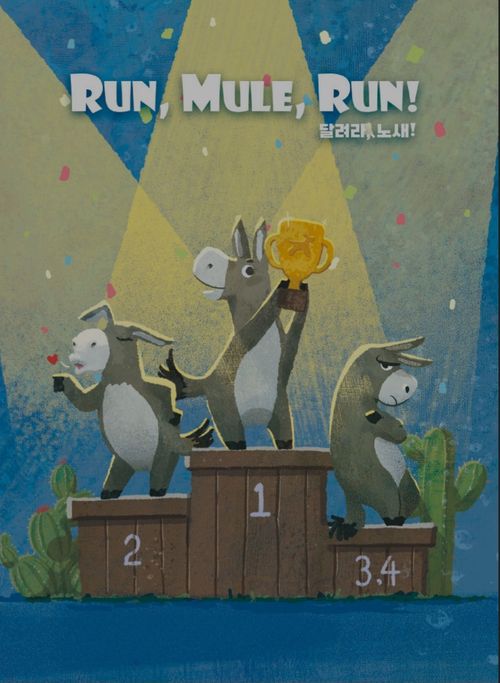
Run, Mule, Run
Run, Mule, Run Rulebook
Table of Contents
Table of Contents
Components
1 Board (2 sides), 4 Mules (Red, Yellow, Blue, Green), 12 Betting cards
Setup
Select a play side (out of 2 sides) and spread it out in the middle of the table. Place the 4 Mules outside the start point (marked with the horse icon).
In the game, no player owns a color.
Distribute the Betting cards as shown in the table below. Keep your cards private in front of you. Starting with the youngest player.
| Players | 2 | 3 | 4 | 5 | 6 |
|---|---|---|---|---|---|
| Cards per player | 4 | 3 | 3 | 2 | 2 |
Play
From the starting player, each player takes their turn in clockwise order and makes a move. A move means in the game, any mule one space forward on to a neighbouring space.
This may set off a chain reaction which causes one or several follow-up movements. Only one mule can occupy a space at a time.
Follow-up moves
The new space contains a colored arrow. This means that the mule of that color moves one space in the direction shown by the arrow.
For example, if the yellow mule is moved on to a space with a green arrow, the green mule is then moved one space in the direction shown by the arrow.
This of course means that the green mule is now on a new space, and a new arrow. This may mean a further follow-up move and so on.
If a mule moves onto one of these white arrow spaces, the mule in last place (nearest to the start) is moved in direction of the arrow, (if possible).
If there is than one mule in the same row, the player chooses which to move.
Stop!
There are two possible moves that will end this chain reaction. First, if a move results in a mule being moved onto an arrow of it's own color.
Second, if a mule would be forced by an arrow to move onto a space already occupied by another mule. (In the case, the mule is not moving foward).
[Example 1: pictorial diagram of two chain-reaction positions, omitted from the text.]
Mud space
A mule on the darker colored spaces near the end of the course may be moved backwards as it's first move, rather than forwards.
All subsequent moves are in the direction of the arrows as before, i.e, always forwards.
Arrival
When the first mule reaches 'Goal!' spaces, the mule's race is over. The mule that arrives first is placed in winner's podium.
If two or more mules goal in the same turn, then they cross the line in the order that they arrived there.
Once there is one mule already finished, a move onto an arrow in the color of that mule stops the move. Mules may not be moved backwards any more, even if they are on the mud spaces.
Game ends
As soon as the second mule goals in, the game is end.
[Example 2: pictorial diagram of the finish area with the mules on the podium spaces, omitted from the text.]
Scoring
The players now reveal thier betting cards and score points as per the follwing table. Summing up, out of several betting cards, they only score the beggest card. The player with most points wins.
| Card | Points |
|---|---|
| 1st place on the card | 3 |
| 2nd place on the card | 1 |
| First and Second place correct, but transposed | 2 |