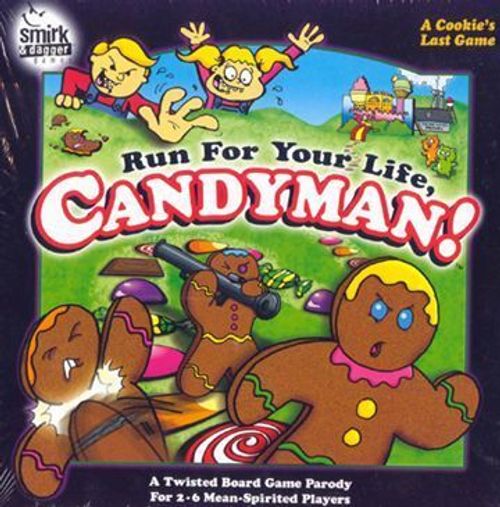
Run for Your Life, Candyman!
Run for Your Life, Candyman! Rulebook
Table of Contents
Table of Contents
- Game Components
- What You'll Need
- Object
- Set Up
- Player Turns
- Movement
- Sweet Toof's Special Movement Rule
- Combat
- Special Combat
- Combat Examples
- Candy Cage Match
- Candy Cage Match (cont)
- Winning the Game
- Last-Man-Standing Gauntlet
- Special Edition Challenge
- Extended 'Classic' Game
- Playing with Real Gingerbread
- Gingerbread Status Sheet
Game Components
- (4) Rules cards
- Game Mat
- (6) Gingerbread Meeples
- (65) Dash N Bash cards
- (44) Special Treat cards
- Gingerbread Status sheets. 12 are included in the Game Mat box and you can print more with this QR code.
What You'll Need
Pens or pencils - one per player.
Object
Crush your opponents in cookie combat by ripping off their limbs and claiming them as trophies. Or, failing that, be the first player to escape - and WIN - by crossing over the Finish Line border.
Set Up
Shuffle both the Dash N Bash Cards and the Special Treat Cards thoroughly and place them face down alongside the game board.
Give each player a Gingerbread Status sheet and pen or pencil. This is how you will track the relative health of your Gingerbread Man. As you take damage during the game, you will darken a box for each point of damage assessed to that particular candy-coded area. When there are no more unmarked boxes, you're a pile of crumbs and are out of the game.
NOTE: for the basic game, use only the 4 unshaded white boxes. The grey boxes are for the extended 'classic' version of the game.
Have each player select a Gingerbread Man meeple and place them all on the START space at Candy Keep.
The player who most recently enjoyed a delicious cookie will be the First Player. Play proceeds in turns, clockwise around the table.
Flip over a card from the Dash N Bash deck until you draw a card with a single piece of candy printed on it. Have all players circle this candy on their Status sheets as a reminder of what Candy Icon will allow you to draw a Special Treat card this game. More on that later. Place the cards back and reshuffle.
Player Turns
- Draw a card from the Dash N Bash deck for movement.
- Perform a Normal Attack for all players that you pass along the path and/or Special Attacks using your Special Treat cards.
- Play passes Clockwise.
Movement
All movement is determined by drawing a card from the Dash N Bash deck. It will show either a single candy icon or a double candy icon. If it is a single icon, move your meeple to the first space showing that candy icon along the path. If it is a double candy icon showing two identical icons, move to the second space showing that candy icon on the path. If the two icons are different, you may choose which icon to move onto first and end your movement on a space matching the other icon. You may choose to move forward or backwards along the pathway. Any number of players may occupy a space at the same time.
If your card shows a candy character on it, move immediately to the matching character icon on the game board. Note: This move transports you to the designated spot... you do not wind your way past every space in between and therefore do not 'pass' any other players on your way.
If you draw a Candy Cage Match card, transport your meeple immediately to the nearest candy icon showing a burst around it. (There are three along the path.) More on this area later.
If you end your move on a candy icon linked to a bridge entrance, you must immediately 'fall back' to the space linked to the exit of the bridge.
Sweet Toof's Special Movement Rule
If a player lands on Sweet Toof before at least half of the other players pass the 1st Candy Cage Match space, Sweet Toof tears off your head and throws you immediately onto the 'Pink Gumball' Candy Cage Match space. This initiates a Candy Cage Match. (see Candy Cage Match) Nobody likes a runaway leader - who's just running away.
Combat
It's not just a simple race, people. It's a desperate, no-holds-barred, matter of survival.
Combat takes two forms: NORMAL COMBAT and SPECIAL COMBAT.
NORMAL Combat occurs when a player moves through or lands on a space occupied by another player. The moving player may attack the player they pass or land upon by drawing a new card from the Dash N Bash deck. The number and type of candy icons shown are matched up to the defending player's Status sheet and assessed as damage, marking off the appropriate number of squares on the candy-coded area of the character. ex: a double hard candy card will cause two boxes to be marked off the corresponding arm of the defender.
If there are no boxes left on an area, the cookie part (the arm, leg, head or body) is destroyed. Tear off the destroyed cookie part from the Status sheet and hand it to the attacker as a Trophy. Any further damage to that area is ignored. If you draw a Character card or Candy Cage Match card when attacking, you may do two blocks of damage to 1 part of your choice.
Note: if a player begins their turn on the same space as another player, they may attack them before moving.
Unless directed by a specific card, you may only attack a given player once per turn. You may, however, attack as many players as are legal during a given turn. So, if you pass three players in a move, you may attack each once.
Special Combat
SPECIAL COMBAT: Special Combat occurs when a player chooses to play a Special Treat attack card they have collected.
Drawing Special Treat Cards
During set-up, you drew a Dash N Bash card with a single candy icon and circled it on your sheets. During the game, any player drawing a card showing that icon for movement will also draw a Special Treat card. There is no maximum number of Special Treat cards you can hold.
A Special Treat card replaces Normal Combat as outlined by the specific rules on the card. If these rules conflict with the main rules, the rules on the card take precedence. The card will also detail when a card may be played or which players may be targeted. Unless otherwise stated, Special Treat attacks are resolved just like normal combat – targeting a player whose space you are moving through or have landed on. Instead of drawing a card from the Dash N Bash deck, however, the card itself will outline the damage or effects.
Most cards are single use and are discarded after the attack. Where there are deviations from these general rules, keywords are printed in bold and followed by specific details.
Keywords Defined
- EQUIP - These cards are assigned to specific limbs of your character and may be used once per turn for a single attack until the assigned limb is destroyed or the card is forcibly removed.
- RANGED - These cards are weapons that can strike from a distance whether or not you have passed by or landed on another player's space during your turn. Details on how far the range extends are provided following the keyword.
- DEFENSE - These cards may be played in reaction to an attack upon you.
- PLAY AT ANY TIME - These cards may be played out of turn at anytime during the game.
Combat Examples
Example 1: A player passes through a space occupied by another player and decides to use a Special Treat card from their hand instead of conducting a normal attack. They play "Jawbreaker" and immediately assess 3 blocks of damage to the defending player's head. This card is discarded at the end of the attack.
Example 2: A player decides to interrupt another player's turn with "Push'n Pop" (which has the 'PLAY AT ANY TIME' keyword) to shove the other player back 5 spaces. This card is discarded after use. Had they played it on their own turn, this would have counted as the player's attack against the opponent even though it causes no damage.
Example 3: The attacker lands just short of another player's location. They choose to play "Licorice Whip" which has the 'RANGED' for 3 spaces keyword, allowing them to attack a player within three spaces (not counting the one they are on). This card also has the 'EQUIP' keyword and calls for the player to assign it to one of their arms. The card remains displayed to the side of the assigned arm on the Status sheet and may be used throughout the game until the assigned arm is destroyed or the card is forcibly removed by a discard effect.
Candy Cage Match
When a player ends their movement on a candy icon surrounded by a burst, they must choose another player from anywhere on the board to the space they occupy. This initiates a Candy Cage Match, temporarily placing the game on hold until the match concludes.
Starting with the player who initiated the match, players take turns drawing cards from the Dash N Bash deck and assessing damage to the opposing player. No Special Treat cards may be used during a Candy Cage Match. Attacks continue to be exchanged one at a time - until a player draws a Dash N Bash card matching the icon of the space they occupy. When this occurs, the match is over. The player who drew the card to end the match immediately moves to the first matching candy icon forward or back on the board.
This Hard Candy attack hits the opponent and then releases the attacker from the match.
Candy Cage Match (cont)
Multi-Match: If the card releasing you from the match has two icons, you MAY escape forward (using one icon) - and then choose to move back as your second move, drawing an additional player into the match. In this way, any number of players may fight at once.
This attack hits the opponent. Purple escapes to Peppermint and then returns to Hard Candy, forcing Yellow to join and restarting the match with 3 players.
AND/OR, should a "Candy Cage Match" card be drawn during the damage exchange of a Candy Cage Match already in progress, summon another player to the space and do 2 damage to a cookie part of your choice.
When 3 or more players fight at once, take clockwise turns and announce your target foe BEFORE drawing a Dash N Bash card to attack them.
Regardless of how many cookies battle and when they joined the fray, continue the match until only one player remains on the space. Then, return to standard turn order, starting with the player clockwise to the person who originally began the match.
Winning the Game
The game is all about battling others and reducing them to a pile of crumbs - but ultimately, the first player who draws a Dash N Bash card that would place them on the last space on the path will be the winner. Still, this is no small feat, because you must first pass by the TWINS. These two ill-mannered children guard the border and only one Gingerbread Man even has a chance to escape in one piece.
Any player whose meeple occupies the last nine spaces on the path awakens the Twins and is subject to attack. As long as your meeple occupies the 'Danger Zone', the Twins will make FOUR attacks upon you (using Dash N Bash Cards) at the beginning of your turn. If you survive your opponents AND cross beyond the Twins first – YOU WIN!
Last-Man-Standing Gauntlet
Real cookies stand and fight 'til the last crumb, without fleeing for the finish line... BUT eliminating the other players is not an automatic win. You must still face the Twins. After eliminating your last opponent, place your token on the very last space (the Peppermint Swirl) in front of the Twin's 'Danger Zone'. You will need to move through normally, taking your four attacks at the beginning of each turn that you are in the zone.
IF YOU DO NOT SURVIVE, HAVE EACH PLAYER COUNT THE NUMBER OF TROPHIES (COOKIE PARTS) THEY HAVE EARNED. THE PLAYER WITH THE MOST TROPHIES IS NOW THE WINNER!
Special Edition Challenge
Try this bonus rule for your end game. When the first player attempts to pass into the Twin's Danger Zone, draw Dash N Bash cards, until at least 3 different candy icons have been revealed. Only these 3 or 4 icons may be used to pass into the Finish space. Note: If you draw movement for an icon that is not part of your escape - and only lies behind you, you must move backwards.
Border Cards: Only Peppermint, Hard Candy and Gumball would allow a player to leave the land and win, in this example.
Extended 'Classic' Game
In the base game, only four damage boxes per limb are used. However, you may choose to use all 6 boxes for the Classic, extended game.
Playing with Real Gingerbread
We encourage playing with real gingerbread men, either home-baked or store bought. Mark damage on the cookies with tubes of cake decorating gel - and bite your limb off when you lose it. Yummy - and fun!
(But still award paper limbs, just in case no one makes it across the border)
Gingerbread Status Sheet
The Gingerbread Status Sheet is a component, not a rules section. It shows the candy-coded areas of the Gingerbread Man (head, body, two arms and two legs) with boxes for damage. The boxes marked as "Basic Game" (unshaded white) are used in the basic game and the grey "Extended Game" boxes are used in the extended 'classic' version.
Candy key printed on the Status Sheet:
- Ju Ju, aka Gumdrop
- Peppermint Swirl, aka Head Shot
- Gumball, aka Candy Buttons
- Candy Corn, aka The Corns
- Hard Candy, aka Grandma Candy
- Chocolate, aka Candy Bar