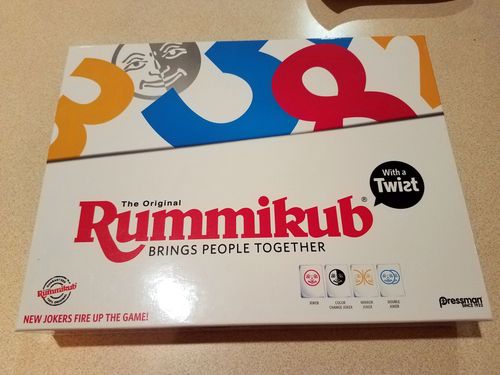
Rummikub Twist
Rummikub Twist Rulebook
Table of Contents
Table of Contents
Contents
112 tiles (8 sets of tiles 1-13 in four colours and 8 jokers), 4 racks + 8 rack holders.
Assembly
- Split the rack holder into its left (L) and right (R) halves.
- Slide the left half onto the rack from the left side.
- Push the left half in and the right half in from the right side, so the two halves meet in the middle.
- Fold the assembled rack holder down onto the rack base.
Object of the Game
To be the first player to play all the tiles from your rack by forming them into sets (runs and/or groups).
Sets
There are two kinds of sets:
A group is a set of either three or four tiles of the same number in different colors. For example: 7 7 7 7 (in black, red, blue, and yellow).
A run is a set of three or more consecutive numbers all in the same color. The number 1 is always played as the lowest number; it cannot follow the number 13. For example: 3 4 5 6 (in blue).
Set-up
Place the tiles face down on the table and mix them thoroughly. Each player picks a tile; the player with the highest number goes first. Return the tiles to the table and mix them. It is recommended to stack the tiles in piles of 7 for ease of playing. Each player takes 14 tiles and places them on his/her rack. The remaining tiles are called the "pool". The players decide how many rounds they want to play; each round is made up of multiple games. The number of players determines the number of games in a round — with four players a round is made up of four games, with three players a round is made up of three games, and with two players a round is made up of two games. When a player plays the last tile on his/her rack a game ends. Players then start over again until they have played the number of games/rounds they agreed to play.
Playing the Game
Each tile is worth its face value (the number shown on the tile). In order to make an initial meld, each player must place tiles on the table in one or more sets that total at least 30 points. These points must come from the tiles on each player's rack; for their initial meld, players may not use tiles already played on the table.
A joker used in the initial meld scores the value of the tile it represents. When players cannot play any tiles from their racks, or purposely choose not to, they must draw a tile from the pool. After they draw, their turn is over. Play passes to the left (clockwise). On turns after a player has made his/her initial meld, that player can build onto other sets on the table with tiles from his/her rack. On any turn that a player cannot add onto another set or play a set from his/her rack, that player picks a tile from the pool and his/her turn ends. Players cannot lay down a tile they just drew; they must wait until their next turn to play this tile. Play continues until one player empties his/her rack and calls, "Rummikub!" This ends the game and players tally their points (see Scoring). If there are no more tiles in the pool but no player has emptied his/her rack, play continues until no more plays can be made. This ends the game.
Manipulation of Tiles
Using strategy in manipulating tiles is an exciting part of playing the game of "Rummikub®". Each player tries to lay as many tiles as possible on the table by forming new sets and rearranging or adding on to existing sets. When breaking down existing sets, the player must use all tiles from the set in the same turn and all sets formed must follow the rules for groups and runs (see above). The existing sets can be manipulated in many ways as can be seen in the following examples.
Examples of Manipulating Tiles
Building on to a set by adding one or more tiles from your rack:
Blue 4,5,6 are on the table. The player adds the blue 3 to the existing run and the blue 8 to the group of 8's on the table.
- Tiles on rack: 3, 8
- Tiles on table before: 4 5 6 | 8 8 8
- Tiles on table after: 3 4 5 6 | 8 8 8 8
Forming a new set with the fourth tile from a group:
A blue 4 is needed to form a new blue run with the tiles on the rack. By taking the blue 4 from the group of 4's on the table, the player can lay a new run: blue 3,4,5,6.
- Tiles on rack: 3, 5, 6
- Tiles on table before: 4 4 4 4
- Tiles on table after: 3 4 5 6 | 4 4 4
Forming a new set by adding a fourth tile to an existing set and removing the needed tile:
The player adds the blue 11 to the run, removes the blue 8, and uses it to form a new group of 8's.
- Tiles on rack: 11, 8, 8
- Tiles on table before: 8 9 10
- Tiles on table after: 9 10 11 | 8 8 8
Splitting a run:
The player splits the run, using the pink 6 to form two separate runs.
- Tiles on rack: 6
- Tiles on table before: 4 5 6 7 8
- Tiles on table after: 4 5 6 | 6 7 8
Combined split:
A new group of 1's is formed by taking the blue 1 from the rack, the yellow 1 from the run, and the pink 1 from the group.
- Tiles on rack: 1
- Tiles on table before: 1 2 3 4 | 1 1 1 1
- Tiles on table after: 1 1 1 | 2 3 4 | 1 1 1
Multiple split:
The player manipulates the three existing sets and uses the black 10 and blue 5 from the rack to form three new groups and one new run.
- Tiles on rack: 10, 5
- Tiles on table before: 5 6 7 | 5 6 7 | 5 6 7 8 9
- Tiles on table after: 5 6 7 | 5 6 7 | 5 5 5 5 | 6 6 6 | 7 7 7 | 8 9 10
Jokers
- A player cannot replace a Joker before or during the initial meld.
- The tile used to replace the Joker can be taken from the rack or from a set on the table.
- A set with a Joker can have tiles added to it, be split apart, or have tiles removed from it.
- A Joker that has been replaced must be used in the same turn as part of a new set.
Regular Joker
- Replace the Regular Joker in any set with a tile showing the same number and colour of the tile the Joker represents.
- In the case of a group of 3 tiles, the Joker can be replaced by a tile of either of the two missing colours.
- The penalty value of a Regular Joker when it remains on a player's rack at the end of the game is 30 points.
There Are 4 Ways to Clear the Regular Joker
- The player can replace the Joker with either one or both of the tiles on the rack.
- Tiles on rack: 3, 3
- Tiles on table: 3 3 [Joker] — the Joker can be cleared by replacing it with a black 3 (giving 3 3 3), or a yellow 3 (giving 3 3 3), or both (giving 3 3 3 3).
- The player splits the run and clears the Joker.
- Tiles on rack: 1, 7
- Tiles on table before: 2 3 [Joker] 5 6
- Tiles on table after: 1 2 3 (clearing the Joker) | 5 6 7
- The player adds the blue 5 and clears the Joker.
- Tiles on rack: 5
- Tiles on table before: 6 7 [Joker]
- Tiles on table after: 5 6 7 (clearing the Joker)
- The player splits the run — the black 1 is moved to the group of ones and the black 2 is moved to the group of twos, clearing the Joker.
- Tiles on table before: 1 2 [Joker] | 1 1 1 | 2 2 2
- Tiles on table after: 1 1 1 1 | 2 2 2 2 (clearing the Joker)
Special Jokers
- The Special Jokers cannot take the place of a regular Joker or any other type of Special Joker.
- Reminder: Any series that laid on the table should consist of at least 3 tiles. In any case (even when you have a Double Joker), you are not allowed to leave a series with two tiles on the table.
- In scoring of the initial meld, the Special Joker represents the number, or numbers, it replaces. Note: the Mirror Joker's value is zero.
Double Joker
This Special Joker can only be used as a Double Joker (hence, 2 following number).
For example:
-
Run — 2, Double Joker, 5. The Double Joker represents the numbers 3 and 4. In the initial meld, this tile receives the value of both numbers it represents (in this case, the value is 7).
-
Group — Blue 3, Pink 3, Double Joker. The Double Joker represents Yellow 3 and Black 3.
-
A Double Joker can be replaced with either both tiles that it represents in the set or by manipulating the set to free the Joker.
-
The Double Joker tile can be used in any place in the series; as first, last, or middle tiles.
-
The Double Joker cannot be used before number 2 or after number 12 (only 1 can come before 2, and only 13 can come after 12).
Colour Change Joker
The Colour Change Joker is used only in run series and is used to create a set in two colours:
- When using the Colour Change Joker in runs, the tiles before the joker should be in one colour while the tiles after the Joker should be in a different colour.
- The Colour Change Joker can be used at the end of a set, but after the Joker, tiles played must follow in a different colour.
For example: 3, 4, Colour Change Joker, 6 — the 3 and 4 are one colour and the 6 is a different colour.
Mirror Joker
The Mirror Joker is used for creating mirror series in either runs or groups.
For example:
-
In Runs: 2, 3, Mirror Joker, 3, 2
-
In Groups: 3, 3, Mirror Joker, 3, 3
-
Any number added to one side must also be added to the other side, and any number removed from one side must also be removed from the other side.
-
The Mirror Joker, unlike the other jokers, does not have a numerical value (Mirror Joker = 0). He simply acts as a mirror. At all times, the tiles on one side must reflect the same tiles on the other side of the joker.
-
Sets can be taken apart and added to, but this Special Joker can only be used as a Mirror Joker.
-
It is a great tool for playing with double tiles.
-
Note: A series may contain more than one Special or Regular Joker. At all times one side must reflect same numbers sequence.
Example 1: 4, Double Joker, 6, Mirror Joker, 6, Double Joker, 4 Example 2: Regular Joker, 5, Mirror Joker, 5, 4
Time Limit
There is a time limit of 1 minutes per player, per turn. Players who go over the time limit must draw a tile from the pool, ending their turns.
Incomplete Runs
Players who cannot complete a move within the 1 minute time limit must replace the tiles that were on the table to their previous positions, take back the tiles they played, and draw 3 tiles from the pool as a penalty. This ends the turn.
Building Onto Sets
A player may build onto a set in any of the following ways (or in any combination of these ways) as long as there are only legitimate sets on the table and there are no loose tiles left at the end of the turn.
Winning
When the last round ends, the player who has won the most games in all rounds combined is the winner. In the case of a tie, the player with the highest score is the winner.
Scoring
After a player has cleared his/her rack and called "Rummikub!," the other players add up the value of the tiles they are holding on their racks as a negative figure and the winner of the game receives a positive score equal to the total of all the other players' points. As an aid to checking the figures, the winner's score should equal the total of the other players' scores in each game and at end of each round.
Note: the penalty for having a Joker (any Joker, including the Mirror Joker) on a rack is 30 points.
In the rare case that all the tiles in the pool are used before any player goes "Rummikub!" and no player can play any more tiles, the player with the lowest value of tiles on his/her rack wins the round. Each player totals up the value of his/her tiles and subtracts it from the winner's total (this will result in a negative number for each player). They then reduce their scores by this amount. The total of these negative numbers is scored to the winner as a positive amount.
After scoring the game, players place all the tiles back on the table and begin the next game by following the directions under Set Up. In addition to keeping track of points, players keep track of the number of games each player has won.
Sample Score Table
| Player A | Player B | Player C | Player D | |
|---|---|---|---|---|
| Game 1 | +24 | -5 | -16 | -3 |
| Game 2 | -6 | -11 | +22 | -5 |
| Game 3 | -32 | -13 | -2 | +47 |
| Game 4 | -10 | -25 | +41 | -6 |
| Total Round's | -24 | -54 |
Strategy
The beginning of a game of "Rummikub®" may seem slow, but as the table builds up, more plays are possible. In the early stages of the game it's a good idea to hold back some tiles so that other players open up the table and provide more opportunities for play. Sometimes it is useful to hold back the fourth tile of a group or run and play only three, so that on the next turn you can play a tile instead of drawing from the pool. Keeping a Joker on your rack is also a good strategy; however, you risk being caught with it (earning a penalty of 30 points) when another player goes "Rummikub!".