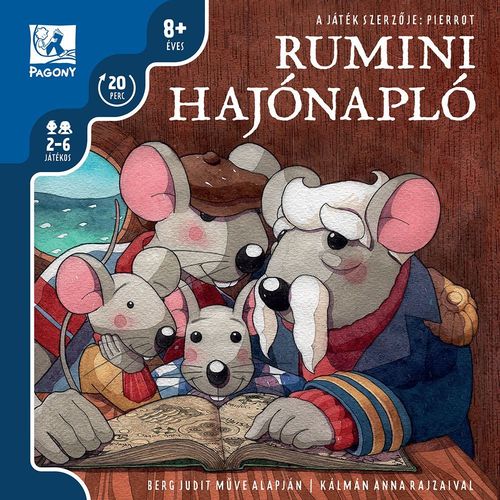
Rumini: Hajónapló
Rumini: Hajónapló Rulebook
Table of Contents
Table of Contents
Components
- 68 character cards
- 32 scene cards
- 1 rulebook
- 1 player aid
- 1 scoresheet pad (pontozótömb)
Character cards (the value is printed on each card):
| Character | Value |
|---|---|
| Rumini | 1 |
| Balikó | 1 |
| Fecó | 2 |
| Kapitány | 3 |
| Sebestyén | 3 |
| Negró | 4 |
| Bandi | 5 |
| Johanna | 5 |
| Rozi | 6 |
| Óriáspolip (Giant Octopus, joker) | none |
The Óriáspolip is a joker card. It has no printed value of its own; see "Playing the Game" and "Penalty Points" below.
Setup
- Shuffle the character cards and deal 6 to each player. Place the remaining cards face down as a draw pile on the table. If a player is unhappy with their hand (for example because it holds too many low-value or identical character cards), they may discard up to 3 cards face up to form a discard pile and draw the same number of new character cards in their place.
- Shuffle the scene cards and deal them out:
- 2–4 players: 4 cards to each player.
- 5–6 players: 3 cards to each player.
- Each player secretly looks at their scene cards. They choose the least useful one (for example, one where none of the characters is in their hand) and return it to the game box. These cards will not be needed.
- Each player passes their remaining scene cards to the player on their left. From the cards they receive, each player discards one. The remaining cards are placed in one pile.
- The game needs 8 scene cards. With 4 players, exactly 8 remain in the pile. With more or fewer players, top up the undealt scene cards to 8 by drawing 2, 3 or 4 more scene cards as needed. Once there are 8, shuffle them and place them face down in the centre of the table.
- Take a scoresheet and write the players' names in the header. Each player then takes their character cards in hand, and the game begins!
Playing the Game
The goal of the card game is to score as many points as possible by playing the cards in your hand, pairing your character cards with the scene cards.
The game lasts 8 rounds, one for each scene card. Each round goes as follows:
- Turn over one of the 8 chosen scene cards face up in the centre of the table and look at which characters appear on it.
- If you have a character in your hand (one or more) who appears in the scene, you may play it. Place it on the table next to the scene card. You do not have to play every matching character; you may hold some back for later rounds. However, you may play only one card of a given character at a time (other players may play a character that you also played). If you cannot or do not want to play anyone, you may pass. The rules for passing differ by round; see "Passing" below.
- The Óriáspolip joker may be played instead of any character. When you do, you must name which card it replaces, which determines its point value.
This phase is carried out by all players simultaneously; there is no order among them.
When everyone is finished, one player writes the results of the round on the scoresheet (see "Scoring" below for how). Then the played character cards and the scene card are discarded, and a new scene card is turned over to begin the next round.
Example: The scene shows Rumini and Balikó playing cards in secret when Negró discovers them. For this scene, a player may play 3 characters at once, and every player may do so. So if Peti played a Rumini, a Balikó and a Negró, Eszti may likewise play her Rumini and Balikó (she has no Negró). Even though she has 2 Rumini cards, she can play only one of them at a time. Gabi plays only one Rumini; she has no Balikó, and she holds her Negró back for later. Évi prefers to pass.
Passing
If you do not play any character card, you have passed. Passing also affects the number of character cards in your hand. Depending on the round, you draw or discard cards:
- Passing in rounds 1–2: draw 2 character cards.
- Passing in rounds 3–4: draw 1 character card.
- Passing in rounds 5–6: no other effect.
- Passing in rounds 7–8: discard 1 character card from your hand.
These rules are also printed on the scoresheet.
Translator's note on the pass column: the scoresheet printed in the rulebook's scoring pad shows the pass effect as "+1 card" for rounds 1–2 and "+2 cards" for rounds 3–4, which is the reverse of the body text above (draw 2 in rounds 1–2, draw 1 in rounds 3–4). The body text is transcribed here as printed, and the worked example in the rules (Peti passes in round 2 and draws 2 cards) agrees with the body text. The scoresheet's values have not been corrected in this file.
Example: In round 2, Peti passed, so he draws 2 cards. Eszti has 8 points (2 + 6), Gabi has 7 points (1 + 6), and Évi has 9 points (1 + 2 + 6).
If the same situation occurs in round 7, the multiplier is ×4. If Peti passes then, he discards 1 card from his hand. The printed example then reads: "Évi scores 32 (8 × 4), Gabi scores 28 (7 × 4), and Évi scores 36 (9 × 4)."
Translator's note on the example: the printed text names Évi for both the 8-point and the 9-point result. From the round 2 example, the 8-point player is Eszti and the 9-point player is Évi, so the first name is likely meant to be Eszti. The text is transcribed as printed; the likely error has not been corrected in this file.
Scoring
Score each round at the end of the round, as follows:
-
For each player, add together the values of the character cards they played, and add the value of the scene card.
-
If the round has a multiplier, multiply the result by it. The multipliers are shown on the scoresheet. They apply to these rounds:
- Rounds 3–4: multiply the result by 2.
- Rounds 5–6: multiply the result by 3.
- Rounds 7–8: multiply the result by 4.
Because of this, identical card values score higher every two rounds as the game progresses.
-
Write the result on the scoresheet next to the current round, in the column of the corresponding player.
Penalty Points at the End of the Game
If you still hold character cards at the end of the game, they cost you points. Add up the values of the cards you hold, multiply the total by 3, and write the result in your column in the penalty points row.
If the Óriáspolip (joker) is still in your hand, it counts as the highest-value card, the 6 of Rozi, so it is worth 6 × 3 = 18 penalty points.
End of the Game
The game ends after round 8, once the last scene card has been scored and discarded. Then add up each player's round scores on the scoresheet and subtract their penalty points (if any). Write the total in the bottom row of the scoresheet.
The player with the most points wins.