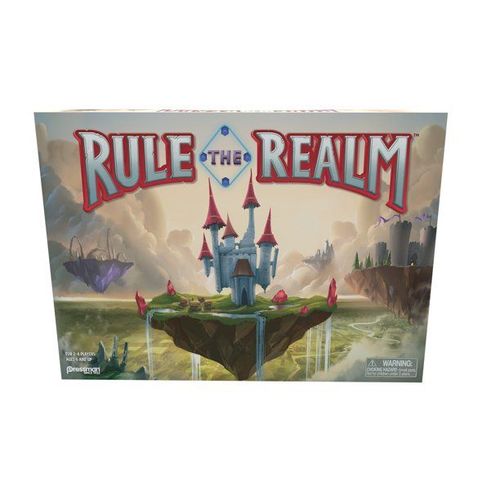
Rule the Realm
Rule the Realm Rulebook
Table of Contents
Table of Contents
Contents
- 3D game base
- 12 double-sided, interchangeable game boards
- 50 cards in 5 different colors (10 of each color)
- about 100 rubber bands in 4 different colors (about 25 of each color — you will not need more than 18 rubber bands of each color, but a few extra are included just in case)
- 50 Energy tokens
- 4 pawns, in the colors of the rubber bands
- 1 round marker
- 1 score track
- Rules of the game
Note: Before your first game, remove the plastic nubs left over from the holes in the game boards. Placing a board on the game base makes this easier.
Goal of the Game
Win the most victory points by collecting precious objects and by fulfilling objectives specific to the locations you visit.
Setup
-
Place the 3D base at the center of the table. Place one of the game boards on top of the base, so that the holes in the board line up with the pegs on the base (to get familiar with the game, we recommend starting with the "Jungle Temples" board).
-
Assemble the score track and place it around the play area.
-
Each player takes the rubber bands and the pawn of the matching color. Place your pawn on space 0 of the score track. If the scenario you chose has a limited number of rounds, place the round marker on space 1 of the round track. At the end of each round (one time around the table), move the marker one space.
-
The most flexible player starts the game. Play then proceeds clockwise. Shuffle the cards and deal:
- 4 cards to the first player,
- 5 cards to the second player,
- 6 cards to the third player (in a 3- or 4-player game),
- 7 cards to the fourth player (in a 4-player game).
These cards let you convert natural resources into Elastium and use it to explore territories and collect treasures!
-
Next, place 5 cards face up next to the board to form a resource pool. Place the rest of the deck face down next to the pool.
Important! In each scenario, the boards differ depending on the number of players. Make sure you choose the game board that matches the number of players present.
Note: In some scenarios, certain setup steps may change the rules described above. In that case, follow the instructions specific to the scenario you are playing.
The symbols on the game boards are:
- Location number (depends on the game scenario)
- Number of players
- The permitted methods for placing rubber bands on the pegs
- Special rules for play and/or scoring
- End-of-game conditions
Playing the Game
A player has 2 actions per turn. They may choose to perform the following actions in any combination or order:
- Draw 2 cards
- Place a rubber band on the board
Important! The following rules are the base rules of the game. Read the additional rules for the scenario you are playing in the corresponding scenario section.
1. Draw 2 Cards
Take two cards from the deck and/or the pool, in any combination. This fills your reserve of natural resources for better exploring and closing territories. There is no maximum hand size.
At the end of this action, refill the pool to five cards, using cards from the deck. If the deck is empty, shuffle the discard pile and form a new deck from it.
2. Place a Rubber Band on the Board
On each board, you will see treasures and Energy symbols, as well as other symbols indicating specific locations. Your objective is to collect as many precious objects as possible by controlling sections of the board, or by fulfilling objectives unique to each location:
- If the section you take control of contains Treasure symbols, gain 1 victory point for each Treasure symbol (move your pawn that many spaces on the score track);
- If there are Energy symbols, take that many Energy tokens from the pool;
- Other symbols are described in the rules specific to the scenarios.
Important! All precious objects, Energy tokens, and artifacts on the board can be collected only once. Other players may explore, close, or pass over territories already controlled if necessary, but they will not collect treasures or Energy tokens from those territories.
TO TAKE CONTROL OF A SECTION OF THE BOARD, YOU MAY EITHER EXPLORE IT OR CLOSE IT.
Explore
To explore a section of the board, stretch a rubber band between 2, 3, or 4 pegs while following the lines shown on the board, and discard the cards of the colors matching those pegs.
Correct methods for stretching the rubber bands: a straight line between two pegs; a triangle between three pegs; a quadrilateral between four pegs.
These methods are incorrect, because:
- At least two pegs must be occupied by a rubber band.
- All the lines between the pegs are not respected.
- Not all lines are respected.
- More than four pegs are occupied.
A section of the board contained inside a rubber band is considered explored, and the player who explores it collects all the precious objects and Energy tokens contained in the rubber band.
Note: certain methods of stretching rubber bands are not allowed in certain scenarios (and new ones may appear in others). Be careful to follow the additional rules of each scenario. The allowed methods are also shown in the top-left corner of each game board.
Closing
In addition to exploring territories, players may also close sections of the board. A section is considered closed if it is completely surrounded by rubber bands belonging to the same player. Territories closed this way may consist of triangular zones, and may contain the rubber bands of other players. The player who closes the territory collects the precious objects and Energy tokens as if they had just explored those territories.
Example:
- The first rubber band is stretched between two pegs.
- The second occupies three pegs.
- The third occupies four pegs.
- By placing the fourth rubber band, the player explores two triangular sectors contained within their rubber band, and simultaneously closes two others (the lighter zone), thereby collecting 1 Energy token and 6 victory points in one move.
Peg Occupation Rules
- When you stretch your first rubber band, use at least one of the bright (starting) pegs on the sides of the board (the side closest to you).
- Each rubber band after that must share at least one of its pegs with a peg from one of the rubber bands you have previously placed.
Discard Rules
- To occupy a peg, you must discard a card of a matching color.
- If there is no rubber band yet on the peg, the card is placed face up in the discard pile;
- If there is a rubber band of your color on the peg, you do not discard a card for it (this peg already belongs to you, even if it has other rubber bands around it);
- If there is already another player's rubber band on the peg, give the card to the owner of the rubber band. If there are two or three different rubber bands on the peg, give the card to one of the players present, of your choice;
- Two cards of the same color can be used as a joker to occupy a peg of any color. If the peg is occupied by other players, give the two cards to one of them or split the cards between them.
Example: To place her 4th rubber band (see the example on the left), Élodie must discard only one red card. The gray, blue, and green pegs are already occupied by rubber bands of her color. With this rubber band, Élodie closes two triangular segments.
To close this territory, Élodie could have placed her rubber band only on the gray and green pegs (example on the right) without discarding any card. Élodie still has one action left.
Example: Élodie (pink rubber bands) has 4 cards. She places a rubber band on gray, blue, and yellow pegs. The blue peg is free for her, since it is already occupied by one of her rubber bands. The green peg is not occupied by anyone. Élodie must therefore discard a green card face up in the discard pile. Élodie has no yellow card. To occupy the yellow peg, she instead gives two gray cards to the player who owns the blue rubber bands, because that player passed a rubber band around this peg before Élodie.
Additional Action
Once per turn, you may spend 3 Energy tokens from your reserve to take a (third) additional action (draw two cards or place a rubber band). This additional action must be performed immediately. Return the three Energy tokens to the pool.
End of the Game
The end-of-game conditions and scoring are different for each scenario. Read the rules corresponding to your location. However, in all cases, the following common rules apply:
- Players always finish the last round. Players all play the same number of turns during a game, even if the end-of-game condition is reached at the start or in the middle of a round (a turn around the table). After the last round, players proceed to final scoring if necessary.
- For 3 unused Energy tokens in a player's reserve at the end of the game, that player gains 1 victory point.
- The winner is the player with the most victory points. In case of a tie, the player who used the fewest rubber bands during the game wins. If the tie persists, the players concerned share the victory.
Important! Remove all rubber bands from the base after a game. It is not recommended to leave the rubber bands on the pegs, or to stretch them too much, as this may wear them out faster.
Location 1 — Jungle Temples
You have finally made a leap through space and time thanks to Elastium, and find yourself at the edge of a tropical jungle. The landscape and the stifling heat remind you of Southeast Asia. Treetops rise above stones that surely belonged to abandoned temples. Curious, you decide to venture into the forest. Find the immeasurable riches hidden deep in the jungle, and be the first to map this area by reaching the other side of the forest.
Additional Setup
Take board 1 for 2, 3, or 4 players, depending on the number of players.
Additional Rules
Each player begins by placing their rubber bands on the board using at least one of the starting (bright) pegs on the side of the board nearest to them.
Your objective is to win as many victory points as possible by collecting precious objects and, if possible, by crossing the board to reach the edge opposite your starting point to win more points. The first player to reach the edge of the board wins 8 additional points, the second player to do so wins 6 additional points.
Example: Only the owner of the blue rubber bands managed to reach the other edge of the board. They therefore win 8 additional points as soon as they have crossed the board.
End of Game and Scoring
The game ends when one of the players has 18 victory points or more. Players finish the round if necessary.
Location 2 — Volcano
Quite unexpectedly, you find yourself at the top of a volcano whose eruption is imminent. There are ancient buildings at its foot, all abandoned. The residents must have fled the eruption and left without taking their most precious possessions. You have a unique chance to recover treasures, but hurry: time is running out.
Additional Setup
Take board 2 for 2, 3, or 4 players, depending on the number of players.
This scenario is played over a limited number of rounds. Place the round marker on space 1 of the time track and move it at the start of each round (turn around the table). Skip this step during the first round.
Additional Rules
Players begin playing using at least one of the bright pegs immediately adjacent to the volcanic crater.
End of Game and Scoring
Players have only 6 rounds to collect as many precious objects as possible before the volcano erupts (just before which they will flee). To escape with your treasures, you must have at least 7 unused Energy tokens in your reserve at the end of the game. Discard the 7 tokens and exchange the remaining tokens (if any) for victory points. If, at the end of the game, you have fewer than 7 Energy tokens in your reserve, alas, you must leave all your precious objects at the foot of the volcano and run for your life. In that case, you automatically lose.
Location 3 — Archipelago City
Your latest journey through space and time brings you to a city built on an archipelago. Fast, energy-rich water runs through the canals. The city will soon sink beneath the waves. But who will save its heritage? Take this opportunity! Use the narrow bridges to cross the canals and accumulate Elastium, which will let you advance faster through the city, and thus recover the most treasures.
Additional Setup
Take board 3 for 2, 3, or 4 players, depending on the number of players.
Additional Rules
Players begin using at least one of the bright (starting) pegs on the side of the board closest to them.
The islands on the board are separated by canals that can only be crossed by using narrow bridges (a rubber band must occupy only 2 pegs, one on each bank of the crossed canal). This lets players collect Energy tokens. Precious objects on the islands can only be collected by exploring territories. There are no closures in this scenario.
Example: Over a series of turns, Vincent explored territories on three islands, winning 16 victory points and 2 Energy tokens, and crossed a canal at three points (thereby winning 6 more Energy tokens). As a result, part of the canal is closed off by Vincent's rubber bands, but he will not collect the energy found inside that closed zone.
End of Game and Scoring
The game ends when one of the players has 18 victory points or more. Players finish the round if necessary.
Location 4 — The Engraved Board
You arrive on a bare plateau, marked by immense lines left by a lost civilization. Forming gigantic pictures, the lines pulse, full of Elastium, but there is nothing of value here. These unusual frescoes, however, are a treasure in themselves, and they will make you rich and famous!
Additional Setup
Take board 4 for 2, 3, or 4 players, depending on the number of players.
Place the round marker on space 0 of the round track, which will be called the "picture track" for this game. Each time the last segment of a picture is explored, move the marker one space on the track.
Additional Rules
Players begin the game using any of the unoccupied starting (bright) pegs on the board.
Your objective is to complete as many pictures as possible, and to avoid empty segments. A picture is considered complete when all its segments are explored with rubber bands (belonging to one or more players). It is allowed to explore segments from different pictures with a single rubber band. If you explore or close a triangular segment that is not part of any picture, you lose 3 victory points (or as many points as you have, if you have not yet won enough points) for each empty segment.
The following scoring rules apply to this scenario:
- 1 victory point per triangular segment of a picture that you control (if you place a band on 4 pegs at once, you explore 2 segments and thus win 2 points);
- 1 additional point for the final segment of each picture;
- As soon as a picture is finished, the players who explored the most triangular segments in that picture win:
- 1 additional point if the picture is small (4 triangular segments of the board);
- 2 additional points if the picture is medium-sized (5 triangular segments);
- 3 additional points if the picture is large (6 triangular segments);
Note: If two or more players control the same number of segments of the picture, each of these players wins the point bonus.
Example:
- On their turn, Alice (orange rubber bands) stretches a band between 4 pegs, exploring 2 segments of a picture. As a result, an empty segment (1a) is closed by rubber bands of different colors: no one loses a point.
- Then Élodie (pink rubber bands) explores a new picture, winning 2 victory points for these segments, and 1 Energy token. However, an empty segment (2a) is closed by her rubber bands, because of her action. After exploring and scoring the segments, Élodie loses 3 victory points for the empty segment.
End of Game and Scoring
The game ends when a certain number of pictures are completed:
- 5 pictures in a 2-player game;
- 7 pictures in a 3-player game;
- 9 pictures in a 4-player game;
Players finish the round if necessary.
Location 5 — Fragile Ruins
Another journey through space and time brings you to a landscape falling into ruin, full of monuments and fossils. This must be an important archaeological site! You can explore it, but planning your movements to close off zones will let you enrich yourself even further.
Additional Setup
Take board 5 for 2, 3, or 4 players, depending on the number of players.
This scenario is played over a limited number of rounds. Place the round marker on space 0 of the time track and move it at the start of each round (turn around the table), including the first round.
Additional Rules
Players begin using at least one of the bright (starting) pegs on the side of the board closest to them.
In this scenario, players may use a new way of occupying pegs: long barriers. To make a long barrier, a player may stretch a rubber band between three pegs while following the lines on the board, and discards one card for each newly occupied peg. Long barriers may be straight, or have bends.
Rubber bands stretched over only 2 pegs not connected by a line, or where both sides of the band must pass around the central peg, are not considered long barriers.
Your objective is to close the excavation sites. An excavation site is a section of the board formed of 4 or more triangular segments, completely surrounded by bands of the same color. Each excavation site earns its owner as many additional points as the number of segments it is made up of (each triangular segment of an excavation site earns its owner 1 additional point). Segments of the board that are explored are not part of an excavation site. The owner of the excavation site does not win points (victory points) for segments of the excavation site already explored by other players (before the excavation site is completely closed).
Example: Élodie closed an excavation site with her pink rubber bands. Section 1 was explored, and so is not included in the site. Élodie will not win additional points for it. Section 2 was explored by Nicolas before Élodie could completely close the excavation site. Nicolas has already collected the victory points and Energy tokens from this section. This section is therefore not included in the site and will not earn Élodie any points. So, in total, Élodie collects 4 Energy tokens and 13 victory points from the closed territory, and wins 9 additional points for having closed a site of 9 triangular segments.
End of Game and Scoring
The game ends at the end of the 6th round. The winner is then the player with the most victory points.
Location 6 — The Cursed Triangle
You are now in the middle of the ocean. All around you is water, and, in the depths, you can make out the remains of numerous shipwrecks. Dive, but don't linger, because the treasures are scattered across the entire ocean floor, and have been buried by treacherous currents. The recipe for success? Search as many sections as possible!
Additional Setup
Take board 6 for 2, 3, or 4 players, depending on the number of players. In this scenario, there is no shared pool of cards. Before the game, shuffle all the cards and deal 12, face down, to each player. These cards form individual decks that the players will use. Place your deck in front of you, face down. Set the rest of the deck's cards aside — you will not need them for this game. Then, the first player draws 4 cards from their deck, the second player draws 5 cards, the third player draws 6 cards, etc.
Additional Rules
In this scenario, there are no starting pegs. Players may begin using any pegs on the board, as long as they have the necessary cards. Players are not required to use pegs they have already occupied previously when placing a rubber band.
Your objective is to explore as many distinct territories as possible. A distinct territory is a section of the board explored by a player, which shares no peg with other territories of the same player. A distinct territory may consist of one or more triangular segments of the board. Each distinct territory gives its owner 4 additional points at the end of the game.
On their turn, a player has two actions, chosen (in any order and combination) from the following:
- Draw 3 cards from their personal deck. If there are no more cards in your deck, shuffle your discard pile to form a new deck. Do not shuffle your discard pile until you actually need to draw, but you may not decline to draw when required.
- Place a rubber band on 3 or 4 adjacent pegs (you cannot stretch a band between only 2 pegs in this scenario). If the pegs are free or occupied by your own rubber bands, the general discard rules apply. However, if a peg is occupied by another player's rubber band, give that player one of your Energy tokens or the matching card (but keep in mind that your deck will shrink). If you choose to give an Energy token, place the played card face up in your discard pile. This must be done before you collect the Energy tokens and precious objects in the new segment you have just explored.
Note: closures (if performed as indicated by the scenario) are not forbidden, and a closed territory gives its owner victory points and Energy tokens as usual. Explored and closed segments sharing the same pegs form a single distinct territory.
End of Game and Scoring
The game ends when a player has 15 victory points or more. Players finish the round if necessary, and proceed to final scoring.
At the end of the game, each distinct territory gives 4 additional points to its owner, regardless of its size.
Example: Élodie (pink rubber bands) managed to explore 2 distinct territories by the end of the game. Segments 1, 2, 3, and 4 form 1 distinct territory because each of these rubber bands shares one or two pegs. So, during final scoring, Élodie wins 8 additional points for her distinct territories.
Location 7 — Two Demanding Deities
In this area, natives apparently worship two entities — hence the two types of idols. The two gods demand respect and loyalty. Show your respect for these deities by exploring their idols separately from the rest of the territory, and collect the most idols of each deity to demonstrate your loyalty. Show your devotion to one god, and the natives will reward you generously! If you manage to satisfy both, you will never need anything ever again!
Additional Setup
Take board 7 for 2, 3, or 4 players, depending on the number of players.
Additional Rules
Players begin using at least one of the bright (starting) pegs on the side of the board closest to them.
The board contains two types of idols: Orange and Blue.
Players are not allowed to explore mixed sections of the board (one idol and a normal territory) with a single rubber band, but it is allowed to explore idols separately, to close off idols, and to mix different kinds of segments (idols and normal territory) within the same closure.
End of Game and Scoring
The game ends when one of the players wins 18 victory points or more. Players finish the round if necessary, and proceed to final scoring.
At the end of the game, the players controlling the most idols of each type win 6 additional points each. If players are tied for the most idols of a type, the points are divided between them. If the result is not a whole number, round it up.
Example: Vincent (blue rubber bands) and Élodie (green rubber bands) finished their game after Vincent managed to close a large part of the board. They proceed to final scoring. Élodie enclosed 1 Orange idol and took control of 2 Blue idols by exploring. Vincent enclosed 1 Orange idol, and explored only 1 Blue idol. Élodie receives 6 points for the majority of Blue idols, and the reward for the Orange idols is split between the two of them. Each of them receives 3 points for the Orange idols.
Location 8 — The Labyrinth
Wow! You find yourself trapped in an immense labyrinth. Powerful, precious artifacts are hidden deep within these tunnels. Explore twisting passages and collect as many sets of artifacts as possible: it will be worth a small fortune. But be careful not to cross your own path, or your Elastium might explode in this confined space!
Additional Setup
Take board 8 for 2, 3, or 4 players, depending on the number of players.
Before the game, each player takes 18 rubber bands of their color. Set the rest of the rubber bands aside — you will not need them for this game.
Additional Rules
Players begin using at least one of the bright (starting) pegs on the side of the board closest to them.
All the precious objects and artifacts in this scenario are located on the lines connecting the pegs, and not inside the triangular segments. Your objective is to collect the most precious objects and sets of artifacts in the labyrinth's narrow tunnels, by following its lines and trying to avoid crossing your own path.
Players may only place their rubber bands on 2 adjacent pegs at a time, connecting each band to the "head" of the chain (your starting peg always forms the "tail" of your chain). If, on the first turn, you choose to occupy two starting pegs, you then choose your direction for good. Starting a new path from the body or the tail of your chain is forbidden.
Example: Alice places her first rubber band on two starting pegs. She can now choose which peg will represent the head of her future chain, and which will represent the tail. She chooses to connect her next rubber band to the yellow peg.
Example: Élodie places her first rubber band on one of the starting pegs, immediately making it the tail of her chain, and the next one must be connected starting from the red peg.
If you cross another player's chain, give them the matching card, as usual. If you cross your own chain (by connecting the "head" to the middle of your chain, or to its "tail"), you immediately lose 5 points (you can lose points this way multiple times). (If you did not have enough points when you receive this penalty, simply set your score to 0.)
If, during your turn, you collect an artifact (a sword, a helmet, or a shield), you get a bonus: take 1 card of your choice from the pool, or draw a card. (This is not an action.)
End of Game and Scoring
The game ends when one of the players has no more rubber bands left. The remaining players finish the round if necessary.
At the end of the game, each set of three different artifacts (a sword, a shield, and a helmet) gives its owner 5 additional points.