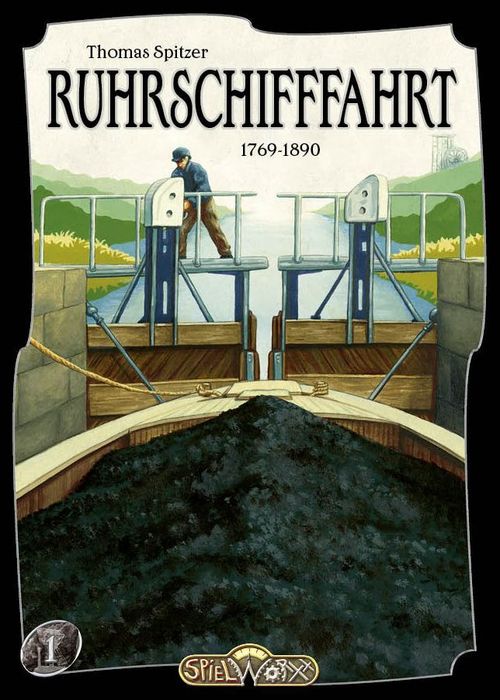
Ruhrschifffahrt 1769-1890
Ruhrschifffahrt 1769-1890 Rulebook
Table of Contents
Table of Contents
- Components
- Objective of the Game
- Preparations
- The Basics
- Sequence of Play
- End of the Game and Scoring
- Two- and Three-Player Rules
- Appendix
Components
Each copy of Ruhrschifffahrt contains:
- 1 large game board (in multiple parts)
- 4 player boards
- 2 cardboard sheets with progress markers, country markers, costs markers, obstacle/demand markers, 30+ victory point markers, 4 player markers, pilot banned marker
- 4 Ruhr barges (1 each in 4 player colors)
- 1 game turn marker
- 8 discs (victory points and special options; 2 each in 4 player colors)
- 14 coal dice (8 black ones, 6 white ones)
- 48 development tokens (natural-colored)
- 45 yellow discs (Thaler, money)
- 40 warehouses (10 each in 4 player colors)
- 1 export marker
- 1 bag for the obstacle/demand markers
- 1 rules booklet
The Game Board
The game board (consisting of several parts) shows the area of the Ruhr river between the cities of Witten and downriver up to Ruhrort. At the river there are seven "city", 12 "small scale industry" and 15 "coal storage" spaces plus the "port Ruhrort" space.
City and small scale industry spaces plus the port Ruhrort space are coal selling spaces. In addition, small scale industry spaces are divided into forges, hammer mills and gun factories.
The river contains 14 obstacle spaces. The players remove these obstacles by building locks during the course of the game.
Somewhat in the interior the coal depots of the local mines are located.
Two spaces of the board keep two warehouses of each player. These are only available to a player after he has built the first lock or when he is allowed to move coal in the territory of the Grafschaft Mark.
A player's barge is loaded with coal at coal storage spaces. The colored arrow indicates which selling space may be reached with a standard trip. Note: The game board contains three coal storage spaces with a black arrow and the "pilot wheel". From these spaces a trip is only allowed with special option pilot. See also 5.2 (Special options).
Examples:
- Standard trip via 2 spaces downriver to the next city space.
- Standard trip via 2 spaces downriver to the next small scale industry space.
- Coal transport is only allowed with special option pilot (more than 2 spaces downriver to a selling space).
The Ruhr runs through several territories. They are colored roughly in the borders of 1800.
At the top of the game board there is the game turn track which indicates the various game turns. A game of Ruhrschifffahrt consists of 12 game turns. In the lower left there are the transport tracks for coal dice; above them is the export area for exporting coal to the Rhineland, to Belgium, and to the Netherlands. The lower right corner holds the special options spaces while the victory points track is at the bottom of the board.
The Player Boards
Each player receives a player board. Before the start of the game the players put, in any order, one each of these progress markers Essen warehouse, Grafschaft Mark warehouse, coal depot, lock building, port Ruhrort, Grafschaft Mark, wage and supply vertically at the top (see 6.5.2, A list of progress markers). Note: It helps to sort these markers separately after the first game.
During the course of the game the boards are filled with development tokens and progress markers. When a player has fulfilled the preconditions for a marker, he moves it down on its space on the board; markers with a white background are placed on its spaces from the common pool.
In the right top corner there is the area for player debt; in the lower left part the income track.
The Playing Pieces
The Game Turn Marker and the Four Player Markers
The game turn marker marks the current game turn on the game turn track. Each player puts the player marker in his color in front of himself as a reminder.
The Discs and the 30+ Victory Point Markers
Each player has two discs in his color. One is used to keep track of his victory points on the victory points track, the other marks his chosen special option. Note: If a player has won more than 30 victory points, he takes his "30+-marker" and places it in front of himself.
The Export Marker
The export marker marks the number of victory points on the game board a player receives when he is exporting coal to the Rhineland, to Belgium, or to the Netherlands.
The Development Tokens and Money
Each player may use 12 nature-colored development tokens. When a player sells a coal die, most of the time he gets a development token. In phase 5 of each game turn they indicate which progress marker(s) a player receives on the player board.
The yellow discs are Thalers (money). The players get them most of the time while selling a coal die and put them on their income track.
The Pilot Banned Marker
The marker pilot banned is placed on top of the three corresponding special option spaces at high water and low water, see 6.2 (Water Level and Demand determination). This indicates that these options may not be chosen in this game turn.
The Obstacle/Demand Markers
14 out of the 20 markers are placed on the 14 obstacle spaces of the game board before the start of the game. The other six markers are put into the bag. When a player builds a lock, that obstacle marker is put into the bag, too.
In phase 2 of each game turn one marker is drawn from the bag and determines the water level and any special demand. Exception: In the last game turn (turn 12) no marker is drawn.
Each marker shows a front and a back side.
The Costs Markers
In game turn 7 (1784) the costs of most special options increase by one Thaler. This is indicated by the two costs markers.
The Country Markers
The country markers are shuffled randomly before the start of the game and are then placed on their spaces of the game board. They determine into which region (Rhineland, Netherlands, Belgium) coal may be exported.
The Progress Markers
The progress markers allow the players increased options during the course of the game. A lot of them may be acquired by all players (each player has them on top of their player board at game's start, see The Player Boards), some (in white) are not available for all players.
The Coal Dice
In Ruhrschifffahrt transported coal is depicted by dice. The die's pips determine the quality of the coal. The eight black dice transport coal out of the territories of Essen and Berg/Broich; the six white dice transport coal out of the Grafschaft Mark territory.
The Ruhr Barges
Each player has one Ruhr barge in his color. It marks his position on the Ruhr river.
The Warehouses
Each player may use up to 10 warehouses in the game. However, he only starts with one. All others are received during the game.
Warehouses are built in cities, coal depots and port Ruhrort. They also mark any debt on a player's board.
The Bag
The obstacle/demand markers are drawn blindly out of the bag.
Objective of the Game
In 12 game turns the players are selling coal (dice) at the Ruhr river, hoping to make profits. Starting in turn 2 they may acquire helpful progress markers.
During the first few turns it is only possible to transport and to sell black dice. When a player has received the Grafschaft Mark progress marker, he may transport and sell white dice of Grafschaft Mark, too. A player receives victory points by building warehouses at cities, coal depots and port Ruhrort, and by building locks.
The player with the most points is the winner at the end of turn 12.
Preparations
The game board is placed on the table.
Each player receives a player board, 1 Ruhr barge, 1 warehouse, 1 player marker and 1 disc in one color.
The game turn marker is placed in the first box ("1769") of the turn track of the game board. The 8 country markers are shuffled and, with the flip-side up, put on the corresponding spaces below the game turn track. Each player places his disc in space "0" of the victory points track. The export marker is moved to the leftmost space (with value "1") of the horizontal track of the export area (below the small dice symbols). Two warehouses of each player are placed in the boxes for locks and Grafschaft Markt on the game board.
One additional warehouse of each player is put on top or next to the "1782", "1784", "1809", "1860" and "1880" spaces of the game turn track.
Each player places the following progress markers, in any order, vertically on top of his player board: Essen warehouses, Grafschaft Mark warehouses, coal depot, lock building, port Ruhrort, wage and supply, see Special Options.
The other (white) progress markers, the costs markers, the 30+ victory points markers, Thalers, and the development tokens are separated and put aside.
The 20 obstacle/demand markers are shuffled blindly. Afterwards, 14 are placed (one each) on the obstacle/lock spaces of the game board, with the white arrow side up. The other six markers are put into the bag.
A die of value 3 is placed on the arrow box of the transport track (brickearth path). According to the number of players the coal storage spaces at the Ruhr river are filled by dice. The illustration in the rulebook shows the set up for four players. The coal storages spaces on the game board are depicted from left to right; the dice show the correct number of pips.
See Two- and Three-Player Rules for the set up for two and three players.
The Basics
This section explains some of the central elements of Ruhrschifffahrt and will ease understanding the following part of the rules.
The Transport Tracks
Coal dice sold are placed on one of the transport tracks, see Movement and Coal Sales.
Coal storage spaces at the river are supplied via the transport tracks. The tracks consist of several distinct parts – from left to right the brickearth path, the paved path and the transport on rails. During the game the shorter parts will bring in coal faster.
Starting with the paved path the transport parts consists of two columns: a left one for black dice of the Essen area and a right one for white dice of the Grafschaft Mark.
At the start of the game the brickearth path is in use. Coal delivered by the players to cities, small scale industries or port Ruhrort are placed on the boxes of a transport track. If a transport track is empty, the first coal die is placed on the box with an arrow. If that box is occupied, additional coal dice are placed on the next empty box above the arrow box. If all of the boxes above are occupied, first the coal dice are all moved one box down, then the new die is placed in the top box.
If, after displacement, a coal die leaves the transport track at the bottom, the current starting player (see Conduct Historical Event and Starting Space and Special Option selection) places it back on an empty coal storage space. The number of pips is not changed.
The coat of arms of the current box of the game turn track indicates in which territory the black coal dice is placed.
Example: The die is placed back into the Herrschaft Broich territory – see the coat of arms.
If all coal storage spaces are occupied in that territory, the player may choose any other territory (but not the Grafschaft Mark). Only white dice are placed on empty coal storage spaces of Grafschaft Mark.
Coal dice that occupy a box with an arrow on a transport track may be moved back to an empty coal storage space in phase 3 of a turn with the special options "transport", "transport and hauling" and "transport and pilot". The number of pips of the die is not changed while doing this. Afterwards any other dice on that track are moved on box downwards so that the arrow box again is occupied.
Starting on game turn 4 coal dice on the transport track are moved from the brickearth path to the paved path; at the start of turn 8 they are moved from the paved path to the transport on rails. All dice are displaced horizontally to the right. In this way the length of transport is reduced.
If coal dice leave the transport track at the bottom by changing the transport area, they are placed back to an empty coal storage space of the board according to the above rules. Remember: The number of pips of a die does not change.
Historical note: The paths from a local coal mine to a coal storage space at the river where termed "transport tracks" (Transportbahnen). The coal path at Rauendahl in Hattingen was one of the first for transporting coal to the Ruhr by using horse-drawn transport on rails in 1787.
Special Options
In phase 3 of each game turn the players may choose one of several special options. They will help them finding a suitable starting space for their Ruhr barge plus helping them transporting and selling a coal die. The special options allow the players always to conduct a "legal" play. The chosen special option is marked by the player's disc. Special option wage may be only selected by one player per game turn; all other options may be chosen by any number of players.
To select special options wage and supply a player has to own the corresponding special option. All other options are available to the players from the start of the game.
In turn 12 special options wage and supply are not available anymore.
Because of high water or low water all three special options with the pilot symbol may not be available in some game turns, see Water Level and Demand determination.
If a player does not have enough Thalers to pay for a fee-based option, he may or has to run into debt to use it and to transport and sell a coal die.
The Special Options
- Pilot: In phase 4 the player may move any distance downriver to reach a selling space. The pilot is necessary to reach port Ruhrort. If there is high water or low water at the Ruhr, the pilot may not be chosen. No costs.
- Transport: The player immediately takes a coal die from the arrow box of the transport track and places it on any empty coal storage space of his choosing. No costs.
- Wage: Only 1 player may select wage in any game turn. He immediately gets 2 Thalers from the "bank". Wage may not be chosen in turn 12. No costs.
- Supply: The player immediately increases the value of any coal die on a coal storage space by 2 (up to a 6). Supply may not be chosen in turn 12. No costs.
- Hauling: The player immediately chooses a coal storage space as his starting space that contains a coal die and is upriver from his current position. This special option has to be chosen if a player has sold at port Ruhrort in the previous turn. Costs: 1 Thaler till turn 6; 2 Thalers from turn 7.
- Transport and pilot: The player immediately takes a coal die from the arrow box of the transport track and places it on any empty coal storage space of his choosing. In phase 4 he may move any distance downriver to reach a selling space in addition. Costs: 1 Thaler till turn 6; 2 Thalers from turn 7.
- Hauling and pilot: The player immediately chooses a coal storage space as his starting space that contains a coal die and is upriver from his current position. In phase 4 he may move any distance downriver to reach a selling space in addition. Costs: 2 Thalers till turn 6; 3 Thalers from turn 7.
- Hauling and transport: The player immediately chooses a coal storage space as his starting space that is upriver from his current position and also immediately takes a coal die from the arrow box of the transport track, placing it on the empty starting position. Costs: 2 Thalers till turn 6; 3 Thalers from turn 7.
Debt
In the game money is scarce. A player may (or must) run into debt if he needs to pay for an option.
To do so, he takes one of his warehouses from his pool and places it on one of the four debt spaces of his playerboard. He now receives 2 Thalers.
A warehouse is "blocked" on the debt space until a player pays back his debt in phase 6 of a turn - 3 Thalers per debt space.
A rare occurrence: If a player does not have any warehouse in his pool when he has to run into debt, he takes the next warehouse from the game turn track. Moreover, he immediately loses 2 victory points (but does not drop below 0 points).
Sequence of Play
Ruhrschifffahrt is played over 12 game turns. Each turn is divided into 7 phases.
- Conduct Historical Event
- Water Level and Demand determination
- Starting Space and Special Option selection
- Movement and Coal Sales
- Progress Markers are received
- Purchasing, Shifting Export Warehouses & Debt Repayment
- Award Export Victory Points & Advance Game Turn Marker
At the start of the game the starting player is determined randomly in phase 1.
The current starting player begins each individual phase of a turn. During the game the sequence of play in a turn may change several times!
The player, whose barge is farthest upriver, is always the start player. The other players follow in the sequence of their barges at the river (downriver from the start player).
Example: The blue barge is farther upriver than the green barge. Blue is start player.
Conduct Historical Event
The players take a look at the current box of the game turn track and conduct the historical event:
Game Turn 1: The first start player is determined randomly. Start of organized coal transport on the Ruhr in the Reichsabtei Werden territory.
Game Turn 2: From now on the players may build locks in phase 6 – if they have the corresponding progress marker. Building a lock costs 2 Thalers. Coal dice from the transport track get to Reichsstift Essen. Start of building 14 locks between Witten and Ruhrort.
Game Turn 3: Each player immediately pays 1 Thaler or 1 victory point. Coal dice from the transport track get to Reichsabtei Werden. The Prussian government introduces the "Ruhrschifffahrtskasse" (Ruhr-Shipment-Fund).
Game Turn 4: All coal dice at the transport track immediately switch to the paved path. Coal dice from the transport track get to Herrschaft Berg. The first country marker for export at port Ruhrort is flipped over. At the Ruhr, transport paths from coal mines to coal storage spaces are expanded.
Game Turn 5: In phase 6 the lock building costs increase to 3 Thalers. Coal dice from the transport track get to Reichsstift Essen. The second country marker for export at port Ruhrort is flipped over. At the Ruhr, the locks have been built.
Game Turn 6: Each player immediately receives an additional warehouse and either 1 Thaler or 1 victory point. Coal dice from the transport track get to Reichsabtei Werden. The third country marker for export at port Ruhrort is flipped over. The transport capacity of Ruhr barges is increased.
Game Turn 7: The costs for fee-based special options increase. The 2 and 3-Thaler-cost markers are placed on the game board. Each player immediately receives an additional warehouse. Coal dice from the transport track get to Herrschaft Berg. The fourth country marker for export at port Ruhrort is flipped over. The average transport costs on the Ruhr increase.
Game Turn 8: All coal dice at the transport track immediately switch to the transport on rails. Coal dice from the transport track get to Reichsstift Essen. The fifth country marker for export at port Ruhrort is flipped over. The first transport on rails at Hattingen is in use.
Game Turn 9: The pips on all coal dice at the transport track increase by 1 each. Each player immediately receives an additional warehouse. Coal dice from the transport track get to Reichsabtei Werden. The sixth country marker for export at port Ruhrort is flipped over. Steam engines are first used to win coal.
Game Turn 10: Each player immediately receives an additional warehouse and either 1 Thaler or 1 victory point. Coal dice from the transport track get to Herrschaft Berg. The seventh country marker for export at port Ruhrort is flipped over. The coal transport at the Ruhr reached its peak in 1860 - 892,000 tons were transported.
Game Turn 11: Some coal dice are removed from the game board.
- 2 player game: 1 black coal die is removed. It is chosen by the player whose barge is farthest downriver.
- 3 player game: 1 black and 1 white coal dice are removed. The first die is chosen by the player whose barge is farthest downriver; the second die by the player whose barge is second farthest downriver.
- 4 player game: 2 black dice and 1 white coal die are removed. The first die is chosen by the player whose barge is farthest downriver; the second die by the player whose barge is second farthest downriver, the third die by the player whose barge is third farthest downriver.
Each player immediately receives an additional warehouse. Coal dice from the transport track get to Reichsstift Essen. The eighth country marker for export at port Ruhrort is flipped over. The Ruhrtalbahn (railway) starts.
Game Turn 12: In phase 2 no obstacle/demand-marker is drawn! The special options wage and supply may not be chosen by the players anymore. The end of the Ruhrschifffahrt.
Water Level and Demand Determination
One obstacle/demand-marker is drawn out of the bag. The event (see the flipside of the marker) is conducted. The marker drawn is out of the game and put back into the game box.
Event explanation:
- The current start player immediately places 1 Thaler on the small scale industry space depicted on the flipside of the marker; either on all small scale industry spaces of a territory (see the coat of arms) or on all forges or all hammer mills or all gun factories of the game board.
- The current start player immediately places 1 Thaler on all city spaces depicted on the flipside of the marker (see the coat of arms). Note: Each small scale industry or city space may have a maximum of 2 Thalers at any time.
- It is low or high water at the Ruhr. The current start player places the pilot banned marker on top of the 3 special option boxes with the pilot symbol. The marker tells the players that these options may not selected in the current turn.
- Markers with +1 and -1: Two of these markers have a +1 or -1 in addition. This means that the value of all coal dice at coal storage spaces (not on the transport track!) either increases by 1 (to a maximum of 6) or decreases by 1 (to a minimum of 1).
Starting with turn 2 all obstacle/demand markers removed in phase 6 are put into the bag. Therefore there is always a pool of markers in the bag.
Important: In the last game turn no marker is drawn!
Very rare occurrence: If there is only 1 marker in the bag after one has been drawn, all players have to build a lock in the upcoming phase 6. All players then have to first build a lock before they may conduct any other actions in phase 6!
Variant: To restrict the influence of the water level somewhat, at the start of the game the players may decide to leave the 2 markers with a red frame and a star completely out of the game. Therefore only 18 obstacle/demand-markers are in play.
Historical note: Coal transport at the Ruhr was extremely dependent on good weather and restricted to a few months a year. Still, transporting the coal by barge was still more profitable than transporting it on land. When the Prussian government took over the administration of the "Ruhrschifffahrt", they banned transporting coal on land. High water again and again swamped or destroyed coal storages. No barge was able to move at low water, however, at least coal could be transported to the coal storages at the river at this time.
Starting Space and Special Option Selection
Note: In the first game turn the players choose their starting space and special option beginning with the start player and continuing in clockwise order. They each select a coal storage space with coal die. Only 1 barge may be at a coal storage space.
Beginning in turn 2 all players, starting with the start player and continuing in the order of the barges downriver, choose a coal storage space as start space plus a special option and move their barge to that spot.
Until they have not received the Grafschaft Mark progress marker, the players may only transport black dice in the Essen and Broich (Mülheim) territories. Starting in turn 5 the players may be able also transport white coal dice of Grafschaft Mark, too.
To make sure that the players may reach a coal storage space with a coal die or receive a new coal die at en empty coal storage space, the players may or must choose a special option.
A player may always choose a start space anywhere downriver. However, to move upriver, he has to choose one of the hauling special options, see Special Options.
Important: To act according to the rules, each player must transport one coal die to a selling space.
Movement and Coal Sales
Remember: Beginning with the player whose ship is farthest upriver, the players conduct their actions!
A ship is moved together with a coal die to its selling space. A standard move is via 2 spaces downriver (an obstacle/demand space is a space). Only when a player has chosen one of the three pilot special options he may move his barge more than 2 spaces downriver. This is e.g. necessary to reach port Ruhrort.
If a barge moves over at least one obstacle space, the value of the transported coal die is decreased by 1.
A coal loses only 1 point of quality, no matter over how many obstacle spaces it has been moved. Only when a lock has been built and the obstacle marker has been removed (it is put into the bag as a demand marker), a coal die's quality is not reduced when moving over such a space.
Historical note: At obstacles, coal was transferred to another barge waiting behind the obstacle. If this happened several times, the quality of the coal decreased dramatically. Sometimes only "coal dust" reached Ruhrort. Most obstacles were weirs or minor dams for fishing.
A barge has to reach a small scale industry or a city space or the port Ruhrort space to sell the coal die. If several barges sell at a city or a small scale industry, earlier arriving barges are farther downriver.
Afterwards, the owner of the barge always receives one development token. For any extra number of pips of the die, he receives that many Thalers out of the pool. The player places the development token at a matching spot of his playerboard – according to the color of the coal die (black or white) and the selling space (small scale industry, city, Ruhrort). The Thaler(s) are put on the income track of his player board.
Example 1: The player sells a black coal die (value 3) at a small scale industry space. He puts a development token at a space "black coal die sold to small scale industry". The 2 Thalers are put on his income track.
Example 2: The player sells a black coal die (value 4) at Werden (city). He puts a development token at a space "black coal die sold to city". The 3 Thalers are put on his income track. A coal die (value 4) has been sold at a city.
When a player sells a coal die at port Ruhrort, he always receives an additional Thaler. The development taken is put on a green-brown space of his player board. In each turn the first player to reach port Ruhrort places his barge at space "1" (the last position of the port!). In addition, the export marker is moved 1 or 2 boxes to the right. It is moved 1 box to the right, when the coal die was of value 1-3; it is moved 2 boxes to the right when the value was 4-6.
If a player already has received all development tokens in one area (small scale industry, city, Ruhrort, for black and white coal dice), he gets the full value of the coal die paid in Thalers when selling next. Example: A player may receive a maximum of 2 development tokens in the area "white (Grafschaft Mark) coal sold at a city".
Finally the sold coal die is placed at the correct spot of the transport track, see The Transport Tracks.
Progress Markers Are Received
All players compare the combinations of the development tokens on their playerboards with the various progresses. Beginning with the current start player each player takes all progress markers whose combinations he now has. Development tokens are never lost again. In this way the players get better progress markers in the course of the game.
Example: The player receives the progress marker lock building if he has 1 development token "black (Essen) coal sold to small scale industry" and 1 development token "black (Essen) coal sold to a city".
Several Progress Markers in a Turn
A player may receive more than one progress marker per turn. Note: There are less white progress markers in play as players. If a player cannot get a white progress marker anymore (because there is none left), he receives a white blank marker and puts it on that progress.
Historical note: During the years the people at the Ruhr organized the coal transport better and better.
A List of Progress Markers
These progress markers may be received by all players – at the start of the game the players have them placed on top of their playerboards. They may be used once per game turn.
- Essen warehouse: The player may build a warehouse in one of the Essen cities (Kettwig, Werden, Steele).
- Grafschaft Mark warehouse: The player may build a warehouse in one of the Grafschaft Mark cities (Hattingen, Blankenstein, Witten).
- Coal depot: The player may build a warehouse in one of the spaces of a coal depot.
- Lock building: The player may build a lock.
- Port Ruhrort: The player may build a warehouse on one of the export columns of port Ruhrort. Remember: A player may have two warehouses at port Ruhrort.
- Grafschaft Mark: From now on, the player may transport and sell white coal dice from Grafschaft Mark, too. When getting the progress marker the player immediately receives 2 warehouses from the place of the game board into his pool.
- Wage: The player may now use special option wage, see Starting Space and Special Option Selection.
- Supply: The player may now use special option supply, see Starting Space and Special Option Selection.
The following progress markers (white background) are in the general pool. They are limited; not all players will receive them. They may be used once per game. When used, the markers are flipped over.
- Coal hauler: The player may increase the value of any coal die at a coal storage space by 3 (up to a maximum of 6).
- Hauling action: The player may conduct one of the three hauling special options (hauling, hauling & pilot, hauling & transport) free of charge.
- Inn: The player either receives 3 Thalers or 2 victory points. Any debt the player may have does not matter!
- Warehouse: A warehouse built in a city or port Ruhrort does only cost 2 Thalers. Note: A warehouse at Mülheim may only be built with this progress marker.
- Ruhraake (special Ruhr barge): At the end of the game the player gets 2 victory points; if his barge is at port Ruhrort, he gets 4 victory points.
- Mayor: At the end of the game the player gets 1 victory point per Thaler on his income track. He only gets these points if he has no debt.
- Ruhrtalbahn (special railway line): At the end of the game the player gets 1 victory point per warehouse in a city (not in port Ruhrort).
Purchasing, Shifting Export Warehouses & Debt Repayment
In this phase the players may purchase: They may build locks and warehouses (in cities or coal depots). To do so, they need the matching black progress markers (which may be only used once per game turn).
The lock progress marker allows a player to build one lock a turn. To build a lock a player has to pay 2 Thalers in turns 2 to 4 and 3 Thalers from turn 5 on to the bank. The player removes the obstacle marker and puts it into the bag.
Building a lock in the Grafschaft Mark is worth 3 victory points; all other locks are worth 2 points. The player immediately marks the victory points with his disc on the victory points track. Note: The Horster Schleuse earns 2 points. When a player has built his first lock, he immediately receives his 2 warehouses from the space of the game board.
Historical note: A total of 14 locks were built within six years. Three of them proved superfluous and were broken down again. The locks were constantly rebuilt, refurbished and improved. Most of them can be still seen today.
The progress markers Essen warehouses, Grafschaft Mark warehouses and coal depot allow a player to build one warehouse each in a city or a coal depot in the hinterland. In Mülheim a warehouse cannot be built with these progress markers!
To do so, a player takes one of his warehouses from his pool and places it on the first empty space of a city or coal depot (always starting from the left).
The costs of the warehouse is listed on the spaces of the game board - in a city warehouses cost 3 to 5 Thalers, in a coal depot 2 or 3 Thalers. If a player does not have a spare warehouse in his pool, he temporarly may not build any additional ones.
Each player may only have one warehouse in each city.
When any player sells a coal die in a future turn in a city, all players who have a warehouse in it receive 1 Thaler from the bank.
A warehouse in a city or a coal depot is worth 2 victory points; the player immediately marks them with his disc on the victory points track. At the end of the game warehouses may earn bonus points, too.
The progress marker port Ruhrort allows a player to build a warehouse in any export column of the port Ruhrort export area (from left to right: Belgium, Netherlands, Rhineland). The first warehouse built costs 3 Thalers, the second and third one 4 Thalers each and all additional ones 5 Thalers each – no matter who owns the warehouses.
In port Ruhrort each player may own two warehouses, however, they may never be in the same column of the export area.
Procedure: The player places his warehouse on the topmost empty space of one of the three columns of the export area (below the flags of Belgium, the Netherlands, and the Rhineland). In addition, he may change the place of an already built warehouse for 2 Thalers each. To do so, he takes the warehouse from a column and places it on the topmost empty spot of one of the other two columns. Other warehouses that are in the original column move upwards afterwards.
Each warehouse at port Ruhrort immediately earns a player 2 victory points (see End of the Game and Scoring); moreover, a player may receive export victory points for his warehouses at port Ruhrort in phase 7 when he is able to export coal.
Warehouse at Mülheim: At Mülheim a warehouse may only be built with the white progress marker warehouse. Such a warehouse costs 2 Thalers. Because there are only three warehouse progress markers in the game, a maximum of three warehouses may be built.
Debt repayment: In this phase the players may repay their debt. To put back a warehouse from a debt space into the pool, the player has to pay 3 Thalers to the bank. The warehouse may now again be used in a city, in port Ruhrort or a coal depot on the game board.
Important: A player may first repay his debt and then use that warehouse immediately for building.
Award Export Victory Points & Advance Game Turn Marker
Starting in turn 4 the player may earn victory points for exporting coal from port Ruhrort. Depending on the country marker flipped over in phase 1 the player gets points for warehouses according to the export track. The warehouses have to be in the column corresponding to the country marker. They either get 1 or 2 victory points. In addition, a warehouse in the first position of the correct column always gets 1 bonus point, in the second position no bonus point and in the third position -1 bonus point.
Afterwards the export marker on the export track is moved as many spaces to the left (however, it never leaves the track!) as there were exporting warehouses involved.
Example: In phase the Rhineland country marker has been flipped over. In the Rhineland column there are two warehouses (blue in position 1, red in position 2). The export track shows 2 victory points. Therefore blue gets 3 victory points (2 plus bonus), red 2 points. Afterwards the export marker is moved two spaces to the left because 2 warehouses have been exporting coal.
Important: In the last game turn no coal is exported!
Now the player discs are again placed near the special option spaces. If the marker pilot banned was in use, it is also placed near the game board.
If a player has more than 10 Thalers at this time, he places any surplus Thalers back in the pool of money.
Finally, the game turn marker is advanced one turn on the game turn track.
End of the Game and Scoring
The game ends after 12 game turns. The player with the most victory points is the winner.
During the game a player may earn the following victory points which are immediately marked on the victory points track:
- Building a lock: 2 (Essen/Broich territory) or 3 (Grafschaft Mark territory) victory points
- Warehouse in a city: 2 victory points
- Warehouse at port Ruhrort: 2 victory points plus variable export victory points (phase 7; turns 4-11)
- Warehouse at a coal depot: 2 victory points
- Possibly 1 victory point in turns 6 & 10 (phase 1)
At the end of turn 12 the following victory points are earned:
- Warehouses in all 3 Essen cities (Kettwig, Werden, Steele): 1 victory point
- Warehouses in all 3 Grafschaft Mark cities (Hattingen, Blankenstein, Witten): 1 victory point
- Warehouses in all 3 Essen cities, in all 3 Grafschaft Mark cities and Mülheim: 3 victory points. Note: These 3 points are cumulative with the points for Essen and Mark warehouses above!
- Warehouses in all 4 coal depots: 2 victory points
- Simple warehouse majority at one coal depot (Herrschaft Broich, Reichsabtei Werden, Reichsstift Essen, Grafschaft Mark): 1 victory point each
- Progress marker Mayor: 1 victory point per Thaler on the income track. Only possible if the player does not have any debt!
- Progress marker Inn: either 3 Thaler or 2 victory points. Any debt does not matter
- Progress marker Ruhrtalbahn: each warehouse of a player in a city (not port Ruhrort) earns him 1 victory point
- Progress marker Ruhraake: 2 victory points; if the player's barge is at port Ruhrort, 4 victory points
Important: At the end of the game, each warehouse at a player's debt space reduces a player's victory points by 2.
Two- and Three-Player Rules
The following rules are changed in two or three player games:
Two Players
Set Up: 2 black and 2 white dice less are set up.
Progress markers: Each white background marker is available only once.
Locks: In phase 6 of game turns 2 to 5 each player may build 2 locks at the price of one. They earn victory points for both. Both markers are placed into the bag.
Three Players
Set Up: 1 black and 1 white die less are set up.
Progress markers: Each white background marker is available only twice.
Locks: When building their first lock, each player may build 2 for the price of one. A player earns victory points for both. Both markers are placed into the bag.
Appendix
Some terms in the game are rooted in 18th century coal mining or the Ruhr coal transport.
- Blankenstein: Nowadays a part of Hattingen and the place of Castle Blankenstein.
- Bürgermeister (mayor): He was also responsible for locks and the part of the Ruhr in his territory.
- Grafschaft Mark: Prussian territory, the cities of Witten, Blankenstein and Hattingen belonged to it.
- Hafen (port) Ruhrort: The main terminal for coal at the mouth of the Rhine.
- Herzogtum Berg/Grafschaft Broich: Formerly independent territories near Mülheim.
- Kettwig: Nowadays a part of Essen.
- Kleinindustrie (small scale industry): Small forges, hammer mills and gun factories that used the hydropower of the Ruhr.
- Kohleniederlage (coal storage space): A special storage space directly at the Ruhr river. From here coal was transferred on barges.
- Kohleschlepper (coal hauler): A worker hauling the coal at the transport tracks.
- Lotse (pilot): He knew all shoals at the Ruhr. At some parts of the river pilots were mandatory.
- Reichsabtei (imperial abbey) Werden: Formerly an independent territory administered by the Abbot of Werden.
- Reichsstift (imperial diocese) Essen: Nowadays a part of Essen and place of the Essener Münster church.
Design: Thomas Spitzer
Development: Uli Blennemann, Henning Kröpke
Graphics: Harald Lieske
Layout: Lin Lütke-Glanemann
We would like to thank the testers: Frank Biesgen, Joachim Cöster, Angela Dahmen, Thorsten Diekmann, Bodo Drews, Reinert Frensemeyer, Hanna Kamitz, Felix Koch, Reinhard Kuschmierz, David Maponya, Bernhard Matelin, Christoph Neumann, Stefan Neumann, Lars Pfaff, Marvin Porsche, Alexander Schramm, Matthias Schulz, Aline Spitzer, Stefan Schwarz, Dirk Terhechte, Justina Terhechte, Sylvia Terhechte and all testers at Bödefeld.
We especially thank: Karsten Höser, the Herner Spielezentrum, Spieleclub Hippodice, Spieleclub CVJM Gelsenkirchen and Spieletreff Weseke.
Last but not least, our very special "thank you" goes to: Michael Naujokat.