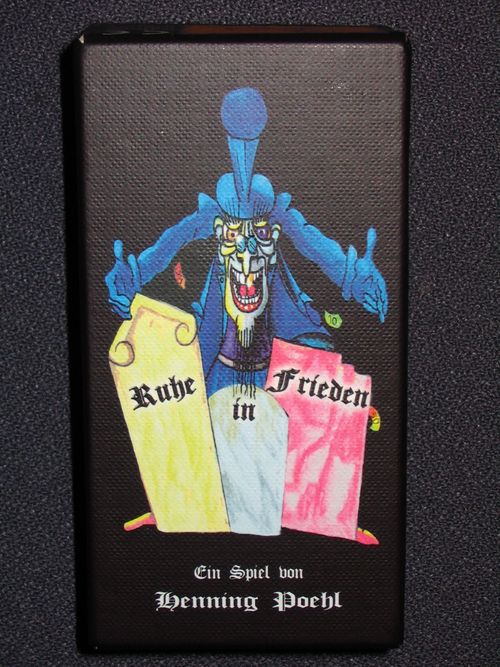
Ruhe in Frieden
Ruhe in Frieden Rulebook
Table of Contents
Table of Contents
Game Material
- 60 cards
- 5 graves
- 5 x 5 shares for the respective graves (Grabrechte)
- 1 x new cemetery (neuer Friedhof)
- 5 x 5 elderly relatives (a set of cards in one of five colors)
- 4 x overview cards
- 12 pills (white plastic chips)
- 10 placebos (black plastic chips)
- 5 bitter pills (red plastic chips)
- 1 pill box
- A lot of demented game money (in 1000 and 3000 denominations "Mäusen")
The sides of the cards which show a gravestone with an epitaph are simply the backs of the cards which otherwise would have only had some boring graphic. These epitaphs have no relation to the play of the game and are only included for entertainment value. They are, however, real epitaphsfound in different cemeteries.
What's It All About?
Things have become tight in the Plüngarden cemetery. Only 5 gravesites are left. Unfortunately, it is the dearest wish of your relatives to be buried in those graves. You can tell which grave each particular relative would like by looking at their cards. However, your relatives are not the only elderly persons in the village. There are many other old people still among the living who also yearn to be buried in those last remaining graves in the cemetery. Thus, your task is to ensure that death catches up with your relatives as quickly as possible in order to prevent one of the other old folks from snatching a grave away from your family. As an aid to that process, you should also be concerned about the health of the other elders and struggle to make sure that they stay as healthy as possible. The player whose relatives are most satisfactorily accommodated in their choice of graves at the end of the game wins.
In this game, only the older relatives that already have specific gravesite desires are represented. The other younger relatives, that do not yet have any specific burial wishes nor any particular interest in the elderly, are irrelevant and, thus, not represented.
Game Set-Up
The 5 gravestones with the numbers on the front are placed face-up side-by-side in the middle of the table. The grave shares are sorted according to the graves they match. Each stack is shuffled separately and placed as a face-down pile above the appropriate grave. The "Neuer Friedhof" ("New Cemetery") card is placed slightly away from these cards where all players can see it. Each player gets a set of cards in one color.
On the front of the cards, the 5 elderly relatives can be seen, while on the back is portrayed the coffin type that each family traditionally prefers. Each player's cards are laid out at the beginning of the game sothat the side of the card which says "etwas unwohl" ("somewhat unwell") is face-up in front of the player. The heads of the persons on the cards are thus all looking to the left and the feet are all pointing to the right.
For each relative, a gravestone with a number is displayed to the left of the head. This is the gravesite into which that relative would like to be buried at the time of his death.
One player is designated to be the banker and distributes the money. Each player then gets 5,000 bucks.
The player who looks the oldest is the start-player. The start-player gets the pill box.
Course of the Game
On his turn, a player executes the following steps one after the other:
- Replenish the pill box
- Distribute pills
- Buy additional pills (optional)
- Buy grave rights (optional)
- Adjust health conditions
- Pass the pill box to the next player
1.) Replenish the pill box
At the beginning of his turn, a player must replenish the pill box of the family doctor, Dr. Tutnichtgut (Dr. Notsogood). The number of pills put into the box depends on the number of living relatives remaining for that player. He puts one white pill into the first compartment of the box for each living relative he still has. He then puts a number of black placebos into the second compartment equal to one less than the number of white pills he added. Finally, he puts one red bitter pill into the third compartment.
Thus, in the first round, each player will get 5 pills (1st compartment), 4 placebos (2nd compartment), and 1 bitter pill (3rd compartment). Once a relative dies, then that player only gets 4 pills (1st compartment), 3 placebos (2nd compartment) and still 1 bitter pill (3rd compartment), etc.
When a player only has one relative left alive, he only gets 1 pill (1st compartment), no placebos (2nd compartment) and still 1 bitter pill (3rd compartment).
2.) Distribute pills
After Dr. Tutnichtgut has replenished his pill box, he makes a house call to each of the relatives since he is very concerned about the condition of their health. In order to fend off the harmful effects of aging, the doctor must distribute a pill during his visit to each relative who doesn't already have a pill or placebo. The pill is placed on the appropriate relative's card. These pills are free since the cost of prescriptions issued by the family doctor is (still) borne by the health insurance company.
Since a pill always has the effect of improving the health of the relative at the end of the turn (see step 5.), a player may not always wish to see the relative get one. Instead, the player may bribe the family doctor and ask him to give one or more of his relatives a placebo instead of a pill. The health of this elder will then worsen at the end of the turn since he has no means to counteract the effects of aging. To do this, the player puts one placebo on the corresponding relative instead of a pill and pays 1,000 bucks to the doctor (that is, the bank).
It is possible that a relative may have already been issued a pill or placebo before the family doctor arrives (see step 3.). In that case, the player may also bribe the family doctor to give one or more of his relatives a pill or placebo instead of the already filled prescription. Since the doctor must first get back from the patient the original prescription before issuing him another, this swap costs a bribe of 2,000 bucks to the family doctor (that is, the bank).
The sequence in which the family doctor visits each individual relative is set by the player of that family. The family doctor visits each relative only once per turn. Relatives that already have a prescription need not be visited. It is only important that each relative have some type of prescription (pill, placebo, or bitter pill) at the end of the turn.
Each prescription swap must be paid for immediately. If a player cannot afford to pay for a prescription, he may not buy it.
The bitter pills: Bitter pills are, on the whole, (at least with regard to cost) treated just like placebos. Dr. Tutnichtgut can only issue the bitter pills (i.e. any old pill that he finds while rummaging about in his medical bag) when he has no more placebos at hand. Thus, a player can only buy a bitter pill when he has already bought and distributed all available placebos. He can provide his own relative with a bitter pill only when he has already provided all the others with normal placebos. The effect of the bitter pill is even more fatal than that of the placebos (see step 5.)
3.) Buy additional pills
After the family doctor has completed his rounds making prescriptions to his relatives, a player may now buy additional pills from those remaining in the pill box.
Each type of prescription (pill, placebo or bitter pill) costs 1,000 bucks.
Bitter pills may still not be purchased, however, unless all available placebos are gone.
Each prescription must be paid for at the time of purchase and is distributed to the members of other families. So that players can later tell which prescriptions they placed on their own relatives and which were placed by other players, those placed by other players should be placed on the edge of the card, half on and half off.
Buying additional pills is an optional action and need not be executed.
4.) Buy grave rights
Now the player may acquire rights to a gravesite by purchasing grave shares cards.
Grave shares for unoccupied gravesites cost 3,000 bucks and grave shares for occupied gravesites cost 1,000 bucks.
A player who buys a grave share must immediately pay the money to the bank and then lays the card face-up in front of himself so that all players can see how many shares he possesses to each gravesite.
Grave shares cards have two sides. A document certifying a normal share to a gravesite is shown on the front. These certificates are required when you wish to bury a newly deceased relative in a grave in the normal manner.
The back of the grave shares cards shows different actions which can be used to annoy the other players. Because of these actions, it still makes sense to spend the 1,000 bucks to buy grave shares cards for graves that are already occupied. The actions on the backs of the cards are reviewed in detail in the appendix at the end of these rules.
Only one side of a grave card may be used, i.e. if you use the burial certificate, you may no longer use the action on the back. Alternatively, if you use the action on the back, you may not use the burial certificate on the front.
Buying grave rights is an optional action and need not be executed.
5.) Adjust health conditions
Now the player must adjust the health condition of his relatives according to the pills lying on their cards.
If a relative has a white pill, its health improves (if it is already in "Top Fit" ("Tip Top Health") then no further improvement is possible). The card is rotated 90° clockwise. If a money payout is indicated for the newly achieved health condition, the player gets this amount from the bank.
Players only get money payouts for relatives whose health just improved; that is, the card was just turned clockwise. If the card cannot be rotated because the relative is already in "Top Fit" ("Tip Top Health), then no money is paid out!
If a relative has a placebo, its health worsens. The card is rotated 90° counterclockwise. When a relative's health worsens, there is never any money paid, even if there is a payout amount indicated.
Tip: As soon as you rotate the card, you should remove the prescription from the card and place it directly above the card so that you can tell which cards have already been rotated and in which direction.
Once the health condition of all that player's relatives has been adjusted, the pills are returned to the stock.
When a card which is supposed to be rotated counterclockwise is already in the "dem Tode nahe!" ("Death draws near!") position, then that relative dies. That card is now turned over so that the coffin (on the back) is visible. The coffin displays a sign or similar symbol indicating which grave the deceased wished to be buried in (this is used for scoring at the end of the game).
You now inherit 2,000 bucks, the final fortune of your deceased relative (amazingly enough, the inheritance is always the same amount).
Bury deceased relatives
The body of the deceased must be buried immediately. You can bury the deceased regularly or irregularly.
For a regular burial, you arrange for the placement of the coffin in an empty grave through the use of grave shares. For a regular burial, you must have the most grave rights (most grave shares cards currently in play) for a grave. If you don't have the most grave rights for a grave, you may not place the deceased in a grave. If you have the most rights to a grave, then you may inter the deceased in the corresponding grave, regardless of whether it is the grave where the deceased relative wished to be buried. The card displaying the coffin is placed below the appropriate gravestone so that the players can easily see which grave is occupied by whom.
All grave shares cards for that grave held by the burying player are then removed from the game. The other players may keep the grave shares cards they hold for that grave and play them later as appropriate.
If you don't want to bury your recently deceased relative in a grave for which you hold the most shares or if you don't hold the most shares to any grave at the time of death, then you must bury your dead relative in the New Cemetery. The coffin is placed below the "Neuer Friedhof" ("New Cemetery") card.
For an irregular burial, you arrange for placement of the coffin into an occupied grave. No grave rights are required to do this. Irregular burials may only accomplished by use of the "Doppelbelegung" ("Double Occupancy") card.
Multiple deaths
If more than one relative belonging to the same player dies in a turn, he may choose the order in which they are buried. If any deaths of other players' relatives occur by "Schock" ("Shock") (see the card explanations in the appendix) during an interment, those burials are dealt with in clockwise order from the current player after he has finished his burials.
6.) Pass the pill box to the next player
When a player has finished his turn, he passes the pill box to the player on his left, who now starts his turn.
End of the Game and Scoring
The game ends as soon as all graves have been occupied or all the relatives of any one player have died. The current active player still completes his turn as normal. Deaths for other players that occur during the last turn through Shock, as well as all cards played by other players, are still resolved normally.
Note: If the last grave becomes vacant again through play of a Verwechslung (Mix-up) played with a Doppelbelegung (Double Occupancy), then the game continues until the last grave is finally occupied.
Scoring is as follows:
- A relative lies in the grave of his choice: +5
- A relative lies in a grave adjacent to the grave of his choice: +4
- A relative lies in another grave in the cemetery: +3
- A relative lies in the new cemetery: +2
- Any still living family-member (still lying face-up in front of the player): -2
Appendix (Explanation of the Cards)
This part need not be read before the first game but should rather bereviewed during the game as needed.
The Relatives
Each relative has a unique combination of values.
For example, this relative pays:
- 1,000, if his condition improves from "schwach" ("weak") to "etwas unwohl" ("somewhat unwell").
- 2,000, if his condition improves from "etwas unwohl" ("somewhat unwell") to "top fit" ("tip top health").
He would like to be buried in grave #4.
The Backs of the Grave Shares
There are 5 grave shares cards for each grave, yielding 5 different possible actions. With exception of the "Unleserliches Dokument" ("Illegible Document") card, these cards may only be played on the grave for which they also act as a grave share. Also, they may only be played there when the grave is occupied. When and if they are played is always up to the owner.
The actions on the grave shares cards may be played by anyone at anytime so long as the conditions described on the card are met.
If several cards are played one right after the other, then the cards are resolved in the sequence in which they were played. Chain reactions can thus develop, which is intended by game design.
Note that graves 1 and 5 have only a single adjacent grave.
Cards may be played at any time, including on another player's turn, once the corresponding grave is occupied. The effects of the cards are applied immediately.
Doppelbelegung (Double Occupancy)
The text of the card: You may play this card only if the corresponding grave is already occupied. When you play this card, you may put one of your newly deceased relatives into the appropriate already occupied grave. You don't need any grave shares for that grave to do this.
Aditional explanation: On a "Dark & Foggy Night" you arrange to place one of your dear relatives in his desired grave, more or less.
This card allows you to place a deceased relative in an occupied grave. The occupied grave must be the grave corresponding to this card. You may not use this card to arrange a burial in an empty grave.
No grave shares are required when using a Doppelbelegung since it does not constitute a regular burial.
This card can be used together with the "Verwechslung" ("Mix-up") card.
Verwechslung (Mix-up)
The text of the card: You may play this card only if the corresponding grave is already occupied. Put the deceased relative currently occupying this grave into another vacant grave of your choice in the same cemetery. You don't need any grave shares for the new grave to do this.
The Mix-up can also be combined with a Double Occupancy in order to relocate a deceased relative into an already occupied grave.
Aditional explanation: At some time after the burial, it is determined by the gravedigger that he had made an error in the location of the "hole" and that the relative was inadvertently buried in the wrong grave.
You can use this card to remove a coffin from the grave to which this card corresponds and place it into any other unoccupied grave in the cemetery. No grave rights (that is, no grave shares cards) are needed for the grave into which the relocated coffin is placed. If the grave from which the coffin is to be removed is currently "Double Occupied", then you may freely choose which coffin should be removed.
If a grave is made vacant through use of a Verwechslung (Mix-up), it may subsequently be occupied in the same turn through a regular burial.
The Verwechslung (Mix-up) can be combined with a Doppelbelegung (Double Occupancy) in order to place a coffin into an already occupied grave. The Verwechslung (Mix-up) must correspond to the grave from which the coffin is removed and the Doppelbelegung (Double Occupancy) must correspond to the grave into which the coffin will be relocated.
If there are no unoccupied graves (only possible in the last turn) and you don't also have a Doppelbelegung (Double Occupancy) card to play at the same time, then you may not play this card.
Schock (Shock)
The text of the card: You may play this card only if the corresponding grave is already occupied. When you play this card, you worsen the health condition of your relative who wanted to be buried in the now occupied grave by two levels (two counterclockwise turns).
Aditional explanation: With this blow, all hope of eternal rest in your desired grave fades. Your relative that would have liked to have been interred in the grave to which this card corresponds, suffers a heavy shock to his system because his desired grave has been occupied by another. When you play this card, his health condition immediately worsens drastically (by two steps).
Relatives that are already in a "schwach" ("weak") or "dem Tode nahe" ("Death draws near") condition, die immediately when affected by this card.
Grabpflege (Grave Maintenance)
The text of the card: You may play this card only if the corresponding grave is already occupied. When you play this card, the player whose relative is occupying this grave must pay you 2,000 bucks for grave maintenance. If the grave is double occupied, then you collect double fees (i.e. 4,000 total) from the appropriate player or players.
Aditional explanation: You have looked after this gravesite for years so that one of your relatives might realize their desire to be buried here but now a stranger lies in his place. Therefore, either his family pays you for your efforts or you will lay it waste.
Every player who has a relative lying in the grave to which this card corresponds must immediately pay 2,000 bucks to the person who plays this card. Players who have no money do not pay anything.
Unleserliches Dokument (Illegible Document)
The text of the card: Instead of using this card as a grave share for the corresponding grave, you may instead play it as a grave share for any one other grave. The card is then removed from the game, even if you were not successful in your attempt to assert a claim to the grave.
Aditional explanation: You have acquired a rather illegible grave share. The crucial statements are so unclear that they could easily be applied to any unoccupied grave. You can play this card in order to execute a regular burial or to prevent a regular burial.
Example: Paul and Dagmar both have two grave shares for grave #2. It is Paul's turn and, thanks to a bitter pill that has been prescribed to him by an opponent, his relative that wanted to be buried in grave #3 has died. Since Paul has no grave shares cards for grave #3, he decides to inter his deceased relative in the adjacent grave #2.
He says: "I bury my deceased in grave #2 since, with my Unleserliches Dokument (Illegible document), I now have the most grave shares for grave #2." He then turns over the Unleserliches Dokument (the back of a grave share for grave #1).
"Hold on! "says Dagmar and turns over his own Unleserliches Dokument (the back of a grave share for grave #5). Now Paul and Dagmar have an equal number of grave shares for grave #2 again. Now that he does not have the most grave shares for any grave, Paul cannot arrange his desired burial and must instead place his relative in the "Neuer Friedhof" ("New Cemetery") by placing the coffin under that card.
The results of the two players' actions.
Overview Card
1.) Replenish the pill box: For each living relative add one white pill, one fewer black placebos, and always 1 red bitter pill.
2.) Distribute pills: Each relative gets a prescription of your choice. Pills are free. Placebos and bitter pills cost 1,000 bucks. Swapping existing prescriptions costs 2,000 bucks.
3.) Buy pills: Buy as many pills as you wish in order to make the other families' relatives happy... Each prescription costs 1,000 bucks.
4.) Buy grave rights: Buy as many different grave shares as you wish but no more than 1 per grave per turn.
5.) Adjust health conditions: Adjust the health condition of your relatives according to the type of prescription lying on their card.
- Pill: rotate the card clockwise – get a money payout according to the instructions on the card.
- Placebo: rotate the card counterclockwise - no money payout.
- Bitter pill: rotate the card counterclockwise twice - no money payout.
6.) Pass the pill box to the next player
Background for the Game
I got the idea for this game from the film "Rosanna's letzer Wille" (literally "Rosanna's Last Will", released as "For the Love of Roseanna" in the USA)". A very beautiful black romantic comedy with Jean Reno, who became well-known for "Léon - Der Profi" (The Professional" in the USA), in the male lead.
In the film, trattoria owner, Marcello, loves his wife, Rosanna, more than anything Rosanna is - or at least so Marcello believes - fatally ill and it is her last wish to be buried in the cemetery of the small Italian village of Trivento.
For love of his wife, he vows to do everything in his power to satisfy her final wish. This soon turns out, however, to be an extremely difficult venture, since there are only three vacant gravesites remaining in the cemetery. Marcello thus has to do everything he can to keep his friends and neighbors alive.
It quickly became clear to me during the film that this subject would make an outstanding concept for a game. Now, the completed game has little in common with the film besides the basic subject. It should be viewed with the same affectionate black humor as the film, however, which I can recommend to everyone most warmly, like this game.