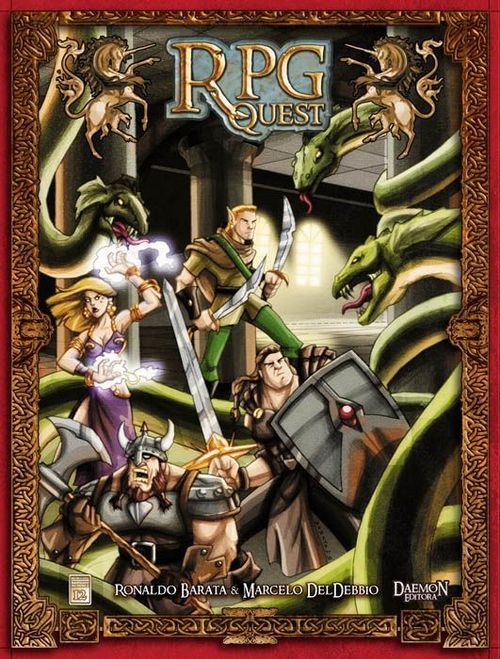
RPGQuest
RPGQuest Rulebook
Table of Contents
Table of Contents
- Introdução
- Conceitos Básicos (Basic Concepts)
- A Ficha de Personagem (The Character Sheet)
- Criação de Personagem (Character Creation)
- Etapas (Steps)
- Escala de Atributos, Perícias e Habilidades (Scale of Attributes, Skills and Abilities)
- Local de Origem da Campanha (Campaign Origin Location)
- O Questionário (The Questionnaire)
- Pontos de Criação de Personagens (Character Creation Points)
- Raças (Races)
- Sexo (Sex)
- Descrição Física (Physical Description)
- Classes
- Habilidades (Abilities)
- Atributos (Attributes) — creation
- Atributos (Attributes)
- Perícias (Skills)
- Riquezas e Dinheiro (Wealth and Money)
- Regras e Testes (Rules and Tests)
- Experiência (Experience)
Introdução
Welcome to the World of Imagination.
Role-playing games (RPG) are storytelling games in which you and your friends play out great adventures, taking on the roles of Heroes in a world full of emotion and lost treasures. The RPG appeared in 1974 as a mixture of theatre and board games, and was quickly adopted by teachers and parents as an important teaching tool, because it develops imagination and the social life of its participants. Today it is used in many schools as a teaching aid and is played by thousands of people around the world.
In an RPG, the participants write a story together, each one collaborating to make the experience more enjoyable and interactive, playing Characters and narrators.
O que faz de RPGQuest um jogo diferente? (What makes RPGQuest a different game?)
RPGs (Role Playing Games) are games designed to develop the imagination and creativity of their participants. RPGQuest is a mixture of a board game with a role-playing game, serving as a gateway into this remarkable hobby.
The RPGQuest game mechanics encourage Players to create and develop their own ideas, instead of using the book as "Immutable Rules". The descriptions of rules, spells, rituals, monsters and races are short and objective, deliberately leaving room for the Game Master and the Players to add their own elements to their own game worlds and adapt the RPG to the specific needs of each campaign.
For example, when we describe a race, this book gives only the essentials that are usually standard for that race in the Multiverse, but EACH Game Master should work together with the authors of this book to adjust the races they want to their needs. The same applies to Classes and Abilities.
Imagine that the Game Master has decided that in their game world there are 7 subraces of dwarves, each tied to a skin tone associated with one of the colours of the rainbow. So in this campaign setting, there are dwarves with reddish skin (the most savage), orange (the Caucasian skin tone), yellow (dwarves with Oriental features), greenish (dwarves who live in the forests...), bluish (dwarves who live in the ice), indigo (the dwarves who live underground) and violet (the dwarves who deal with magic).
The basic rules for the "dwarf" race can be found in this book, but the Game Master is ALWAYS invited to go deeper and detail these races according to their own world.
The authors of Daemon Editora have always believed that the best and most enjoyable feature of the RPG is developing the imagination and mental visualisation of its readers. For this reason, this approach was chosen for what is by far the most complete and organised Core Module in the history of the RPG. Within this premise, the rules have been expanded so that you can go well beyond what is presented here, using these races as parameters to create your own races, classes, spells, rituals, monsters and civilisations, using elements of cultures that already exist or of cultures you will create yourself.
The rules are designed to be simple and easy to understand from an explanatory point of view, but complete from a practical point of view. In this way, the Game Master and the Players are invited to explore more of the descriptive and narrative aspects of their Characters, instead of simply spending hours looking for mathematical bonuses and Characters without any coherence!
Preparação (Preparation)
One Player must take on the role of Game Master. The other participants take on the roles of the heroes. You will need at least two or three friends to start, and at most eight or nine, so as not to lose control of the narrative.
The role of Game Master is vital to the game, because it is the Game Master who controls the monsters and traps, like a Game Master in any RPG, describing the situations and doing the voices and sound effects to make the adventure even more exciting. Only the Game Master knows where the traps, monsters and treasures of the adventure are.
Suggestion: if you are the owner of the game and have invited your friends to play, then it is better for you to be the Game Master the first few times.
Primeiras providências (First steps)
The first thing you should do is get pencils and paper for all participants. In RPG you do not need much more than pencils, paper, some dice and a lot of imagination.
Criando a Campanha (Creating the Campaign)
The Game Master must define what kind of Plane the campaign will start in (their own medieval world? a world with Greek characteristics? a world made of flying cities in the clouds? an underground kingdom? or all of the above?).
Once the type of Campaign has been defined, the Game Master decides which Races, Classes and Abilities will be allowed in their campaign. Within these limits, the Players begin to create their Characters, following the rules in this Book. Together they will form a team that begins the Campaign.
Creating Characters is quick and simple. Perhaps the biggest problem you will have is choosing what to play, from so many options that we provide...
Conceitos Básicos (Basic Concepts)
As in any game, it is necessary to know the rules and the terms used in order to play. RPGQuest is no exception. During the game, or even when you are creating your Character, we will use many terms with which you may not be familiar. The terms used in the magic and combat systems are also dealt with in this chapter.
Personagem (Character)
Before starting to play, each Player needs to create a Character, which is the representation of this Player in the fictional world of RPGQuest. During play, the Character performs the actions proposed by the Player. A Character does not roll the dice or consult the tables, in the same way that the Player will not jump out of the window or fight a vampire.
Ficha de Personagem (Character Sheet)
A form on which the characteristics of each Character are recorded. The Character sheet is found at the end of this book. It should NOT be filled in; each Player should make a photocopy of the sheet for their own use.
Mestre ou Narrador (Game Master or Narrator)
The Player who is responsible for the rules of the game. A kind of director or coordinator of the game. It is their job to control all the other Characters who are not controlled by the Players (see NPCs) and to create and run the Adventures. Much of an Adventure's success depends on them. During a session, it is the Game Master who proposes a problem or a mystery that the Players will try to solve.
Aventura (Adventure)
A story created by the Game Master, containing a problem to be solved by the Players. An Adventure can be short, ending in two or three hours, or very long, requiring successive game sessions. In theory, an Adventure could last forever.
Campanha (Campaign)
A succession of Adventures, involving the saga of the Characters, from the first session onwards.
NPCs
The Game Master's Characters. Also called PdM (Personagem do Mestre). Characters who are controlled by the Game Master. NPCs usually serve as supporting Characters in the Adventures.
Dados (Dice)
In RPGs, several types of dice are normally used. In RPGQuest we use only six-sided dice. The notations used are 1d6, 1d3 and 1d2. Rolling 1d3 is not a roll of a three-sided die, but the roll of a six-sided die divided by two and rounded up (that is, 1 and 2 count as "1", 3 and 4 count as "2", and 5 and 6 count as "3"). A 1d2 works the same way (1, 2 and 3 count as "1", 4, 5 and 6 count as "2"). 2d6 means rolling two six-sided dice and adding the results.
Atributos (Attributes)
Attributes work as a way of transporting a Character into the fictional world and establishing comparisons between them and the various creatures. It is the Attributes that describe your Character as they are. There are 8 of them, divided into physical and mental. The physical Attributes are Constitution, Strength, Dexterity and Agility; the mental Attributes are Intelligence, Willpower, Perception and Charisma. Attributes vary according to their Grades, from Pitiful [-3] to Divine [+20].
Raça (Race)
In a fantasy universe there are many strange and wonderful races that do not exist in the real world. In RPGQuest you can play Elves, Dwarves, Goblins and many other kinds of creatures, each with different powers and abilities. The Game Master must authorise all the races they want in their campaign. If the Game Master does not authorise the use of a particular race, it will not exist in their game world.
Classe (Class)
A set of Abilities and Skills that define a profession. Each Player must choose, when creating the Character, which Class the Character will belong to, and cannot change it later. The Game Master must authorise all the Classes they want in their Campaign. If the Game Master does not authorise the use of a particular Class, it will not exist in their game world.
Perícia (Skill)
Determines what your Character knows how to do. They may know how to use a sword, or be an excellent carpenter. It is the Skill that says how good the Character is at a particular profession. Skills are represented in Grades ranging from Absent [0] to Divine [+20].
Habilidades (Abilities)
Features that make your Hero unique and special. They are chosen during Character Creation and include mundane, mystical and supernatural Abilities, even serving to determine specific types of Classes within the game.
Perícia com armas (Weapon Skill)
Determines how well your Character knows how to fight with a weapon. Together with Dexterity, it defines the Hero's Attack. Weapon Skills are divided into Grades, from Pitiful [-3] to Divine [+20].
Magias e Rituais (Spells and Rituals)
The magical powers in RPGQuest are divided into two types: Spells and Rituals.
Spells are the more elementary ways of dealing with mystical forces, generating bursts of pure energy based on the 6 elements (Fire, Water, Air, Earth, Light and Darkness). Spells create fireballs, gusts of wind, stones, rays of light or forces of darkness, which are used to cause damage to opponents.
Rituals are more delicate forms, dealing with conjurations, creations, protective shields, divinations, enchantments, distillations, transmutations and other more complex magics. To be able to perform a Ritual, the mystic must have the Ritual written in a Grimoire.
Rituais Divinos e Arkanos (Divine and Arkane Rituals)
There are two types of Rituals in RPGQuest: the Divine are the Rituals performed by Priests in the service of a god, and the Arkane are the Rituals performed by Mages, Warlocks or Sorcerers.
Pontos de Magia (Magic Points)
The "fuel" a mystical Character possesses, indicating how much Magic they are capable of performing. The more points a Mage or Warlock Character has, the more powerful they are. Characters who are not mystics have no Magic Points.
Caminhos de Magia (Paths of Magic)
Divisions of Magic that a mystic can choose to learn. There are 6 Elemental Paths of Magic: Fire, Water, Air, Earth, Light and Darkness.
Ponto de Focus (Focus Point)
Focus is the unit that indicates how advanced a mystic is in a given Path. The more Focus Points a mystic has, the greater their powers in that Path.
Poderes (Powers)
Psiônicos (Psionics)
Another type of power a Character may possess, this time linked to the Mental Plane. These are powers developed from the mind, such as the ability to lift objects into the air using thought, among others.
Pontos de Vida, ou PV (Hit Points, or HP)
Represents the "energy" a Character possesses. The more HP a Character has, the harder they are to kill. Human Characters usually have between 12 and 20 hit points. A Character recovers 1 HP per day of complete rest, or 1d3 if lying in a bed under medical care.
Dano (Damage)
When a Character is wounded and loses Hit Points, we say that they have taken damage. When a Character's HP reach 0 (or fewer), they fall unconscious and must roll on a table to see how serious the blow was, and may even die.
Rodada (Round)
A measure of time equal to approximately 10 seconds. It is used to mark time during Adventures. It is an abstract measure used only by the Game Master and Players, sufficient for every Character to perform one action.
Cena (Scene)
A measure of time that is not fixed. As in a film, it takes as long as necessary for the narrative of a "scene". It may take from 3 to 18 rounds (30 seconds to 3 minutes), or up to five or six minutes. When necessary, consider that a Scene lasts 3d6 rounds.
Teste (Test)
In every RPG, Characters make Tests to check whether they managed to open a locked door, whether they found the book they were looking for in the library, or to find out which weapon killed the body they are investigating. This is called a Test. Tests are made by rolling 2d6 + the Grade of the related Skill/Attribute/Ability and comparing the result with a specific value (which may be the result of another dice roll). If the total rolled is equal to or greater than that value, the Character has Passed the Test.
Teste Resistido (Opposed Test)
Tests in which the success or failure of the action depends not only on the Character's Skills or Abilities, but also on the Skill or Attribute of whatever is opposing them. Opposed Tests can be of several kinds: Attribute x Attribute, Skill x Skill, Attribute x Skill, Attribute x Spell, Skill x Spell, Poisons x Resistance, and so on.
Nível de Dificuldade (Difficulty Level)
Some actions are harder (or easier) to carry out than others. To reflect this variation the Game Master may impose Difficulty Levels on Tests. This value is tested against the Character's Ability/Skill (rolling 2d6 + bonus). The values are: 4 (Very Easy), 6 (Easy), 8 (Normal), 10 (Hard), 12 (Very Hard) and 14 (Superhuman).
Acerto Crítico (Critical Hit)
In RPGQuest, a natural roll of "12" (6+6) is considered a Critical Hit and will always hit the target, regardless of the difficulty or the value needed to pass the Test.
Falha Crítica (Critical Failure)
On the other hand, a natural "2" (1+1) is always considered a failure, no matter what bonuses there are or how easy the task is.
IP (Índice de Proteção, Protection Index)
The "armour" your Character is wearing. It can be medieval armour, a bulletproof vest or an energy shield. Each IP protects against one or more specific types of damage (bludgeoning, gunfire, electricity, fire, ice, acid, gases, etc.).
Pontos de Experiência (Experience Points)
Points that each Player receives at the end of each adventure or story arc, representing the life experience the Character has gained over the course of this Campaign, becoming wiser and more experienced. These points are used to improve Skills and Abilities, to acquire new Spells, Rituals, strategies and Class Features.
Regra de Ouro (Golden Rule)
You may add, change or remove any rule you wish, so that your game is the way you like it.
A Ficha de Personagem (The Character Sheet)
Descrição (Description)
Here you will record details such as the name, race, class, sex, height, weight, hair, eye and skin colour, the deities the Character worships, and the Plane of origin.
Atributos (Attributes)
The rules for Attributes can be found in the Attributes chapter, page 86. Racial modifiers are in the Races chapter, page 14.
Combate (Combat)
A summary of the values most used by the Character in combat.
Perícias com Armas (Weapon Skills)
For descriptions of the Skills, see page 88. For details of weapons, see the Equipment chapter.
Perícias (Skills)
The rules for Skills can be found in the Skills chapter, page 88.
Armaduras e Escudos (Armour and Shields)
See the Equipment chapter for details on the IP of shields and armour.
Rituais, magias e PSI (Rituals, Spells and PSI)
Each of these Abilities has its own chapter of rules.
Habilidades (Abilities)
Rules and descriptions of the Abilities can be found on page 54.
Criação de Personagem (Character Creation)
This book includes several ready-made Character sheets, but Players may feel free to create new heroes for their Campaigns, to personalise their Adventures. To create a new Character, just follow these simple steps and, in a few minutes, a brand-new Hero will emerge to defend Arcádia from the Forces of Evil.
Etapas (Steps)
- Choose the Campaign's Origin Location.
- Answer the Character Questionnaire.
- Choose the Character's Race and Class.
- Distribute the Attribute Points.
- Choose the Extra Skills.
- Choose Equipment and Weapons.
Escala de Atributos, Perícias e Habilidades (Scale of Attributes, Skills and Abilities)
RPGQuest is one of the most practical and quick role-playing systems there are. It favours the act of telling stories instead of wasting time on bonuses and elaborate mathematical formulas. The purpose of the RPG is to have fun. To measure the powers of Characters, we use a single table that applies to all Abilities, Attributes, Skills and Powers. The scale below is used to compare Characters and their Abilities in the dice roll.
All Tests are made using 2d6, which are rolled, added to the bonus of the Grade and compared with the Difficulty to determine whether the action was carried out.
Grade table (Tabela de Graduações)
| Grade | Bonus |
|---|---|
| Lamentável (Lamentable) | -3 |
| Patético (Pathetic) | -2 |
| Muito Fraco (Very Weak) | -1 |
| Fraco (Weak) | 0 |
| Normal (Normal) | +1 |
| Bom (Good) | +2 |
| Ótimo (Great) | +3 |
| Incrível (Incredible) | +4 |
| Superior (Superior) | +5 |
| Heróico (Heroic) | +6 |
| Lendário (Legendary) | +7 |
| Espetacular (Spectacular) | +8 |
Local de Origem da Campanha (Campaign Origin Location)
The first thing a Game Master must choose to start their Campaign is the Origin Location where it will begin. This will be the "base of operations" of the Campaign, the first place the Game Master will concern themselves with detailing, and the starting point of the story that they wish to tell together in the RPG.
With it, the Game Master can calculate the cost of acquiring certain Races and Classes for the Players.
The Origin Locations available are the following:
- Afrika: one of the oldest continents of Arcádia, land of the central plains, the savannahs and impenetrable forests. Afrika is the universe of African mythology, with secular tribes, lost gold mines and a range of fantastic animals and creatures.
- Bretanha (Britain): the lands of Avalon and Camelot. It represents mythical England, with Camelot as its capital. Its domains extend from the legendary Loch Ness, to the north in the Highlands, to the stone temples of Stonehenge, to the south.
- Egito (Egypt): the Golden Lands of Rá. Known for their gigantic pyramids and for their villages and temples arranged along the mythical River Nile. Some of the most important cities of Arcádia, such as Alexandria and Cairo, are located in these kingdoms.
- Germania: the territory of war. Covered by dense subtropical forests, Germania is the stage for the eternal war between the orcs and Prussian goblinoids allied with Halzazee and the Arcadians, in a universe similar to that of the First World War, but with magic and fantastic steam-powered machines.
- Halzazee: kingdoms bordering Hell, home of the evil demons, orcs, goblinoids and all the dark creatures of Arcádia. They are devastated lands, inhabited by witches, undead and every kind of evil creature. Imprisoned in these dark lands, medieval villages in the style of Eastern Europe try to survive under the domains of the lords of chaos.
- Hi-Brazil: the Promised Land. With geography identical to that of the South American continent, Hi-Brazil is a continent of many opportunities and many fantastic races, perhaps one of the most interesting in the whole Multiverse.
- Índia (India): also one of the most ancient civilisations of the Multiverse. India is covered by tropical forests, where stone cities of the Lemurian Period rest, protected by their gods and many-armed monsters. Some of the wisest races of the Multiverse were created in this kingdom.
O Questionário (The Questionnaire)
To better compose a Character, you may answer the following questions and note the answers in a diary, which will serve as the basis for defining the Character's Attributes later. These questions are NOT mandatory and should only be used if the Player wishes to have a well-built Character.
Unlike other RPGs, which lose much time focusing on bonus after bonus, RPGQuest sets out to be an exercise of imagination and concentrates on well-built Characters and exciting stories.
História (History)
- What is their name?
- What is their race?
- In what year were they born? How old are they?
- Where were they born and raised?
- Did they know their parents? How do they feel about them?
- Are their parents alive?
- How do their parents live?
- Do they have brothers or sisters?
- If so, do they know where they are and what they are doing? (valid for other kinds of relatives too)
- Did their family take part in the start of their adventuring career? If not, who did, and how?
- Did they have friends in their youth?
- Are they married (or engaged? or widowed?...)? If so, how did it happen?
- Do they have children? If so, what are they like?
- What did they do before becoming an adventurer?
- How might this affect their career as an adventurer?
- Why did they become an adventurer?
- What is their god (or gods) of worship?
Creating a home town and relatives and friends for the Character, although somewhat laborious, will greatly help the Game Master develop ideas for future Adventures, since they can always use these hooks to create events for the group to help resolve. It need not be an Adventure involving combat; for example, it may request the help of the Adventurers to defend a castle that an uncle is building, protect the fleet of a brother or cousin who is being attacked by pirates, investigate the life of a suitor for a sister without arousing her suspicion, resolve a family quarrel, and other Adventures which can be very enjoyable without necessarily involving violence.
The better the description of your Character's past, the greater the quality of the Campaign.
Amigos (Friends)
- Who are their best friends?
- How did they meet them? What do they do in life?
- Describe them in a few words.
- Do they have families? Children?
Objetivos / Motivação (Goals / Motivation)
- Does the Character have any goal? If so, what is it?
- And why do they try to do this?
- What will they do when they achieve their goal?
- What will they do if they fail?
- What do they consider their greatest obstacle?
- What do they do to overcome that obstacle?
- If they could change something in the world, what would they change?
- If they could change something about themselves, what would it be?
- Are they afraid of anything?
Personalidade (Personality)
- How do other Characters describe your Character?
- How would they describe themselves?
- What is their greatest quality?
- What is their greatest flaw?
Here we enter the more psychological aspects of the Character, which may be developed if the Game Master or Players ever wish to write a short story or novel based on their Heroes' Adventures. Know that the greatest and most interesting Characters in fiction are those with a well-developed history. Nobody will remember a "John of many bonuses", but everyone will surely laugh at the Adventures of a Hero who has human traits... virtues and defects like everyone else. And weaknesses too. If even Indiana Jones was afraid of snakes, why can your Character not have a weakness or a soft spot?
Aparência (Appearance)
- What are they like physically (in detail)?
- What is the most distinctive or most easily noticed aspect of their physical appearance?
- Are they satisfied with this appearance?
- What would they change if they could?
- How do they like to dress?
Atitude (Attitude)
- What is their attitude towards the world?
- And towards the other Characters?
- Do they have different attitudes towards certain groups of Characters or professions?
- What is their view of the gods?
An Adventurer's appearance is a very enjoyable factor for creating good stories. Even physical defects can be turned into a source of inspiration that creates memorable Characters (like the gigantic nose of Cyrano de Bergerac or the belly of Sancho Panza). A Character's manner of dress can say a great deal about what they think or how they act.
Do they have refined tastes? Do they use only the good and the best? That could generate ideas for funny adventures in which the Character must survive in disguise in a crude and dirty goblinoid village. What would their reaction be? Are they a troglodyte barbarian? How would they prepare for the royal ball held in honour of the Adventurers for having saved the kingdom from the red dragon? Does your Character hate dwarves? And what if the only healer in the whole Valley of Namir who has the healing potion for the disease killing the Character's sister is a dwarf? How would your Character react?
Gostos e preferências (Likes and Preferences)
- How do they spend their leisure hours?
- What do they like to wear?
- What do they like most about their work / occupation?
- What do they like to eat?
- Do they collect anything or have any hobby?
- Do they have a pet?
- What kind of company do they prefer?
- And what kind of lover?
- Do they have any dreams?
- Do they like to travel? Do they prefer the sea or the mountains?
- Do they prefer cities or wilder places?
Ambiente (Environment)
- Where do they live and what is that place like?
- What is the climate like?
- Why do they live there?
- What are the common problems there?
- What is their daily routine?
- Is there anything they left behind?
Detalhes da história (Story Details)
Do this part of the work together with the Game Master, since much of what is chosen here will be used by them as background for the Adventure later. Try to fit your Character's story with those of the other Characters in the Campaign, with the plot created by the Game Master and with the other NPCs. If the stories of ALL the Characters in the group are not compatible, start again. Your Character's story must be consistent with the world structured by the Game Master.
Pontos de Criação de Personagens (Character Creation Points)
The Game Master will determine how many Character Creation Points each type of Campaign will allow. The fewer Creation Points, the more realistic the campaign; the more Creation Points, the more fantastic it will be.
Creation Points are spent to buy Races, Classes and Improvements, both individual and for the group.
| Type | Points |
|---|---|
| Realistic (Realista) | 6 |
| Medieval Fantasy (Fantasia Medieval) | 8 |
| Fantastic (Fantástica) | 10 |
Beyond the point total, the Game Master decides whether or not to allow the choice of Races and Classes that do not belong to the Campaign's Location. They may decide that only Races and Classes belonging to the Campaign Location are authorised, OR may authorise the choice of Races and Classes from other universes at an additional cost of +2.
Note: the Campaign's Origin Location may change over the course of the Campaign itself. If a group starts the game in Nova Arcádia, nothing prevents an Adventure from taking them to the Jade Kingdoms, where they may meet a new member of the group. In that case, the point totals for choosing the Race and Class of this new group member are different!
Raças (Races)
Once the starting location of the Campaign has been set, the Player may choose a race from among those available for the game. The Races chapter presents about 80 different Races out of the thousands that exist in the Multiverse. [Not transcribed; see the Scope note in the Table of Contents.]
Each Race has a cost in Character Creation Points. This cost reflects the special Abilities of each Race, balanced against the specific Weaknesses of each Race as well. In addition, there is a Rarity cost. Choosing a Race that does not belong to a given Plane incurs an additional +2 points.
Worked example (the Race costs quoted are those of the book's illustrative examples): with 8 Creation Points and Nova Arcádia as the origin, one Player wants a Gnome (4 points). Another, with 8 points, chooses an Elf (4 points). A Player who wants a Nezumi (3 points) from the Jade Kingdoms pays 5 points, since it is not a native race of Nova Arcádia. A Player who wants a Scorpion-Folk (4 points) pays 6 points for the same reason. A Human costs 1 point.
Sexo (Sex)
A Character may be male or female. There are no differences in terms of play, except for some Races (Amazons, Fauns, Nymphs...) that allow only Characters of a specific sex. Most Classes and Abilities may be chosen by either sex.
Descrição Física (Physical Description)
The Players then note on their Character sheets the physical descriptions of each of their Characters, describing what each of them looks like. (The book illustrates this with example Characters; those narrative descriptions are not transcribed.)
Classes
Again, according to the Campaign's Origin Location, the Player must choose one (or more) Class for their Character. In this book we provide approximately 110 different Character Classes to choose from. [Not transcribed; see the Scope note in the Table of Contents.]
As with Races, Classes also have a cost in Character Creation Points, reflecting the Special Abilities, Skills, Weapon Skills, Hit Points and Special Powers of each Class. Again, there is a Rarity cost. Choosing a Class that does not normally belong to a given Plane incurs an additional +2 points.
Worked example: a Gnome with 8 points who takes the Bard Class (4 points) has 4 points left over. An Elf who takes the Bounty Hunter Class (3 points) has 1 point left over. A Nezumi Cleric of the god Oghma (Celtic) costs 3 points, leaving the 8 points spent in full. A Scorpion-Folk Mercenary costs 2 points, leaving 1 point for Special Abilities. An Archer costs 3 points, leaving 4 points for Abilities.
Habilidades (Abilities)
In addition to Race and Class, the Player may buy specific Abilities with the points that remain, to personalise their Hero a little further.
There are about 200 Abilities that can be bought and, within them, you may still spend more Creation Points to raise their Grade (from Normal to Good, Great, Incredible and so on...).
Worked example: an Elf with 1 remaining point buys the Ability Ropes [Normal]. Another Character spends 2 points on the Ability Incorporeal Attack, 1 point on Fire Arrow [Normal] and 1 point raising Piercing Shot from [Normal] to [Good].
Atributos (Attributes) — creation
The next step is to choose the Attributes. Each Character begins with all Attributes at Weak and has 10 Attribute Points to divide as they wish among them. Each point invested raises the Grade of an Attribute by +1, and no Attribute may be higher than Great [+3] at this stage of Character creation, nor lower than Weak [0].
Example distribution (CON = Constitution, FR = Strength, DEX = Dexterity, AGI = Agility, INT = Intelligence, WILL = Willpower, PER = Perception, CAR = Charisma): one Character takes FR +1, CON +1, DEX 0, AGI +2, INT +1, WILL +2, PER +1, CAR +2. Another takes FR +2, CON +1, DEX +1, AGI +3, INT +1, WILL +1, PER 0, CAR +1.
Modificadores Raciais (Racial Modifiers)
Racial Modifiers are applied AFTER the Attributes are bought, because they may raise (or lower) the limits of normal Attributes. For example: Gnome = FR -1, INT +1; Elf = FR -1, DEX +1; Nezumi = DEX +1, INT -1; Scorpion-Folk = FR -1, CON +1, AGI -1, PER +1; Human = no modifiers.
Perícias (Skills) — creation
Each Character automatically receives Skill Points as a result of their chosen Class. In addition to these, each Character has FIVE extra Skill Points to spend on the Skills they wish. These extra Skill Points may be used to buy a new Skill at [Normal] or to raise ONE Grade in a Skill the Character already has.
Worked examples in the book list the Skills and Weapon Skills each Class receives at creation (for example, a Bard receives Disguise-Arts [Good], Knowledge-Geography [Normal], Knowledge-History [Normal], Manipulation-Impress [Normal], Manipulation-Smooth Talk [Good], Music-Singing [Good] and Music-String Instruments [Good], with a Short Sword [Good] and a Dagger [Normal]), and then spend their five extra points, for instance on Stealth [Normal], Swimming [Normal] and Profession [Normal], and on raising Music-Singing and Music-String Instruments from [Good] to [Great].
Magias e Rituais (Spells and Rituals) — creation
Characters who have Spells or Rituals note their number and description on their sheets. Mages note these Rituals in their Grimoires, while Clerics and Priests have access to any Divine Ritual of the Circles, simply by praying to their deity in the morning, asking for the Rituals they wish to know during the day.
Characters of magical aptitude (for example, a Gnome or Elf with the magical aptitude of their race) have the ability to learn Spells and Rituals, but do not begin the Campaign knowing any of them. Later, with Experience Points, they may buy their magical capabilities.
A Cleric of Oghma has Divine Ritual Proficiency [Normal], which allows them to prepare 1 First Circle Ritual per day, from ANY Divine ritual. Every morning they must choose which Ritual to ask their god to memorise.
Some Characters have no Rituals or Spells at the start of the Campaign.
Pontos de Vida (Hit Points) — creation
A Character's Hit Points are determined by the Class the Player chose and by the value of their CON. Look up the Class chapter and fill in the sheet. For example: a Bard with 9+2xCON = 11 HP; a Bounty Hunter with 12+2xCON = 14 HP; a Nezumi Cleric with 10+2xCON = 12 HP; a Mercenary with 12+2xCON = 18 HP; an Archer with 11+2xCON = 13 HP.
The Character Creation is then complete. All that remains is to choose equipment and prepare the final touches on the sheets, such as defining when and where the Characters met and how the Campaign begins.
Atributos (Attributes)
There are 8 Attributes in the game that define what your Character can or cannot do during the Adventure. Like all Abilities, Powers, Spells, Rituals and Skills, Attributes are graded to indicate how developed they are.
They serve as a comparison between Characters in the fantasy world of the RPG. With these statistics, the Game Master and the Players can determine whether one Character is stronger than another, or more athletic, or more intelligent. By looking at the Attributes you can get a very good sense of the physical and mental characteristics of each Hero.
The Attributes are divided into two basic types: Physical (dealing with the Hero's physical body) and Mental (dealing with the Character's intellect). There are 4 Physical Attributes: Strength, Constitution, Dexterity and Agility. There are also 4 Mental Attributes: Intelligence, Willpower, Perception and Charisma.
Tabela de Peso Carregado (Carried Weight Table)
The Attribute grades correspond to the following values for Strength (FR) and Constitution (CON):
| Grade | FR | CON |
|---|---|---|
| Muito Fraco (Very Weak, -1) | +25 | +15 |
| Fraco (Weak, 0) | +50 | +25 |
| Normal (+1) | +75 | +35 |
| Bom (Good, +2) | +100 | +50 |
| Ótimo (Great, +3) | +150 | +75 |
| Incrível (Incredible, +4) | +200 | +100 |
| Superior (+5) | +300 | +150 |
| Heróico (Heroic, +6) | +400 | +200 |
| Lendário (Legendary, +7) |
Note by the transcriber: the table in the source has 22 rows and 2 value columns, and the rows are aligned to the grades in this order. The Lamentável and Patético grades (-3 and -2) do not appear in the table.
Atributos Físicos (Physical Attributes)
Força (FR, Strength)
Determines the Character's physical strength, their muscular capacity. Strength has less influence on appearance than Constitution: a skinny kung fu fighter may be strong enough to break stacks of bricks, but a muscular bodybuilder could hardly match the feat.
Strength affects the Damage Bonus (extra damage) that the Character is able to cause with melee weapons, and the Maximum Weight the Hero can carry or hold (for a few moments), according to the Table. It also determines the Maximum Range of objects thrown by the Hero.
The combination of FR + CON determines the Maximum Load the Character is able to lift.
Divide this value into 4 equal parts. From zero up to 1/4 of this value is the maximum weight the Character can carry without penalty. From 1/4 up to half of the value, the Character is Loaded, and all Tests are made at -1. From half of the value up to 3/4 of the value, the Character is Heavily Loaded and makes all Tests at -2. From 3/4 up to the maximum value, the Character is Overloaded and makes all Tests at -4.
Example: a Character with FR 1 and CON 1 can lift up to 110 kg. Up to 27 kg they carry without difficulty. From 28 kg to 55 kg they are Loaded and make all Tests at a -1 penalty. From 56 kg to 82 kg they receive the -2 penalty, and finally from 83 to 110 kg they are Overloaded and make all Tests at a -4 penalty. They cannot lift more than 80 kg.
Note by the transcriber: the source's last sentence ("They cannot lift more than 80 kg") contradicts its own 110 kg maximum for the same example. It is transcribed as printed; the 80 kg figure may be a printing error.
Example: a Hero with FR 2 and CON 3 can lift 175 kg (100 + 75). Up to 43 kg they receive no penalty, from 44 kg to 87 kg they receive a -1 penalty, from 88 kg to 131 kg a -2 penalty, and from 132 kg to 175 kg a -4 penalty.
Constituição (CON, Constitution)
Determines the Character's vigour, health and physical condition. In general, a Character with a low value in Constitution is slight and unattractive, while a high value guarantees a good appearance, or a brutish look, as you decide. This does not necessarily mean that the Character is strong or weak; that is determined by Strength.
Constitution determines the Number of Hit Points: the higher the CON, the more HP the Character will have. All Characters begin with a number of HP determined by their Class plus 2 x CON Hit Points.
CON is also used for any Resistance Test involving specific physical capabilities (for example, holding one's breath, enduring pain, resisting poisons, corrosives, hallucinogens and the like).
Destreza (DEX, Dexterity)
Defines the Character's manual ability, their accuracy with their hands and/or feet. It does not include bodily agility, only manual dexterity. A Character with high Dexterity can handle weapons better, use tools, operate delicate instruments, shoot a bow and arrow, catch objects in mid-air...
Agility and Dexterity are not necessarily related. A Character may be an exquisite artist or a great archer, but completely clumsy.
Dexterity determines part of the Attack Bonus, together with the Weapon Skills, and also determines the Test for throwing objects, flasks or weapons.
Agilidade (AGI, Agility)
Unlike Dexterity, Agility does not apply to things done with the hands, but to the whole body. With a high value in Agility a Character can dodge opponents' attacks better, balance better on a wall, dance with more grace, grab hold of parapets or escape traps... It is important to fix the difference between Dexterity and Agility for game purposes.
Agility determines part of the Character's Defence Bonus, together with Dodge or the Shield. It is used in Agility Tests (any Test involving balance, escaping collapses, cushioning damage from falls, grabbing hold of parapets or pipes, jumping off a moving cart before it falls over a cliff, etc.).
AGI, together with PER, also influences Initiative (the Initiative Bonus is equal to PER + AGI divided by 2).
Atributos Mentais (Mental Attributes)
Inteligência (INT, Intelligence)
Intelligence is the capacity to solve problems, no more and no less. An intelligent Character is better able to understand what is happening around them and is not easily fooled. It also governs memory, the capacity to abstract concepts and discover new things.
Intelligence affects the Duration of Rituals and Powers, affects the Difficulty of resisting the Hero's Psionic Powers, and also grants extra Magic Points if the Character is a Mystic.
The Character receives 1 extra Magic Point for each Grade they have in INT.
Intelligence Tests may be made to solve riddles, puzzles, mathematical challenges or problems of logic.
Força de Vontade (WILL, Willpower)
This is the Character's capacity for concentration and determination. A high Willpower will make a Character resist things like psychological torture, hypnosis, panic, temptation and mind control. The Game Master may also require Willpower Tests to check whether a Character does not become terrified in a frightening situation. It is also related to Magic and psychic powers.
We use the term WILL (from the English Willpower) as an abbreviation so that Players do not confuse it with the physical Attribute Força (FR). Willpower Tests are directly linked to Resistance Tests against Magic and Psionics, as well as Tests against Domination and Mind Control.
Percepção (PER, Perception)
The capacity to observe the world around and notice important details, such as that tip of a dagger appearing at the bend of a corridor. A Character with high Perception is always alert to strange things and almost imperceptible minutiae, while someone with low Perception is absent-minded and scatterbrained.
It is used to make Tests to Find Lost or hidden Objects, Detect Traps, notice enemies or secret passages.
PER, together with AGI, also influences Initiative (the Initiative Bonus is equal to PER + AGI divided by 2).
It is also used for Tests involving objects propelled by magic or telekinesis (aiming the attacks).
Carisma (CAR, Charisma)
Determines the Character's charm, their ability to make other people like them. A high value in Charisma does not mean that they are beautiful or anything of the sort, only likeable: a professional model with high Constitution and low Charisma would be an insufferable bore; a short, ugly and scrawny but friendly little fellow could gather heaps of friends around him without any trouble.
Charisma also determines the Character's Luck. The Charisma Bonus indicates how many times per game session the Player may Roll a Second Time the dice of a Test or Attack they make (each Test may be rolled again ONCE only, no matter how many Charisma points the Character has; Charisma determines how many times you may use this benefit).
The Charisma bonus is also used in Tests to obtain discounts in negotiations or purchases of equipment, to acquire information, and in Reaction Tests (using this bonus together with the Skill Manipulation-Seduction or Manipulation-Diplomacy), to find out whether an NPC liked your Character or not.
It is also much used in conjurations and negotiations with extraplanar creatures (genies, demons, angels, elementals and other summoned spirits). A conjurer with low Charisma may even be attacked by the beings they intended to command...
Perícias (Skills)
After the Class has been chosen, the Player still has FIVE Skill points to add to any Skills they wish, or to buy new Skills.
A Character begins with ALL Skills "Unranked" (Sem Graduação). If the Hero does not have at least one Grade in a Skill, they cannot make any Test relating to that Skill.
Each point invested in a Skill raises its Grade to the next category (Unranked, Normal, Good, Great...). A newly created Character cannot have any Skill better than Great, but Skills may be raised later with Experience Points.
Lista de Perícias (List of Skills)
Acrobacias (Acrobatics)
The Character is able to perform complex acrobatics such as walking on ropes, jumping farther, doing somersaults, spins and other manoeuvres. The Difficulty of the Test is given by the complexity of the acrobatic feat the Character wishes to perform [difficulty 8 for easy acrobatics such as rolls or spins, up to difficulty 14 for heroic acrobatics such as triple somersaults].
Alquimia / Herbalismo (Alchemy / Herbalism)
The Hero is able to prepare small potions with herbs and secret ingredients. Alchemy focuses on manipulating chemicals, while Herbalism focuses on manipulating natural herbs, but both Skills do the same thing. Potions of sleep, poison, healing and others are possible, with the Game Master's authorisation. Sleep potions have a bonus equal to the Grade of the alchemist who prepared them. Healing or Poison potions may cause or cure up to 1d3 HP per Grade.
The Hero may also prepare elixirs of antidotes against poisons or magical diseases [the antidote has the same Grade as the alchemist or herbalist who made it]. Potions, remedies and elixirs may require a laboratory to be produced. Production costs may vary from 50 gp to 500 gp, depending on the type of potion desired.
Animais (Animals)
The Character is able to treat wounds on animals, understand what they are feeling, calm them or drive them away. The difficulty of the Test depends on the type of action the Character wants the animal to perform, or on the complexity of the wound to be treated (the Tests vary from Easy [dif. 8] for a cut or graze to Heroic [dif. 14] for a delicate operation).
Armas (Weapons)
The Character knows how to use a melee weapon to attack. Each weapon must be bought individually (e.g. Longsword, Katana or Foil). If the Character must fight with a weapon in which they have no Skill, they make the Tests at -1 with weapons of the same category as the one they chose, and at -2 with weapons of other categories.
The categories are:
- Weapons (Daggers): knives, daggers, stiletto, main gauche, sai daggers, throwing dagger, katar.
- Weapons (Swords): short sword, longsword, claymore, katana, sabre, machete, tien sword, bastard sword, greatsword, gladius, two-handed sword, foil, flamberge.
- Weapons (Axes): dwarven axe, throwing axe, barbarian axe.
- Weapons (Whips): whip, chain, spiked chain, cat-o'-nine-tails, hard whip.
- Weapons (Flails): flail, chain with ball, metal flail, double flail, triple flail.
- Weapons (Maces): maces, clubs, tacapes, cudgels, morningstar.
- Weapons (Hammers): war hammer, two-headed hammer, awl pike, dwarven hammer, Norse hammer, Chinese hammer.
- Weapons (Bows): short bow, longbow, composite bow, war bow, dai kyu, elven bow.
- Weapons (Crossbows): light crossbow, heavy crossbow, one-handed crossbow, arbalest, repeating crossbow.
- Weapons (Spears): long spear, throwing spear, trident, war spear, dragonslayer, jousting lance.
- Exotic Weapons: because of their extreme complexity, there is no "exotic weapons" category. Each of the following weapons counts as its own category: boomerang, sling, dart, brass knuckles, blowpipe, bola, nunchaku, scythe, shuriken, san-tien-kwan, tonfa, fan, kusarigama, manriki gusari, etc.
Armadilhas (Traps)
The Skill used to create or disarm traps. The Hero tests their Skill against the Difficulty of the trap. A failure may mean that the trap was set off accidentally. The difficulty of disarming traps varies from Easy [dif. 8] up to Heroic [dif. 14], according to the Traps Skill of the Character who built the trap.
The Traps Skill may also be used to tie someone up with ropes or chains. In this case, the difficulty of the Stealth Test that the victim must pass to free themselves will be equal to 9 + the Grade of the one who tied them up.
Artes (Arts)
Each of the sub-Skills below must be bought separately and reflects the Hero's capabilities in each field of the arts.
- Artes (Atuação) (Performance): the capacity to represent, bluff, deceive or feign a feeling, as well as to follow a script. Performance Tests are made against the victim's PER.
- Artes (Dança) (Dance): the capacity to dance to various rhythms, songs and different styles. The more complicated the dance, the greater the Difficulty of the Test.
- Artes (Disfarces) (Disguise): the Skill used when the Character intends to disguise themselves as another Character. The difficulty of the Test starts at 8 and varies according to the difference between the weight, height, sex and race of the target and the Hero (apply a difficulty of +1 for each difference).
- Artes (Escultura) (Sculpture): the art of moulding clay, shaping wood or stone, and creating forms in metal. It also influences the construction of automatons or golems.
- Artes (Joalheria) (Jewellery): the art of carving jewels and working with gems and precious metals in general. The quality of a carved jewel has the same Grade as the artisan who made it.
- Artes (Pintura) (Painting): drawing with paints, chalk, brushes and everything related to lines and graphic representations. The quality of a drawing or painting varies according to the Grade of the painter.
Artífice (Artificer)
The Character can repair automatons, golems, machines, equipment and steam combat machines. The artificer may make a Test against difficulty 10 for each hour of work to repair 1d2 hit points of a construct.
Up to 3 artificers may work on the same construct at the same time, unless the construct is of a Size larger than the Artificers. In this case, one extra artificer may work for each Size Category of difference.
Avaliar (Appraise)
The Character can estimate the value of objects and know how much they cost. The difficulty varies with the rarity of the object. The more intricate it is, the harder it is to appraise (the difficulty varies from Easy [dif. 8] up to Heroic [dif. 14]). Appraise may also be tested against 8 + Forgery to detect forgeries.
Conhecimentos (Knowledge)
As with the other divided Skills, the Character must choose their area of knowledge:
- Conhecimentos (Arquitetura/Engenharia) (Architecture/Engineering): used to detect structural flaws, and to build bridges, castles, houses, fortifications, passages and other kinds of constructions.
- Conhecimentos (Geografia) (Geography): knowledge of mountains, valleys, rivers, plains, types of vegetation and climate.
- Conhecimentos (Heráldica) (Heraldry): knowledge of troops, banners, kingdoms, rulers and court and noble etiquette.
- Conhecimentos (História) (History): knowledge of the history of the region, important events, historical personalities, curious facts and other aspects of history.
- Conhecimentos (Magias Arkanas) (Arkane Spells): knowledge of rituals, spells and magical effects. It may be used to identify the Ritual being cast from its effects. The Test is made against dif. 8 + Circle of the Ritual.
- Conhecimentos (Multiverso) (Multiverse): knowledge of the nature of Arcádia, of portals, paths, passages, the most common maps, temporal and spatial openings and other characteristics.
- Conhecimentos (Religião) (Religion): the Skill used to know the doctrines, dogmas, sacred objects and rituals of churches and temples. It is also used to identify spells cast by clerics, priests, shamans, yamabushi or monks, to create holy water, and in Tests to expel or exorcise the undead.
Cura / Primeiros socorros (Healing / First Aid)
Also known as First Aid. With this Skill the Hero can aid a wounded comrade (the Difficulty varies according to how lethal the wound is). A First Aid Test is made against Difficulty 9 and may restore up to 1d2 HP of damage if the Test succeeds.
To treat poisons or diseases, you may test Healing against 8 + the Strength of the poison or disease in question. For wounds, the Test may be made only once per Character per battle and, if it fails, cannot be tested again against wounds that already exist.
Decifrar (Decipher)
The art of deciphering riddles, puzzles, secret codes and other forms of writing. It is tested against 8 + Encryption (which varies with the Decipher Skill of the Character who prepared the document). Deciphering does not guarantee that the Character understands the language in which the document was written. For that, they will also need the corresponding Language!
Escalar (Climb)
The Skill used to climb the walls of castles, ruins and cliffs, but which may also be used against natural walls such as crags and slopes. If the Character is not using suitable equipment, they receive a -1 penalty. The Difficulty varies according to the type of wall to be climbed, from dif. 6 for climbing walls with the aid of hanging ropes, dif. 8 for trees, walls with many recesses, or pulling oneself up when hanging only by the hands, dif. 10 for dungeon walls, to dif. 12 for hanging somewhere with only one hand or walls with few handholds.
Escudo (Shield)
Increases the Character's Defence, according to their Grade in this Skill. The value of the Defence is the result of adding AGI to the Shield Skill, divided by 2 (rounded down), whenever the Character is using a shield.
Shields with spikes, thorns or other blades fitted to them may also be used as attack weapons. In this case, the Character may use this Skill to attack at the corresponding Grade (spikes cause from 1d2 to 1d3+1 points of damage, according to the type of spikes and shield).
Esquiva (Dodge)
The Skill used to evade the opponent in combat, to move away from blows and to keep one's guard up. It is used in Defence when the Character is not using a Shield.
Falsificação (Forgery)
The Skill used to forge documents, works of art, paintings and other objects. It is also used to detect whether a painting, signature or document is genuine. The value of a forgery in game terms is equal to the Grade of the one who forged it. For an Expert to detect a forgery, they must make a Test of an appropriate Skill (for example, Arts-Painting to assess a painting) against 8 + the Grade in Forgery.
Fechaduras (Locks)
This Skill is used when the Character attempts to open doors, padlocks and locks that are closed. The Character needs a set of lock-picking tools, or will receive a -3 penalty on the Test. The difficulty varies with the quality of the lock, using the formula 8 + Grade (from Easy [dif. 8] up to Heroic [dif. 14]).
Furtar (Pickpocket)
Also known as "picking pockets". The Skill is used when the Hero needs to take something without drawing attention, or to put something into someone's pockets (or poison into a drink, for example). The Test is made against 8 + the victim's PER. It may also be used to pass objects secretly to a companion. In this case, the Test will be 9 + the PER of whoever is observing the pair.
Furtividade (Stealth)
The art of walking silently and remaining in the shadows. A Hero who is stealthy and approaches an opponent from behind receives a +1 bonus on their first attack roll if the opponent does not notice the Character's presence. The Test is made against 8 + the victim's PER.
Stealth also serves to escape ropes, chains, handcuffs or other bonds. The Test is made at a difficulty equal to 8 + the Traps Skill of whoever prepared the ropes or chains [from Normal (dif. 9) up to Heroic (dif. 14)].
Idiomas (Languages)
As the name says, this Skill allows the Hero to speak more than one language. Each Grade in this Skill gives the Character deeper knowledge of the corresponding language. This Skill may be bought multiple times: once for each new language the Character wishes to know, at Normal Grade. At Good, the Character can Read and Write the chosen language correctly. From Great onwards, the Character has no accent in that language.
There are thousands of languages in the Multiverse, but the most common are Greek (Velha Arcádia, Neokosmos), English (Nova Arcádia, Britain, West), Latin, French (Langedoc), Portuguese (Hi-Brazil), Arabic (1001 Nights, Afrika), Hindi (India), Chinese (Jade Kingdoms), Japanese (Kingdoms of the Rising Sun), besides racial languages (Elvish, Dwarvish, Orcish, Minotaur, Draconian, etc.).
Manipulação (Manipulation)
The art of inducing people to do what your Character wants, through several distinct methods.
- Manipulação (Diplomacia) (Diplomacy): used in official matters. It is the art of representing someone or a company, guild or kingdom and defending their best interests. It is tested against the Diplomacy Skill of the other side of the negotiating table.
- Manipulação (Impressionar) (Impress): the capacity to wear the right clothes and use the right words, all at the right time. The intention is to win the confidence of those present, making them feel that the Character is one of them, even if they are not.
- Manipulação (Interrogatório) (Interrogation): through skilful questions and strong emotional pressure, the Character manages to "put the subject against the wall" and make them fall into contradictions (whether they exist or not), obtaining from them whatever is desired. The victim makes a WILL Test against 9 + Grade to resist.
- Manipulação (Intimidação) (Intimidation): similar to Manipulation (Smooth Talk), but uses threats instead of civilised conversation. A skilful Character may intimidate someone even if they are not in a position to carry out the threat. The victim makes a WILL Test against 9 + Grade to resist.
- Manipulação (Lábia) (Smooth Talk): persuading people through heavy flattery, friendly conversation or convincing lies. The victim makes a WILL Test against 9 + Grade to resist.
- Manipulação (Sedução) (Seduction): the Character feigns romantic feelings towards the targeted Character in order to seduce them. The victim makes a WILL Test against 9 + Grade to resist.
Meditação (Meditation)
Increases the Character's capacity to recover Magic or Psi Points. By meditating for one full round, the Hero makes a Meditation Test against Difficulty 8 + the number of Points they wish to recover (up to a maximum equal to their Grade). If they pass, the Character recovers these Points; if they fail the Test, they recover only 1 point.
Montaria (Riding)
The Skill used to ride any kind of (domesticated) creature, from horses, camels or donkeys to griffons and dragons. If the Character must ride animals other than those for which they bought the Skill, they make the Tests at -1 with animals of the same category as the one they chose, and at -2 with animals of other categories.
- Montaria (Animais) (Animals): used for Tests involving land mounts such as horses, mules, war dogs, camels, dromedaries and giant lizards.
- Montaria (Insetos) (Insects): giant spider, giant bee, giant ant, giant cricket, giant beetle, giant moth.
- Montaria (Animais Voadores) (Flying Animals): griffon, pegasus, dragon, oriental dragon, wyvern, giant eagle.
- Montaria (Veículos) (Vehicles): cart, biga, carriage, war chariot, steam cars, sled, trap.
Música (Music)
The Character is skilful with musical instruments. The Character makes Tests at -1 with instruments of the same category as the one they chose, and at -2 with instruments of other categories.
- Música (Canto) (Singing): the capacity to perform a song using only the voice.
- Música (Instrumentos de Corda) (String Instruments): used for Tests involving violas, guitars, violins, harps, zithers...
- Música (Instrumentos de Percussão) (Percussion Instruments): used for Tests involving drums, tambourines, atabaques, xylophones, bells...
- Música (Instrumentos de Sopro) (Wind Instruments): used for Tests involving flutes, panpipes, recorders, whistles, horns...
- Música (Instrumento de teclado) (Keyboard Instrument): used for Tests involving pianos, organs and other keyboard instruments.
Natação (Swimming)
As the name says, it is used for swimming. Each point of armour IP the Character is wearing increases the difficulty of the Swimming Test by +2. The base difficulty varies according to the type of body of water (dif. 6 in still waters, dif. 8 in deeper rivers and lakes, dif. 10 against currents). A failed Test means that the Character receives 1d6 points of drowning damage.
Navegação (Navigation)
The Skill used to pilot any kind of large boat or ship. It is also used for balloons, flying carpets, flying machines and others. Note that some kinds of ship require more than one Character with this Skill to pilot them properly.
- Navegação (Barcos) (Boats): boat, ship, dinghy, galleon, canoe, caravel, raft, submarine.
- Navegação (Balões) (Balloons): balloons, airships, flying boats, flying saucers, varanas.
Profissão (Profession)
Choose a profession for the Character: what they do when they are not adventuring. Examples of professions include mason, carpenter, peasant, cattle breeder, guide, librarian or any other.
Each week (in game time spent practising the profession), the Character receives an income according to their Grade [1 gold coin for Normal, 2 for Good, 4 for Great, 8 for Incredible, 16 for Superior and 32 for Heroic]. The Character's profession may also be useful during the Adventure.
Rastreio (Tracking)
Involves pursuit techniques and methods of following trails left by enemies, animals or monsters. The difficulty varies with the terrain [dif. 4 for muddy terrain, dif. 6 for sandy terrain, dif. 8 for grassy terrain or forests, dif. 10 for terrain with many rivers], added to the lowest Stealth bonus of all the targets the Character is tracking.
Sobrevivência (Survival)
The Skill that allows the Hero to survive in inhospitable lands such as deserts, glaciers, forests, swamps and others. If the Character passes the Test, they will be able to hunt animals and find water and plants to provide food for [1 + Grade] Characters per day.
Riquezas e Dinheiro (Wealth and Money)
This section is the opening of the Equipment chapter. The equipment, weapon, armour and shield lists and tables that follow it are not transcribed.
In many regions of Arcádia there are no coins. All trade is done by barter and informal exchange, trading one's produce for the items or services one needs. In the largest kingdoms, however, it is common to use coins as a medium of exchange.
Moedas (Coins)
To allow trade between the different Kingdoms, mages, kings, diplomats and court advisers met and adopted a standard of measure that has been observed by all the major Kingdoms of Arcádia.
The so-called "trade measure" was established as 10 grams of Gold. All kingdoms and territories with enough power and wealth began to mint their coins based on this weight (the diameters of the coins vary from 2.5 cm to 3.5 cm, with varying thicknesses). Some coins have holes to make them easier to carry (as in the Jade Kingdoms), but the WEIGHT of the coins is always 10 g.
The second trade measure is Silver, which is worth exactly 10 times less than gold. Silver coins also weigh exactly 10 g and are worth 1/10 of gold coins.
The third trade measure is Copper, which is worth 100 times less than gold. Copper coins also weigh exactly 10 g and are worth 1/100 of gold coins.
Some kingdoms have coins or other forms of exchange (such as the Dollar banknotes of West, the Black Gold pieces of Halzazee, the Renminbi banknotes of the Jade Kingdoms or the ivory pieces of Afrika). These coins usually have value only within the Kingdom where they were created (the best example of this is the paper Dollars, which have value only in West and are considered "pieces of paper" elsewhere). Some values may be exchanged between neighbouring Kingdoms (for example, Renminbi can be exchanged for Ryu with relative ease). Many merchants accept exchange of coins for equivalent value, especially in the great bazaars. In smaller towns, merchants may be more distrustful of this.
Gold may be traded in bars, called Ingots, of 1 kg of gold (each worth 100 gold pieces). There are also, although rarer, Silver Ingots, but not copper, as this metal is used only for small transactions between peasants.
In the tables of this chapter, we use the terms gp (gold piece), sp (silver piece) and cp (copper piece), which are the standard of the Kingdom of Britain, and can easily be adapted to any other Kingdom of Arcádia.
Regras e Testes (Rules and Tests)
During a game of RPGQuest, the heroes will enter physical combat against their opponents many times, because the great majority of treasures are protected by the forces of evil and chaos. The monsters and creatures will not hesitate to attack our heroes, and it is necessary to know how to defend yourself!
Informações Básicas (Basic Information)
Tabuleiro (Board)
The board defines the space where the battles will take place. It may be a tavern, a set of dungeons, a mountain, the shore of a lake, a bridge guarded by a troll, or any other scenario. The scale used for RPGQuest miniatures follows the traditional RPG miniature scale, that is: 2.5 cm (or one "square") equals 1.5 m (1 cm = 60 cm).
Rodada (Round)
The round consists of approximately ten seconds (during combat) to one minute (during exploration) of real game time. It is the time needed for each Character in the scene to perform one Action.
Cena (Scene)
A scene is a span of time that varies according to the drama of the narrative. It may vary from a few rounds (during a battle scene) to a few hours (a peaceful journey without encounters). If it is necessary to qualify a scene in number of rounds (for example, the number of rounds a Ritual remains active during a combat, where this makes a difference), use the following measure: a scene equals 3d6 + INT rounds. If time does not really make a difference, imagine the Campaign as a film and create the effect for the duration of the "scene".
Ações (Actions)
Each Character may perform one Action per round, under normal circumstances. An Action may be:
- Move (Movement)
- Attack (Combat)
- Use a Skill (Skill Test)
- Use an Attribute (Attribute Test)
- Prepare an object, item or weapon for use
- Use an object or item
- Cast a Spell (Magic)
- Cast an Arkane or Divine Ritual (Magic)
- Activate a Psionic Power (Psionics)
Movimentação e Deslocamento Básico (Movement and Basic Movement)
Deslocamento Básico (Basic Movement)
Basic Movement indicates the number of metres the Character is able to move in one round. A Character with a Basic Movement of 9 m may walk up to 9 m (6 squares) each round. Characters with a Basic Movement of 6 m may walk 4 squares, and so on...
When using Basic Movement, the Character cannot perform any other action, but still keeps their Defence values.
Corrida (Running)
A Character may move twice their Basic Movement. When they do this, their Defence is reduced to 7.
Movimento e Ataque (Movement and Attack)
A Character (or monster) may walk up to 3 m (2 squares) and attack in the same round. In addition, they receive a -1 penalty on their attack roll for each square advanced. Diagonal movements may be made normally, as long as no object blocks the passage (for example a wall).
A Character who is at a distance from an Orc may choose to move 4 squares and attack it in the same round, but in doing so they will have a -2 penalty on their attack roll.
Movimento Atravessado (Movement Through Occupied Squares)
Two Characters, heroes, monsters or NPCs may never occupy the same square at the same time. However, sometimes you may pass through an occupied square in certain situations:
- Allies: you may pass through a square occupied by an ally, but may not end your movement in it.
- Insignificant enemy: you may pass through a square where there is an enemy who is dead, immobilised, frozen, tied up or incapacitated. You may even end your movement in it.
- Enemies: you may not pass through a square where there is an enemy. There are only two ways to do this: pass a Test of Acrobatics with a difficulty of 8 + the opponent's AGI, or Charge against the opponent. To charge, you need at least 2 free squares before them in which to run, and you make a Strength (FR) Test against a difficulty of 8 + the opponent's FR. If you pass the Test, the Hero has managed to force their way through the enemies' blockade.
Vôo (Flight)
A Character or creature capable of flying must obey two simple conditions:
- use at least half of their Basic Movement (without suffering attack penalties because of this);
- respect their Flight Manoeuvrability;
- respect the altitude limits.
Manobrabilidade de Vôo (Flight Manoeuvrability)
Flight Manoeuvrability is the characteristic that determines how controllable the aerial movement of a flying creature or Character is. Like other RPGQuest characteristics, Manoeuvrability has Grades. The grades are described below. (The source marks the squares of each grade with diagrams: squares marked with a dot (.) represent the start of a movement, those marked in black are the squares occupied in straight-line movement, and those marked in grey are the squares where turns are made. The diagrams are not reproduced here.)
- Normal Manoeuvrability: the Character or creature may make only one 45° turn per round.
- Good Manoeuvrability: the Character may make two 45° turns, with a minimum of 3 squares between them, per round.
- Great Manoeuvrability: the Character or creature may make one 90° turn per round.
- Incredible Manoeuvrability: the Character may make two 90° turns, with a minimum of 3 squares between them, per round.
- Superior Manoeuvrability: the Character or creature may make two 180° turns. The diagram shows the flight returning parallel to the outward path, but squares already used may be occupied again with this Grade.
- Heroic Manoeuvrability: the Character or creature may occupy whichever squares it wishes, without needing to worry about turns or minimum limits.
Altitude (Altitude)
Altitude is also determined in metres or squares. A flying creature or Character may change its altitude by up to half of its Basic Movement in one round.
Important: for melee attacks, the attacker must be within 3 m (2 squares) of altitude. Above this altitude, it is not possible to make melee attacks on creatures of Large size or smaller.
The rules for movement and combat are detailed in "Movimento e Ataque" (Movement and Attack).
Combate (Combat)
The attacking Character must be in what we call "combat range", which is up to 1.5 m from the opponent (or a square adjacent to the enemy), facing towards them (there are therefore 3 squares that a Character can attack each round).
1 - Iniciativa (Initiative)
Initiative is determined by adding PER + AGI divided by 2 (rounded down). This value is the Initiative Bonus of each Character (marked on the Character sheet). In a round, all Players taking part in that scene roll 1d6 + Initiative. The order of Actions for each Character and Monster is carried out in descending order of initiative. Equal values mean the actions happen at the same time. If it is essential to decide who acts first, have the tied participants roll again until one of them wins the contest.
Example: André (Initiative +2), Bianca (Initiative +1) and Carlos (Initiative 0) are facing a Troll (Initiative +2) and 3 Orcs (Initiative +1). In the first round of combat, everyone rolls 1d6 and adds their modifiers. André scores 6 (4+2), Bianca 3 (2+1), Carlos 2 (3+0), the Troll 4 (2+2) and the Orcs 7 (6+1), 4 (3+1) and 2 (1+1). One of the Orcs (7) acts first; then André (6); then the Troll and one of the Orcs simultaneously (4); and finally Bianca and Carlos act together (3). Last, the remaining Orc (2) takes its action.
The Game Master rolls the NPCs' values in secret, because a Character or Monster may die before performing its actions, and the Game Master should not reveal the order of their NPCs' actions so as not to favour the Players' actions (for example, attacking a monster with low initiative to kill it before it can act).
2 - Movimentação em Combate (Movement in Combat)
The rules of movement and combat are detailed under "Movimento e Ataque" above.
3 - Ataques (Attacks)
Each Character's Attack Value varies with two characteristics: DEX and the Weapon Skill being used (different weapons may vary the Character's attack value, according to their training with each weapon). For this, the Player uses the following formula: (DEX + Weapon Skill) divided by 2 (rounded down). The resulting value is called the Attack Bonus.
A Character's Defence may be calculated in two ways, depending on their fighting style:
- If the Character fights with a Shield, Bracer or Buckler, the Defence Bonus equals (AGI + Shield Skill) divided by 2 (rounded down).
- If the Character fights without shields, their Defence Bonus is (AGI + Dodge Skill) divided by 2 (rounded down).
To calculate a Character's Defence value, simply add 7 to the Hero's Defence Bonus. For NPCs and Monsters, the final Defence value is indicated on the sheet of each specific type of creature, already including the +7.
The Player whose Character is making the attack rolls 2d6 + Attack Bonus against the opponent's Defence.
If the value rolled on the dice plus the Attack Bonus is equal to or greater than the enemy's Defence number, the attack is considered a success and causes damage.
Example: André has DEX +2 and Sword +3. His Attack Bonus is +2. André acts first and decides to attack one of the Orcs. The Orcs have Defence 7. André rolls 2d6 and gets a 5. Added to his bonus, André has a final Attack of 7, meaning his sword strike hit one of the Orcs.
4 - Dano (Damage)
The damage caused depends on the type of weapon used, added to the Character's FR Bonus (the stronger the Character, the more damage they cause to the opponent).
If the target has some kind of armour, subtract the Protection Index from the damage caused (although every attack causes at least 1 point of damage, regardless of the target's reductions).
The IP is determined by the type of Armour the Character is wearing. Some armours protect better against Piercing attacks, others protect better against Slashing attacks, and some protect better against Bludgeoning attacks.
Example: André hit the attack. As he has FR +1 and is armed with a Sword (damage 1d6), his total damage is 1d6 + 1. He rolls 1d6 + 1 and adds the result, causing 5 points of damage to the Orc. As the Orc has no Armour, it does not reduce the damage and takes all 5 points, which are subtracted from its HP.
Regras Especiais de Combate (Special Combat Rules)
Some combat situations require more specific rules. We now detail these special conditions, which give greater realism to the combats held during a game of RPGQuest.
Ataque à distância (Ranged Attack)
Armas de Projéteis (Projectile Weapons)
The attacker makes an attack by rolling 2d6 + the weapon's attack bonus (Archery, Pistols, Blowpipe, and so on) against the Defence of the target. The distance is determined by the weapon.
The distance given on each projectile weapon's sheet is the Ideal Distance. Projectiles may be fired up to 4 times the distance indicated on the sheet, with penalties of -1, -2, -4 and finally "out of range".
A Longbow has an Ideal Distance of 30 m (20 squares). This means that any shot made between 31 m and 60 m is made with a -1 penalty, any shot made between 61 m and 90 m is made with -2, any shot made from 91 m to 120 m is made with -4, and beyond that, the target is out of range of this weapon.
Armas e Objetos Pesados (Heavy Weapons and Objects)
Weapons with a certain aerodynamic shape (swords, axes...), light furniture (chairs, small tables, vases) and small creatures (halflings, kobolds) may be thrown short distances.
Use as the attack value 2d6 + DEX of the thrower. The maximum distance a non-aerodynamic object may be thrown is 1 + FR squares (x 1.5 m).
The range above (1 + FR) is the Ideal Distance. Heavy objects may be thrown up to double the indicated distance, with a -2 penalty.
Example: Ukla has FR +3. He must throw his barbarian axe at a skeleton on the other side of a ditch. He may throw his axe up to 6 m (4 squares) without penalty, or up to 12 m (8 squares) with a -2 penalty. The skeleton is 8 m away, so Ukla makes his Test with a -2 penalty.
Armas de Arremesso (Throwing Weapons)
For Throwing Weapons (spear, dagger, hatchet, shuriken, throwing hammer, discus, boomerang...), and Grenades (consider as "grenades" any small, heavy object that may be thrown long distances: flasks of oil, potions, Holy Water, bottles, sticks of dynamite, climbing hooks, stones), all these objects and weapons may be thrown up to 3 + 2 x FR squares (x 1.5 m).
The range above (3 + 2 x FR) is the Ideal Distance. Throwing Weapons may be thrown up to double the indicated distance, with a -2 penalty.
Ataque Surpresa (Surprise Attack)
Sometimes the Heroes are ambushed by Monsters or Traps and may be attacked by surprise. In this case, the attackers receive a +1 bonus on their FIRST attack (and the monsters attack first). The same applies to heroes who managed to sneak up using the Stealth Skill.
In addition, Surprised Characters may not use the Dodge or Shield bonuses in their Defence in this first round.
Note that a target may be distracted by another opponent during a combat so that a second attacker can surprise them, but this surprise exists only if the target is unable to detect the presence of this second attacker (this second attacker must be completely outside the target's field of vision to count as a surprise attack; merely running towards the victim does not characterise a "surprise").
Example: Thomas has AGI +2 and Dodge +2. As he passes a tree in the forest, a goblin leaps on him to attack with a dagger. Normally Thomas has Defence 9, but as he is surprised this round his Defence will be 8, and the Goblin makes its attack with a +1 bonus.
Ataque pelas costas (Attack from Behind)
Each Character has what we call a "detection circle" around them. This is an area near the Character in which they are aware of what is or is not happening around them (represented on the map by the 8 squares around their miniature). The three squares immediately in front of the miniature are called the Front Squares or Front Arc. This is the Character's main field of vision and the areas their miniature can attack.
The Side and Rear-Side squares on each side are called the Sides or Peripheral Vision, and indicate areas the Character is not actively paying attention to, but which are within their control during a combat.
The remaining square (immediately behind the miniature, facing the side painted black) is considered the miniature's Back. Attacks coming from behind (with the attacker positioned in the rear square) receive a +1 bonus, whether or not the target is surprised. In the case of an attack from behind with the victim surprised, ADD the Surprise bonus and the Attack from Behind bonus together.
Example: Klunk is facing three kobolds in front of him. A fourth kobold is positioned behind Klunk. This last kobold makes all attacks against Klunk with a +1 bonus on its rolls.
Defesa Total (Total Defence)
A Character or creature may need to defend itself at all costs. When this happens, it may choose Total Defence.
The Character makes no attacks in the round in which they choose Total Defence and receives a +3 bonus to their Defence.
Mira (Aiming)
A Character or creature may choose to observe a target more carefully when they wish to make a ranged attack. This gives them greater precision in the attack.
When using Aiming, the attacker spends a whole round with the ranged weapon pointed at the target. If they are not interrupted, and the target does not leave their field of vision and the range of the weapon, in the following round the attacker receives a +2 bonus on their attack. The attacker is not obliged to attack in the following round; they may continue observing and thereby keep the bonus for the next round (the target must still remain in their field of vision and within the weapon's range).
Combate Desarmado (Unarmed Combat)
When weapons are not available, the last (in fact the first) resource is the fists.
Unarmed combat is carried out with blows without the aid of weapons or equipment. A specific attack Skill is used: Unarmed Combat. Each blow causes 1d2 + FR bonus points of damage.
Combate Não-Mortal (Non-Lethal Combat)
In some cases, it is necessary to fight without the intention of killing. The opponent may be a capture target, a subdued companion, or a beast to be taken alive. For these cases there is non-lethal combat.
A non-lethal combat is carried out with the same rules as standard combat. The only difference is that the damage dealt cannot kill the opponent. After a non-lethal combat, only 1/2 (rounded up) of the damage dealt is marked as effective damage. The rest must be disregarded after a night's rest.
A Character always knows when they receive non-lethal damage. If a Character receives enough non-lethal damage to reach 0 or fewer HP, they simply faint, waking 1d6 + 2 hours later. The rule described above, of disregarding a portion of the damage, still applies.
Mão Oposta (Off Hand)
When a Character or creature is forced to use any equipment or weapon related to their DEX in their off hand (left hand for right-handed characters and right hand for left-handed characters), they receive a -2 penalty on all Tests. In combat, they stop using DEX in the calculation of the Attack bonus.
Combate Montado (Mounted Combat)
When fighting while using a mount, the attacker receives a +2 bonus on all attack rolls and a -2 penalty to their Defence, and uses the Basic Movement of the mount.
If the attacker receives an attack that causes damage greater than their FR + CON, they are knocked to the ground, losing their weapon (which falls to the ground), and suffering 1d6 additional points of damage from the fall.
Acerto Crítico e Falha Crítica (Critical Hit and Critical Failure)
When the player rolls a natural "12", it is considered a Critical Hit. In this case, they cause +1d3 extra points of damage in their attack, and the attack is considered a hit, regardless of the difficulty of the Test or the Defence.
On the other hand, when the player rolls a natural "2" on the dice, it is considered a Critical Failure. In this case, they not only miss the attack or fail the Skill, but something more serious happens (they lose or break their weapon, stick their weapon into a piece of furniture, trip, catch their arm somewhere, slip, break something important, construct a defective object, set off the trap accidentally, etc.).
Tipos de Dano (Types of Damage)
There are several different types of Special Damage in RPGQuest. These damages are used for Spells, Rituals, Psionic Powers and magic items, to determine specific Protection Indexes (a fireproof cloth shirt may fully protect its user against fire-based attacks, but will not stop a sword blow, in the same way that a full suit of battle armour will not protect the Character from a 6 m fall!).
Kinetic and Ballistic Attacks:
- Cutting (swords, axes, claws)
- Piercing (spears, firearms, arrows, blowpipes)
- Bludgeoning (hammer, punch, kick, cudgel, mace)
Magical or Natural Attacks:
- Heat/Fire (fire, dragon's breath, fire spells)
- Cold/Ice (ice breath, freezing, cold weapons)
- Electric (lightning bolts, spells, rituals)
- Light/Laser (magic weapons, luminous attacks)
- Sound/Wind (tornado, loud sound, vibration, harpy screams)
- Acid (enzymes, acidic saliva, corrosive liquids)
- Poison/Chemical (potions, toxic gases, venoms)
Special Damage:
- Falls
- Suffocation (drowning, gases, vacuum)
- Mental (psychic, psionic, phantasmal)
Weapons or magic objects and special attacks usually cause ONE specific type of damage. Special defences also usually protect only against ONE specific type of damage. Of course there are exceptions (rituals that cause damage of more than one type, or armour that protects against more than one type of damage).
Example: Liu Bei finds a +1 Ring of Protection against Fire. It gives him a +1 bonus on all Resistance Tests involving Fire, and absorbs 1 point of damage from any Fire-based attack, whether that fire is natural or magical.
Saltos (Jumps)
To perform a jump, the Character makes an AGI Test (+ the Jump bonus) according to the following rule: to jump 1.5 m (1 square), they make the Test at difficulty 6; to jump 3 m (2 squares), a Test at difficulty 8; for 4.5 m (3 squares) difficulty 10; for 6 m (4 squares) difficulty 12; for 7.5 m (5 squares) difficulty 14, and so on. If they fail, they land in the area they were trying to jump over (whether into the hole or into a bonfire...).
If your Character fails the Test by up to 2 points, a second AGI Test is allowed to grab onto the edges of the hole they were trying to jump.
Quedas (Falls)
The damage is 1d6 for every 3 m (2 squares) fallen. The Character may make an AGI Test vs. dif. 8 to reduce this damage by 1d6 points.
Morrendo (Dying)
If the Character reaches zero HP (or fewer), the Player must roll 2d6 minus the number of Hit Points lost (for example, someone who fell with -5 HP makes the Test rolling 2d6 - 5) and consult the table below:
| Result | Description |
|---|---|
| -2 | Dead |
| 3-5 | Seriously wounded (unconscious for 1d6 days) |
| 6-9 | Badly hurt (wakes in 1d6 hours) |
| 10+ | Wounded (wakes in 1d6 rounds) |
Note by the transcriber: the source table lists "-2" as the first result, with no range given beside it; it is transcribed as printed.
The Character will have 1 Hit Point when they wake up.
Testes de Perícia ou Atributo (Skill or Attribute Tests)
Tests are made when a Character wishes to perform a slightly more complicated action, to check whether or not they managed to carry out the manoeuvre they were planning. To make a Test, the Player rolls 2d6 and adds the bonus of the relevant Skill or Attribute, against the difficulty of the Test. The value varies according to the difficulty of the action:
| Difficulty | Value |
|---|---|
| Very easy | 4 |
| Easy | 6 |
| Normal | 8 |
| Hard | 10 |
| Very hard | 12 |
Teste Resistido (Opposed Test)
When two Characters need to make an Opposed Test (for example, an arm wrestling contest), both Players/NPCs roll 2d6 + the relevant bonuses. Whoever rolls the higher value wins the contest. In case of a tie, the Game Master may treat it as a tie or ask the Players to roll again to break it.
Uso de Itens Mágicos e Equipamentos (Using Magic Items and Equipment)
Before using a magic item or any equipment, it must be prepared. Readying a magic item or piece of equipment for use takes one round. This includes drawing a weapon, unrolling a scroll or map, putting on a piece of clothing, wearing a jewel or taking equipment from the backpack, among many other situations.
Some objects require more time to be prepared, such as putting on armour or fitting a saddle to a mount. For these cases, it is up to the Game Master to use their good sense and decide how much time such a preparation consumes.
The vast majority of objects may also be used within one round with the Action the Character is entitled to. Activating magic items, reading a map or using a Skill kit fall within this definition.
Destruindo Objetos (Destroying Objects)
Objects have a number of HP, and IPs against Cutting (IP-C), Piercing (IP-P) and Bludgeoning (IP-E). For an object to be destroyed, the Characters must cause enough damage to reduce its Hit Points to zero, in a similar way to combat. The effect of breaking varies according to the object: a door gives way at the lock or the hinges, while a rope is cut. It is up to the Game Master to create a detailed description of the situation.
Below is a list of the characteristics of some objects. (In the source, the column headed "IP-E" is printed between IP-C and IP-P; it is transcribed in the same order as printed.)
| Object | HP | IP-C | IP-E | IP-P | Special |
|---|---|---|---|---|---|
| Wooden chest | 3 | 1 | 0* | 2 | x2 vs. Fire |
| Straw basket | 1 | 0 | 10 | 0 | - |
| Hemp rope | 10 | 0* | 10 | 10 | x2 vs. Fire |
| Silk rope | 3 | 0* | 10 | 10 | x2 vs. Fire |
| Chain |
* The characteristic may be improved according to the Artificer Skill of the craftsman who made the object.
Special: some materials are more sensitive to a certain type of damage or Path of Magic, as described in this column. This effect applies only to the material described.
Condições Especiais (Special Conditions)
Here we present some special conditions to which a Character may be subjected, which may be temporary or permanent. The definition does not take the duration of the condition into account, only its practical effect in play. The conditions are:
-
Nauseated (Enjoado): the Character feels unwell in the stomach and weak throughout the body. While the cause of the nausea persists, the Character makes all Attacks with a -1 penalty.
-
Surprised (Surpreso): when the Character has no knowledge that they will receive an Attack, they are considered Surprised. It is important to stress that even if the Player knows of the attack, it is the Character who is Surprised. Surprised Characters may not use their Dodge in the calculation of their Defence bonus.
-
Stunned (Atordoado): when the Character is Stunned, they cannot understand what is happening around them. Stunned Characters may not cast Spells or use Psionic Powers, they attack and make Resistance Tests at a -1 penalty, and have Defence 7 (they do not use AGI, nor Shield, nor Dodge in calculating Defence).
-
Blind (Cego): a Blind Character cannot see their opponents and allies. Blind Characters attack at a -3 penalty, and receive a -3 penalty to their Defence, and may not perform any action that requires seeing what is being done, such as performing a Ritual with material components (since they cannot see what they are using). Blind Characters are also immune to visual attacks based on Light, such as illusions or intense flashes, suffering no effect of any kind. The Character is not immune to (light) damage caused by weapons.
-
Deaf (Surdo): Deaf Characters cannot hear any kind of sound. If they are able to speak, they may still make sounds normally, and may even cast Spells. But they receive no information or instruction by sound. Deaf Characters are immune to sound-based attacks, but receive a -2 penalty on Balance Tests.
-
Mute (Mudo): Mute Characters cannot speak, which prevents them from giving any kind of information or orders. Mute Characters may not cast Spells and Rituals that require verbal components.
Experiência (Experience)
As the adventures pass, the heroes become more and more experienced, aware of the dangers around them and prepared for even more dangerous missions. In game terms, this is called Experience (XP).
After each successful Adventure, defeated monster or solved riddle, each Hero receives a quantity of Experience Points that the Player may use to improve their Attributes, Skills or special Abilities. The Player may only make Experience Point investments when they are not adventuring. Even if they have Experience Points to spend during the Adventure, the Player must wait until returning home to improve their Character. However, there is no problem in buying several investments at once.
Ganhando XP (Earning XP)
At the end of an adventure, the Game Master gives the Characters Experience Points according to the complexity and duration of the adventure, the success of the Characters in facing it, and the quality of the Player's roleplaying (acting).
Follow the table below:
| Adventure | XP |
|---|---|
| Simple adventure, 2-3 hours of play | 100 XP |
| Standard adventure, 4-5 hours of play | 200 XP |
| Long adventure, 6-8 hours of play | 300 XP |
| Complex adventure, several sessions of play | 400-500 XP |
| Modifier | Adjustment |
|---|---|
| Characters fail the mission | -25% |
| Complete success, beyond what was expected | +25% |
| Good roleplaying | +25% |
Investindo XP (Investing XP)
The following shows how you may spend your precious experience points to improve your Character. The investments are divided into 7 groups: Attributes, Skills, Abilities, Learning Spells and Rituals, Upgrading Spells and Rituals, Activated Powers and Memorised Rituals, and Magic. You may spend the points in whatever way you like. There are only two rules:
-
You may not increase the same group twice in a row. That is, if you bought an Attribute, the next investment must be a Skill, Ability or another group, and so on.
-
You may not increase the same characteristic twice in a row. That is, if you have just increased your Character's AGI, the next time you increase an Attribute it must be a different Attribute; the same applies to other characteristics (if you bought a different Ability, you may not increase that Ability in the next investment).
Example: San Zhang returns from a mission and receives 200 XP for it. He has CON +1 and decides to spend 150 XP to raise this Attribute to +2. Later, after another adventure, he earns 400 XP (which, added to the points he did not use, gives 450 XP). He must choose another group to invest in, and decides to raise his Tracking Skill from +2 to +3 (at a cost of 90 XP). Now Zhang may increase an Attribute (other than CON) or another characteristic. He chooses to raise his CHA from +1 to +2 (at a cost of 150 XP), and 210 XP remain to be spent...
Costs (Custos)
| Group | Investment | Cost (XP) |
|---|---|---|
| Attributes | Weak to Normal | 100 |
| Attributes | Normal to Good | 150 |
| Attributes | Good to Great | 200 |
| Attributes | Great to Incredible | 250 |
| Attributes | Incredible to Superior | 300 |
| Attributes | Superior to Heroic | 350 |
| Attributes | Heroic to Legendary (Dom) | 400 |
| Skills | Unranked to Normal | 30 |
Note by the transcriber: the source sets out these costs as aligned columns, and the transcriber matched each cost to its row in printed order. "Dom" is kept as printed in the source's last grade step of the Attribute, Skill and Ability groups.