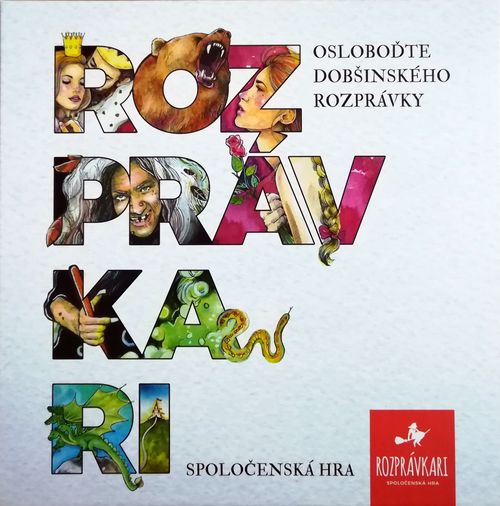
Rozprávkari
Rozprávkari Rulebook
Table of Contents
Table of Contents
Overview
The game is for two to four players aged eight and up. The game ends when you have freed all the tales. The player with the most points at the end of the game wins.
Contents of the game:
- 1 game board
- 70 playing cards
- 4 scoring cards
- 12 wishes
- 12 dukáty
- 6 tokens
Setup
Place all the tokens, dukáty and wishes in the upper right corner of the game board.
Each player receives:
- 1 scoring card,
- 3 wishes,
- 1 dukát.
Playing cards. There are three kinds of playing cards in the game. They can be told apart by the colour of their back:
- green cards (40) – tales and action cards,
- red cards (15) – monsters,
- blue cards (15) – weapons.
Shuffle the cards of the same colour together and place each deck face down on the left side of the game board. Then reveal the top three cards of each deck face up, as shown in the setup illustration. Cards are laid out in a grid: the three rows are green (tales and action cards), red (monsters) and blue (weapons), and the cards are placed in the columns to the right of each deck.
The oldest player begins. Play then passes to the player on the right.
Playing Cards and Strength
Monsters and weapons. All weapon and monster cards have a strength. It is shown in the bottom right and the top left corner of the card. For example, the Club (Kyjak) weapon has a strength of "two", and the monster Death (Smrtka) has a strength of "five". Why strength matters is explained below.
Fairy-tale cards. Fairy-tale cards are marked with a symbol in the bottom right corner. Each fairy tale consists of three cards with the same symbol. The illustration shows the three cards of the tale Trojruža (Three Sisters' Tale).
Your goal is to collect as many complete sets of three cards – complete tales – as you can. At the start of the game simply collect as many cards as you can. After a few rounds you will see which tales it is worth focusing on. If during your turn you have no choice of one of "your" tales, that is fine. Collect all the ones you can reach.
Scoring fairy-tale cards:
- for a complete tale (3 cards) you receive 10 points,
- for 2 cards from one tale you receive 5 points,
- for 1 fairy-tale card you receive 2 points.
Example: a player who holds all three cards of Trojruža, two cards of Lomidrevo and one card of Janko Hraško receives 10 + 5 + 2 = 17 points at the end of the game.
Action Cards
Action cards are also considered fairy-tale cards, but they are not marked with the symbol, and you do not get any points for them at the end of the game. An action is written on each of them. You may perform it immediately when you take the card, or later – at any time during your following turns, or at the start of an opponent's turn. Place an action card you have taken in front of you so that your opponents can see it too.
Taking a Turn
During your turn you attack a monster.
If you defeat it, you take the tale that you freed. You may defeat a monster when your weapon is equal in strength or stronger than the monster that is placed on the game board directly above it (in its column).
The illustration shows what an attack looks like in practice. Note that the weapon used and the defeated monster are placed on the right side of the game board immediately after the attack. The fairy-tale card you gained is placed in front of you so that your opponents can see it.
Attacking twice. Now note this! If the strength of your weapon in the attack was equal to the strength of the monster, you may attack once more. In a single turn, however, you may attack at most twice.
After an attack (or two attacks), the next player takes a turn. Before attacking, the player refills the empty spaces on the game board from the left-side deck. During the turn itself no further playing cards are added to the empty spaces on the board. A player uses only the cards that are face up at that moment. (The exception is when an action card allows adding cards during a turn.)
If you run out of monster or weapon cards on the left side of the game board, take the pile from the right side, shuffle it, and place it on the left side, from where you can again lay cards out on the game board.
Wishes. Each player has 3 wishes at the start of the game. By using a wish you may swap two cards of the same type (weapons, monsters, tales) with each other. In this way you can set up a better turn. But be careful: you have only 3 wishes for the whole game.
Dukáty
Each player receives 1 dukát at the start of each round. It is your pay, that is, your reward for taking part in the fight against the monsters. If there are no longer enough dukáty for all players, nobody receives one.
Scoring: at the end of the game each dukát is worth 1 point.
During the game you can use dukáty to join weapons, which lets you defeat strong monsters:
- for 1 dukát you may attack a monster with two of your weapons,
- for 2 dukáty you may attack with all three of your weapons.
The example on the page shows a player who paid 1 dukát and joined the strength of two weapons to create a better turn.
Paid dukáty are placed back on the game board. At the start of the next round they may again be given out to the players.
Wishes
Each player has 3 wishes at the start of the game. Using a wish you may swap two cards of the same type (weapons, monsters, tales) with each other. In this way you can prepare a better turn. But be careful: you have only 3 wishes for the whole game.
Scoring: at the end of the game each unused wish is worth 1 point.
The example shows a player who swapped two weapons to create a turn in which he can attack twice.
Tokens
There are 6 tokens in the game: 3 dragon-slayer shields and 3 other tokens – the Whip (Korbáčik), the Golden Egg and the Scythe (Kosa).
Dragon-slayer shields
There are three monster cards in the game that show dragons – the more dragons you defeat, the more points you receive. When you defeat a dragon, take the dragon-slayer shield shown on its card.
Scoring dragon-slayer shields:
- for 3 shields you receive 10 points,
- for 2 shields you receive 5 points,
- for 1 shield you receive 2 points.
Kosa, Golden Egg and Whip
Whenever one of the players defeats Death (Smrtka), he takes the Kosa token. The player who has this token at the end of the game receives 5 points.
A similar procedure applies to the Iron Monk and the Grošokráľ (Penny King). For defeating the Iron Monk you take the Golden Egg token. The player who owns it at the end of the game receives 6 points. When you defeat the Grošokráľ, you get the Whip (Korbáčik). The owner of the Whip receives 7 points at the end of the game.
If after defeating a monster you have a claim to a token, but the corresponding token is no longer on the game board because your opponent obtained it, you may take it from him.
End of the Game
The game ends at the moment when one of the players frees the last fairy-tale card (or action card).
After this turn no action cards may be played. The exception is when the last freed card was an action card. The player who obtained it may still use it.
Then the points are counted according to the scoring card. Points are received for collected tales, dragon-slayer shields, tokens, dukáty, and wishes that were not used.
The player with the highest number of points wins. If there is a tie, the player with more tokens wins.
Scoring card:
| Item | Points |
|---|---|
| Fairy-tale cards: 3 cards of one tale | 10 points |
| Fairy-tale cards: 2 cards of one tale | 5 points |
| Fairy-tale cards: 1 card | 2 points |
| Dragon-slayer shields: 3 | 10 points |
| Dragon-slayer shields: 2 | 5 points |
| Dragon-slayer shields: 1 | 2 points |
| Dukát | 1 point each |
| Wish not used | 1 point each |
| Kosa (Scythe) token | 5 points |
| Golden Egg token | 6 points |
| Korbáčik (Whip) token | 7 points |
Notes
- What if you are on your turn and you cannot defeat any monster, or you do not want to spend dukáty or wishes? Even in that case you must attack. You do not defeat the monster, but the weapon you used is placed on the discard pile, and the next player adds a new weapon to the board.
- Some action cards allow you to obtain cards from an opponent. However, if a player has a complete tale (3 cards), it is impossible to take these cards from him in any way.
Advanced Rules
Once you know the basic rules, this simple extension lets you enrich Rozprávkari with many interactions between players.
At the start of a turn, after the player has refilled the cards on the game board, the other players may use their dukáty to strengthen the monsters. Players may place any number of their dukáty on any one of the monsters currently on the game board. The strength of a monster is now calculated as the sum of the strength shown on the card and the number of dukáty placed on it.
Players have a limited time to place their dukáty – for example, five seconds. (After the players have placed their dukáty, they may still play their action cards.)
The player who is on turn continues the turn according to the normal rules.
If a player defeats a monster that has a dukát (or several dukáty) placed on it, he receives this dukát (these dukáty).
If a player defeats a monster that has dukáty on it but does not defeat it, the dukáty remain on the monster (and its strength remains increased) until one of the players defeats it.
Card Reference: Monsters
Card names and descriptions are printed in the rulebook as reference. The descriptions are reproduced in English translation.
Grošokráľ (Penny King) – The strongest monster in Rozprávkari, and at the same time the smallest of them – Grošokráľ is an ant. His weapon is a whip, which he merely flicks, and at once everything is dead. Where does he get his immense power? Every day at noon a deer brings him a jug of wine and a towel. When he drinks the wine and dries himself with the towel, he gains power over the whole world. More about Grošokráľ, and about who finally defeated him, can be read in the tale Vintalko.
Železný mních (Iron Monk) – This monster from the tale Popolvár najväčší na svete (Popolvár, the Greatest in the World) is a powerful sorcerer who can transform into anything he pleases. His strength is hidden in a golden egg, which a golden duck lays once every seven years. In our game the Iron Monk is the second-strongest character.
Smrtka (Death) – A tall, emaciated creature in a cloak, who is forever behind every person's back. Instead of eyes there are sockets, instead of a nose only a hole, and in its dry long hand a sharp scythe. This is Death. Read in the tale Kmotra Smrť a zázračný lekár (Godmother Death and the Miraculous Doctor) that it is not wise to trifle with her.
Zbojníci (Robbers) – Robber gangs roam the forests and rob whoever they come across. On our card the robbers are just dividing their loot, but something has gone wrong. What was it? Read the tale O hlúpej žene (The Foolish Wife).
Obor (Ogre) – Ogres, giants and overgrown monsters are blessed in Dobšinský's tales. Many of them drink and eat a great deal, and the worst of them do not disdain even human flesh. But in the end nothing good awaits them – Ogre Miško from the tale Hádač, strelec, struhač, poprac could tell you about it, if he were still among the living.
Macocha (Stepmother) – A gloomy creature is the stepmother. She has poison in her heart; she torments and beats her stepchildren. Fortunately, she is no problem to defeat with any weapon, even a rod of willow twigs. Only go at her!
Čert (Devil) – When devils are not stirring under the cauldrons in hell, they wander among people and cause mischief. You can recognise them by their horns and by a goat's hoof instead of a foot. This one is from the tale Zlatý zúbok (Golden Tooth): a lordly devil who used to live in a castle and guarded barrels of gold and human bones.
Čarodejník (Sorcerer) – Reading books is important. Why? In the tale Černokňažník (The Black Wizard) you will find out. Here we will only reveal that thanks to books you can not only avoid poverty, but can also come to the kingdom.
Draci (Dragons) – In Slovak tales dragons swarm just like that. Dragons with three, six and twelve heads, menacing monsters from dark caves and from enchanted castles, from whose paper jaws flames pour. Their weaknesses are princesses, human beings, and battles with stately young heroes. (Three cards: Three-headed Dragon, Six-headed Dragon, Twelve-headed Dragon. Each shows a dragon-slayer shield.)
Ježibaba (Witch) – Witches belong to Slovak tales the way bacon belongs with dumplings. They control all kinds of magic, brew poisonous potions and like to live in a hut on chicken legs. Beware of them: a moment of inattention and they will turn you into a frog!
Striga a strigôň (Striga and Strigoň) – A lovely pair of monsters. She is young and beautiful, bakes honey cookies, loves cats, and is learning to fly on a broomstick and to cast spells. He does not say much; he strolls through the forest in enchanted boots, and rather than cats he prefers dogs. How did they fare in their old age? You will read in the tale Šurienka a Atalienka.
Laktibrada (Elbow-Beard) – A chin on an elbow, a beard on a foot. Laktibrada is one of the most famous troublemakers in our fairy-tale world. He hides immense strength in his long beard, which the strongman Lomidrevo managed to [verb unclear in the photograph]. Caution: the tale Laktibrada is not suitable for the faint-hearted.
Card Reference: Weapons
Sekerka (Axe) – This axe is not like the others. When you command it: "Axe, chop!", it will chop until you say only: "Enough!" Janko got it as a gift from a snake, with whom he has been a friend since childhood. If you want to know the whole story, read the tale Hrdopýška.
Nožík (Knife) – Without a knife a proper farmer cannot take a step. But one sturdy farmer never used his knife as it should be used, and so he was punished for it. For more, read the tale Či sa hneváte? (Are You Angry?).
Valaška (Shepherd's Axe) – Many a hero of Dobšinský's tales had a valaška as a good helper. But of all of them, the most excellent is the one from the tale about Lomidrevo: forged from two hundred and ninety centners of iron by the strongman Miesiželezo with his own hands, and Lomidrevo tested its quality on his own back.
Kyjak (Club) – Clubs are plentiful in our tales. Wooden, copper, small and large. The shepherd in the tale Mlynček even had one that could beat everything by itself, and would fetch whatever you wished.
Trojitý klobúk (Three-Cornered Hat) – The magic hat from the tale Mlynček is a weapon few monsters can withstand. Cannonballs pour from each of its corners; just turn it on your head and say: "Dbŕf!"
Palica (Stick) – The best-known stick in Slovak tales is the one from the tale Fundži palica, cepy von z vreca. In our game, however, we chose the more common kind – a birch stick from Slovak forests, without magical abilities.
Budzogáň (Mace) – A budzogáň is large and heavy, which is why it is popular especially among dragons and giants. They can hurl it so hard that it bounces from the ground up to the clouds. With a budzogáň at hand you need not fear almost any monster.
Strieborná šabľa (Silver Sabre) – This sabre is from the tale Tri citróny (Three Lemons). Only thanks to it did our prince survive his journey through the world unharmed, and then luck in the form of a beautiful bride found him. And what is the raven sitting on the sabre's blade? Read the tale and everything will be clear.
Hrdzavý palaš (Rusty Broadsword) – When Popolvár set out into the world, he wanted nothing from his father but a mangy little horse and a rusty broadsword. And he chose well: the broadsword is magical and chops and hacks everything by itself. The whole story is in the tale Popolvár najväčší na svete.
Kuša (Crossbow) – No one had such a crossbow as the youngest of the three sons in the tale Dobrý strelec (The Good Marksman). When a twelve-headed dragon burst out at him, the youth seized it and shot arrow after arrow until he had shot off all the dragon's heads. And that was not all! He even managed to shoot off legs by night and by day. Why did he have to do that? Read the tale and you will find out.
Víťazný zlatý meč (Victorious Golden Sword) – Only one who has the strength of a hundred men can wield this sword. Our good marksman from the tale of the same name had such strength, and thanks to it he freed the kingdom from the spell and won the rescued princess as his wife.
Puška (Rifle) – This rifle belonged to the lad from the tale Chudobných rodičov syn (Son of Poor Parents), who shot sparrows off a fence with it. A rifle is a crafty thing, and our youth was truly crafty too. He eventually even became king.
Vŕbový prút (Willow Rod) – Even an ordinary rod can achieve great things. The lad from the story of Mrs. Mačička knows all about it: he swung himself into golden clothing, a golden-maned stallion, and even a beautiful bride. But it was not simple. If you are interested in everything that happened to him, read the tale Pani Mačička (Mrs. Mačička).
Čarovný prútik (Magic Wand) – Whoever you strike with this wand turns to stone at once. Originally it belonged to an old striga who lived in an enchanted forest. Whoever got into that forest never came out again, and many people were ruined by the striga with this wand. Who finally defeated her? Read the tale Zakliata hora (The Enchanted Mountain).