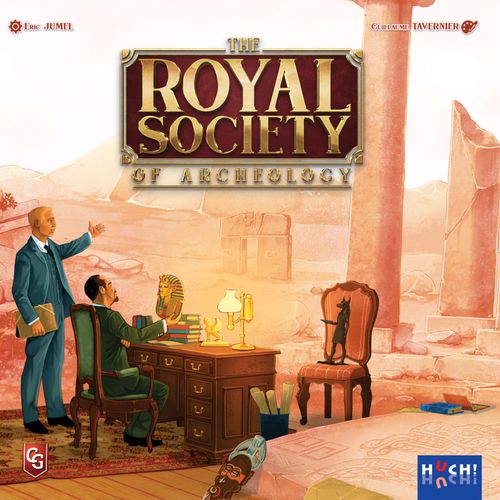
The Royal Society of Archeology
The Royal Society of Archeology Rulebook
Table of Contents
Table of Contents
- Game Overview
- Objective
- Components
- Game Setup
- Concepts
- Expedition Cards
- Expedition Program
- Relics
- Prestige and Science
- Actions
- Society Discs
- Game Flow
- End of Game and Scoring
- The 4 Location Actions
- Optional Actions
- Solo and 2 Player Game
- The Royal Society Tiles
- The Royal Requirement Tiles
- The Bloomsbury Tiles
- The Study Cards
- The Society Cards
- Iconography
- Example of Resolution for the Organize an Expedition Action (Port of London)
- Simplified Setup
- Rules to Remember
Game Overview
Each player manages a team of 3 explorers to deploy in London or send on an expedition, based on their expertise.
In London, explorers prepare their expeditions by studying civilizations at the University and by scouring The City district in search of funding to depart. Upon their return from an expedition, they deepen their knowledge, exhibit relics in the Grand Gallery of the Royal Museum and gain the recognition of their peers from the Royal Society of Archeology. But they must not forget to meet the requirements set by King George V, a great archeology enthusiast and an ardent promoter of England's influence in this field.
Objective
Players have between 4 and 5 years (depending on the number of players) to develop their archeological society and gain Prestige and Scientific knowledge. To achieve this, they must organize expeditions requiring expertise, knowledge and funding, which will allow them to achieve personal objectives and objectives common to all players. At the end of the game, only each player's lowest score between Prestige and Science is considered to determine the winner.
Components
- 1 London board (double-sided)
- 1 Year marker
- 12 Royal Society tiles (4 each of types A, B, and C)
- 20 Bloomsbury tiles (10 x [10] Prestige value, 10 x [25] Prestige value)
- 2x4 Royal Requirement tiles (period 1, period 2)
- 12 Collection tiles (double-sided) (4 tiles x 3 sizes)
- 60 Relic tokens (15 per region) + 4 Region bags
- 48 Expedition cards
- 16 Patron cards
- 12 Society cards
- 16 Study cards
- 96 £ tokens (56x1, 24x5, 16x10)
4 Society kits in 4 colors:
- 1 Society board
- 3 Explorer pawns
- 3 Expertise cubes
- 15 Society discs
- 3 Society markers (turn order x1 and score tracks x2)
- 1 Rulebook
- 1 Player aid (double-sided)
- 9 Automa cards (solo and 2-player mode)
Game Setup
See Solo and 2 Player Mode on pg. 13.
- Place the London board in the center of the table, on the side corresponding to the number of players (indicated at the top left of the board).
- Form a supply with the £ tokens next to the board.
- Sort the Relic tokens by region (color) and place them in their respective bags. Shake the bags and place them next to the London board.
- Randomly place three Collection tiles of 3 relics, two of 5 relics, and one of 7 relics on the corresponding spaces of the Grand Gallery.
- Place the Year marker on space I of the Calendar track.
- Randomly draw one Royal Requirement tile from period 1 and place it face up on space 1 of the Calendar track. Do the same with a period 2 tile on space 2.
- Randomly draw 1 A tile and place it face up on the corresponding space of the Royal Society. Do the same with B and C tiles.
- On Bloomsbury, form a face down draw pile of number of players +1 [10] Prestige tiles (e.g., 5 tiles for a 4-player game). Do the same with the [25] Prestige tiles.
- Shuffle the Patron cards, then form a deck and place it, honored side visible, on "The City" location space.
- Shuffle the Expedition cards into a face-down Expedition deck; place it above the left-most space of the Program (found along the top of the London board). Reveal the top six cards and place one face up on spaces 1 through 6. Note: The cards shown in the illustration are used during player setup and are placed later.
- Shuffle the Society cards and the Study cards separately, then form two separate decks and place them next to the London board.
Return any unused components to the game box.
For your first games, we recommend a simplified setup. (see Simplified Setup)
Player Setup
Each player does the following:
A. Choose a color and take the corresponding components: 1 Society board, 15 Society discs, 3 Explorer pawns, 3 Expertise cubes and 3 Society markers.
B. Place one Society disc on space 4 of the Reputation track.
C. Place one Society marker on each 0 space of the Prestige and Science tracks around the London board.
D. Place one Society disc in front of each line of the Knowledge track. The remaining 10 Society discs form your reserve for use during the game.
E. Draw 2 Study cards, 2 Society cards, and 4 Expedition cards. Based on these cards:
- Choose the side of your Society board.
- Using the Expertise cubes, assign 1 Expertise to one of your explorers, 2 Expertise to another (different) one, and 3 Expertise to the remaining one.
- Keep 2 Expedition cards. Discard the 2 remaining ones face up on the right-most space of the Program.
- Keep 1 Society card from the 2 received. Gain the starting benefits indicated at the bottom of the card. Then slide the card into the slot at the top of your Society board, leaving your special ability visible (see Description of Society cards).
F. Place the 2 Study cards face down next to your Society board (see Description of Study cards).
G. Place your Explorer pawns on their respective portraits on your Society board.
Start of the Game
H. Randomly determine a player. They place a Society marker on a free space of the Turn Order track and immediately gain the indicated bonus (see A.1 Define Turn Order).
Following clockwise order, the other players do the same.
The turn order for the first year is now set; the game can begin.
Concepts
Explorer
Each player manages 3 explorers who allow them to perform actions each turn. Each explorer is characterized by:
- A portrait,
- A permanent skill, which facilitates the organization of certain expeditions,
- Their Expertise, which determines the power of their actions and their ability to go on expeditions.
See Description of explorer skills.
Expertise
An explorer's Expertise, defined during setup, can increase during the game in two ways.
If gained, Expertise is permanently increased by one level on the Society board.
Any number of times, up to a maximum of 6 total Expertise, you may spend 1 Reputation to gain 1 temporary Expertise for the duration of an action.
An explorer's Expertise can never exceed 6, even with a temporary increase.
Furthermore, an explorer's Expertise cannot be temporarily increased beyond the threshold required by the action.
The higher an explorer's Expertise, the more actions they have access to or the more powerful their actions' effects are.
The lower an explorer's Expertise, the more chances they have to learn from their peers in the Location. See Locations and location rewards below.
An explorer can always perform an action requiring lower Expertise instead of the action corresponding to their Expertise.
Reputation
During the game, players will gain or lose Reputation, depending on the actions they perform. Track Reputation using the Reputation track. Reputation has multiple uses.
Reputation is used to determine the turn order at the beginning of each year. It also determines whether a player has access to The City and Royal Museum locations (see the Locations column at right).
Reputation can be spent to enhance an explorer's action, satisfy missing prerequisites for going on an expedition, reserve an expedition, or sell a relic (see The 4 Location Actions).
If a player must place their Society disc on a space of the Reputation track that is already occupied, they place it on top of the stack.
Gaining Reputation: During their turn, a player can exchange 1 Society disc for 2 Reputation (see the Gain Reputation action).
Honoring a patron (see Optional Actions) and various other bonuses obtained during the game also allow gaining Reputation.
Locations and Location Bonuses
Explorer placement follows the same principles in each of the 4 London locations.
There is no limit to the number of explorers that can be placed in the same location. Several explorers from the same player can be placed there.
The City and Royal Museum locations require the player to have a Reputation of at least 4 (or 6) respectively to place an explorer there. Reputation is checked before activating an explorer (before optionally spending reputation to temporarily increase expertise).
Location Bonuses: Learning from peers
When placing an explorer in a Location, only if the placed explorer has lower Expertise than any explorer(s) already at the Location (even their own):
- The placed explorer immediately gains the left location bonus once; then,
- All players with explorers at this location of the highest Expertise gain the right location bonus, for each of their explorers of highest Expertise (or tied for highest) at this location.
Example: Please see the back cover of the rulebook for a detailed example.
Clarification: Placing an explorer of highest Expertise does not award a bonus.
Expedition Cards
Expeditions are at the heart of the game! They allow you to increase your explorers' Expertise, acquire relics, and gain Prestige and Science.
Expedition cards represent the different expeditions you can organize during the game in the four regions, each identified by a different color.
The top left corner indicates the prerequisites you must meet to go on an expedition:
- The minimum Expertise the explorer you send on the expedition must have, the minimum Knowledge level you must have in the expedition region (tracked on the Knowledge track), and the Cost to spend to go on the expedition.
- On some cards, an additional condition is required to go (having already organized an expedition of a particular type or in a given region).
The bottom section of an expedition card shows:
- The Expertise icon (which reminds you that upon returning from an expedition, the sent explorer gains expertise).
- The symbol of the expedition region and the name of the explored site.
- The type of expedition (Excavation, Exploration, Anthropology, Cartography) and any specificity of the site (linked to a Myth or listed as a Wonder of the ancient or modern world).
- The icons in the lower part indicate what you immediately gain by playing this expedition.
Expedition Program
The Royal Museum has just published its excavation program, setting priorities.
The top of the London board offers 6 permanently accessible Expedition cards, hereafter called the Program.
The 4 left positions require spending Reputation if you wish to play them (see Organize an Expedition) or reserve them (see Reserve an Expedition).
Reminder: You can spend a Society disc at any time to increase your Reputation and thus access coveted cards (see Gain Reputation).
As soon as you take a card from the Program, slide the Expedition cards to the right, without changing their order, then fill the vacant space on the left with a new card drawn from the top of the Expedition deck.
If the Expedition deck is empty, shuffle the discard pile to reform the deck and place it face down on the designated space to the left of the Program.
Relics
Relics acquired on expeditions are the second core element of the game.
They allow you to deepen your knowledge at the University of London, earn money in The City, or gain Knowledge, Prestige, and other benefits at the Royal Museum.
Each expedition region bag (Africa, Mediterranean, Asia, and South America) contains 15 Relic tokens.
There are 4 types of Relic tokens (x6, x4, x3, x2 per bag): musical instruments, pottery, scrolls, and jewelry. Item types are not evenly distributed across regions. Scrolls appear more frequently in Asia, while South America is richer in jewelry and decorative artifacts.
Discard: Whenever you must discard a Relic token, place it face up next to the bag of its original region. If the bag is empty, place all discarded tokens into the bag to replenish the supply.
Prestige and Science
Throughout the game, you will progress on 2 tracks present around the London board to track:
Prestige, which represents the public image of your archeological society. You progress on it notably through the expeditions you organize and the relics you exhibit in the Grand Gallery.
Science, which values your level of scientific knowledge, acquired through study and observation. This will essentially evolve thanks to presentations made to your peers at the Royal Society of Archeology and your Study cards.
During the final scoring, your science marker moves to its adjacent prestige space, then you only gain prestige showing by your lowest marker (see End of Game and Scoring).
Actions
2 types of actions can be performed during a game:
- Location actions, triggered by placing an explorer in a location,
- Optional actions, activated by gains, bonuses, or by the player themselves.
All actions have prerequisites. These can be:
- Minimum Expertise that the activated explorer must have.
- Minimum Reputation that the player must possess.
- An element to discard (Relic token, £ token, Society disc, ...).
If you do not meet the prerequisites of an action, you cannot perform it.
An optional action, triggered by the player, can be performed at any time during their turn, even during the resolution of a Location action.
An optional action, activated by a gain or a bonus, is never mandatory.
Society Discs
Society discs are used to validate your positions in the Grand Gallery and at the Royal Society. They also remind you of unmet Royal Requirements.
Once the setup is complete, you only have 10 Society discs for the duration of the game.
If you have no more discs in your reserve, you can no longer exhibit relics in the Grand Gallery or claim an objective at the Royal Society.
Game Flow
A game of The Royal Society of Archeology takes place over a total of 4 years (with 4 players) OR 5 years (with 2-3 players).
Each of these years is divided into 2 phases:
- A. Upkeep
- B. Activation of explorers
- Royal Requirements in years 2 and 4 for 4 players, 3 and 5 for 2-3 players.
Phase A. Upkeep
At the beginning of each year (except the first), perform the following steps:
A.1 Define Turn Order
Set aside all Society markers on the Turn Order track to the left of the track. Then, starting with the player with the highest Reputation and following descending order, place their Society marker on an unoccupied King's Favor (turn order track) space. Immediately gain the indicated favor of your selected space:
- Gain 3 Prestige.
- Gain £5.
- Gain 2 Reputation.
- Perform the Reserve an Expedition action (see Optional Actions).
- Gain 1 Knowledge in the region of your choice.
- Take 1 relic of your choice from the Region bag of your choice.
Note: If 2 players have the same Reputation, the player whose marker is on top chooses first.
The leftmost player on the Turn Order track becomes the first player for this year.
A.2 Gather Explorers
Retrieve all your Explorer pawns and place them on the corresponding portraits on your Society board.
A.3 Announce New Expeditions
Discard the Expedition cards from spaces 1 and 2 by placing them in the Discard space to the right of the Program. Shift the remaining cards two spaces to the right, then draw two new cards to replenish the two left spaces.
Note: If the draw pile becomes empty, shuffle the discard cards to reform the Expedition card deck.
Phase B. Activation of Explorers
Support an explorer: You can temporarily increase an explorer's Expertise by spending Reputation. An explorer's Expertise can never exceed 6.
Each year, players take turns, following the order defined on the Turn Order track, until they have activated all their explorers.
On your turn, perform the following steps:
- Choose an explorer from your Society board.
- Place them in a Location in the numbered section corresponding to their Expertise or lower (an explorer can always perform an action requiring lower Expertise).
- Grant the Location bonuses if the conditions are met (see Learning from Peers).
- Perform one Location action (and only one).
- Apply the special ability of your Society and/or any Bloomsbury tile if applicable.
- Discard down to 3 cards in hand (see Hand Limit).
At any time during your turn, you can also:
- Gain Reputation (see Optional Actions).
- Honor a patron by discarding the requested relic (see Optional Actions).
End of the year
When players have activated all their explorers, the year ends.
Depending on the year, check if you meet the Royal Requirement. See below.
Advance the Year marker one space and begin a new year.
ROYAL REQUIREMENTS
At the end of certain years (depending on the number of players), players check if they achieved the objective set by King George V, indicated on the Royal Requirement tile (see Description of Royal Requirement tiles).
If you did not succeed (whether intentionally or not), suffer the indicated penalty and place one of your Society discs on the corresponding Royal Requirement tile.
If you have no more in reserve, you must retrieve one from the Grand Gallery. If you don't have any in the Grand Gallery either, use a discarded disc and immediately lose 15 Prestige.
End of Game and Scoring
The game ends at the conclusion of the 4th year (with 4 players) or 5th year (with 2-3 players). Then proceed to the final scoring.
Each player modifies their Prestige and Science as follows:
-
Grand Gallery For each complete collection, the player with the most Society discs there gains 12 Prestige. For each incomplete collection, the player with the most Society discs there gains 6 Prestige. In both cases, in case of a tie, players share the Prestige equally (rounding down).
A collection is considered COMPLETE when all spaces on that Collection tile have been filled with Society discs. A collection is INCOMPLETE if at least one space remains empty at the end of the game.
-
Study Cards Choose one of your two Study cards and gain Science based on the number of objectives achieved (see The Study Cards).
-
Bloomsbury Tiles Gain the Science and Prestige from your tiles (see The Bloomsbury Tiles).
-
Patron Cards Lose the Prestige indicated on each unhonored Patron card.
Each player moves their Society marker from the Science track to the adjacent space on the Prestige track. Their least advanced Society marker indicates their final score.
The player with the highest final score is declared the winner.
In case of a tie, compare the tied players' secondary scores (the marker that was NOT used for final scoring). The player with the higher secondary score wins. If still tied, the player with higher Reputation wins.
Example of Final Scoring
At the end of the 5th year, the purple player reached scores of 49 Prestige and 10 Science.
Thanks to their exhibited relics, they gain 6 Prestige for collection II (incomplete) and 6 Prestige for collection V (complete), for a score of 61 Prestige.
They lose 5 Prestige due to an unhonored patron. Their score decreases to 56 Prestige.
They achieved 2 out of 3 objectives on their Study card and thus gain 2 Science.
They finish with a score of 56 Prestige and 12 Science (12 Science equals 60 Prestige on the track).
Their final score is therefore 56.
The 4 Location Actions
University of London — Study in the university
Spend hours on the University benches to perfect your knowledge of the different regions of the globe.
Location Bonus (left): +1 Knowledge. Location Bonus (right): +1 Reputation.
If your explorer has an Expertise of 1 or 2, gain 1 Knowledge in the expedition region of your choice.
OR
If your explorer has an Expertise of 3 or more, gain 2 Knowledge to distribute in one or two expedition regions of your choice.
Deepen knowledge: If your explorer has an Expertise of 4 or more, discard 1 Relic token from a region to gain 3 Knowledge in that region.
Knowledge Track
Going on an expedition requires a minimum Knowledge level in the explored region. You can acquire Knowledge by going to the university, going on expeditions, or through various bonuses. The Knowledge track allows you to follow your score in each of the expedition regions (Mediterranean, Africa, Asia, South America).
Knowledge Bonuses
Each time you reach or exceed a score of 5 in a region, gain 1 Science.
Each time you reach or exceed a score of 8 in a region, gain either 1 Science OR 5 Prestige.
Each time you reach a score of 12, gain 2 Science.
If you already have a score of 12, gain 1 Prestige for each point you would have gained beyond 12.
Royal Museum — Exhibit a relic / Study a relic
Contribute to the splendor and wealth of the Royal Museum.
Location Bonus (left): +1 Reputation. Location Bonus (right): +2 Prestige.
The museum administrator is looking for relics, represented on the Collection tiles placed at the start of the game. Collections can contain:
- relics of a specific type and region, e.g., Mediterranean pottery.
- relics of a specific type, but any region of origin, e.g., a scroll.
- relics from a specific region, but of any type, e.g., a relic from Asia.
Exhibit a relic
You must have a Reputation of 6 or more before activating an explorer (count this before spending Reputation for Expertise if you do).
If your explorer has an Expertise of 2 or 3, you can discard 1 Relic token.
If your explorer has an Expertise of 4 or 5, you can discard up to 2 Relic tokens.
If your explorer has an Expertise of 6, you can discard up to 3 Relic tokens.
For each relic you discard in this way, place 1 Society disc in the Grand Gallery on a corresponding free space of the collection of your choice.
Gain the reward described at the top of the supplied collection(s) — up to once per collection per turn.
Example: If you place 2 or 3 relics in the same collection, you only gain the reward once.
Study a relic
You must have a Reputation of 6 or more before activating an explorer (count this before spending Reputation for Expertise if you do).
If your explorer has an Expertise of 1 to 4, discard 1 Relic token to gain 1 Science.
If your explorer has an Expertise of 5 to 6, discard 2 Relic tokens to gain 2 Science.
The City — Meet a patron / Sell a relic
Scour the business district in search of patrons ready to finance your expeditions.
Location Bonus (left): +£3. Location Bonus (right): +2 Prestige.
Meet a patron
You must have a Reputation of 4 or more before activating an explorer (count this before spending Reputation for Expertise if you do).
Draw 2 Patron cards, choose one to keep in front of you with its unhonored side face up (the side showing "gain £3-£5"). Place the remaining Patron card at the bottom of the Patron deck.
As shown on the card, gain between £3 and £5 per Expertise level of your explorer used to gain the Patron.
Patron Cards
Patron cards are one of the ways to finance expeditions. At the end of the game, an unhonored patron makes you lose Prestige.
To honor a patron, you must discard the relic shown on the card (see the Honor a patron action).
Sell a relic
You must have a Reputation of 4 or more before activating an explorer (count this before spending Reputation for the action below).
Lose 1 Reputation and discard 1 Relic token to gain £15.
-- A bit of history --
This game is rooted in history and addresses a sensitive subject: the theft of cultural heritage. At the beginning of the 20th century, theft and study unfortunately often went hand in hand and many relics ended up in national museums or private collections. Modern archeology has changed behaviors and opened an era of unprecedented discoveries.
This game is not intended to glorify the practices used at the time but rather to pay tribute to all those archeologists who helped illuminate our past.
Port of London — Organize an expedition
Join the ship you chartered and set sail for a new expedition.
Location Bonus (left): Reserve an Expedition. Location Bonus (right): +1 Reputation.
Organize an expedition (See resolution example, Example of Resolution for the Organize an Expedition Action)
Take an Expedition card from the Program or from your hand and place it next to your Society board.
When taking from the Program: If there is Reputation indicated under the space from which the Expedition card is taken, you must pay it to take that card.
Prerequisites
- Verify that you meet the prerequisites (see Expedition Cards) and pay the indicated Cost.
Play your Reputation
When you go on an expedition, you can spend 2 Reputation to reduce the cost of the expedition by £3 once and/or spend 2 Reputation to decrease the Knowledge required by the expedition by 1 once. To clarify, you may spend 4 Reputation to receive each compensation once.
Explorer Skills
Your explorers each have a skill, mentioned on the right of your Society board. You can use it when you send an explorer on an expedition, regardless of their Expertise. They can be of 2 types:
- Logistics: this explorer reduces the cost of the expedition by £3 when you Organize an Expedition.
- Expertise: When you Organize an Expedition, and the expedition's region matches the region shown on this explorer's skill icon (on your Society board), reduce the card's Knowledge requirement by 2 for requirement purposes only; this does not increase/decrease your tracked Knowledge.
Gains
- Add 1 Expertise to your explorer on expedition, then gain the indicated benefits (3) (see the example, Example of Resolution for the Organize an Expedition Action).
Note: Your society's special ability can influence the cost or gains of an expedition, don't forget it!
If you took the Expedition card from the Program, shift the cards to the left of the empty space to the right and reveal a new card on space 6.
Optional Actions
Present discoveries to the royal society
Sit on the illustrious benches of the Royal Society to present your discoveries to the greatest scientists of the United Kingdom.
Trigger: achieving the objective of one of the Royal Society tiles.
Directly score the Science or Prestige indicated under the validated objective:
- If you are the first, place a Society disc on the left icon and score what you cover (4 Science or 20 Prestige).
- Otherwise, place a Society disc on the right-hand icon and score what you cover (2 Science or 10 Prestige).
(See Description of Royal Society tiles)
Note: multiple players can place a Society disc on the right-hand icon.
Reserve an expedition
Trigger: Collection reward, location reward, King's Favor (Turn Order), Bloomsbury tile.
Perform one of the 2 following actions:
Take an Expedition card from the Program and place it in your hand.
- If Reputation is shown under the card's position, you must pay it to take that card; then refill the Program as normal.
OR
Draw 3 Expedition cards from the top of the deck, place one in your hand and discard the other 2.
Hand limit
You cannot have more than 3 cards in hand. At the end of your turn, check the number of cards you have in hand and discard the excess to respect this limit.
Find a publisher in bloomsbury
Knock on the doors of publishers in the Bloomsbury district to sell the tales of your expeditions.
Trigger: Reach a Prestige score of 10 or 25.
Look through the stack of Bloomsbury tiles corresponding to the Prestige (10 or 25) reached, choose one of the tiles in the stack to reveal.
- If it is a tile with the immediate-effect symbol, gain its benefit immediately (and keep it face down next to your board as a reminder you cannot gain another tile of that type). Otherwise, place the tile face up next to your Society board.
- Place the remaining tiles face down in their place.
You can only take one tile of each type for the entire game. If you were to lose Prestige, reaching the triggering score again does not allow you to obtain a new Bloomsbury tile of that type.
Support an explorer
Trigger: when activating an explorer.
Spend 1 Reputation to temporarily grant 1 Expertise to the activated explorer.
- The Expertise obtained can never exceed a value of 6.
- An explorer's Expertise cannot be temporarily increased beyond the threshold required by an action.
- You can perform this action multiple times when activating an explorer.
- The explorer is placed in a Location in the numbered section corresponding to their total Expertise.
- The explorer's increased Expertise is only valid for this single activation; do not modify their Expertise on your Society board.
Gain reputation
Trigger: At any time during your turn.
- Place 1 Society disc, taken from your reserve, on the London board below the Reputation track to gain 2 Reputation.
- Discs placed in this way remain until the end of the game and cannot be used again.
- You can place multiple discs at the same time.
- You cannot increase your Reputation beyond 9.
- If you have no more Society discs in reserve, you can no longer do this action.
Honor a patron
Trigger: at any time during your turn.
Discard the Relic token indicated on the Patron card.
Flip the Patron card to its Honored side and immediately gain 1 Reputation.
You can perform this action multiple times in the same turn, as long as you have patrons to honor and you have the required relics.
Each unhonored patron makes you lose 3 to 5 Prestige at the end of the game, depending on the card.
Solo and 2 Player Game
You can play The Royal Society of Archeology as 1 player in Solo mode or as 2 players in two different ways:
- Confrontation Mode: with blocked spaces from setup for the entire game.
- Competitive Mode: with the Solo mode Automa as if you were playing a 3-player game.
Solo Mode
Setup (see Game Setup) for a 2-player game up to step D, then apply the Automa setup rules. Then resume setup steps E, F, and G.
At the end of the game, the player is awarded an honorary title by King George V based on their score:
| Score | Title |
|---|---|
| < 40 | Novice |
| 40-49 | Royal Archeologist |
| 50-59 | Honorary Fellow of the Royal Society |
| 60-69 | Grand Archeologist of His Majesty |
| 70-79 | Fellow of the Royal Society |
| > 80 | Sir |
Confrontation Mode
Setup (see Game Setup) for a 2-player game up to step D, then take 12 Society discs of an unused color and place one:
- On the [4] section of each location (Royal Museum, University of London, The City, Port of London),
- On the left space of objective B of the Royal Society,
- Randomly on 1 space of each top Collection (3 collections with 3 spaces, 2 collections with 5 spaces) and on 2 spaces of the bottom Collection of the Grand Gallery.
The Royal Society and Grand Gallery spaces blocked are unusable for the entire game.
The Automa's Society discs are counted at the end of the game when calculating collection points for the Grand Gallery.
The discs placed on locations allow you to gain the location reward if you play an explorer with an Expertise lower than 4.
Then resume the course of a setup by performing steps E, F, and G.
Competitive Mode
Perform a general setup (see Game Setup) for a 3-player game up to step D, then apply the Automa setup rules.
Then resume setup by performing steps E, F, and G.
Automa
The Automa simulates an additional virtual player in the action phases. It allows playing in Solo mode and can be used for 2-player games to play in Competitive mode.
Setup
After step D, perform the following steps:
- Take the Automa card deck, shuffle it and place it face down within reach.
- Place the Society discs and Explorer pawns of an unused color next to the Automa card deck.
- Place 1 Automa Society marker on space 1 of the Turn Order track (the Automa does not gain King's Favors).
The Automa plays first in the 1st turn. Then resume the course of setup from step E.
Phase A. Upkeep
At the beginning of step A.1 (except during the first year), place the Automa's Society marker from the Turn Order track onto the King's Favor shown in the upper right corner of the last Automa card played. You will not be able to benefit from this bonus during this round.
During step A.2 Gather Explorers, also remove the Automa's explorers from the London board.
Phase B. Activation of Explorers
When it is the Automa's turn to play:
- Reveal the top card of the Automa deck and perform the action indicated on the line corresponding to the current year.
- If needed, shuffle all previously played Automa cards to rebuild the deck.
Automa Actions
- Place an Automa Explorer pawn on the indicated location, in the corresponding numbered section.
- Place an Automa Society disc in collection III, on the leftmost empty space. Then a second one in collection V, on the rightmost empty space.
- Take the Expedition card from space [3] of the Program. Place an Automa Explorer pawn in the Port of London location, in the numbered section corresponding to the expedition's expertise level. Return the Expedition card to the box then complete the Program.
- Draw an Expedition card. Place an Automa Explorer pawn in the Port of London location, in the numbered section corresponding to the expedition's expertise level. Return the Expedition card to the box.
- Draw the top tile from the indicated Bloomsbury tile stack and return it to the box.
- Place an Automa Society disc on the left space of the indicated objective. If this space is no longer free, the Automa does nothing this turn.
The Royal Society Tiles
See the Present Discoveries/Royal Society action.
- Have completed 2 expeditions in one region and 2 expeditions in another region.
- Have completed 3 expeditions in 3 different regions.
- Have completed 4 expeditions all requiring a different Expertise.
- Have completed 3 expeditions of the same type (Excavation, Exploration, Anthropology, Cartography).
- Have reached an Expertise of 4 or more for each of your explorers. Temporary Expertise does not count toward this.
- Have reached an Expertise of 5 or more for two of your explorers. Temporary Expertise does not count toward this.
- Have placed 7 relics in the Grand Gallery.
- Have 8 Relics, containing at least 1 from each region.
- Have honored 3 patrons.
- Have organized 2 Myth expeditions or 2 Wonder expeditions.
- Have reached a Knowledge level of 4 or more in each of the exploration regions. Temporary Knowledge does not count toward this.
- Have reached a Knowledge level of 12 in one of the exploration regions. Temporary Knowledge does not count toward this.
The Royal Requirement Tiles
See Royal Requirements.
Royal Requirements 1
Activate at the end of year II for 4 players or at the end of year III for 2 or 3 players. All these penalties are permanent.
- Requirement: Have reached a score of at least 15 Prestige. Penalty: You can no longer temporarily increase an explorer's Expertise beyond 5 until the end of the game.
- Requirement: Have a score of at least 3 Science. Penalty: Until the end of the game, instead of choosing Relic tokens, draw them at random.
- Requirement: Have completed at least 3 expeditions. Penalty: You no longer gain Collection rewards until the end of the game.
- Requirement: Have placed at least 3 Society discs in the Grand Gallery. Penalty: You no longer gain location rewards (right bonus) until the end of the game.
Royal Requirements 2
Activate at the end of year IV for 4 players or at the end of year V for 2 or 3 players. The following penalties only activate once.
- Requirement: Have reached a score of at least 45 Prestige. Penalty: Lose 1 Science.
- Requirement: Have reached a Knowledge level of 6 or more in two different regions. Penalty: Lose 1 Science.
- Requirement: Have reached a score of at least 6 Science. Penalty: Lose 8 Prestige.
- Requirement: Have completed at least 1 objective of the Royal Society. Penalty: Lose 8 Prestige.
The Bloomsbury Tiles
See Prestige and Science and Find a Publisher in Bloomsbury.
Immediate gain effects:
- Take 1 Relic of your choice from the Region bag of your choice. You cannot take from discarded Relics.
- Perform the Reserve an Expedition action.
- Gain up to 4 Reputation.
- Add 1 Expertise to the explorer of your choice.
- Gain £20.
- Gain 3 Knowledge to distribute as you wish on the Knowledge tracks. Gain Prestige or Science bonuses if applicable.
Permanent gain effects:
- Each time you organize an expedition at the Port of London, gain 1 additional Knowledge in the explored region.
- Each time you place an explorer in the University of London location, gain 1 relic from the region of your choice, drawn randomly from the bag.
- Gain up to 2 Reputation each time you place an explorer in the Royal Museum location.
- Gain 2 Prestige each time you place an explorer in The City location.
End of Game effects:
- Gain 7 Prestige.
- Gain 1 Science.
- Gain 2 Expertise to distribute as you wish among your 3 explorers.
- Gain 2 Science if you have completed at least 1 expedition of each type.
- Gain 2 Science if you have completed at least 1 expedition in each region.
- Gain 3 Prestige per Expertise 5 or higher expedition you have completed.
- Gain 1 Prestige per relic in your possession (maximum 12) at the end of the game.
- Gain 2 Prestige per Grand Gallery collection where you have placed at least one Society disc.
- Gain 1 Prestige per Knowledge point in the region where you have the highest score at the end of the game.
- Gain 1 Prestige per Reputation point you possess at the end of the game.
The Study Cards
Study cards allow you to score Science at the end of the game based on the expeditions you have organized.
Each card contains 2 or 3 objectives to be completed in any order, up to once each. At the end of the game, choose one of the two cards and gain Science based on the number of objectives achieved on that single card. Discard the unchosen Study card (at the end of the game).
Warning: Each Expedition card can only satisfy one symbol requirement, once per your selected card, among all of its objectives. For example: The Study card with 6 symbols shown directly below requires you to have organized 6 separate expeditions, each matching a different required type as shown.
Example Study card A — Objectives:
- Have organized 2 expeditions in the Mediterranean region and 1 Excavation type expedition.
- Have organized 1 expedition in the Mediterranean region and 1 Cartography type.
- Have organized 1 Wonder expedition.
Gains: Gain 1 Science if you have achieved 1 objective. Gain 2 Science if you have achieved 2 objectives. Gain 4 Science if you have achieved 3 objectives.
Example Study card B — Objectives:
- Have organized 1 expedition in each region.
- Have organized 1 Myth expedition.
Gains: Gain 2 Science if you have achieved 1 objective. Gain 4 Science if you have achieved 2 objectives.
Example Study card C — Objectives:
- Have organized 1 expedition in the Mediterranean region and 1 Excavation type expedition.
- Have organized 1 expedition in the South America region and 1 Excavation type expedition.
- Have organized 1 expedition in the Mediterranean region and 1 expedition in the South America region.
Gains: Gain 1 Science if you have achieved 1 objective. Gain 2 Science if you have achieved 2 objectives. Gain 3 Science if you have achieved 3 objectives.
The Society Cards
Livingstone's friends Cenacle — Each time you carry out an expedition in Africa, choose a relic of your choice from the Africa bag. Setup: Gain 3 Knowledge in Africa. Gain 1 Knowledge in another region of your choice. Draw 2 relics at random from the Africa bag.
Greater London Foundation of Archeology — Each time you carry out an Excavation type expedition, draw 2 relics at random from the bag of the explored region and keep 1. Discard the other relic beside its bag. Setup: Gain 2 Knowledge in the region of your choice. Gain 2 Knowledge in another region of your choice. Gain £20.
The Red Lion Club — Each time you carry out an Anthropology type expedition, gain 1 Knowledge in the explored region. Setup: Gain 2 Knowledge in the region of your choice. Add 1 Expertise to the explorer of your choice. Gain 1 Reputation. Gain £10.
British School of Orient — Each time you gain Knowledge in the Asia region, regardless of the number of points, gain 1 Reputation. Setup: Gain 2 Knowledge in the Asia region. Draw 2 relics at random from the Asia bag. Gain 1 Reputation. Gain £10.
Levantine Society of London — Each time you exhibit a Mediterranean relic at the Royal Museum, gain 2 Prestige. Setup: Gain 2 Knowledge in the Mediterranean region. Draw 1 relic at random from the Mediterranean bag. Add 1 Expertise to the explorer of your choice. Gain £10.
London Institute of Anthropology — Each time you take a Patron card, gain £3 more. Setup: Gain 1 Knowledge in the region of your choice. Add 1 Expertise to the explorer of your choice. Gain 1 Reputation. Gain £10.
Mesoamerica Institute of Camden — Each time you carry out an expedition in the South America region, gain £3 (you must be able to pay its cost before gaining the £3). Setup: Gain 2 Knowledge in the South America region. Add 1 Expertise to the explorer of your choice. Gain 2 Prestige.
King's Cross Archaeological Circle — Each time you carry out a Cartography type expedition, take 1 relic of your choice from the bag of the explored region. Setup: Gain 2 Knowledge in the region of your choice. Draw 2 relics at random from the bag of the previously chosen region. Perform the Meet a Patron action (see Meet a Patron) as if you had placed an explorer with an Expertise of 4.
St Pancras Geographical Society — Each time you carry out an Exploration type expedition, gain 1 Reputation. Setup: Gain 2 Knowledge in 3 different regions.
Association of British Archaeologists — A Reputation of 4 (instead of 6) is enough for you to go to the Royal Museum. Setup: Gain 2 Knowledge in the region of your choice. Gain 1 Knowledge in another region. Take 1 relic of your choice from the bag of one of the 2 previously chosen regions. Gain £20.
Westminster Antiquarian Society — Selling 1 relic at The City location earns you £18 instead of £15. Setup: Draw 1 relic at random from the bag of each region. Add 1 Expertise to the explorer of your choice.
London's Explorers Club — Each time you reserve an expedition from the Program (see Reserve an Expedition), do not lose Reputation. Setup: Gain 1 Knowledge in the region of your choice. Gain £10. Gain 1 Reputation. Perform the Find a Publisher in Bloomsbury action (see Find a Publisher in Bloomsbury) using the [10] Prestige tiles that were returned to the game box during setup.
Iconography
Expedition Regions: Africa, Asia, South America, Mediterranean, Region of your choice.
Financial Cost / Gain: Gain £5 from the supply; Cost of £10 you must pay; Cost Reduction of -£3.
Relics: A relic; Gain a random relic; Gain a chosen relic; Gain a chosen Mediterranean relic; Gain a random Mediterranean relic; Gain 2 random relics; Discard a relic; Discard a jewelry type relic; Discard an african relic; Discard an asian pottery type relic.
Famous Locations in London: Royal Museum; University of London; The City; Port of London.
Expeditions: An Expedition card; Reserve an expedition (from the deck or program); Organize an expedition; Organize an expedition in South America; Organize an Excavation type expedition; Organize an expedition on a Myth site; Organize an expedition of level 5 or more.
Reputation: Required Reputation of 6 or more; Gain +2 Reputation; Lose -2 Reputation.
Expedition types: Anthropology, Cartography, Exploration, Excavation, Identical expedition type, Wonder, Myth.
Expertise: Required Expertise of 3 or more; Gain +1 permanent Expertise; Gain +1 temporary Expertise; Different Expertise.
Prestige (victory points): Gain +3 immediate Prestige; Gain +12 Prestige at end of game; Lose -3 immediate Prestige.
Knowledge: Required Knowledge of 4+ in 1 region of choice; Gain +1 Knowledge in 1 region of choice; Required Knowledge of 2+ in Africa; Gain +1 Knowledge in Asia; the Knowledge required for an Africa card is Reduced by 2 (Cost requirement reduction of 2).
Science (victory points): Gain +2 Science; Lose -1 Science.
Relic Types: Pottery, Musical instrument, Scroll, Jewelry.
Society Discs: Society disc; Discard a Society disc; Place a Society disc in the Grand Gallery.
Bloomsbury Tiles: Immediate and unique effect; Permanent effect; Effect during final scoring.
Other pictograms: Action/Bonus forbidden; Linked elements (from the same region); Patron honored.
Example of Resolution for the Organize an Expedition Action (Port of London)
Blue starts their turn with 4 Reputation, 18 Prestige, and an explorer of 4 Expertise.
They wish to go to Ur which requires 5 Expertise.
They lower their Reputation by 1 to temporarily increase their explorer's Expertise to 5 and place them on the corresponding numbered section of the Port of London location.
This expedition was in position [6], so they lower their Reputation by 2 to take the card from the Program.
Blue has 5 Asia Knowledge. Applying their player board skill: they meet the required prerequisite of 7.
Blue only has £20, so they must reduce the cost by 3. They first discard a Society disc to gain 2 Reputation, then lower their Reputation by 2 to obtain a £3 reduction and pay the required £20 cost that remains.
Blue meets the last requirement as they have already carried out an expedition to Palmyra, Asia.
They can now resolve the expedition:
They begin by increasing their explorer's Expertise by 1, reaching 5 Expertise.
They then gain 10 Prestige and 2 Science (advancing on those tracks).
They also progress by 1 on the Asia Knowledge track.
As they have just increased their Knowledge in Asia, they gain 1 Reputation thanks to their Society.
They draw one relic at random from the Asia bag and then take one relic of their choice from the same bag.
Finally, having reached a score of 28 Prestige, they can perform the Find a Publisher in Bloomsbury action.
Simplified Setup
(first games)
For your first games, to limit the choices available to players, here is a simplified setup.
Make the following modifications compared to a standard setup (see Game Setup):
10. Isolate the Expedition cards showing the simplified-setup symbol (top right). Shuffle them then deal 2 to each player. Shuffle the remaining cards with the other Expedition cards to form the draw pile on the left space of the Program. Reveal the first 6 cards and place them on spaces 1 to 6.
11. Shuffle the Study cards and form a deck. Return the Society cards to the box.
E. Draw only two Study cards (no Society card). Based on these cards and the 2 Expedition cards received in step 10:
- Choose the side of your Society board.
- Assign 1 Expertise to one of your explorers, 2 Expertise to another, and 3 Expertise to the last one using the Expertise cubes.
Gain £20 and 2 Knowledge in each region.
Rules to Remember
Explorer Expertise
An explorer's Expertise can never exceed a value of 6, whether permanently or temporarily.
An explorer's Expertise cannot be temporarily increased beyond the threshold required by an action.
Reputation
When determining the turn order, if 2 players have the same Reputation, the player whose marker is on top chooses their King's Favor first. When moving to a space with a marker, put yours on top.
Cards in your hand
You cannot have more than 3 Expedition cards in hand. If an action or reward allows you to take a card from the deck or the Program, you must, at the end of your turn, discard a card to respect this limitation.
Location Bonuses
When placing an explorer in a Location:
- If the placed explorer has lower Expertise than at least one explorer at the Location (even their own), they immediately gain the left location bonus once.
- Then (only when the left location bonus is awarded) all players who have at least one explorer tied for highest Expertise at this location gain the right location bonus, for each of their explorers of highest Expertise (or tied for highest) at this location.
Location Bonus Example: At the University of London, these explorers are placed there: Yellow with an explorer of 4 Expertise; Blue with an explorer of 1 Expertise; and Purple, with 2 explorers, each of 4 Expertise.
It is Yellow's turn, and they place an explorer of 2 Expertise at the University of London. There is at least one other explorer here of an Expertise higher than 2, so Yellow gains 1 Knowledge once (the left bonus). Blue has a lower expertise, but that doesn't impact a player gaining the left bonus.
Since the left bonus was awarded, highest expertise at this location is awarded with the right bonus: Yellow gains the 1 Reputation (right) bonus once, Purple gains the 1 Reputation bonus twice, and Blue gains nothing.
Royal Museum & Grand Gallery
You must have a Reputation of 6 or more to be able to place an explorer there. The Reputation check is performed at the beginning of your turn, before possibly spending Reputation to support your explorer.
If you donate relics to several collections on your turn, you gain the reward for each collection.
If, on your turn, you place 2 or 3 relics in the same collection, you only benefit from the collection's reward once.
The City
You must have a Reputation of 4 or more to be able to place an explorer there.
The Reputation check is performed at the beginning of your turn, before possibly spending Reputation to support your explorer.
The theme of this game is inspired by real historical events. Although we have sought to faithfully depict certain aspects of this period, we wish to specify that the behaviors, practices or systems described within the framework of this game (notably the theft of cultural heritage) in no way reflect our values or those of our current society.
We recognize that these events have had negative and lasting impacts, particularly in terms of exploitation and injustices and we commend the progress made towards better understanding, recognition and historical reparation.
Our intention is to offer a playful experience that invites reflection and exploration of complex historical contexts, while firmly condemning the oppressive practices of the past. We hope that this game will spark respectful and constructive dialogue about history and its lessons for the future.
Author's Acknowledgments
This game would never have seen the light of day without a great team. A huge thank you to Cesare, Ben and Guillaume for this wonderful playful expedition, ready to go again whenever you want!
A special nod to Bruno Cathala, the Jeux de Demain team (Paris est Ludique 2017), Guillaume Chifoumi and the Ludix 2017 jury, as well as Nicholas Bodart and Pascal Ribrault for their precious support.
And above all, a huge kudos to you, players! Whether you discovered the game recently or have been following it since its first steps in 2016, your enthusiasm and patience have been the best fuel for this adventure. Thank you for playing and dreaming with us!
Credits
Game Design: Eric Jumel Illustrator: Guillaume Tavernier Artistic Director: Benjamin Treilhou Rules: Eric Jumel, Benjamin Treilhou Project Manager: Cesare Mainardi Technical Editing: Jonathan Bobal
Capstone Games, 2 Techview Dr., Cincinnati, OH 45215 USA, www.capstone-games.com
Under licence Atalia Jeux.
© 2025 HUCH! Hutter Trade GmbH + Co. KG, Bgm.-Landmann-Platz 1-5, 89312 Günzburg, GERMANY, www.hutter-trade.com