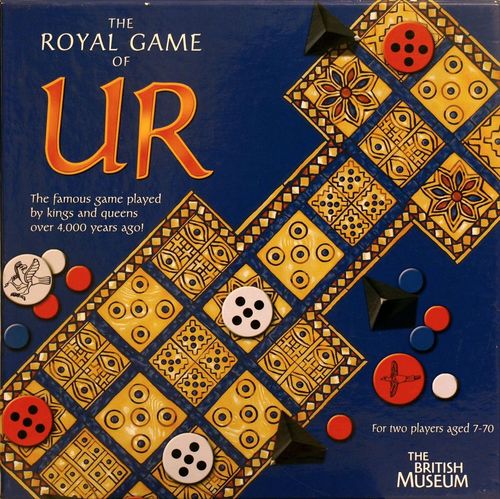
The Royal Game of Ur
The Royal Game of Ur Rulebook
Table of Contents
Table of Contents
Components
- 1 Rule Book
- 10 Stones (5 white, 5 black)
- 1 Board
- 4 Dice
- 1 Bag
2 Players • 10-20 Minutes • Ages 12+
Overview
The Game of Ur is a strategic race game for 2 players. Each player must move all 5 of their stones through the board's route before their opponent does.
Setup
Place the board onto the center of a table. Ideally, you are facing your opponent to play with the board in between both players. Each player receives their 5 stones, either black or white, and places them in their starting area. Both players will roll the provided dice – the player with the highest number will go first. The starting player only rolls 2 dice on their first turn.
Gameplay
On your turn, roll the 4 dice. The number of face-up stars you roll determines how many squares along the route you will move your stone. You can only move 1 stone each turn, and you must move as long as there is a move available. Each square can only have 1 stone on it at once.
Entering and Exiting the Board
Your stones begin their route with the square adjacent to the starting arrow on your side. For example, on your starting turn if you roll 2 stars, you should place your stone on the 2nd square in from the starting arrow. As your stone approaches the end of its route it must exit the board with the exact number needed to move off the board. For example, if your stone is in the last square in your route, you must roll a "1" to move it to your victory area. Your completed stones can be shown off together in your victory area, on either the left or right side of the board.
Board Layout
The board route has two sections: restricted and neutral. The restricted territories are squares that only your stones can go (the squares closest to you). Neutral squares are the squares along the middle of the board. When your stones are in a neutral square, your opponent can choose to "land" on you, pushing your stone off the board and back into your starting area. One exception is the square occupied by a special Rosette (see "Rosettes") in the center of the board. While occupying this square, your stone is safe and cannot be pushed off.
Gameplay Example: Below shows a game currently being won by White, 2 to 1. Black just rolled a 4, and moved a stone from their Starting Area to their first Rosette (Stone A), and gets to roll again. They now roll a 3, and have a few options: they can play another stone onto the board, move Stone A, pushing off White's stone, or move Stone B to their Victory Area by completing its route.
Rosettes
There are 5 total Rosettes on the board, but each player only has access to 3. Rosettes are special squares — each time your stone lands on one, you receive an additional roll. You also don't have to move the same stone from your previous roll. If you land on the special Rosette in the neutral area of the board, it not only gives you an additional turn, but protects your stone from being pushed off the board.
Pro Tip: If you strategize correctly, you can use several Rosettes on a single turn.
Winning
The winner is the first player to get all 5 of their stones in their victory area.
History
The Royal Game of Ur was first played in ancient Mesopotamia during the early third millennium BC. The novel game was considered popular in the Middle East, but is now enjoyed by people all over the world. Original boards have been found in places including Crete and Sri Lanka. One board, held by the British Museum, is dated c. 2600 – 2400 BCE, making it one of the oldest game boards in the world at nearly 5,000 years old. Due to the game's age and history, the rules are widely debated. This rule set combines the rules that the publisher feels bring the best strategy and experience to the players.