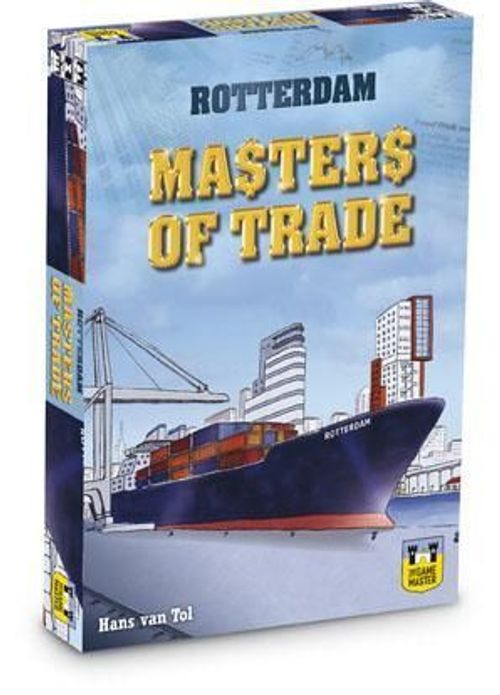
Rotterdam: Masters of Trade
Official rulebook: The Game Master BV · PDF
Rotterdam: Masters of Trade Rulebook
Table of Contents
Table of Contents
- The Game's Goal
- New Tactical and Strategic Possibilities
- Game Components
- Cruising Through the Game
- Setting Up the Game
- Preparing the Game
- Before Starting to Play Masters of Trade
- Gameplay
- Choosing and Playing Characters
- Explanation of the Characters
- The Shipping Cards
- End of the Game
- Final Scores and Declaring the Winner
- Alternative Game Plays
The Game's Goal
In Masters of Trade the players gather points by obtaining product cards and completing assignments. As soon as one of the players has 15 points worth of assignments, the game round will be completed and the player with the highest score in points wins the game.
New Tactical and Strategic Possibilities
In Masters of Trade you will recognize some of the characteristics of the original Rotterdam harbour game. But the comparison stops there – in Masters of Trade the players no longer follow the 6 game phases of the compass. They plan their own moves by placing their Dock Workers on the harbour planning board.
Additionally, in Masters of Trade the players have the following new tactical options:
- Trading raw materials to speculate or keep in stock.
- Trading products to generate cash or gather points.
- Building factories to profit from the delivery of raw materials.
- Making the same move again in one game round.
- Profiting from the fact that the product cards in the harbours are now open on the table.
- Facing more competition as the open assignments are every player's goal.
- Choosing a shipping card as they are now also open on the table.
Game Components
In order to play this game you will need the game components of the original Rotterdam game as well as the Masters of Trade components:
- 1 Harbour planning board (for 2 players, the last column is not used).
- 16 Dock Workers (4 red, 4 blue, 4 yellow, 4 green).
- 16 factories (4 colours).
- 1 Product market price survey board.
- 8 product markers for the product market.
- 1 Raw material market price survey board.
- 4 harbour overlays with factory sites.
- 15 ducats of € 5 million.
- 21 ducats of € 1 million.
- 1 Characters survey board (ship owner, captain, deck hand, discharger, trader, shipping agent, cashier, manufacturer).
- 1 set of game rules.
The component list follows the printed component illustrations; the character labels are shown on the Characters survey board art.
Cruising Through the Game
Every player gets 3 turns in every game round. The Harbour Master begins.
On every turn the player places one of his 3 Dock Workers on the harbour planning board, thus choosing and playing a character. After every player has placed his first Dock Worker, the Harbour Master places his second Dock Worker and so on.
As soon as the last player has placed his last Dock Worker the game round ends. After completing a game round the players collect their Dock Workers and the next player to the left becomes Harbour Master. Now a new game round starts by the Harbour Master placing his first Dock Worker on the harbour planning board.
The players have to navigate their ships to the right harbour in order to receive product cards every time raw material units arrive in the right harbour. By building a factory a player can profit from the delivery of raw materials by other players. So you can also earn a product card when raw materials are processed in your factory.
The raw material market is a trading opportunity for every player to make a profit or to secure the arrival of raw materials into the right harbour.
The product market is all about buying and selling product cards. For example, you could buy to complete assignments or you could sell to generate cash. Or you could buy product cards to collect victory points directly.
As soon as one of the players has 15 points worth of assignments, the game round will be completed and the player with the highest score in points wins the game. Do not forget to add to your total score the points on the product cards and the shipping cards in your possession.
Setting Up the Game
The setting-up diagram is labelled A to K, matching the components listed below:
- A Harbour planning
- B Raw material market
- C Product market
- D Assignment cards
- E Product cards
- F Factory sites
- G Shipping cards
- H Factories
- I Harbour Master
- J Dock Workers
- K Characters survey board
Preparing the Game
Each player receives the following game components:
| Number of players | Number of ships | Money | Number of Dock Workers |
|---|---|---|---|
| 2 players | 4 | € 15 million | 4 |
| 3 players | 3 | € 15 million | 4 |
| 4 players | 3 | € 15 million | 3 |
The rest of the money forms the money bank.
A Harbour planning. This planning board is where the players place their Dock Workers to choose and play one of the characters.
B Raw material market. The price survey board is placed on the left-hand side of the game board, overlaying the raw material squares. All raw material units are sorted by colour and placed on the squares of the subsequent markets. The price survey indicates the current price of the various raw materials. A first purchase of oil (black) for example costs € 1 million and a first purchase of fruit (red) costs € 2 million.
C Product market. The price survey board for the product market is placed alongside the game board. The 8 different product markers are placed on the corresponding starting squares of the survey board. For example, the bread and cookies markers are placed on the yellow starting squares of the survey board. The opening price of these products is € 5 million. The clothes and shoes markers are placed on the grey starting squares of the survey board. They have an opening price of € 10 million. As the game progresses, the change in prices must be accurately indicated on the survey board.
D Assignment cards. The assignment cards are shuffled and placed in a covered stack. The top three cards are laid open alongside the game board. These are the assignments – every player can try to complete them.
E Product cards. The product cards are sorted by harbour (= colour), shuffled and placed in a covered stack on the product card squares in the corresponding harbours. Then the top card will be revealed, so that all players can see which product is available.
F Factory sites. The four harbour overlays are placed on the corresponding harbours on the game board. The factory sites offer the players the possibility to build a factory later on in the game. As indicated by the factory symbols on the overlays, a maximum of 4 factories can be built in the Botlek and Vulcaan harbours and a total of 2 factories can be built in the Merweharbour as well as the Eemharbour.
G Shipping cards. The stack of shipping cards is placed (backside up) on the designated square on the game board. The top three cards are placed open alongside the game board.
H Factories. The factories are sorted by colour. Players can build factories after they have invested in one (= playing the Manufacturer's character).
I Harbour Master. Drawing of lots decides which player is the first Harbour Master to receive the blue pawn.
J Dock Workers. The players each get their Dock Workers. When you are with 2 – 3 players everyone receives 4 Dock Workers in his colour and when you are with 4 players everyone gets 3 Dock Workers. During the game the Dock Workers are placed on the harbour planning board to indicate which character the players choose in that game round.
K Characters survey board. Survey and explanation of the various characters and the actions they can take. There are two boards so that all players can keep track of the possibilities.
Before Starting to Play Masters of Trade
Before starting to play, each player can place one of his own ships on the starting position of his choice. Then they can take one free raw material unit from the raw material market and place it on the ship. The Harbour Master is the first to do so, then the other players follow clock wise.
Gameplay
The Harbour Master begins by placing his first Dock Worker on one of the available fields on the harbour planning board. He can choose one of the following characters and their corresponding moves:
- Ship owner: place and load 2 ships, receive 1 raw material unit and buy and/or sell raw materials
- Captain: navigate ships by twice choosing a channel colour
- Deck hand: receive 1 shipping card plus 1 shipping card for each ship in an anchor position
- Discharger: unload and produce in each harbour
- Trader: buy and/or sell products with a maximum of three transactions
- Shipping agent: complete 1 assignment
- Cashier: collect money
- Manufacturer: build 1 factory
The Harbour Master plays the character of his choice. Then the player to his left picks one of the characters and places one of his Dock Workers on the corresponding field on the harbour planning board. All players get their turn, moving clock wise.
As soon as all Dock Workers have been placed (i.e. as soon as every player has had 3 or 4 turns) the game round ends and the Harbour Master's blue pawn changes hands with the next player in line. The players collect their Dock Workers and the new Harbour Master starts the next game round by placing his first Dock Worker.
When it is your turn, you can choose and play one of the characters but you can also play one or more shipping cards in your possession. However, it is not allowed to play a shipping card that affects a ship and/or its cargo that is already in one of the four harbours (i.e. the Safe Harbour principle).
Choosing and Playing Characters
The players can choose a character when it is their turn. They are allowed to choose the same character repeatedly in one game round with one exception: the Manufacturer can only be played once per game round per player.
There is a limited number of Dock Worker places as indicated by the available fields on the harbour planning. When you are playing Masters of Trade with 2 players: there is one less field available for each character because the last column on the harbour planning will not be used.
Explanation of the Characters
1. The Ship Owner
The Ship owner can make the following moves:
- place and load ships (with a maximum of 2 ships)
- receive one raw material unit (free of charge) at the lowest price
- trading raw materials
Place and load ships (with a max. of 2). The Ship owner can place a maximum of 2 ships on the starting positions on the game board. He may place raw material units on these ships. He can take raw materials either from his own stock or he can buy from the raw material market. Just one raw material unit can be placed/transported on each ship. It is allowed to place a maximum of 1 ship on a starting position without cargo.
Receive one raw material unit free of charge. The Ship owner receives one raw material unit from the raw material market, free of charge. This has to be the unit at the lowest price. When there are more units with the same lowest price, the Ship owner can choose. This unit need not be placed on a ship and can therefore be added to the stock. A player is not allowed to keep more than 3 raw material units in stock.
Trading raw material units. The Ship owner is allowed to buy and sell raw materials. The price is determined by the number of available units on the price survey board. When a player buys a unit, the general stock decreases and the market price rises. When a player sells a unit, he receives the price that is mentioned in the next available space on the survey board. As a result the market price falls.
Players can buy and sell raw materials without limitations, as long as there are units available. Players can also sell raw materials from their own stock – however, a player cannot keep more than three raw material units in stock, regardless of their colour. The players' stocks are kept in plain sight.
Example: A player can buy a container (grey unit) for € 4 million and sell fruit (red unit) for € 2 million.
2. The Captain
The Captain chooses 2 colours which determine the direction the ships can take to navigate the Maas River.
Captain's bonus: € 1 million from the player and € 1 million from the general money stock for every ship that arrives in the right harbour.
Navigating. The Captain chooses a colour (red, yellow, green, blue or violet) to open all channels of this colour. Every ship, that lies in front of a channel of this colour, must now navigate one position forward. The Captain's ships are the first to navigate – then the other players follow clock wise.
Then the Captain chooses a colour again (this may be the same colour). Ships have to navigate the channel of this colour, unless they are blocked by another ship. When a ship is in front of two channels of the same colour, the ship's player will choose a channel. Ships cannot navigate backwards, except when a shipping card is played.
The Captain's bonus. When a player chooses the Captain's character and he leads other players' ships into the right harbour, they pay him € 1 million per ship. On top of that he receives € 1 million from the money bank for each ship. The right harbour is the harbour where the ship can deliver the raw material that can be processed in that harbour. Crude oil (black units) has to be brought into the Botlek harbour and grain (yellow units) can be processed in the Vulcaan harbour.
When a player has no cash to pay the Captain's bonus, his ship has to stay in place and cannot enter the harbour. No bonus will be paid.
If you are the Captain and you bring your own ship into the right harbour, you do not have to pay a Captain's bonus obviously and you do not receive a bonus from the money bank.
Example: The yellow player plays the Captain. First he chooses the violet channel and can move one place forward. The blue player can also move one place forward, as his ship is positioned in front of a violet channel. The blue player can now bring his ship into the right harbour: the Merweharbour. The yellow player receives a Captain's bonus of € 1 million from the blue player as well as € 1 million from the money bank.
3. The Deck Hand
The Deck hand can take one shipping card for free and every player who has a ship on an anchor position will receive a shipping card as well.
When someone plays the Deck hand, he can take one of the three uncovered shipping cards free of charge. Or he can take one shipping card from the covered stack. Then, clock wise, every player who has a ship on an anchor position can take one of the shipping cards (either covered or uncovered). When all players with a ship on an anchor position have had their turn, the open shipping cards will be completed again to three.
A player is not allowed to own more than three shipping cards. Once you have three shipping cards in your possession you cannot receive any more. You can only use a shipping card when it is your own turn.
You can, however, play several shipping cards in one turn, either before, during or after a move. Ships (and their cargo) that have arrived in a harbour are safe and can no longer be affected by a shipping card. Even your own ships cannot be affected by a shipping card.
Please note: When you play the Deck hand you can play the shipping card(s) you have just received immediately.
4. The Discharger
The Discharger oversees that:
- the raw materials of all ships that are in a harbour, will be unloaded and transferred to the factories to be processed
- the factory owners receive product cards every time raw materials are taken into their factory.
Unloading. The Discharger coordinates the unloading of every ship that enters the harbour. When a ship arrives with the right raw materials, the ship's owner receives the top product card. There need not be a factory in the harbour. The raw material unit is placed back on the raw material market and the ship returns to its rightful owner.
Production. It is possible that one or more factories have been built in the harbour where a ship is unloading. In that case the player who plays the Discharger determines in which factory raw materials will be processed. The ship's owner receives a product card plus the owner of the factory that has been assigned gets a product card too. When this is the case, the ship's owner will receive the top card of the product card stack. Then a card is handed to the factory owner – this card will remain covered!
Example: The red player plays the Discharger and determines that crude oil on board the blue ship in the Botlek harbour will be processed in the red factory. The blue player receives the top card of the product card stack and the red player will receive the next card. Had the green player been playing the Discharger, he would have had the opportunity to have the oil processed in his own (green) factory in order to receive a product card.
Unloading the wrong raw material. When a ship arrives in the harbour with the wrong raw materials, the unit cannot be unloaded (or processed in a factory). The ship's owner does not receive a product card and has to take back the ship as well as the cargo to try again from a starting position when it is his next turn. When a player already has three raw material units in stock, the returned cargo will be placed back on to the raw material market.
5. The Trader
The Trader buys and sells products with a maximum of 3 transactions.
Trading products. When playing the Trader you can buy as well as sell products:
- Selling a product: for each product sold the player receives from the money bank the current market price (as indicated on the price survey board for the product market). The relevant product marker will be moved one square to the left every time one product is sold. The product card will be placed back at the bottom of the product card stack in the harbour.
- Buying a product: for each purchased product the player pays to the money bank the current market price (as indicated on the price survey board for the product market). The relevant product marker will be moved one square to the right every time one product is bought. The player takes the product card stack from that specific harbour and looks (from the bottom upwards) for the right product card to take into his possession.
Trading regulations.
- The Trader can make up to three different transactions in one turn. Buying one or more of the same product cards is considered one transaction. Selling one or more of the same product cards is considered one transaction.
- The Trader is not allowed to buy and then sell the same product in one turn.
Top and bottom prices. The prices of cookies, bread, plastics and gasoline product cards range from € 3 million to € 7 million per card. The prices of orange juice, jam, shoes and clothes product cards range from € 8 million to € 12 million per card.
Example: A player wants to complete an assignment card for jam and shoes. He owns 1 jam product card and 2 gasoline product cards as well as € 2 million in cash. When he plays the Trader, he can sell the first gasoline product card for € 5 million and the second gasoline product card for € 4 million. He just added € 9 million to his money supply and now has € 11 million in cash. He can buy 1 shoes product card at the current market price of € 10 million and keep € 1 million in cash. In his next turn he can play the Shipping agent and complete his assignment, that is ... if no one else beats him to it! (As a result of his trading the market price for gasoline has fallen to € 3 million and the market price for shoes has gone up to € 11 million).
6. The Shipping Agent
The Shipping agent completes one assignment.
When a player decides to play the Shipping agent he has to complete one assignment by showing the right combination of product cards. The player takes the relevant assignment card into his possession and places it open on the table, for everyone to see how many victory points he has just won. Then he takes one card of the assignment card stack to complete the open assignment cards to three again. The product cards will be placed back at the bottom of the relevant product card stack in the harbour(s).
The Game Master's hint: Take good notice of the other players' moves to see if they might be trying to complete the same assignment – don't wait too long to play the Shipping agent!
7. The Cashier
The Cashier collects money (€ 3 million, € 2 million or € 1 million).
When you play the Cashier you collect money from the money bank. You receive the amount of money mentioned in the field you put your Dock Worker on. This can be € 3 million, € 2 million or € 1 million.
8. The Manufacturer
The Manufacturer builds a factory.
Investment. The Manufacturer builds 1 factory in the harbour of his choice. Building the first factory is the biggest investment – after that building factories becomes cheaper. The first factory in a harbour must be built on the first position and that price must be paid. In the Botlek and the Vulcaan harbour the first factory costs € 7 million. In the Merweharbour and the Eemharbour the first factory will set you back € 10 million. It is not allowed to build more than 1 factory per game round.
Revenues. When you own a factory, you receive a product card every time the Discharger chooses your factory to process the raw materials that have just been brought into a harbour. When you play the Trader you can sell these product cards for cash.
Productive capacity. The factory's capacity is limited to process one raw material unit into one product at a time, every time the Discharger is played.
The Game Master's hint: There is a limited number of factory sites available in every harbour, so invest in a factory as soon as you can!
The Shipping Cards
For an explanation on the shipping cards we refer to the game rules of the original Rotterdam harbour game. It is not allowed to play shipping cards on ships or cargo that are already in the harbours.
End of the Game
As soon as one of the players has 15 points worth of assignments, the game round will be completed (i.e. all players have placed all their Dock Workers) to end the game.
Final Scores and Declaring the Winner
When the game ends the final scores will be determined by how many victory points every player has collected.
For your final score you should add up:
- The victory points on your completed assignments
- The points on the remaining product cards you have in your possession
- The victory points (1 or 2) on the shipping cards you still have in your possession.
The player with the highest score wins Rotterdam Masters of Trade. If the game ends in a tie, the player with the highest score in completed assignments wins. If there is still a draw after that, the amount of cash will be decisive.
Alternative Game Plays
It is possible to play Masters of Trade in an alternative way:
- A set number of game rounds. The players go through a set number of game rounds: 6 game rounds when playing with 4 players, 8 game rounds when playing with 3 players and 10 game rounds when playing with 2 players. At the end of the last game round the player with the highest score in points wins.
- Auctioning off the Harbour Master's pawn. At the beginning of every game round the players can put in an offer to have first use of the Harbour Master in that specific game round. The highest bidder receives the pawn and can start by placing the first Dock Worker. If there are no bids, the Harbour Master is handed to the next player in line clock wise.