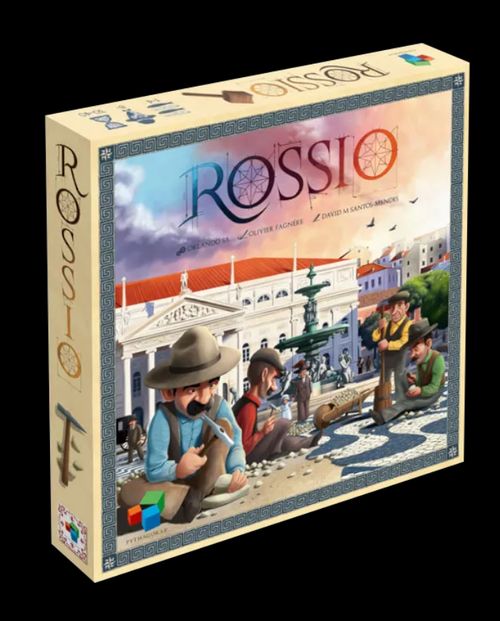
Rossio
Rossio Rulebook
Table of Contents
Table of Contents
Components
- 12 Square Pieces
- 1x Square Right Side piece
- 1x Square Left Side piece
- 5x Square Top Side pieces
- 5x Double sided Square Bottom Side pieces (Easy Mode / Hard Mode)
- Important: Use 3/4/5 top and bottom right pieces in a 2/3/4 player game. Unused pieces are placed back in the game box.
- 4 Player Boards
- 96 Calçada Tiles — 24 tiles in each color
- 66 Victory Point tokens — 26x 1, 15x 5, 16x 10, 8x 50, 1x 3 (special)
- 34 Coins — 20x 1, 14x 3
- 1 First player marker
- 59 Cards
- 40x Helpers
- 15x Solo Mode
- 4x Noble Cards (Mini-Expansion)
Setup
1 — Assembling the Square
- A. Place the left side piece on the table.
- B. Assemble all the top pieces of the square according to the number of players.
- C. Randomly pick a number of bottom pieces according to the number of players. For an easier game use more pieces showing the easy mode side. On top of the rightmost bonus of the rightmost bottom piece, place the special 3VP token.
- E. Finally, assemble the right piece of the square.
Important: Use 3/4/5 top and bottom right pieces in a 2/3/4 player game. Unused pieces are placed back in the game box.
2 — Calçada Tiles
Shuffle the 96 calçada tiles and create several face down piles.
- A. Draw 1 tile and place it on the bottom left corner of the square.
- B. Draw another tile and place it on the top left corner of the square. If both tiles are the same, discard this last one to the bottom of one of the stacks and draw another one. Repeat this until you have 2 different tiles: 1 on the top left corner and 1 on the bottom left corner.
3 — Helper Cards
Shuffle all 40 helper cards and form a facedown draw deck.
- A. Draw 4 cards from the deck and place them in a line, on the left of the deck. This is called: the market.
4 — Victory Point Tokens
Separate all Victory Point tokens by value and form several stacks (value side face up).
5 — Coins
Separate all coins by value and form two different stacks.
6 — The Player
- A. Receives a player board that he places in front of him.
- B. Draws 4 calçada tiles and places them from the left to the right on his player board, filling up the 4 spaces reserved for them.
- C. Draws 5 cards from the deck, chooses 3 to keep in his hand and discards the other 2 cards to the discard pile (D).
The player who more recently visited the Rossio Square in Lisbon, takes the first player marker. This marker never changes hands during the game.
Game Structure
Rossio is played during several rounds until 1 player triggers the end of the game by building the last tile in the square.
Players will then end that round (players who haven't played will have the chance to recruit a card) and then the player with the most points wins the game.
On a game's round, starting from the first player and going clockwise, each player performs his turn by recruiting 1 helper card from his hand, building tiles in the square and drawing a card from the market. We will describe a player's turn in detail further on.
Player Turn
On his turn, the player must perform the following 3 steps in this exact order:
- Recruiting and Activating Cards
- Building Tiles in the Square
- Drawing 1 Card from the Market and Tiles
After the player has performed these 3 steps, his turn ends and the next player's turn begins.
1. Recruiting and Activating Cards
This action is divided in two parts. First, the player must recruit one of the three cards he has in his hand and place it under his player board. Then, the player must activate all the cards under his player board, and he will either score victory points or gain coins (this depends on the side of the card that is visible). Below we explain this in detail.
Recruiting a Card
There are 3 spaces illustrated at the bottom of the player's board where cards are played. The player recruits one of the three cards in his hand and places it in the rightmost space under his player board. From the second round on, this space will always be occupied with a card, therefore, the player must first free the space by pushing the cards that are under his player board from the right to the left. Only afterwards, he places the card he wants to recruit. The cards that are expelled from the player's board are sent to the discard pile.
The player can recruit the side A or B of a card (leaving visible the side he wants to recruit). To recruit side A the player immediately pays the amount of coins indicated on the top of the card to the reserve. To recruit side B the player pays nothing. Below we explain more about side A and B of the cards. A card under a player board can never be flipped to the other side.
- Side A: shows the recruitment cost (top), a pattern (of tiles of a certain color), and the number of victory points gained when activating this side.
- Side B: shows the Rossio hammer icon; gain 1 coin when activating this side.
Activating All the Cards
After recruiting a card, the player activates ALL the cards he has under his player board. He activates them one at a time (from the left to the right).
On side A of a card is shown a pattern of tiles of a certain color. When activating this side the player counts the number of times that pattern is built in the square and gains victory points (indicated on the card) for EACH time the pattern is seen in the square.
When activating side B of a card, the player receives 1 coin from the supply.
Important
- Since the player starts the game without coins, it is mandatory that, in his first turn, he recruits the side B of a card.
When counting the patterns built in the square the player must take into account that:
- A tile scores only once for each card.
- A tile can be used to score several cards.
- It does not matter the orientation of the pattern in the square.
We recommend that the top part of the recruited cards is partially tucked under the player boards in order to hide the paid amount (side A) during the recruitment, because this amount is only paid once when recruiting the card.
Example 1
In her two previous turns, Joana recruited side B of a card (she didn't pay anything) and then side A of another card (she paid 5 coins). Joana is starting her third turn.
To recruit a card
- She slides to the left the 2 cards that are under her player board.
- She plays the card she wants to recruit in the rightmost space under her player board and pays its cost (4 coins).
To activate the cards (from the left to the right) 3. She gains 1 coin.
- She gains 4 victory points because the red pattern is repeated twice in the square (A + A) and (B + B).
- She gains 8 victory points because the blue pattern is also repeated twice in the square (C+C+C) and (D+D+D).
Joana does not score the pattern (C + E + E) because the same tile cannot be used twice to score the same card. In the future, if a blue tile is built in space F, she will form a third blue pattern (E + E + F). (this can be seen in example 2)
At the end of this phase, Joana receives 12 victory points and 1 coin.
2. Building Tiles in the Square
The player starts this phase with four tiles on his player board and he MUST build, at least, one of the tiles in the square. He builds one tile at a time and in the order they are placed on his player board (he starts from the left-most tile first and so on). At any moment during this phase, the player can (unlimitedly) change the position of two adjacent tiles in his player board, by paying 1 coin for EACH exchange made.
Building more than one tile is optional, however, to continue building, the player must build the tile (in the square) orthogonally adjacent to another tile of the same color. Each time he does so, he can (if he wants to) continue to build. If he doesn't, he cannot continue to build. The player can thus build the four tiles from his player board. When he stops building (because he can't or because he doesn't want to), he counts the amount of visible coin icons on his player board and receives the respective amount of coins from the supply.
When building a tile in the square the player must take into account the following rules:
- It is mandatory that the tile is built orthogonally adjacent to at least two of the following elements: one tile and a wall or two tiles. For this purpose, we consider the board piece on the left side and the board pieces at the bottom and top of the square as walls. For game purposes, we do not consider the board piece on the right side as a wall (the Theater piece). The piece must be built on the leftmost empty space of that row.
- The player who completes a column gains, immediately, one of the three types of bonus available. The type of bonus is specified on the bottom piece of the square.
Bonus
- Gain 1 coin.
- Draw 2 cards from the draw deck and add them to the hand. Then discard 2 cards from the hand to the discard pile.
- Gain the 3 victory points token and activate the end of the game.
Example 2
When Joana starts her building phase, she can build her first tile in one of the four spaces marked with the letters A, B, C or D. Only in these spaces can she build orthogonally adjacent to a wall and one tile (A and D) or at least two tiles (B and C). She cannot build in any of the spaces marked with an E.
Joana proceeds as follows:
She builds the yellow tile (1) orthogonally adjacent to another yellow tile. She can (if she wants) continue to build.
She continues to build and builds the next yellow tile (2) orthogonally adjacent to another yellow one. She can (if she wants) continue to build.
She could close the column and immediately win the bonus by building the red tile (3) adjacent to two yellow and one green tiles, but that would not allow her to build the blue tile (which will score points for the blue pattern indicated on one of her recruited cards).
Joana wants to build the blue tile from her player board, so she pays 1 coin to exchange the position of the red tile with the blue tile (4).
She builds the blue tile (5), closes the column and wins the bonus: she draws 2 cards, adds them to her hand and discards 2 cards from her hand (6). Joana cannot build anymore because the blue tile was not built orthogonally adjacent to another blue tile.
She gains 2 coins (7) because there are 2 coin icons visible on her player board.
3. Drawing 1 Card from the Market and Tiles
In the last phase of his turn, the player must draw ONE card from the market into his hand and then draw tiles from the stacks to refill his player board.
To pick a card from the market, the player needs to know:
- If he built one tile in the square, he must draw card A;
- If he built two tiles in the square, he can choose between cards A or B;
- If he built three tiles in the square, he can choose between cards A, B or C;
- If he built all four tiles in the square, he can choose any of the market cards (A, B, C or D);
After drawing one card, the player slides the cards of the market, from the right to the left (except if the rightmost card was taken), then draws a new card from the deck and places it in the rightmost space of the market (that is currently empty) so that four cards are again available.
The player ends this phase by sliding from the right to the left all the tiles remaining on his player board (if any). Then, the player refills his player board by drawing tiles from the stacks and placing them on the spaces left empty of his player board, filling them from the left to the right.
Example 3
In the previous phase, Joana has built three tiles. In this phase she can thus buy one of the A / B / C cards. Joana proceeds as follows:
She takes card C (1). Slides card D to the left (2) and draws a new card from the deck (3) which is placed in the rightmost space.
She slides the red tile on her player board to the left (4) and draws 3 new tiles from the stacks, refilling her player board from left to right (5).
Joana ends her turn.
End of the Game and Final Scoring
The end of the game is activated when a player builds the last tile in the square. The player who activated the end of the game immediately takes the three victory points token and his turn is completed. The players who still haven't played in that round, do so. However, they only perform the first phase of their turn: recruiting and activating cards (at this point it is no longer possible to build more tiles in the square).
The game ends immediately after the last player has completed his turn. Players count the amount of victory points they collected during the game and the player with the most points is the winner. In the event of a tie, the winner between the tied players, is the one who spent the most money to recruit the cards that are currently under his player board (only the cards with side A visible). If the tie persists, the tied players share the win and then play a new game.
Example 4
Afonso builds the last tile in the square (1) and activates the end of the game. He collects the three victory points token (2). His turn ends: he gains coins for building, draws a card and refills his player board with tiles.
In this round, Inês still has to play and perform the first phase of her turn: recruiting and activating cards. In this three-player game, Joana has already played (she is the first player) and she will not be able to play again. The game ends and players total their victory point tokens.
The Nobles (Mini-Expansion)
To play with the mini-expansion just shuffle the four noble cards together with the forty helper cards during setup. The noble cards work basically in the same way as the helper cards with the following exceptions:
- When recruiting face A of a noble card, the player does not pay any amount to the supply, however, when recruiting the card, ALL other players receive 1 coin from the supply.
- Noble cards do not specify a color, just a pattern. The player can score several patterns of different colors. Each scored pattern, however, has to be composed by tiles of the same color.
Example 5
The player receives 8 victory points because the depicted pattern on the Noble card is repeated twice in the square: (A + A + A blue) and (B + B + B yellow).
Variants
Hidden Victory Points
Players keep their victory point tokens with the numerical side face down. At the end of the game, they reveal their tokens to the rest of the players and add up the total amount of victory points.
Experienced Players
For experienced players, it is recommended that, when setting up the square (during setup), they use the bottom pieces of the square only with the hard mode face up (side marked by a red dot). The bonus coins on that side are scarcer, making it more challenging for players.
Solo
In the solo game you play against ROSS: an opponent full of tricks that will try at all costs to score the maximum victory points.
Game Setup
The square is set up in the same way as a two player game. Follow the regular setup rules with the following exceptions:
-
ROSS receives a board and fills it with four tiles from the stacks but does not draw or play helper cards during the game. During the game ROSS has his own deck consisting of twelve cards.
-
Take all 15 solo cards, separate the nine regular cards, from the three easy mode cards (with a green dot) and the three hard mode cards (with a red dot). Depending on the level of difficulty desired, randomly pick twelve cards using one of the combinations described below.
-
Easy Mode: 9 regular + 3 easy
-
Medium Mode: 9 regular + 2 easy + 1 hard
-
Hard Mode: 9 regular + 1 easy + 2 hard
-
Very Hard Mode: 9 regular + 3 hard
Shuffle the chosen twelve cards and form a deck on the right side of his player board. This deck will be used by ROSS to determine his actions.
Gameplay
The solo game takes place over several rounds. Each round the player (Human) is the first player and then ROSS plays. The player's turn is played exactly in the same way as in the multiplayer game.
On ROSS's turn, follow this procedure:
- Draw the top card of his deck and place it near his player board.
- ROSS gains the victory points of ALL of his cards visible next to his player board. The more cards ROSS has, the more victory points he receives.
- Align the drawn card on the right side of his deck: check the turn indication arrow on the back of the card at the top of his deck. It points to 1 of the 3 sections of the drawn card.
- This section will tell you how many tiles he will build in the square and which card he is going to discard from the market (on the next page we will explain how ROSS builds). ROSS does not receive or uses coins.
- He draws tiles from the stacks to refill his board (follows the same rules as a human player).
ROSS builds normally like a human player, respecting the same rules. However, he builds all the number of tiles as indicated on the section of his card, even if he doesn't build tiles orthogonally adjacent to tiles of the same color. When he builds, he follows the procedure below for each tile that he builds:
Can ROSS build the tile orthogonally adjacent to another tile of the same color?
- YES: go to step 1
- NO: proceed to step 2
1. ROSS can build the tile in the square orthogonally adjacent to similar one(s):
- 1a) If there is only one possibility to do so, the tile must be built in that space.
- 1b) If there are several possibilities, the tile must be built in the leftmost space that meets the requirements. If several leftmost spaces meet the requirements, use the priority arrow to choose which. If the arrow points from the bottom to top, he builds in the empty leftmost space from the bottom to the top. If the arrow points from the top to the bottom, he builds in the empty leftmost space from the top to the bottom.
2. ROSS cannot build the tile orthogonally adjacent to a similar tile:
- 2a) Build the tile in the leftmost space that meets the requirements. If several leftmost spaces meet the requirements, use the priority arrow to know where he builds (these rules have already been explained in point 1b).
Example 6
ROSS starts his turn by drawing a card from his deck. He receives the victory points of the three cards visible next to his player board (the one that was now drawn + the two cards that were drawn in his first two turns): 4 + 2 + 3 = 9 victory points.
The turn indication arrow on the back of the top card of his deck indicates to the bottom section of the card he draw: this section says that ROSS must build exactly three tiles and discard the third card of the market.
The leftmost tile on his player board is red. Since he cannot build orthogonally adjacent to an equal tile, he builds in space A (the leftmost available empty space). As he does not need to build orthogonally adjacent to a similar tile, he continues to build.
His next tile is also red and since he cannot build it orthogonally adjacent to a similar tile, he must build it in one of these three spaces: B, C or D. Since B is not the leftmost space, he can only build in C or D. The priority arrow says that he must build from the bottom to the top up, so in space D.
His third tile is green and he has three possibilities to be able to build orthogonally adjacent to an equal tile: E, F or G. Since E is not the leftmost space, he can only build in F or G. The priority arrow says that he must build from the bottom to the top up, so in space G.
ROSS ends his turn by discarding the third card from the market and then he refills his player board with tiles from the stacks.
Note: If you activate the end of the game, ROSS still performs his turn (draws 1 card and scores the points for all visible cards).
Win condition: You win the game if you have more points than Ross at the end of the game. In case of a tie, Ross wins the game.
Historical Information
Calçada Portuguesa is a way of paving sidewalks and public spaces with limestone and basalt stones. Many of the works are done with stones of different colors: white, black, brown or red, creating geometric or figurative elements of particular cultural interest and great beauty.
There are reports that Calçada Portuguesa may have been used for the first time in the reign of D. Manuel. The king intended to organize a parade through the city streets to show a rhino recently brought from India. So that participants did not get muddy, the streets of the city were paved.
It is true that Calçada Portuguesa, as we know it today, was for the first time built in 1842 by a group of prisoners called «grilhetas» that, by order of the governor of arms of the Castle of São Jorge, Eusébio Furtado, paved the parade of the «Batalhão de Caçadores» No. 5 at the Castelo de São Jorge. The zigzagging of the drawing became famous and later Eusébio Furtado was granted funds to carry out the first great work, paving the Rossio Square. From that moment on, Calçada Portuguesa became fashionable not only throughout the country but also in the Portuguese colonies.
Many patterns were created with Calçada Portuguesa. According to mathematicians, walking down a cobbled street in Portugal is like setting foot in mathematics, because it is made up of symmetries, rotations and translations.
Mar Largo, the pattern used for paving the Rossio Square is one of the most used. The alternating lines in white and black stones, make a parallel with the rhythm of the waves of the sea and the tides.
The «Mestres Calceteiros» (master stonemasons) are the workers who create and build the Calçada Portuguesa. This game is dedicated to all of them!