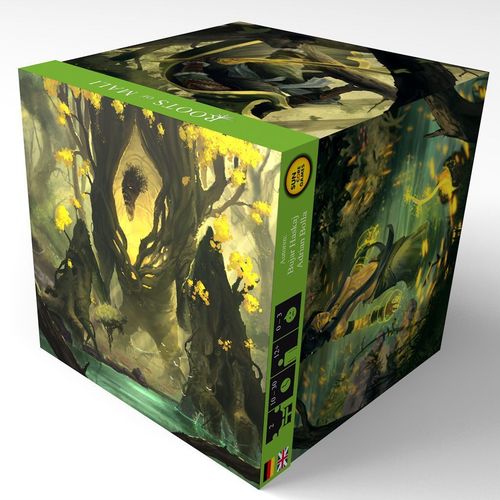
Roots of Mali
Roots of Mali Rulebook
Table of Contents
Table of Contents
Game Concept
DiceWar – Light of Dragons is the core game of the series. Tribes of all editions can be combined for more variety and refreshing gameplay. Every tribe consists of 6 diverse creatures with distinctive abilities and different Power Levels.
Winning Condition
By defeating opposing creatures, you gain Victory Points equal to their Power Level. The player to first collect 10 Victory Points wins the game.
Game Contents
- 1 Rulebook
- 6 Creature Cards
- 1 Overview Card
- 1 Location Card
- 3 Location Tiles
- 15 Red Creature Dice
- 15 Black Creature Dice
- 2 Red Indicator Dice
- 2 Black Indicator Dice
- 1 Gameboard
Game Material
Dice
Included are 2 sets of 15 dice each (red and black). They are all identical and depict the creatures of a tribe. Depending on their position on the gameboard, they are referred to as Reserve Dice, Creature Dice or Dice in Exile.
Indicator Dice
The Indicator Dice are placed at position 0 on the Victory Points Bar and Trigger Points Bar. They are used to depict gained Victory Points and available Trigger Points.
Gameboard
Each side of the gameboard consists of 7 areas: Reserve, Warlands, Supply Zone, Exile, Field Bonus, as well as the Bars for Victory Points and Trigger Points.
- Warlands (7x7 fields)
- Supply Zone
- Exile (area for Dice in Exile)
- Reserve (area for Reserve Dice)
- Field Bonus
- Victory Points Bar
- Trigger Points Bar
Creatures
Dice Symbols
Creature Dice depict all available Creatures with their respective symbol and Power Level. Clarifications are on the Creature Cards.
Hint: We recommend to keep the Creature Cards close at hand during the first few games.
Power Hierarchy
A Creature with a higher Power Level defeats all the Creatures with lower Power Level.
Exception: Additionally, Creatures with Power Level 3 defeat Creatures with Power Level 6.
The Power Levels, from highest to lowest, are 6, 5, 4, 3, 2, 1. The exception above is shown in the booklet as an arrow running from Power Level 3 back to Power Level 6.
Creature- & Location Cards
Creature Cards
Creature Cards (Figure 1) provide information about the Creatures depicted on the dice. They tell their background stories, positions in the Power Hierarchy and their special abilities.
Figure 1 labels a Creature Card as follows: Dice Symbol, Creature Name, Explanation (story), Name and kind of ability, Standard Actions & Specialities, and Power Hierarchy. The figure shows the Light Dragon card as an example of the layout only; its card text is not reproduced here.
Location Cards
Location Cards (Figure 2) provide new game variations. Their use is optional and recommended for advanced players.
Figure 2 labels a Location Card as follows: Story, Position, Location, Explanation and Location Tile. The figure shows the example Location Card "The Ruins":
The Ruins
Before the Setup Phase, the Ruin Tiles are placed as shown in the illustration below.
Alternative Victory Condition: If a player occupies all Ruins at the same time with his own Creatures, he will win the game at the end of his turn. Creatures with Power Level 1 that occupy Ruins will be put immediately into the Reserve.
Note on the transcription: the printed figure reads "illustraton"; it is transcribed here as "illustration".
Standard Actions
In each player's turn, one of the following Standard Actions is performed. They can only be carried out with one's own Creatures. Some of them have additional abilities (Specialities), which complement a Standard Action.
- Movement
- Attack
- Upgrade
- Spell
Note: The abilities of Creatures always precede the game rules.
Movement
Move a chosen Creature to an adjacent unoccupied field. Adjacent fields are positioned horizontally and vertically to the creature.
Note: Some Creatures have different movement patterns, which are described in detail on the Creature Cards.
The booklet's movement diagram shows the four adjacent fields (up, down, left and right) around the chosen Creature.
Attack
Move a chosen Creature to a field occupied by an opposing Creature. Attacks are only possible on Creatures of a lower Power Level.
Exception: Additionally, Creatures with Power Level 3 defeat Creatures with Power Level 6.
Defeated Creatures are put into the Exile. The attacking player receives Victory Points accordingly to the Power Level of the defeated Creature. The gained Victory Points are indicated by moving the Indicator Dice on the Victory Points Bar.
Field Bonus
If Creatures are defeated in the opposing half of the gameboard, additional Victory Points are rewarded accordingly to the Field Bonus.
Example: A player defeats a Creature with Power Level 3 in the opposing Supply Zone. The player receives a total of 6 Victory Points.
Power Level 3 + Field Bonus 3 = 6 Victory Points.
The Field Bonus values shown on the gameboard are +3, +2 and +1.
Upgrade
Increase the Power Level of a chosen Creature by 1.
Example: a Creature of Power Level 3 is upgraded to Power Level 4.
Hint: For a quick turn of the dice, the order of the symbols is as followed. 1-3 turn to the left, 3-4 turn down, 4-6 turn to the left.
Spell
Use the Spell of a chosen Creature.
Spells which require Reserve Dice can only be cast, if there are enough dice in the Reserve.
Some Spells use the Trigger Points Bar. It indicates the strength or other effects of a Spell.
Note: Some Creatures do not have Spells.
Special Abilities
As an addition to Standard Actions, some Creatures possess special abilities.
Specialities
Specialities are passive (Non-Standard Actions) and can affect both players. They are described in detail on the Creature Cards.
Gameplay
Preparation Phase
- The players put the gameboard between them. They should leave enough space for additional game material around it.
- Each player chooses one tribe (one set of dice).
- All 15 Creature Dice are placed into the Reserve on the right side of the gameboard.
- The Indicator Dice are placed on position 0 on the Victory Points Bar and the Trigger Points Bar.
- Roll a dice each to determine who starts. The higher number starts (reroll when tied).
Setup Phase
The starting player puts any number of dice in his Supply Zone until it consists of Creatures with a total Power Level of 10. Then, the opposing player sets his starting lineup.
Example: Player 1 sets a Creature of Power Level 4 and one with Power Level 6. With a combined Power Level of 10, Player 1 finishes the Setup Phase. After that, Player 2 sets Creatures with Power Levels of 2, 3 and 5 respectively. Their combined Power Level is 10 and Player 2 finishes the Setup Phase.
War Phase
- The starting player opens the game by performing 1 Standard Action.
- After this, the players perform alternately 1 Standard Action per turn.
- The player to obtain 10 Victory Points first wins the game.
Glossary
- Victory Points (icon: ship)
- Trigger Points (icon: swoosh)
- Opposing Creature (icon: skull)
- Threatening opposing Creature (icon: red skull)
- Immune against opposing Attacks (icon: red shield)
- Immune against opposing Spells (icon: purple tablet)
- Immune against opposing Specialities (icon: blue arc)
Opposing Creatures: All Creatures under your opponent's command in the Warlands.
Your Own Creatures: All Creatures under your command in the Warlands.
Friendly Creatures: All your own Creatures except the chosen one are considered friendly.
Virtual Victory Points: Virtual Victory Points are counted the same way as gained Victory Points in combat. However, they are not displayed on the Victory Points Bar.
Adjacent: The horizontal and vertical neighboring fields.
Diagonal: The diagonal neighboring fields.
Surrounding: The horizontal, vertical and diagonal neighboring fields.
The glossary also shows diagrams of the Adjacent, Diagonal and Surrounding fields, and a 7x7 Warlands diagram labelled Opponent Zone (top) and Your Zone (bottom).