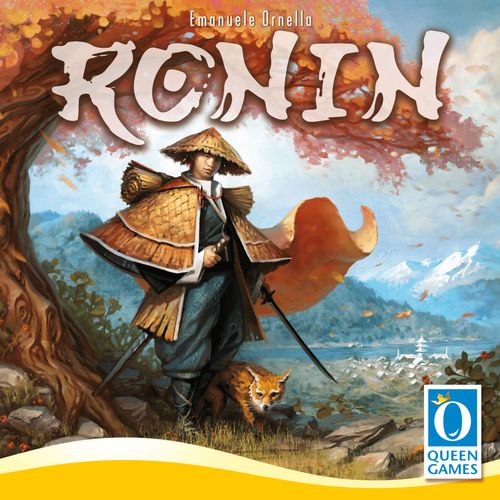
Ronin
Ronin Rulebook
Table of Contents
Table of Contents
Game Components
- 1 game board with victory point track, three-part
- 1 storage board, two-part
- 5 player boards in 5 colors
- 21 action tiles: 15 single action tiles, 6 double action tiles
- 54 mission cards
- 27 bonus tiles: 9 in each of three colors
- 30 character tiles
- 35 clan tiles: 5 each with seven different symbols
- 20 meditation tiles
- 25 Ronin figures in 5 colors
- 65 resources: 10 yellow coins, 12 red swords, 13 green porcelain, 14 blue fish, 16 white rice
- 5 tea markers in 5 colors
- 25 castles in 5 colors
- 5 victory point markers in 5 colors
- 1 round marker
- 1 starting gate
- 1 cover tile
- 1 bag for resources
Game Preparation
The rules and game preparation for 2-5 players are as follows.
-
Join the three game board pieces together to form one large game board and place it in the middle of the table. If you are playing with two or three players, cover the location Myazaki in region 10 with the cover tile.
-
Join the two parts of the storage board together and place it next to the game board.
-
Shuffle the mission cards and place them face down on the corresponding space of the storage board. Place the top four cards face up on the four spaces next to it.
- Note: If you are playing with three players, put the cards with "2/3" on the right edge back into the box. In a two-player game, the cards with "2" on the right-hand side are also put back in the box.
-
Shuffle the character tiles and place them face down in a pile on the corresponding space on the storage board. Place the top three tiles face up on the three spaces next to it.
-
Shuffle the bonus tiles separately according to the three colors and place them in a face down stack on the corresponding three spaces on the storage board.
- With 5 players: return the top tile of each color to the box.
- With 4 players: return the top two tiles of each color back into the box.
- With 2 or 3 players: return the top four tiles of each color back into the box.
-
Place the meditation tiles in the corresponding space on the storage board.
- With 5 players: 20 tiles
- With 4 players: 16 tiles
- With 2 or 3 players: 12 tiles
Important Note: The resource spaces with horse heads are only used when playing with two players. More information on page 9 (see The Game for Two Players).
Gameplay
Ronin is played in four rounds, each with four phases.
- Phase 1: Place Ronin in the cities
- Phase 2: Collect resources
- Phase 3: Complete missions
- Phase 4: End of round
After phase 4, phase 1 begins again. At the end of the 4th round, final scoring takes place.
Phase 1: Place Ronin in the cities
If you have the start gate, you begin. The others follow clockwise. Choose one of your Ronin and place him in an empty city on the game board.
Important: Only when playing with five players is it allowed to have a maximum of two figures of different colors stand in a city that has a duplicate action tile at the same time.
Example: Yellow places a Ronin on an empty city.
Ronin without character ability
Immediately afterwards, you may perform the action indicated on the action tile of the selected city. If there is a tile with a double action, you choose one of them. Then the action tile used is turned over to the reverse side.
Alternatively, you can forego the action and immediately receive two victory points. In this case, the action tile is not turned over.
The actions are described on page 8 (Overview of actions).
Example: Yellow has the choice between "Take a meditation tile" or "Build a castle." He chooses the meditation tile and places it on his tableau. Then Yellow flips the action tile.
Ronin with character ability
If you choose a Ronin with a character tile, you may use their ability. Some character abilities can only be used in conjunction with a specific action.
If you do not use the character ability, you may use the action tile of the city as normal. If you do not use either, you receive two victory points as usual.
The character abilities are described on pages 10 and 11.
Then it is the next player's turn, who places a Ronin of their color in an empty city. Once all Ronin have been placed on the game board, phase 1 ends.
Example: Red has the "Horseman" character. With this ability, he may place his Ronin on a resource. He chooses the "Swords" resource in region 9.
Phase 2: Collect resources
Starting with region 1, you now check everyone's influence on the region. The influence and thus the order in which you can collect a resource in a region is based on the number of your Ronin in cities bordering that region.
If you have also built a castle in this region, your influence increases by 1. A castle alone in a region has no influence.
The player with the most influence in a region collects first and therefore has more to choose from. This is followed by the player with the second largest influence and then in some regions, the third largest influence.
In the event of a tie, the player who is further ahead on the tea track collects first.
When it is your turn to collect, you may choose exactly one resource from that region. This also applies if you are the only person with influence in that region.
Each collected resource is placed on the corresponding space of your game board. During this phase, there is no limit to the number of resources you can place on your game board. In phase 4, however, you may have to remove resources.
Resources that have not been collected will remain in that region for the next round. It may also happen that your influence in a region is so low that there are no resources left for you.
Example: Region 1 is checked. Red has one Ronin in Hirosaki and one in Hachinohe. Yellow has one Ronin in Akita and has built a castle in the region. Red and Yellow have equal influence in Region 1. Since Yellow is ahead of Red on the tea track, Yellow may choose a resource first, then Red collects the last resource.
Phase 3: Complete missions
Now you can fulfill one or more mission cards that you have in your hand. If you have the start gate, you begin. The others follow in clockwise order.
To complete a mission, you must have the resources shown on the card on your player board and have a Ronin in at least one of the two cities shown on the mission card.
You receive the victory points shown next to the resources. You only receive the victory points next to the cities if one of your Ronin is standing in that city.
You may replace one resource per mission card once with a meditation tile.
Resources used for mission cards are placed next to the game board. They only return to the bag when it is empty. Used meditation tiles are returned to the storage board.
Example 1: Blue has this mission card in their hand and wants to complete it: Blue discards 1 rice, 1 porcelain, and 1 coin resource. Their ronin is in Edo. They have thus completed the mission. Blue receives 7+6= 13 points.
Example 2: Red has this mission card in their hand and wants to complete it: Red pays 1 rice, 1 porcelain, and 1 fish resource. Two of their ronin are in Osaka and Hirosaki. They have thus completed the mission. Red receives 6+2+6= 14 points.
Example 3: Yellow has this mission card in their hand and wants to complete it: Yellow gives up 1 rice, 1 sword, and 1 fish resource. Instead of the coin resource they do not have, Yellow gives up a meditation tile. Two of their ronin are in Akita and Matsuyama. They have thus completed the mission. Yellow receives 10+2+2= 14 points.
Bonus tiles
The completed mission card is placed at the top of your game board according to its color. If you have two identical or the three different mission symbols of one color, you may immediately take the stack of bonus tiles of the same color from the storage board.
Choose a bonus tile and place it face down next to your player board. You may view your face-down bonus tiles at any time. The remaining tiles are placed back on the storage board as a face-down stack. You may have as many bonus tiles as you like. At the end of the game, you receive bonus points for the bonus tiles you have.
These are the bonus tiles (shown in blue as an example):
- 3 points for each resource (maximum 15 points) on your player board.
- 4 points for each character tile on your player board.
- 9 points.
- 2 points for each of your own castles in a region.
- 4 points for each meditation tile on your player board.
- 3 points for each bonus tile (for a maximum of 15 points) that you have at the end of the game.
- 5 points for each set of 3 mission cards in different colors (for a maximum of 15 points).
- 2 points for each clan token on your player board.
- 1 point for each mission card, completed or in your hand (for a maximum of 15 points).
Phase 4: End of round
At the end of the round, the number of your meditation tiles and resources are checked and the regions are replenished. If you have the start gate, you begin. The other players follow clockwise.
Note: At the end of the fourth round, only the first two points are resolved.
- If you have more than three meditation tiles, return any excess tiles to the supply.
- If you have more than four resources, excess resources must be placed next to the game board. You may choose which ones you want to keep.
- Remove your Ronin from the game board and place them back on your player board.
- Move the round marker to the next space.
- The start gate is given to the next person in clockwise order.
- Note: In a three-player game, the start gate is given to the player with the fewest points at the end of the third round. In the event of a tie, the gate is given to the player who is furthest behind on the tea track among the players involved in the tie.
- Fill the empty resource spaces starting with region 1 on the game board with randomly drawn resources from the bag. If the bag is empty, refill the bag with the resources set aside earlier and distribute the remaining resources.
End of the Game
At the end of the 4th round, the game is over and final scoring takes place. You receive points for your own castles in adjacent regions.
| Number of neighbouring castles | 1 | 2 | 3 | 4 | 5 |
|---|---|---|---|---|---|
| Points | 1 | 3 | 6 | 10 | 15 |
You can score multiple rows, for example, a row consisting of two neighboring castles and a row consisting of three adjacent castles. This earns you 3 + 6 = 9 points.
If you have bonus tiles, you receive the points indicated on the tiles.
The player with the highest score wins. In the event of a tie, the player who is further ahead on the tea track wins.
Example scoring for red: At the end of the fourth round, the marker is on space 95 of the victory point track. Red has a row of five adjacent castles and receives 15 points for this. In addition, Red has the bonus tile, which is worth 9 points at the end of the game. Red has a total of 95+15+9=119 victory points.
Overview of Actions
Meditation tile
Take a meditation tile from the supply and place it on the corresponding space on your player board.
Mission cards
You may take 1-4 mission cards from the display and place them in your hand.
- The card on the far right of the display is free.
- The two cards in the middle of the display each cost one meditation tile each.
- The card on the far left of the display costs two meditation tiles.
It is not possible to take a card from the deck.
At the end of the action, the cards that have not been taken slide to the right and any empty spaces are then filled from right to left with open cards from the deck.
Example: If you want to take the 1st and 4th mission cards into your hand, you must discard two meditation tiles. Then move the two remaining cards to the right and fill the empty spaces in the display from the draw pile.
Clan tile
Take the clan tile shown on the action tile from the supply and place it on the first free clan space on your game board, starting from the left. You receive the points indicated there.
Note: You may only collect different clan tiles.
Castle
Place one of your castles on a free castle space in any region, regardless of which city you placed your ronin.
Only one of your castles may stand in each region. In a three-player game, only one castle may be placed in a region.
If you have castles in neighboring regions, you receive bonus points at the end of the game.
Tea
Move your tea marker one space forward on the tea track. In addition, for each meditation tile you currently have, you may move one space forward. You do not discard your meditation tiles for this, you just need to have them. On certain spaces on the tea track, you can perform actions, if you stop on them or move over them. If you don't perform the action, you immediately receive two victory points.
This track is also used to break ties. Whoever is furthest ahead is the first to act in the event of a tie. Tea markers on a space are stacked. The marker on top of a stack is in front.
Note: The markers are no longer stacked on the last space of the tea track. Whoever gets there first stays in front. The other markers are lined up behind them.
Example: You have two meditation tiles on your player board, so you move three spaces forward on the tea track. Your marker moves to the space with the mission card symbol, so you can perform this action immediately.
Character
Take a character tile from the display. Then replace it with the top tile from the stack. Place the taken tile on any Ronin space on your game board. If you place it on a space where there is already a Ronin, you can use the character ability in the same round.
If you have filled all Ronin spaces, you can replace your current character tile with a new one. The replaced character is then removed from the game.
The Game for Two Players
In a two-player game, there is a neutral player named Sakura, who does not collect victory points but can block you.
Once you have completed the game setup for two players, place the following materials in a neutral color for Sakura:
- 4 Ronin
- Tea marker
Place Sakura's tea marker on the last space of the tea track.
Phase 1: Place Ronin in the cities
This phase is played largely according to the familiar rules. However, after your 1st and 2nd moves, place a Ronin from Sakura on an empty city space and block it for the rest of the current round.
Sakura does not perform any actions and the action tiles will not be turned over.
Phase 2: Collect resources
Carry out this phase according to the usual rules. In case of a tie, Sakura always has the advantage because her tea marker is at the end of the tea track.
However, Sakura only receives the resource that is on the resource space with the horse head symbol. The resource is then removed from the game. If there are no resources on this space, because the resource was previously collected by one of you, Sakura does not receive a resource.
Example: Sakura has more influence on the purple region than Green. Sakura receives the coin resource because it is on the horse head.
Phase 3: Complete missions
Complete this phase according to the familiar rules. Sakura does not fulfill any mission cards.
Phase 4: Actions at the end of the round
Complete this phase according to the rules you already know. The player with the fewest points receives the start gate. If there is a tie, the person who is behind on the tea track receives the start gate.
Overview of Character Abilities
Merchant
At the end of phase 4, you may keep up to eight resources on your player board. (The restriction on meditation tiles remains.)
Fighter
This Ronin is placed lying down. When checking influence in the adjacent regions, this Ronin counts as two figures. However, you still only perform the city action tile once.
Commander
If you place this ronin in a city, you may execute any action tile from a neighboring city (occupied or not). The action tile used there is then turned over. A neighboring city is the next city along a region border.
Alchemist
If you place this Ronin in a city, you may draw five random resources from the bag and exchange as many of them as you wish with the resources on your player board. Then place four resources back into the bag. After the exchange, you have one more resource than before.
Apprentice
You may place your Ronin figure in any city where there is already a figure of a different color. You can also ignore the student ability and place the Ronin figure in an empty city.
Horseman
You do not place this Ronin in a city, but directly on a resource in any region. You can now carry out an action from a city that borders this region, even if it is occupied. Flip the action tile of the action used as usual.
In phase 2, this ronin only has influence in the region where he is located. If you are allowed to take a resource in this region, you don't take the resource on which your figure stands, but another one. Only when all unoccupied resources in this region have been distributed, do you take the resource occupied by your figure. No one else may take the occupied resource.
Note: This Ronin cannot be used in Phase 3 to fulfill Mission Cards.
Scout
You do not place this Ronin in a city, but on a region border between two neighboring cities. You can now perform an action from one of these two cities, even if they are occupied. Flip the action tile of the action used as usual.
In phase 2, the ronin figure "Scout" has influence over both neighboring regions. In phase 3, a figure with the "Scout" ability can be used to complete missions in both neighboring cities.
Traveler
You do not place this Ronin in a city, but in a region (not on a resource). You can now perform an action from a city that borders this region, even if it is occupied. Flip the action tile of the action used as usual.
In phase 2, this ronin only has influence in the region where he stands. In phase 3, this Ronin can be used to fulfill Mission Cards in any of the cities adjacent to that region.
Scholar
If you place this Ronin in a city, you immediately receive three victory points.
Monk
If you place this Ronin in a city with the action marker of a specific clan tile, you may take a clan tile of your choice from the supply.
Teacher
If you place this Ronin in a city with the character action marker, you may choose any character tile from the display or from the stack. If you take a character from the stack, shuffle it afterwards.
Example: You don't like the three character abilities in the display. You take the stack, look at all the tiles, and then choose one. You place it on any Ronin space on your game board. Then you shuffle the draw pile and place it back in its place.
Hermit
If you place this Ronin in a city with the meditation action marker, you receive a meditation tile. In addition, you may place any of your resources to the supply to receive the same amount of meditation tiles. If you have no resources that you can or want to exchange, you cannot use this ability.
Architect
If you place this Ronin in a city with the castle action marker, you can place your castle in any region, even if there are already two castles there (one castle if there are three players). If your castle is the first one, place it on both castle spaces to indicate that no further castles may be built in this region.
Magistrate
If you place this Ronin in a city with the Mission Card action tile, the second Mission Card from the right in the display is also free for you.
Example: You want to take all four mission cards in the display in your hand, then you only have to give up three meditation tiles instead of four.
Tea Master
If you place this Ronin in a city with the Tea Symbol action marker, you move one space forward on the Tea Track. You can then perform the tea action as usual, as described on page 8.