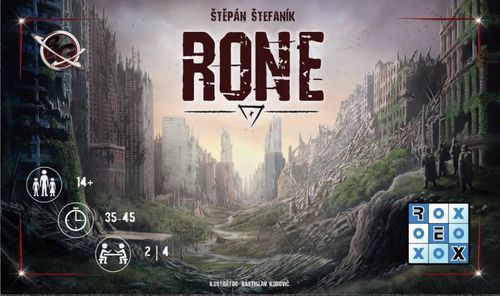
RONE
RONE Rulebook
Table of Contents
Table of Contents
Components
Your copy of the "RONE: Races of New Era" starter set should include the following components:
- Rulebook
- 4 water dials
- 20 damage/health tokens
- 10 melee attack tokens
- 10 ranged attack tokens
- 156 cards
Components Overview
Water Dials
There is only one resource in the game – water. All available water creates a player's water pool, and these dials help players track the amount of water that's available to them during the game.
Players are not limited to only 19 water. In the rare case that a player has more than 19 water they can just continue to rotate the dial to track water. In this case the 0 would be 20, 1 would be 21, etc. To indicate totals higher than 19 you can put any token on the dial.
Damage/Health Tokens
Players place these tokens on units to help keep track of health or damage and can be used in two ways:
- With the damage side visible as an indicator of how much damage the target unit has taken. Each token represents 1 damage.
- With the health side visible as an indicator of the remaining health of the target unit. Health tokens are generally useful when a unit's health exceeds its basic health amount. Each token represents 1 health.
For example, if a player has a unit with 3 health and it takes 1 damage, the player can place 2 health tokens on it to indicate that the unit has 2 health left; or they can place 1 damage token on it to indicate that it has taken 1 damage.
Melee Attack Tokens
These tokens represent the modification of a target unit's melee attack and can be used in two ways:
- With the purple colored side visible as an indicator that the unit has a bonus of 1 more melee attack damage for the next combat.
- With the gray colored side visible as an indicator that the unit has 1 less for their melee attack damage for the next combat.
Ranged Attack Tokens
These tokens represent the modification of a target unit's ranged attack and can be used in two ways:
- With the red colored side visible as an indicator that the unit has a bonus of 1 more ranged attack damage for the next combat.
- With the gray colored side visible as an indicator that the unit has 1 less for their ranged attack damage for the next combat.
Cards
The RONE starter set features 156 cards that are playable right out of the box.
Common Card Anatomy Key
- Level: Represents the level of the card. Indicates what level a player's hero must be in order to play or recycle the card.
- Activation cost: The amount of water a player must spend, from their water pool, in order to play the card.
- Recycle cost: The number of cards, from the top of a player's graveyard, a player must remove from the game in order to recycle the card.
- Name: The name of the card.
- Edition symbol: Cards with the same symbol create a complete edition. This symbol has no influence on the game and is useful only in identifying cards from different editions.
- Card type: The type of the card (Hero, Technology, Unit, Tactic), which determines the basic behavior of the card.
- Card subtype: Subtypes appear only on unit and hero cards and indicate which race the unit/hero belongs to.
- Game text: Special abilities unique to this particular card. If any text is written in italics it is considered "flavor text" and has no game influence, it just provides you with additional information about the game's story.
- Illustrator: Illustrator's name.
- Card number: This number has no influence on the game and is useful only in identifying the card by its number, not by the card's name (e.g., in multi-language communication, etc.).
There are four different types of cards divided into two categories: Permanents (Heroes, Technologies and Units) and One-time effects (Tactics).
Permanents
Permanents are cards which enter the battlefield, after they are played or recycled, and stay there until they are destroyed or removed from the game. Permanents can have Activated abilities which require a player to rotate the card by a certain amount of exhaustion phases – each exhaustion phase is expressed by rotating the card 90° clockwise. After a card uses its Activated ability it is exhausted X times (i.e. rotated X times 90° clockwise), where X is the exhaustion cost of this ability. In order to help players deal with this unique mechanism, Permanents are equipped with rotation symbols on three sides of the card. This is to help players easily distinguish how many times the card is currently exhausted.
Permanent Card Anatomy Key
- First rotation symbol: If a card is rotated with this symbol toward the player (rotated 90° clockwise) it indicates that it is exhausted 1 time.
- Second rotation symbol: If a card is rotated with this symbol toward the player (rotated 180° clockwise) it indicates that it is exhausted 2 times.
- Third rotation symbol: If a card is rotated with this symbol toward the player (rotated 270° clockwise) it indicates that it is exhausted 3 times.
Active state
If a card is not exhausted (i.e. positioned with the illustrator's name toward the player) it means it is active and can perform its Activated ability.
One-Time Effects
One-time effects, or Tactics, are cards which are placed in the discard pile (in this game called the "graveyard") after they are played and their effects have been executed. This card category is easily distinguishable from the other types because it does not have any rotation symbols.
Hero Cards
Each player chooses to play as one hero, which is represented by three cards that show the abilities of the hero at the 1st, 2nd and 3rd level. Hero cards are placed on the battlefield at the beginning of the game and provide players with a unique set of abilities and income.
A player's hero starts at the 1st level and can be leveled up by paying their Activation cost. Once a player's hero levels up, their current hero card is swapped with the next level card. The position and exhaustion phase of the hero remains unchanged when it is leveled up.
Hero Card Anatomy Key
- Water income: Represents the amount of water a player's hero generates at the beginning of each of their turns.
- Card income: Represents how many cards a player may draw at the beginning of each of their turns. Players do not have to draw any cards if they do not want to, or they can draw as many cards as they want, up to and including the number of the Card income.
- Economic ability: Each hero has a basic Activated ability which allows them to gain additional water or a card.
- Passive ability: Each hero might be equipped with a Passive ability that triggers under certain circumstances (e.g., when a player's unit dies, deals damage to an enemy hero, etc.).
- Activated ability: Each hero might also be equipped with an additional Activated ability.
Unit Cards
When on the battlefield, units can participate in combat with other units or heroes by either attacking or defending. Unit cards are easily distinguishable since they are the only cards with health, melee, and ranged attacks.
If a unit's health is reduced to zero, or less, it is destroyed and goes immediately into the graveyard.
Unit Cards Anatomy Key
- Health: Represents the starting health amount of the unit. The amount of health can be increased or decreased during the game. Health may be increased above the starting value.
- Melee attack: The amount of melee damage the unit deals to other cards.
- Ranged attack: The amount of ranged damage the unit deals to other cards.
- Attack speed: A yellow colored rotation symbol represents how many times a player has to exhaust the unit if they want to declare an attack with it.
Technology Cards
Technologies are like wild cards. All of the cards in a player's technology deck are available for use from the start of the game. It is up to the player to determine the right time to play them and put them on the battlefield. These cards do not count as cards in a player's hand, even though they can hold them as part of their hand.
When an effect takes a technology off the battlefield (e.g., returns it to the player's hand, their graveyard, or their deck), it is placed back into their technology deck instead.
A player can have a maximum of 3 technologies on the battlefield at any given time. Once played, a technology cannot be replaced (unless it is removed from the battlefield by some other effect). Players should carefully choose which technology to play and when to play it.
Tactic Cards
Tactics are one-time effects that can be played at any time in reaction to anything happening in the game (attack declaration, another tactic activation, etc.).
Special Icons in Game Text
Water Icon
Represents water, which is used to pay for card activations or Activated ability costs.
Card Icon
Represents drawing the top card from the player deck and putting it into the player's hand.
Melee Attack Icon
Some cards have this icon in their Game text. The text will include the amount to raise or lower the melee attack value of the target unit for the next combat.
Ranged Attack Icon
Some cards have this icon in their Game text. The text will include the amount to raise or lower the ranged attack value of the target unit for the next combat.
Health Icon
Some cards have this icon in their Game text. The text will include the amount to raise the health value of the target unit. It can raise the amount of health above the starting value.
Recycling Icon
Some cards have this icon in their Game text. This icon refers to the removal of the top card of a player's graveyard from the game. The text will indicate the number of cards to remove from the game.
Activated Ability Icons
Activated ability icons appear in two colors, yellow and purple, and are connected with the rotation symbol of the same color on the card. The number inside represents how many times a player has to exhaust a card to use the Activated ability. Activated abilities can only be used when a card is in an active state. After activating an ability, the card is rotated so that the rotation symbol of the same color as the Activated ability is toward the player.
Game Zones
The Player Deck
A player's deck includes a combination of units and tactics and can contain up to 24 cards. Players draw their cards from the top of this deck throughout the game.
There is no penalty when a player has to draw a card and there are no cards left in their player deck. In that case, the player does not draw a card.
The Player's Hand
Each card a player draws goes into their hand, from which it can then be played. There is no limit to the number of cards a player can hold in their hand.
The Hero Deck
The hero deck consists of three cards which show the abilities of the hero at the 1st, 2nd and 3rd level. The top card of this deck represents the current level of the hero. Only cards with the same name are allowed in this deck. Combining different heroes to form the hero deck is not allowed.
The Battlefield
Each permanent (hero, unit, technology) card is placed on the battlefield, after playing or recycling, and stays there until it is destroyed or removed from the game. Each recycled permanent is exhausted 2 times after it is placed back on the battlefield.
The Graveyard
Every card, after it is destroyed (from the battlefield or the player's hand), is placed in its owner's discard pile face up – in this game called the graveyard. Once a card goes into the graveyard, the player (owner of the graveyard) can decide if it goes on the bottom or on the top of their graveyard. Players must choose wisely where they place their cards, because only the top card of their graveyard can be recycled.
The Technology Deck
The technology deck can contain up to 5 technology cards. These cards are available to the player from the start of the game and, together with a hero, are essential cards for creating the core strategy of your play. Cards in the technology deck do not count as cards in a player's hand.
Any technology card in a player's technology deck can be played during the main phase of their turn, provided they pay the indicated Activation cost.
A player can have a maximum of 3 technology cards on the battlefield at any given time. Once played, a technology cannot be replaced (unless it is removed from the battlefield by some other effect).
Basic Game Principle
Lifebound System
The number of cards in a player's deck and a player's hand is directly connected to the health of their hero. Each damage point inflicted on a hero requires the player to destroy one of their cards, either from the top of their deck or from their hand. All destroyed cards go into the player's graveyard. Once a player loses all cards from their deck and hand, they lose the game.
For example, if a player attacks an enemy hero with a unit that has 1 melee attack and 1 ranged attack, this unit does 2 damage (1 melee + 1 ranged) to the enemy hero, and the attacked player must destroy 2 cards. They can choose any combination of cards to destroy, for example:
- Destroy 1 card from their hand and destroy 1 from the top of their deck.
- Destroy 2 cards from their hand.
- Destroy 2 cards from the top of their deck.
For the First Game
For the first game, we highly recommend not using technologies. Technologies have a more complex impact on the game and sometimes use advanced abilities. Without technologies it is easy to slip into the game and familiarize yourself with its basic principles.
Playing the Game
Game Setup
Before you start playing RONE, follow these quick steps to get setup:
- Prepare Player Decks. Shuffle all of the player cards (unit and tactic cards) and randomly create each player's deck by drawing 24 playing cards for each player. Next, shuffle each player's deck separately and then put the deck face down on the playing field.
- Prepare Hero Decks. Each player randomly chooses a hero (players can chose which hero they want to play, but a random pick is preferred) and places their hero deck face up on the battlefield with the 1st level hero on top. The 2nd level and then the 3rd level hero cards are placed beneath the 1st level hero card.
- Prepare Technology Decks. This step is optional and is not recommended for beginning players. To prepare the technology decks, randomly create a technology deck for each player that contains up to 5 technology cards. Each player then places their technology deck face down on their playing field.
- Determine First Player. Randomly determine which player will be the first player.
- Setup Starting Water Resources. The first player sets their starting water resources to 0 and the second player sets their starting water resources to 2.
- Draw Starting Hand. Each player draws 6 cards from the top of their player deck.
- Mulligan Rule. In case a player is not satisfied with the cards in their hand they may choose any number of cards from their hand and put them on the bottom of their player deck, in any order, and then draw the same number of cards so that they have exactly 6 cards in hand. Or, they may shuffle all 6 cards back into their player deck and then draw 6 new cards so that they have exactly 6 cards in hand. Players can use the mulligan rule only once per game.
Round Sequence
RONE is played over a series of rounds. Each round players alternate turns. Each turn is divided into 5 phases. These phases are in the following order:
- Beginning of turn phase
- Income phase
- Refresh phase
- Main phase
- End of turn phase
Once all 5 phases of the first player's turn are complete, the turn is over and the second player takes their turn. After both players have taken their turn, the round is over and a new round is started. The player whose turn it is is called the "active player".
Beginning of Turn Phase
Some cards on the battlefield can have effects that are triggered at the beginning of a turn. The active player has to execute all these effects in any order.
Income Phase
During this phase, the active player adds X water resources to their water pool (where X is the number on their hero card in the water income section), and may draw up to X cards (where X is the number on their hero card in the card income section).
Refresh Phase
Each card on the battlefield controlled by the active player is refreshed 1 time, i.e. rotated counter-clockwise 90° (e.g., rotated from 3 times exhausted to 2 times exhausted, from 2 times exhausted to 1 time exhausted, or from 1 time exhausted to the active state).
Main Phase
Players can play cards and use their card's abilities during the main phase. Here is a list of possible actions a player can take, divided into two categories - fast effects and slow effects.
Fast Effects & Stack
- Play tactic cards
- Execute an Activated ability
Fast effects can be played anytime, even during an opponent's turn or in reaction to anything happening in the game. When effects are played they are placed in an imaginary "Stack" and, after no one wants to add an additional effect to the Stack, they are executed from the last to the first. So, the very last effect will be executed first.
For example, if a player has a unit with one life and then plays an effect that adds 1 life to it, an opponent can react with a fast effect that deals 1 damage to that unit. Now, let's say that there are no more effects to add to the Stack, these effects will now be executed in reverse order. Since the damage effect was played last, it is now executed first and causes 1 point of damage to the unit, which effectively destroys it. The next effect in the Stack is the health effect. However, since the target unit has already been destroyed, this effect cannot be executed.
On the other hand, if the effects were played in reverse order (i.e. first 1 damage to the unit and then add 1 health in reaction to the damage), the unit would receive 1 additional health first, and then one damage. So, the unit would still be alive and have 1 health left.
Slow Effects
- Play unit cards
- Play technology cards
- Level-up a hero
- Recycle unit cards
- Recycle tactic cards
- Declare an attack
- Declare end of turn
Slow effects can only be used during a player's turn. Slow effects cannot be used during combat. Slow effects cannot be executed as a reaction to any other effect waiting to be executed or any player's move or decision.
When a slow effect is played, if no other players want to react by playing a fast effect, then the slow effect is executed. However, if players react by playing one or more fast effects those effects are placed on the Stack. After all effects have been played the Stack is resolved and if all conditions for the original slow effect are met then it is executed, otherwise the effect is discarded.
Play Cards
Cards can only be played from a player's hand or from their technology deck. In order to play a card, the player must pay for it by spending water from their water pool. The number of water spent is equal to the Activation cost of the card.
A player's hero has to be at least the same level as the level of the card that is played. No one can play a higher level card than their hero.
Cards with an Activation cost of zero do not require any water to be spent, but they still require the level of the player's hero to be at least the same level as the level of the card being activated.
If the Activation cost of the card is grayed out, it can't be played.
Play Unit Cards
After a player plays a unit card from their hand, they place it face up and in an active state on their battlefield.
Play Technology Cards
After a player plays a technology card from their technology deck, they place it face up and in an active state on their battlefield. A player can have a maximum of 3 technologies on the battlefield at any given time.
Play Tactic Cards
After a player plays a tactic card from their hand, and after all card effects have been executed, they place it on the top or bottom of their graveyard.
Level Up a Hero
The hero Activation cost represents the water cost to level up a player's hero 1 level. Leveling up a player's hero does not count as playing a card.
Once the hero level up price is paid, the player has to swap the current hero card with the next level card. Please note that the position and exhaustion phase of the hero remains unchanged.
Recycle Cards
A card can be recycled only if it is the top card of the player's graveyard. To help a player keep important cards on top of their graveyard, whenever a card would be placed into the graveyard the player can decide to put the card on the top or the bottom of the graveyard.
In order to recycle a card from the graveyard, the player must pay for it by taking X cards (where X is the cost of the card being recycled) from the top of their graveyard and remove them from the game (i.e. the cards that are removed cannot be used in the game anymore).
Similar to playing a card, the player's hero has to be at least the same level as the level of the card that is recycled.
Recycling is a slow effect and can only be performed by the active player. A fast effect card cannot be recycled in reaction to other actions (e.g., during combat), it can only be recycled during the main phase of the active player's turn.
Cards with a recycling cost of zero do not require any cards to be removed, but they still require the level of the player's hero to be at least the same level as the level on the card.
If the recycling cost of the card is grayed out, it can't be recycled.
Recycling Unit Cards
After a player recycles a unit card from their graveyard, they place it face up on the battlefield and then exhaust it 2 times.
Recycling Tactic Cards
After a player recycles a tactic card, and all of its effects have been executed, the card is removed from the game and does not go back into the graveyard.
Note that recycled tactic cards are not returned back to the game, but are removed from the game to avoid undesirable behavior and combos.
Declare an Attack
Attack declaration is a special kind of Activated ability that can only be used by units. Units in an active state can declare an attack on a target enemy unit or on a target enemy hero. If a player wants to attack with more than one unit, they must do it one by one and decide who will attack first and who will be next.
A unit with zero melee and ranged attack can declare an attack (e.g., to exhaust an enemy unit by declaring an attack on it, etc.).
Follow these steps before your attack declaration:
-
Announce the Attack. The active player announces the unit that would like to attack.
-
Change Defensive Positions. Players can now react (i.e. use fast effects) before the attack is declared and can change the position (exhaustion phase) of cards. This can make it so the unit has to attack cards of the opponent's choice, or so it can't attack at all.
For example, after a player announced an attack with their unit, their opponent exhausted it (e.g., they played a tactic card) so it couldn't attack.
-
Declare Attack. The active player chooses the target for the attack (unit or hero), they announce it, and exhaust the attacking unit X times, where X is the unit's attack speed (yellow colored rotation symbol). This shows that the card is going to attack its target. At this point, both units enter combat and can't be removed from it.
-
Change the Course of Combat. When units enter combat, players can do sneaky tricks to try and turn combat in their favor (i.e. by playing fast effects). Players usually increase or decrease combat statistics of fighting units at this time. Players can use only fast effects during combat.
-
Deal Damage. Once all effects have been played, it is time to deal damage.
First, both units participating in combat gain damage equal to the ranged attack of their enemy.
If a unit's health is reduced to zero, or less, it is destroyed and goes immediately into the graveyard.
If both units survive the ranged attack, it is now time to resolve the melee attack. The same rules are followed as for the ranged attack, except the melee attack value is taken into consideration.
Again, if a unit's health is reduced to zero, or less, it is destroyed and goes immediately into the graveyard.
Guardian
There are a few keywords in the game that determine whether a unit can be attacked or not, or if a unit can directly attack an enemy hero, etc.
Each unit in an active state is a guardian. This means that attacks on an opponent's card, including exhausted units and the hero, may be declared only after there are no guardians on the battlefield for the opponent's card.
If a player does not attack with their unit, it stays active and is considered a guardian. The opponent must attack this unit first, before they can attack anything else (i.e. non-guardian cards: exhausted units and the hero). In other words, not attacking with units is the best way for a player to defend their hero and the rest of their army.
Cards are considered guardians only if they are able to declare an attack on an attacking unit, and the attacking unit can declare an attack on them.
For example, if an invisible unit wants to declare an attack and the opponent has a unit in an active state, the invisible unit can ignore it and attack the opponent's hero directly (as long as there is no unit with the Detection ability). This is because the opponent's unit (a potential guardian) can't attack invisible units, so it does not count as a guardian for this attacker.
Execute an Activated Ability
Every permanent card in an active state can execute one of its Activated abilities. To trigger this ability, a player has to exhaust the card X times, where X is the number inside the Activated ability icon. To help players with rotation, cards always have one of the rotation symbols in the color of the Activated ability icon. So, after activation, the same colored rotation symbol should face toward the player.
Activated abilities can have additional costs which are stated after the word "Pay", right next to the Activated ability icon. Players have to pay all mentioned resources in order to be able to activate the ability and execute its effect.
There is no limit to the number of Activated abilities that can be used. Other card's effects can allow a player to use the Activated ability of a card more than once during a single turn (e.g., a player can declare an attack with a unit twice in one turn, or use a hero's economic ability more times per turn, etc.).
Executing Game Text
Each ability, Passive or Activated, is read from the beginning to the end and executed continuously as the text is read. Once the effect can't be executed, the execution of the remaining text is canceled.
If multiple card's Game texts are triggered at the same time, the player who is the active player that turn chooses the order in which they are executed.
If a card's Game text is triggered, the player must find a valid target for that effect, if one exists.
For example, a player plays a unit with the Battlefield ability that will trigger the effect that adds 1 melee attack to another unit for the next combat. However, in reaction to this, the opponent adds cards to the Stack that kill all of the player's units. So, after the Stack is executed and it is time to execute the Battlefield effect, the player has no units of his own to target. Even though the player does not want to, he has to target an opponent's unit with the Battlefield effect and add +1 melee attack to the enemy unit, provided the enemy has a unit to apply this effect to.
Passive Abilities
Permanent cards can have a Passive ability. Passive abilities are denoted by text written in the card's Game text area and are easily distinguishable from other abilities because they do not start with the Activated ability icon or any keyword.
A Passive ability is a persistent effect which affects cards or players only when the card is on the battlefield. Passive abilities can be triggered even if the card is in an exhausted state.
Declare End of Turn
If the player decides to end their main phase, they declare end of turn and the opponent can react to this situation and play any number of fast effects.
For example, players usually wait to use the Activated abilities of their cards until it is necessary to use them. However, if such a situation did not occur, they can use them at the end so they are not wasted.
End of Turn Phase
Similar to the beginning of the turn, cards on the battlefield can have effects that trigger at the end of a turn. The active player must proceed with all of these effects, in any order.
End of Game
The check to see if the game has ended is executed once all card effects in the current "Stack" have been executed. The game ends when one player loses all of the cards from their player deck and all of the cards from their hand. This player is considered to have lost the game. The game can be tied when both players have lost all cards in their player deck and hand at the end of this check.
Keywords
Keywords are used as shorthand for common game effects that appear on cards. Keywords are denoted textually, usually at the beginning of a card's Game text. Keywords are explained below.
Battlefield
After the card is placed from outside the battlefield, onto the battlefield, the effect of this ability is executed.
Death
After the card leaves the battlefield and is placed into the graveyard (not removed from the game, or returned to hand, etc.), the effect of this ability is executed.
Recycle
After the card is recycled, the effect of this ability is executed.
Defender
Defenders do not exhaust during defending. When a unit attacks a defender, the defender does not exhaust 1 time after combat ends, as do other cards.
In addition, defenders are guardians with the highest priority. If a player wants to attack, they must attack the defender first, even if the enemy has other guardians.
Invisibility
Invisible units can't be the target of any effect, either by the active player or by the opponent. The opponent can't declare an attack on an invisible unit because it is not visible to any units. Also, invisible units can't be used as guardians for a player's units or hero; they are not valid targets (they are not visible) so they are ignored.
On the other hand, invisible units can ignore guardians and attack the opponent's hero directly (or any other valid unit). This is possible because to be a guardian the unit must be able to attack the attacking unit and since invisible units are not visible this condition is not met.
Detection
If a player controls (has a card on the battlefield) a card with this ability, it enables all units they control to be able to see and target invisible units, including their own. Enemy invisible units can now be attacked and act as guardians.
For example, if the active player has a card with the detection ability on the battlefield, it reveals all invisible units (the active player's invisible units and their opponent's invisible units) to all of the units of the active player. The active player can now target their own invisible units as well as their opponent's invisible units. The opponent's invisible units act as guardians and the active player can now use any unit they control to target an opponent's invisible unit(s). However, once the active player no longer has a card with the detection ability in play, invisible units are no longer able to be targeted.
Common Words in Game Text
Each Passive or Activated ability of a card can use common words or phrases.
Exhaust a Card
This means that the target card of this effect will be rotated 90° clockwise. Note that the card can't be exhausted more than 3 times, so any other exhaustion effect on a card that has already been exhausted 3 times can be ignored.
For example, if you target a unit that is 1 time exhausted with an effect that would exhaust the target 3 times, the target unit is only exhausted 2 times and the third exhaustion is ignored.
Refresh a Card
This means that the target card of this effect will be rotated 90° counter-clockwise. If the card is already in an active state, this effect is ignored.
For example, if you target a unit that is 1 time exhausted with an effect that would refresh the target 2 times, the target unit is only refreshed 1 time and the second refresh is ignored.
Card Owner vs Controller
The card owner is the player who started the game with this card, but the controller is a player that is able to use the card's abilities. Generally, the owner and the controller are the same player who played or recycled the card, but some card effects can change the controller.
Execute Other Card Ability
Some abilities on cards copy abilities from other cards. In this case, the card that is copying the ability inherits the ability of the card it is copying, as if the copied card's Game text was written on the copying card. However, if a card's name is referenced, it still refers to the card from which the ability is copied.
Card Name Usage
When a card's name is used inside its Game text, it always refers to itself, and not to another card with the same name.
Target Card
The target (unit, hero, technology, etc.) is always the card to which the effect is applied, and can even be the card itself, if not stated otherwise.
Construction Modes
In addition to random decks, which are playable right out of the box, players can customize their decks for even more variety. Custom decks add a lot of new possibilities to the game and enrich the gaming experience.
Custom Decks
Much of the depth and fun of RONE comes when players conceive and construct original decks using cards from this core set and those found in expansions. Follow these simple steps to create your custom decks:
- Player deck: A custom player deck must contain 24 cards (unit or tactic). Any combination of cards can be used in this deck, but no more than two copies of any unit or tactic card can be included.
- Hero deck: The hero deck contains 3 hero cards of a chosen hero. Combining different hero levels from multiple heroes is not allowed.
- Technology deck: The Technology deck contains 5 different technology cards. No more than one copy of a technology card can be included in this deck.
Two on Two Variant
In addition to the classic 1v1 game, there is also the possibility to play 2v2. To play a game with four players, you need to divide the players into two teams.
The following rules are changed for 2v2 play:
Shared Battlefield
Players on the same team share all units on the battlefield as though they are their own. Every unit on a team's side of the battlefield is refreshed 1 time during the refresh phase, even if it is a teammate's unit.
This rule completely changes how the game progresses. In general, a four player game is faster and more game control oriented because loss of game control can quickly lead to defeat.
Shared Player Decks and Graveyards
Both teammates share a single player deck that contains 36 cards. Players must draw and play cards from this shared deck.
Both teammates also share a single graveyard and can use it for recycling.
Shared Technology Deck
Both teammates share a single technology deck, which can contain up to 8 randomly chosen technologies.
Teammates decide who will play and when to play technology cards, but the limit for each player is the same – each player can have a maximum of 3 technologies on the battlefield at any given time; together they can have up to 6 technologies.
Order of Turns
Players alternate in their turns during the rounds in this order:
- First player from the first team.
- First player from the second team.
- Second player from the first team.
- Second player from the second team.
Starting Water Resources
Both players from the second team start with 2 water resources in their water pool and both players from the first team start with 0 water resources in their water pool.
In other ways, the game is the same as the game for two players. The game ends when one team loses all of their cards in their hands and their shared player deck.