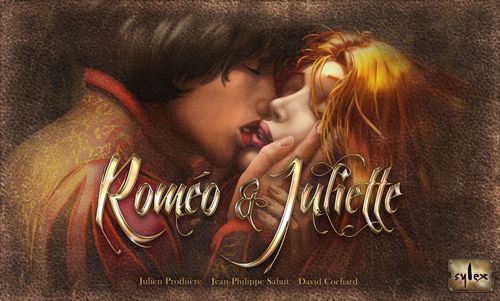
Roméo & Juliette
Roméo & Juliette Rulebook
Table of Contents
Table of Contents
Principle of the Game
Roméo & Juliette is a cooperative game: you will win together, or lose together.
One player plays Juliette and the other plays Roméo. You must try to find each other so that your love can blossom beyond the hatred tearing your families apart.
You will not be able to communicate freely; you will have to make your plans understood by your partner, and discover where they want to meet you.
To win, love must reach its maximum before the end of the third act. If instead hatred reaches its lowest point, fate turns against the doomed lovers, and you will have lost.
Components
- 1 box that unfolds into the City of Verona and 1 Scene board.
- 3 markers: Hate, Love, and Act.
- 1 Heart token.
- 2 standees: Roméo Montaigu and Juliette Capulet.
- 9 Chaperone tokens: 4 members of the Capulet family, 3 members of the Montaigu family, Brother Laurent, the Allegory of Hate.
- 14 Juliette cards (blue back): 7 Locations, 7 Chaperones.
- 14 Roméo cards (red back): 7 Locations, 7 Chaperones.
- 27 Event cards.
- 9 Chapter cards.
- 5 Missive tokens.
- 2 player aids.
Setting Up the City of Verona
- Each player chooses one of the two families, then the board is unfolded at the center of the table with the blue (Capulet) side facing Juliette.
- The Scene board is placed on the central support of the box.
- The Hate marker, 4 Love marker, and 5 Act marker are placed on their respective tracks.
- Finally, each player takes the cards in their color (blue for Juliette, red for Roméo) and splits them into 2 decks: one for the Location cards, and one for the Chaperone cards. Each deck is shuffled then placed face down, as shown below.
Your First Game
The Chapters
Roméo & Juliette includes 9 Chapters for as many difficulty levels. They are represented by cards that list the distribution of Event cards to use, the number of Missive tokens available, and the starting placement of the characters.
For your first game, we recommend Chapter I, "In the Beginning," which serves as an introduction to the game. You can later increase the difficulty by trying other Chapters, either in increasing order or in the order of your choice.
Using the chosen Chapter card, follow these steps:
- Look for the Event card matching your Chapter. Place it face up on the book space of the Scene board.
- Among each level of events, randomly take as many cards as indicated. Shuffle these 9 cards together without looking at them to form a deck, which you place near the players.
- Give each player as many Missive tokens as indicated.
- Place all the characters in the locations indicated on the back of your Scenario card. Each player looks in their Location deck for the card matching where their character is placed (in this example, the Balcony for Juliette and Brother Laurent's Cell for Roméo). They keep this card in hand to begin the game, then reshuffle their Location deck.
Course of the Tragedy
Roméo & Juliette is played over 3 acts maximum. Each act is made up of 4 scenes.
To grow their Love, Roméo & Juliette must meet in the same location, having beforehand both chosen Passion (see Rendezvous, phase 2). Hate, meanwhile, will increase for each location in which members of opposing families are present.
Each scene is divided into 5 phases, played in this order:
- Preamble — Fill your hand back up to 4 cards of each type (Locations, Chaperones).
- Rendezvous — Send missives and choose Passion or Reason.
- Behind the Scenes — Secretly decide where to go, and with whom.
- Entrance on Stage — Move the characters.
- a. Movement by chosen cards — of Roméo and Juliette, accompanied by their chaperones.
- b. Movement by location effects — of the chaperones.
- Resolution — Consequences follow from your actions.
- a. Juliette gains a missive — if the Nurse is with her.
- b. Hate falls upon Verona — for each location where members of enemy families are found.
- c. Love grows — if you chose Passion and Roméo and Juliette are in the same location.
- d. An Event occurs — if Love has just grown.
1. Preamble
Fill your hand back up to 4 cards of each type.
Each player draws as many cards as needed from each of their decks to have 4 Locations and 4 Chaperones in hand.
2. Rendezvous
Sending missives and choosing Passion or Reason.
The players must choose between meeting each other or properly looking after their relatives. But communicating is no easy matter when our families hate each other!
Note carefully that in Roméo & Juliette, the players cannot exchange information freely. However, during the Rendezvous phase, each player may attempt to enlighten and guide their partner:
- By spending a missive, a player may indicate a location where they wish to arrange a rendezvous with their lover.
- By proposing one of the two faces of the heart, Passion/Reason, a player indicates whether they think they can meet their lover.
These actions may be repeated freely as long as missives can be spent, and as long as one face of the heart has not been confirmed. As soon as a player confirms the face of the heart proposed to them by their partner, phase 2 ends.
Example: Roméo spends a missive to indicate to Juliette that he wishes to go to Verona Street. Juliette does not have Verona Street in hand and spends another missive to propose to Roméo that they meet on Juliette's Balcony. Roméo has the Juliette's Balcony card in hand and says "Passion." Then Juliette confirms "Passion." They agree and place the heart token on the "Passion" face.
Depending on which face of the heart is chosen jointly by the players during the Rendezvous phase, the consequences will differ:
If Passion is chosen: At the Resolution (5.): Love will grow if the two lovers meet in the same location.
Prefer Passion if you think you can meet your lover.
If Reason is chosen: Immediately, each player takes a missive, if any remain. If only one remains, it goes to Juliette.
At the Resolution (5.): Love will not grow, even if Roméo and Juliette meet.
Favor Reason when you think you cannot meet each other.
3. Behind the Scenes
Secretly deciding where to go, and with whom.
Each player chooses from their hand one Location card (where their character will go) and one Chaperone card (who will accompany them to the chosen location), and places them face down in front of themselves.
4. Entrance on Stage
The characters move.
a. Movement by chosen cards
- Juliette and Roméo reveal the Location and Chaperone cards previously selected.
Leave all revealed cards visible until the end of the act; they will provide you with essential information for deciding your next movements.
- Roméo moves his Roméo figure to the revealed location, accompanied by the token of the chosen chaperone.
- Juliette moves her Juliette figure to the revealed location, accompanied by the token of the chosen chaperone.
b. Movement by location effects
- Roméo chooses which chaperone(s) to move, as indicated by the location he is in.
- Juliette chooses which chaperone(s) to move, as indicated by the location she is in.
To be moved, a chaperone does not need to be in the same location as Roméo or Juliette. If Roméo and Juliette are in the same location, then Roméo chooses where to move the indicated chaperone(s), then Juliette does the same. (See Locations, page 14.)
Note: for Chapter I, since location effects are optional, each player independently chooses whether or not to apply the location's effect.
5. Resolution
Consequences follow from your actions.
a. The Nurse's Complicity
If Juliette is in the same location as the Nurse, she gains a Missive token (if any remain).
b. Hate Falls Upon Verona
For each location in which at least one character from each of the enemy families is present, lower the Hate marker by 1 (regardless of the number of characters in that location).
Since our two lovers are, despite themselves, members of enemy families, Roméo counts as a Montaigu (red) and Juliette as a Capulet (blue). Of course, Roméo does not generate Hate from Juliette's presence, nor does Juliette from Roméo's presence.
Note: the game is immediately lost when the Hate marker is at the lowest point of its track.
c. Love Grows
If Roméo and Juliette are in the same location and the heart is on the Passion side, increase Love by 1.
Love grows a second time if the lovers are on Juliette's Balcony (see Locations, page 14).
Note: if Love reaches its maximum, the game is immediately won.
d. Events
Each time Love grows, reveal 1 Event card and resolve it as follows. If Love grows twice, resolve 2 Event cards, one after the other.
- If the card bears an hourglass, place it face up on the Event space corresponding to the position of the Love marker, then apply its effect (if possible).
- If the drawn card does not bear an hourglass, immediately apply its effect, then place it face down on the Event space corresponding to the position of the Love marker.
End of a Scene
The players then play scenes 2, 3, and 4 in the same way. The act ends after 4 scenes, when the players' decks are empty.
End of an Act
At the end of each act, keep, of your choosing, one Location card and one Chaperone card in hand. Then randomly reconstitute each of your decks with all the remaining cards.
Move the Act marker to the next act. Simply begin the new act with its first scene (see Course of the Tragedy, page 6).
End of the Drama
Tragedy, or love in the end?
-
If the Hate marker is at the lowest point of its track, Roméo is attacked by a member of Juliette's family. Defending himself, he kills him. From then on, Roméo is banished from the city. In reaction, Juliette fakes her own death. Mad with grief, Roméo takes his own life. Waking to find Roméo lying dead, Juliette in turn kills herself. The Capulet and Montaigu families hate each other irremediably. You have lost.
-
If the 12 scenes have played out and Love is not at its maximum, it has not managed to blossom enough in the hearts of our young lovers. You have lost.
-
If Love is at its maximum, Roméo and Juliette persuade their families to halt the escalation of hatred. They become symbols of peace and triumphant love in the city of Verona. You have won!
The Characters
During the Resolution phase of each scene, for each location in which at least one character from each family is present, Hate falls upon Verona (see 5.b).
Three chaperones, as well as Roméo & Juliette, are special:
- Brother Laurent is a mediator and a guarantor of peace. During the Resolution phase, Hate cannot fall upon a location in which Brother Laurent is present.
- The Nurse allows Juliette to recover a Missive token whenever they are together.
- During the Resolution phase, if the Allegory of Hate is in the presence of a Montaigu or a Capulet, Hate falls upon that location, unless Brother Laurent is also present.
- Roméo & Juliette, being despite themselves members of enemy families, are considered characters of their own family with respect to the other family, and can therefore generate Hate. Of course, Roméo does not generate Hate from Juliette's presence, nor does Juliette from Roméo's presence.
The Locations
Reminder: a chaperone does not need to be in the same location as Juliette or Roméo to be moved.
Juliette's Balcony: if Roméo and Juliette meet in this iconic location having chosen Passion, Love grows twice instead of once.
Capulet Ballroom: move two chaperones of the Capulet family (blue) to a location adjacent to their current position, but in the same direction (both to their right, or both to their left). These chaperones need not be in the same location.
Montaigu Parlor: move two chaperones of the Montaigu family (red) to a location adjacent to their current position, but in the same direction (both to their right, or both to their left). These chaperones need not be in the same location.
Brother Laurent's Cell: move one chaperone, blue or red (neither Roméo, nor Juliette, nor the Allegory of Hate, nor Brother Laurent), to a location adjacent to its current position.
Church: move Brother Laurent to a location adjacent to his current position.
Verona Street: move the Allegory of Hate to a location adjacent to its current position.
A Step Aside: in addition to the 6 locations present on the board, Roméo and Juliette each have a special card in their deck. It simply lets them move their character (Juliette or Roméo) to a location adjacent to their current position.
Distribution of Cards for Juliette and Roméo
Each player has each of the 6 locations, as well as a A Step Aside card that lets them move their character to an adjacent location.
The Chaperone cards, meanwhile, are distributed as follows:
Roméo — virulent and bloodthirsty:
- 1 card of each of the 3 Montaigus
- 1 of Brother Laurent
- 3 of the Allegory of Hate
Juliette — sweet and cherished:
- 1 card of each of the 4 Capulets, and a second one of her Nurse
- 1 of Brother Laurent
- 1 Allegory of Hate
Reminder of the Phases of Play
- Preamble — Fill your hand back up to 4 cards of each type (Locations, Chaperones).
- Rendezvous — Send missives, and choose Passion or Reason.
- Behind the Scenes — Secretly decide where to go, and with whom.
- Entrance on Stage — Move the characters.
- a. Movement by chosen cards, of Roméo and of Juliette, each accompanied by their chaperone.
- b. Movement by location effects, of the chaperones.
- Resolution
- a. Juliette gains a missive if her Nurse is with her.
- b. Hate falls upon Verona for each location where members of opposing families are found.
- c. Love grows if you chose Passion and the 2 lovers meet.
- d. An Event occurs if Love has just grown.