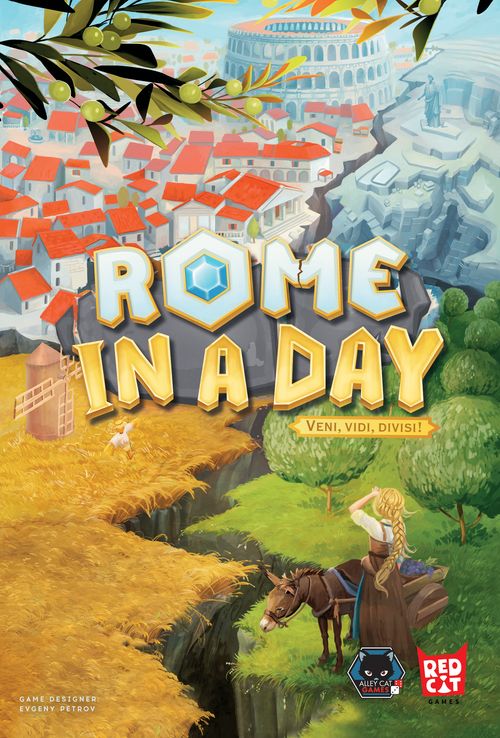
Rome in a Day
Rome in a Day Rulebook
Table of Contents
Table of Contents
Components
100 lands (20 olive groves, 20 vineyards, 20 fields, 20 town quarters and 20 quarries)
40 buildings (8 oil mills, 8 wineries, 8 mills, 8 antique theatres and 8 workshops)
10 choice cards (5 "small" and 5 "large")
5 building cards
20 gems (crystals)
5 double-sided reminder tiles
Score sheets
5 screens
Set Up
Before your first game, sort the lands into 5 sets with the same coat of arms on the back.
-
Choose one screen and take the screen, land tiles, and choice cards (one "small" and one "large") that match the coat of arms.
Shuffle your lands facedown and stack them up in a draw pile.
-
Give one random building card to each player. Put your card in front of you and place the buildings of the corresponding type on the spaces.
-
Give one reminder tile to each player – it tells you from which neighbour (to your right or to your left) you will take lands from in the current round.
The yellow half of the tile shows which of your neighbours you will take lands from. The red half of the tile indicates which of your neighbours will take lands from you.
In the first and third rounds, put the reminder tile with the yellow half on the left. In the second and forth, flip the tile to the other side – now the yellow side will be on the right.
-
Each player takes 4 gems and puts them next to their building cards – this is the player's personal stock.
Example of a setup for a 3-player game.
Description and Aim of the Game
The Roman Empire has fallen, but with this tragedy comes a great opportunity!
Work with other players to divide and claim the lands and buildings of the fallen empire. Larger sets of lands increase your territories but smaller sets come with gems that make you richer.
Each round you'll choose how to divide your lands into sets, and you'll claim sets from adjacent players to improve your empire. But pay attention, because adjacent players will also claim territories from you and only the most cunning player will be remembered as the victor.
How to Play
The game takes place over four rounds. Each round consists of four phases: Exploration, Division, Selection, and Expansion.
All players perform these phases simultaneously.
Phase 1. Exploration
Turn over the top 5 lands from your draw pile placing them face up in front of you in a row from left to right. The lands must be visible to other players. Put the two buildings from the uppermost non-empty row on your building card on the first two lands from the left (you cannot move the buildings to other lands!).
Example: Anna opens the top five lands from the draw pile and lays them out in front of them: a quarry, a field, a vineyard, one more field and one more quarry. Now they take buildings from the uppermost non-empty row of their card: she puts the winery on the quarry and the workshop on the field.
Phase 2. Division
Hide the laid out lands from your neighbours behind your screen. Then divide your lands into two sets in any ratio (2:3, 1:4, or even 0:5). Add 1 gem from your stock to the smaller set.
Once all players have divided their lands, remove the screens and proceed to the next phase.
Remember: Once placed, buildings cannot be moved or rearranged from their lands.
Example: behind their screen, Anna divides their lands into two sets: The larger set consists of the field with a workshop on it, another field, and the quarry without a building.
The smaller set consists of the vineyard and the quarry with the winery on it. Anna adds a gem from their stock to this set.
Phase 3. Selection
Now it's time to assess the neighbour's lands and claim the most appealing ones! First, check the reminder tile to see which of your neighbour's you are going to take lands from in this round.
Remember: in the first and third rounds, you take the lands from the neighbour to your left, and in the second and forth rounds, from the neighbour to your right. If you forgot to flip your reminder tile, check the icon in the centre of your building card — in the current round, the yellow and red halves of the tile must be on the same sides as in the icon for the current round, in the row of buildings you used this round.
Decide which set of the lands you would like to take (the bigger or the smaller one) and choose the appropriate choice card without showing it to other players. Lay the card face down between you and your neighbour. At the same time open your choice cards and take the selected set of lands from your neighbour. But remember that some of your lands will be taken away from you, too...
At the end of this phase, you will have two sets of lands: one that you'll have taken from your neighbour and the other (originally yours) that another neighbour will have left for you.
Add any gem(s) you gained or retained this round to your stock.
Example: in this round, the players took the lands from the players on their right. Sam, Anna's neighbour to the left, chose the bigger set that Anna proposed and took three lands and one building. Anna, chose the smaller set from Lena, the neighbour to their right (an olive grove with a winery, a town quarter, and a gem).
Phase 4. Expansion
Now it's time to add the lands to your domain. In the first round, connect the lands in front of you to each other as you see fit. In the second, third, and fourth rounds, attach the lands you receive to your existing domain.
Players must add all the lands obtained in Phase 3 to their domain. The lands must be connected to each other by at least one side. If there are buildings on the received lands, they cannot be moved to other ones.
Once lands have been placed into your domain they cannot be moved in the future.
Example: Anna already owns four buildings (a workshop, an oil mill, a theatre, and a winery) as well as seven lands in their domain. With the four lands they gained this round, they expand the existing town and vineyard areas by adding one more town and one more vineyard. Anna connects the quarry and the olive grove with wineries to four vineyards. Thanks to such a good location, they have become more profitable – they will bring more points at the end of the game. Moreover, a sole workshop has become adjacent to the quarry and will also bring points.
End of the Round
At the end of each round, all players flip their reminder tiles. In the next round, they will take lands from their other neighbour.
End of the Game
The game ends after the fourth round. Players count how many points they get from their buildings and lands and how many points they get for gems in their stocks.
Scoring Victory Points for Buildings
If a building stands on a land of its own colour or is adjacent to it, it brings as many victory points as there are lands of the matching type connected in the adjacent area.
If a building is adjacent to two or three lands at once, it earns points for each area of this type of land.
Oil mills bring victory points for each olive grove, wineries – for each vineyard, mills – for each field, antique theatres – for each town, and workshops – for each quarry.
If the building does not stand on a land of its own type and is not adjacent to it, it brings no points.
Scoring Victory Points for Gems
The player receives victory points depending on the number of gems in their stock, according to the table:
| Gems | 0 | 1 | 2 | 3 | 4 | 5 | 6 | 7 | 8 |
|---|---|---|---|---|---|---|---|---|---|
| Points | 0 | 3 | 5 | 6 | 9 | 13 | 18 | 24 | 31 |
Determining the Winner
Sum up the points received for buildings and gems. The player with the most points becomes the winner. If there is a tie, the player with more land plots in their possession wins. If there is still a tie, the tied players share the victory.
Example of the scoring:
First, Anna counts points for buildings.
Two oil mills bring 9 points in total: one oil mill is adjacent to an area of 4 olive groves and brings 4 points, and the second one is adjacent to two areas (a 4-land area and a 1-land area) and brings 5 points.
Four wineries surround an area of 7 vineyards and bring 7 points each (28 points in total).
One mill earns 2 points, since it borders an area consisting of two fields.
Two theatres are located in opposite parts of Anna's domain: one theatre stands on an area of 5 town quarters (5 points), and the second theatre stands next to two town quarters (2 points).
One workshop is located next to two quarries and also earns 2 points. Another workshop stands on the town quarter and is not connected to any quarry, so it brings no points.
The buildings in Anna's domain score a total of 48 points.
Anna also has 2 gems left in their stock, which score 5 more points.
In total, Anna scores 53 points.