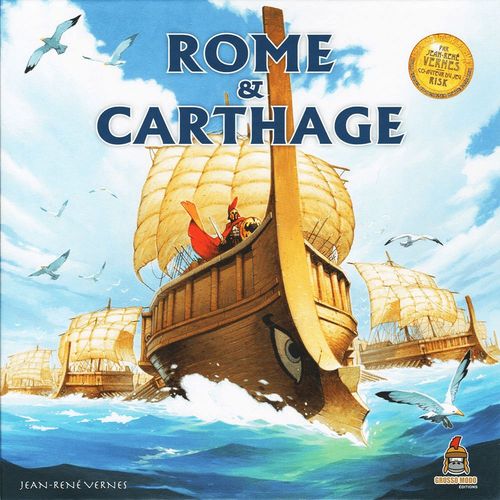
Rome & Carthage
Rome & Carthage Rulebook
Table of Contents
Table of Contents
Components
- 52 resource cards
- 2 "Trahison du Général" (General's Treason) special cards
- 2 "Sédition Populaire" (Popular Uprising) special cards
- 1 board
- 28 pieces (7 armies per Empire: 3 infantry, 2 galleys, 1 chariot and 1 elephant)
Each colour corresponds to an Empire:
- Greeks (Byzantium)
- Carthaginians (Carthage)
- Egyptians (Alexandria)
- Romans (Rome)
Object of the Game
Simultaneously occupy both enemy capitals for one complete turn, or eliminate all of the enemy armies.
Setup
Forming teams
"Unity is strength!" Two sides face each other. Teams are formed as follows:
- 4 players: each player chooses an Empire. The players then ally two against two to form two teams.
- 3 players: one player chooses two Empires and plays alone. The other two players each choose one Empire and form a team.
- 2 players: each player chooses two Empires.
Players on the same team win together, including if one of the two players no longer has any armies.
Distributing the armies
"The men await your orders!"
- A player who plays one Empire (3 or 4 player game) takes the 7 armies of his colour.
- A player who plays two Empires (2 or 3 player game) takes the 14 armies of his two colours.
Distributing the resource cards
"The riches pour in!"
- A player who plays a single Empire takes the following cards, in the colour of his Empire: 0 – 0 – 2 – 4 – 6 – 8 – 10 – 15.
- A player who plays two Empires takes the following 13 cards in the colour of one of his Empires, plus one additional "15" in the colour of his other Empire: 0 – 0 – 1 – 2 – 3 – 4 – 5 – 6 – 7 – 8 – 9 – 10 – 15 – 15.
Zeros that are not dealt out are removed from the game permanently. (Illustration caption: "The two Zeros of the Greek Empire.")
The remaining cards are shuffled carefully and placed face down to form a draw pile. Allied players may advise each other and show each other their cards.
Distributing the special cards
"Strength is nothing without cunning!"
Each team takes one "Trahison du Général" card (1) and one "Sédition Populaire" card (2). A player who plays two Empires does the same. These cards are placed face up in front of the players.
Playing the Game
Players decide who starts. Players then take turns in clockwise order.
Turns 1 and 2: placing the armies
"Mobilisation générale!" (General mobilisation!)
Only one army may be placed on a city. An army must be placed on a city of its own colour.
- First turn: a player who plays one Empire places 4 armies of his choice. A player who plays two Empires places 8 armies: 4 armies per Empire.
- Second turn: a player who plays one Empire places his 3 remaining armies. A player who plays two Empires places 6 armies: 3 armies per Empire.
From the third turn: the start of the game
"War is declared!"
Each player, in turn, performs the following actions:
- Draw a card.
- Play one or two special cards (optional).
- Move an army.
- Carry out a battle (if the move brings the army into a city occupied by an enemy army).
1. Draw a card
"Let the harvests be good!"
The player draws a card from the draw pile. He looks at its value secretly and adds the card to his hand. In a three-player game, the player who plays alone draws TWO cards.
The player may then pass his turn, or carry out the following actions.
2. Play one or two special cards (optional)
"Traitors can sow discord!"
- Special cards are single-use.
- In 3- or 4-player games, an allied player may use one (or two) special card(s) without necessarily having the agreement of his partner.
Popular Uprising (Sédition Populaire): if his capital is occupied, a player may destroy the occupying army without a battle. That army is eliminated as after an ordinary defeat.
General's Treason (Trahison du Général): allows a player to move an army of the OPPONENT (or two, if they are infantry) under the same conditions as if the opponent were playing it.
Note: you may move two infantry of different Empires. You may not make the opponent carry out a "forced march".
3. Move a piece, or two if they are infantry
"Straight ahead!"
A player who plays two Empires plays as if they formed a single Empire. On his turn he therefore moves a single army of the Empire of his choice (or two infantry of the same Empire, or of two different Empires).
- An army may not stop in a city occupied by a friendly army.
- In a move of 2 cities or more, an army may pass through a city occupied by a friendly army (but not through a city occupied by an enemy army).
- There may never be three or more armies on the same city.
Simple move ("En avant, marche!")
- Elephant: on land, from one city to a neighbouring city.
- Galley: at sea, or following the coasts, from one city to a neighbouring city.
- Infantry: on land, from one city to a neighbouring city. One or two infantry may be moved.
- Chariot: on land, from 1 or 2 neighbouring cities. It advances twice as fast as the other armies.
Forced march ("Marche forcée") — "The drums will sound!"
By discarding one (or several) card(s) from his hand, for a minimum of 3 points, a player may carry out a forced march.
A forced march corresponds to 2 successive moves of the same army, OR to the simple move of two different armies.
After moving two infantry, a player who pays for a forced march may move a single army (infantry or other) by one additional simple move.
Example 1: [diagram] The player moves 2 infantry by a simple move and the elephant by a forced march.
Example 2: [diagram] The player moves 2 infantry by a simple move and moves one of them again with a forced march.
Example 3: [diagram] The player moves his galley by a forced march.
4. Carry out a battle
A battle takes place when the move of an army brings it into a city occupied by an enemy army.
If several battles take place simultaneously in different cities, the attacker chooses which one is fought first.
Special advantages ("La charge des unités les plus lourdes peut être dévastatrice!") — the charge of the heaviest units can be devastating!
- The ELEPHANT doubles its highest card against land armies (not against galleys).
- The CHARIOT doubles its lowest card against all armies.
Example: [diagram] Elephant: 4 + (2 x 10) = total 24. Chariot: (2 x 4) + 10 = total 18.
General case ("Que le meilleur gagne!") — may the best win!
Each of the two combatants chooses TWO cards, which he places in front of him face down. They are then turned over at the same time. The player with the highest total is the winner. The losing army is eliminated permanently.
- The cards laid on the table are lost to the players, except for the Zeros, which are always recovered by the players.
Example of a battle between 2 infantry. Player 2 wins. [diagram]
Ties ("Rien n'est perdu pour les braves!") — nothing is lost for the brave!
- The battle continues: each player plays a new card in the same way as before, but only one card, and so on, until one of them wins.
- The special advantages of the elephant and the chariot do not apply in the case of a tie.
- If both opponents play a total of Zero, the battle ceases and the attacker returns to his previous place. If the previous city is occupied by an army, that army also retreats (a rare case).
- In the case of a tie, the players may no longer play the spy.
Spies ("Infiltrez les forces de l'ennemi à la veille du combat!") — infiltrate the enemy forces on the eve of battle!
- If a player plays "1 and 1" or "2 and 0", he learns the points played by his opponent. He may then choose to replay two new cards to beat his opponent, if necessary, or to withdraw.
- The combinations "1 and 1" or "2 and 0" are worth 2 points (or more for the Chariot and the Elephant). They can sometimes be enough to beat the opponent.
- Note: with "0 and 1", an Elephant obtains a total of 2 points against a land army, but it cannot use this as a spy.
- If both opponents simultaneously play a spy, the battle restarts under the ordinary rules, each player playing two cards.
- After a battle involving spies, all the cards are discarded, including those used to form the spy (except the Zeros, which are always recovered by the players).
Example: [diagram] Player 1: total 0. Player 2: total 12.
The player whose capital is occupied must play a "2" to make a spy.
Occupied capital ("La capitale est le cœur de votre Empire!") — the capital is the heart of your Empire!
When the capital of a player is occupied by an enemy army, that player plays only one card in the battles of all his armies, for as long as the occupation lasts.
- 4-player game: only the player whose capital is occupied plays just one card in battle. His ally plays two (unless his capital is also occupied).
- 3-player game: only the allied player whose capital is occupied plays just one card in battle. His ally plays two (unless his own capital is also occupied). A lone player whose capital is occupied plays just one card in the battles of all the armies of both of his Empires.
- 2-player game: the player whose capital is occupied plays just one card in battle for all the armies of both of his Empires.
The Elephant doubles the value of its single card against land armies, but the Chariot does not double it!
The "2" card counts as a SPY.
Draw pile
The resource cards spent during battles and forced marches are stacked face down. When the draw pile is exhausted, they are shuffled carefully and form a new draw pile.
- The first two "15"s played are permanently eliminated from the game and put back in the box.
- The last two "15"s are added to the new draw pile after the last "15" held by a player has been played.
- The Zeros are always taken back by the players and never go into the draw pile.
Tips for new players
- It is recommended to conceal your cards from your opponents throughout the game, so as not to give information about the state of your resources!
- Avoid placing a land army on an island. The army would be immobilised for the whole game and could not serve as reinforcement.
- Protecting your capital is essential: place armies on the cities and ports near your capital to prevent the enemy from having direct access.
- Your objective is to paralyse the opponent by occupying his capital. Reinforcements will soon be needed: avoid placing armies too far back. Post armies at the border with the enemy. When you need reinforcements, you will not regret it!
Victory Conditions
"The Heroes will enter History!"
The game is won by a team (or by one player, depending on the starting configuration) in one of the following cases:
- Occupying both enemy capitals: when a team occupies BOTH enemy capitals for a complete turn. No opponent may have freed at least one of the two capitals after one complete turn of play following the occupation of the two capitals.
- Note: a complete turn is over when all the players have played once after the capture of the second capital.
- Eliminating all enemy pieces: when the opposing team no longer has any piece. A player who has no army left is excluded from the game, but if he had an ally, the game continues. All the cards still in his hand are lost. The players of the same team win together, including if one of the two players no longer has any army.
The game is a draw when one of the opponents evades battle and the other cannot force him into combat, nor simultaneously occupy both enemy capitals (a rare case).
Advanced Variant: "A armes égales!" (Equal Arms)
2, 3 or 4 players. — "Strength is nothing without strategy!"
In "A armes égales!" the teams draw the same resource cards, in a different order. This variant minimises the element of chance and offers experienced players more strategic games.
Setup
- Separate the cards of the draw pile into two equal piles. After shuffling them carefully, each team is given one of the two piles, which forms its own draw pile.
- The "15"s used during the game are permanently removed from the game: they do not return to the draw pile.
Distributing the special cards
- A player who plays in a team takes one special card and his ally takes the other card. Each player may only play his own special card.
- The special card not used by an eliminated player is removed from the game.
Course of the turn
- Allied players may NOT show each other their cards.
- The standard rules then apply.
Advanced Variant: "Conquête rapide" (Rapid Conquest)
4 players. — "Make your enemy surrender!"
In "Conquête rapide", play one piece of your ally or give him a resource card. Each battle will be decisive: coordinate your attacks to establish your supremacy! This variant is for all types of players.
Object
Reduce the army of the opposing team to 5 pieces (all civilisations combined).
OR
Reduce the army of one opponent to 3 pieces or fewer, and occupy the capital of his ally for one complete turn.
OR
Simultaneously occupy both enemy capitals, under the same conditions as in the standard rules.
Course of the turn
-
Draw one, two, three or zero card(s):
- A player who has 9 cards or more (his two Zeros and at least 7 cards) draws no card.
- A player who has 6, 7 or 8 cards (including his two Zeros) draws 1 card.
- A player who has 5 cards or fewer (his two Zeros and at most 3 cards) draws 1 card, or 2 cards if he passes his turn.
- A player who has only his two Zeros draws 2 cards, or 3 if he passes his turn.
-
Optionally play the General's Treason card: the two Popular Uprising cards are removed from the game. Only the General's Treason card may be played, and only with the agreement of the allied player.
-
Move a piece, or give a card: move one or more of his pieces, move a piece of his allied player, or give up a move in order to give a card.
- Carry out a move under the standard rules, OR
- Move a piece of his allied player. To carry out this action, the player must discard one (or several) card(s) from his hand, for a minimum of 3 points. To move the allied player's piece by forced march, the player must discard cards A SECOND TIME for a minimum of 3 points. If the move brings the piece into a city already occupied by an enemy piece, it is the allied player (the owner of the piece) who fights it. This action is only possible with the agreement of the allied player!
- OR give one of his cards to his ally. In this case the player makes no move. It is permitted to give a card to a player who has 9 cards or more.
-
Carry out a battle: battles are carried out in accordance with the standard rules.
Player Aid
(The French rules sheet's "Aide de jeu" page, transcribed as printed.)
1. Draw a card
With three players, the player who plays alone draws 2 cards.
2. Play Popular Uprising and/or General's Treason
- Popular Uprising (Sédition Populaire): allows a player, if his capital is occupied, to destroy the occupying piece without a battle (that army is eliminated as after an ordinary defeat).
- General's Treason (Trahison du Général): allows a player to move an army of the OPPONENT (or two, if they are infantry) under the same conditions as if the opponent were playing it. Two infantry of different Empires may be moved. The opponent may not be made to carry out a "forced march".
3. Move a piece or pass the turn
No more than one friendly piece per city.
- 1 Elephant: land move of one city.
- 1 Chariot: land move of one city or of two cities.
- 1 Galley: sea move of one city.
- 1 or 2 Infantry: land move of one city.
- Forced march: after your move, you may move a piece once more, paying a minimum of 3 points.
4. Battle
- Both players play 2 cards. The highest total wins.
- In case of a tie, the players replay one card (if both totals are Zero, the attacking piece returns to its city of origin).
- Elephant: doubles its highest card against land pieces.
- Chariot: doubles its lowest card against all pieces.
- Spies: 0+2 or 1+1. The player may replay 2 new cards knowing the cards played by his opponent.
- Occupied capital: in a battle, the player may play only one card. "2" is a spy. The chariot does not double its card.