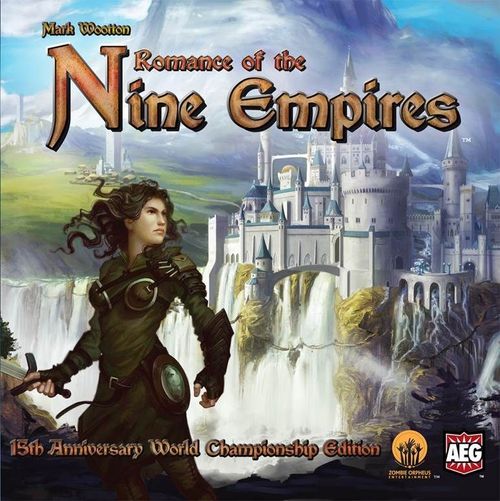
Romance of the Nine Empires
Romance of the Nine Empires Rulebook
Table of Contents
Table of Contents
Object
Your goal is to become the undisputed leader of Countermay. There are three methods by which you can obtain your goal:
- You win a dominance victory if you are the only player to have castles with food at the end of a turn. In this case, the people come to you to survive, and pay homage to your banner.
- You win a popular victory if you have 50 Renown and have at least three quests in play at the end of a turn. In this case, the people all respect you, and swear fealty to your banner.
- You win a conquest victory the instant you destroy the last castle (other than your own) in the game. This is almost always done in combat, but can be accomplished by other means. In this case, the people all fear you, and grovel before your banner.
To seize control of Countermay, you'll use your properties and stronghold to bring powerful heroes, cohorts, items, and spells into play to build your army. You can send your heroes to attack enemy castles, raid your opponents and steal their food, or undertake dangerous quests. Through all this, you must mind your castles, your food, and your enemies' Renown to ensure they don't steal a victory from you.
Components
Your copy of Romance of the Nine Empires should have the following components. If it does not, contact [email protected] for assistance.
- Five different playable decks of 61 or 62 cards each (for the complete deck lists, see page 16).
- One pack of 100+ extra cards (for customizing) and token cards (for game play).
- 125 punchboard tokens.
- Enough crazy imagination to transport you to Countermay.
Decks
This set holds the top-placing deck of each faction that made it into the quarterfinals at Gen Con 2012.
- Holden
- Ixhasa
- Malchior
- Ord
- Displaced
(The player names and placings printed beside each deck are attribution and are omitted.)
Since players from Arcanix, Esh, Shad-Hujem, and Tuatha did not make it into the quarterfinals, their decks do not appear here. And the one guy who played an Unaligned deck (using a promo stronghold from 2003) was mathematically eliminated halfway through Swiss.
In the following pages we'll describe each of the card types in the game. Don't worry if you don't understand everything yet; we just want you to be familiar with the components before we teach you all the rules.
Stronghold Card
This designates which of the factions you are playing in the game. There are nine factions in the land of Countermay, each with a unique style, and various strengths and weaknesses. You can learn the basics of each faction on page 18.
Your stronghold card is never in play like other cards, cannot be attacked or destroyed, and never goes into your deck.
- Castle Points (1) are how many points' worth of castles you can select to have in play at the start of the game. You do not need to use them all.
- Renown (2) gives the starting level of your faction's fame, which shows how well known you are across Countermay.
- Keywords (3) affect which cards you can and cannot bring into play.
- Text Area (4): Strongholds can bow to generate gold to pay for gold costs. This is given in the Text Area immediately below the keywords. In addition, each stronghold has some sort of special ability.
- Fate Value (5) has no inherent benefit or effect, but is referenced by other card effects.
Castle Card
Castles are the fortresses in which you stash your food. With the spread of war, curses, and diseases from alternate realities, food has become the most important commodity in Countermay, with the possible exception of enough weapons to protect that food.
- Might (1) shows how much damage a castle can take before it is either destroyed in battle or looted during a raid. All castles in this set have a Might of 1.
- Storage (2) is the castle's capacity for holding food. It shows how much food the castle holds at the start of the game. Obviously, you want this to be as high as possible, since you get that food for free. Storage is also the maximum amount of food that the castle can hold.
- Point Cost (3) is how many of your stronghold's Castle Points you spend to start with this castle in play.
- Text Area (4) holds the keywords at the top. The keywords primarily affect which factions can use the castle card. The rest of the text area shows what abilities (if any) the castle has.
Property Card
Properties are economic or strategic resources available to each leader: farmland, smithies, or even cantankerous advisors.
- Food Cost (1) is how many food tokens you must spend to bring the property into play.
- Gold Cost (2) is how much gold you must spend to bring the property into play.
- Keywords (3) we have already gone over in the previous card types.
- Gold Production (4) (if any) shows how much gold the card can generate for buying other cards.
- Abilities (5) we have also gone over in the previous card types.
- Fate Value (6) ditto.
Hero Card
Hero cards (called personages and individuals in earlier versions of the game), are the main people who serve you as leaders, specialists, and advisors.
Each hero belongs to one of the factions in Countermay (or else eschews all allegiance). While each hero's faction can be seen in the keyword line of the text box, it's quicker to tell a hero's faction by the faction's unique decoration in the card border.
- Strength (1) represents a hero's prowess, and is used for inflicting and absorbing damage. This mainly happens in battles. Note that in card text, Strength is abbreviated as "S", so a penalty of –1S means one less Strength.
- Will (2) is a hero's cleverness, as well as his or her desire to continue to fight the good fight. If a hero's Will drops to zero, that hero quits, dies, or otherwise leaves your service; bury that hero immediately. Note that in card text, Will is abbreviated as "W", so a bonus of +1W means one extra Will.
- Glory (3) is a hero's fame and charisma. It is used for launching quests, and is also referenced by a number of card effects.
- Food Cost (4) is how many food tokens you must spend to bring the hero into play.
- Gold Cost (5) is how much gold you must spend to play the hero.
- Keywords (6) affect which factions can use the card, and may be referenced by card effects and abilities.
- Abilities (7) detail what other game effects the card may have, if any.
- Fate Value (8) is used by a variety of card effects.
Item Card
These are special objects that enhance the abilities of your heroes. While all heroes carry mundane weapons and armor, item cards represent special things like a flaming sword or a Sherman tank or the gizzard of a dragon.
- Strength Bonus (1) is how much the item modifies the hero's Strength. If there is no icon here, the item does not boost a hero's Strength at all.
- Will Bonus (2) is the same as a Strength bonus, but for the mind instead.
- Glory Bonus (3) helps out, because in Countermay, fame is not fleeting.
- Food Cost (4) is how many food tokens you must spend to bring the item into play.
- Gold Cost (5) is how much gold you must spend to bring the item into play.
- Keywords (6) affect which factions can use the card, and may be referenced by card effects and abilities.
- Abilities (7) detail what other game effects the card may have, if any.
- Fate Value (8) is used by a variety of card effects.
Spell Card
Spell cards put the 'whiz' into wizards. They are kind of like items for bookish sorts. When brought into play, a spell can only be attached to a Wizard, who then gets to use the abilities printed on that spell card.
- Food Cost (1)
- Gold Cost (2)
- Abilities (3)
- Fate Value (4)
Cohort Card
Cohorts are the soldiers that follow your heroes into battle or on raids. When brought into play, they must be attached to a hero you already have in play. They're not quite bright or organized enough to act on their own.
- Strength (1)
- Food Cost (2)
- Gold Cost (3)
- Keywords (4)
- Abilities (5)
- Fate Value (6)
Tactic Card
Tactic cards are surprise moves that you can use. They do not come into play in the way that (for example) heroes and properties do, thus they do not have a gold cost or food cost in the center of the card. Instead, the costs for the tactic card's effects are given in the ability description. If a tactic card has more than one ability, you can only use one of them when you play it.
- Cost (1)
- Keywords (2)
- Abilities (3)
- Fate Value (4)
Quest Card
What's an epic story without an adventure? Quest cards are noble deeds that your heroes can undertake to generate Renown for your faction.
Unlike most cards, quests have a Glory Cost (1), which is the total Glory of heroes that you must bow to bring the quest into play. Some also have additional conditions that have to be met.
- Renown Reward (2), which is added to your faction's Renown when you put the quest into play. This is a boost to your fame simply because you have sworn to undertake this quest.
- Completion Condition (4), which is what you need to do or accomplish to complete this quest. If you meet this condition, you get the rewards for doing so.
- Abilities (3): In addition, some quests have abilities that they confer on players just by being in play.
- Fate Value (5)
Quest Reward Tokens
These are token cards that you bring into play when you complete a quest. They do not go into your deck, and can only be brought in by meeting the completion condition on the matching quest card.
- The Renown Reward (1) is added to your faction's Renown as soon as you complete the quest and bring this card into play. This is a boost to your fame because you have succeeded in your sworn task.
- Some quest rewards have Abilities (2) that they confer on the player.
- Fate Value (3)
Tokens & Markers
Romance of the Nine Empires uses a variety of tokens and markers to track game needs.
Food tokens are an essential resource for any empire. If you lose all your food, you lose the game at the end of the turn.
Cohort, hero, and item tokens are game elements that act like cards, except that they are not played from your deck or hand, but are instead created by card effects. When one of these tokens leaves play for any reason, remove it from the game.
Markers are used to track a variety of ongoing effects. Markers cannot be targeted. When a card with markers on it leaves play, remove those markers from the game; their effects end.
Not Enough? The quantity of tokens and markers is not intended to be limited. We've provided an amount of each token and marker that should be plenty for 99% of the games you'll play, but if you find that you need more, just mock something up with coins, beads, or whatever. If a token or marker gets buried just return it to the pool for reuse.
Learning the Game
Preparing to Play
When learning a game as deep and rich as Romance of the Nine Empires, we don't recommend learning all the rules at once. Instead, a stepwise approach can make the learning easier and more enjoyable. And while R9E can be played by any number of players, it's perhaps easiest to learn playing head to head.
As tournament decks, these are built to be played in a one-on-one format. In your first game, play Ord versus Malchior. These two decks are fairly straightforward military decks. You won't need to read all the rules, either, you can skip the sections on Raids and Quests. The Malchior Deck is a military hammer. It is the quicker of the two, but is heavily food reliant. The Ord deck is a military toolbox, and is more subtle. Because it uses items rather than cohorts, its units are more vulnerable to certain cards.
Once you've mastered those, read the section on raiding and play the Displaced deck against the Ord deck. The Displaced deck is a combat-ready defensive deck that seeks to win through hardcore raiding. Its heroes are geared toward stealth and theft rather than direct combat and are, in general, expendable.
Next play Ixhasa against Malchior. The Ixhasa deck is a control deck that wins through a non-military starvation strategy. It seeks to steal or bleed out opponent's food. Yet it's flexible; it can attack a raid deck or raid a military deck, but in general it seeks to control the board position and food resources.
Finally, play the Holden deck against either the Ord or Malchior decks. The Holden deck is a combination deck that seeks to win by completing quests.
From there, you should have mastered the game, and you can use the extra cards provided (voted on by past champions) to customize the decks to better suit your individual play style. See page 16 for rules on building your own decks.
Simultaneously, all players reveal their stronghold and starting castles. Each player can start with castles with a total Point Cost up to (but not more than) the Castle Points listed on his or her stronghold card (the decks in this box are, of course, legal). Each castle starts with food tokens equal to its storage.
Each player also starts with one Motte and Bailey property card in play.
Each player shuffles his or her deck and draws 4 cards plus 1 additional card for each castle that player has in play.
All players review their hands. If desired, each player can take one mulligan: discard his or her hand, discard two food tokens, and draw a new hand.
Finally, select a player randomly to take the Ordained marker and go first. (In a two-player game, one player can hold out both fists, one of which holds the Ordained marker, and the other player chooses a hand.)
Setup
Players purchase properties to increase their economy. They also recruit heroes and increase their power with items, cohorts, and spells to improve their armies. Then players attack one another's castles, raid to steal food, and send their heroes on quests.
Each player selects one of the championship decks to play. This could be done by drafting, random assignment, or mutual agreement. Alternatively, each person could make a custom deck using the rules on page 16 and bring custom decks to the table. We suggest initially playing a one-on-one round robin game (where each player plays each other player once).
How to Play
Romance of the Nine Empires is a game for at least two players, but you can seat as many as you like. Most fans like to play head to head, but the rules are written to encompass both faceoff and multiplayer games.
Each player has his or her own deck to play. Each turn represents one year, and all players get to do whatever actions they want each turn.
Overview
Fundamental to all aspects of Romance of the Nine Empires is that the game is not divided into "my turn, then your turn." Instead, each player is active at all times, and players alternate resolving actions.
Key Concepts
The First Rule
The cards often break rules in the game. Wherever a card contradicts the rules, the card's text takes precedence, unless the person playing the card is obviously rules-lawyering.
Decks, Discard Piles, and Hands
Your hand is comprised of the cards you have drawn but not yet played or discarded. You have two different places to put cards that leave play: Your buried pile is filled with those cards that have been destroyed during the course of the game, and your discard pile is filled with those cards that have been discarded without having been destroyed. Cards in your buried pile cannot be reclaimed without a card effect, while the discard pile is shuffled whenever your deck runs dry.
Your deck is the shuffled stack of face down cards that you draw from. If your deck runs out of cards, that's fine. The instant you need to draw or reveal cards from an empty deck, shuffle your discard pile (but not your buried pile) to create a new deck.
Bowing and Straightening Cards
Bowing a card means to turn it 90° to the side. It does not matter which direction the card is turned. (This is a rule change pursuant to the disqualification of the reigning world champion—who was left-handed—for bowing her cards in the wrong direction at the 2010 World Championships.)
After a card bows, it is termed "bowed." A bowed card cannot be used to perform any ability printed on it (that is, anything preceded by descriptors like Summer, Autumn, Battle, and React), except for actions that specify straightening that card. Bowed cards cannot attack, defend, or raid. In addition, spells and items attached to a bowed hero cannot use their abilities. Keywords and non-ability game text (e.g., text like, "Cohorts attached to this hero gain +1S") continue to function even if the card is bowed. Cohorts attached to a bowed hero may bow to use abilities.
When a card is straightened, turn it upright. A straight card is considered "unbowed."
Paying Gold Costs
When playing a card with a gold cost, you must select a combination of your stronghold and/or property cards with a total gold production greater than or equal to the gold cost of your card. Each property that can produce gold specifies in its card text how much gold it produces.
Bow all the selected cards, and play the card you just purchased. Any excess gold produced (e.g., from your stronghold) is lost, spent to buy extravagant luxuries for your personal gratification.
Paying Food Costs
Many cards and abilities also have a food cost. To pay a food cost, destroy one food token from any of your castles for each point of food cost the card has. If you do not have enough food on your castles, you cannot play that card or ability. You cannot pay food costs with food on a hero.
Turn Order
Romance of the Nine Empires is played in a series of turns, each representing one year. However, there are no player turns; during each turn every player gets to do whatever actions he or she wants.
Each turn is played through the following steps, in order: Spring Phase, Summer Phase, Autumn Phase, and Winter Phase.
During each phase, each player may take one action at a time or pass, beginning with the Ordained and proceeding clockwise around the table. If a player passes, he or she can still take another action later in that phase. When all players pass consecutively, the current phase immediately ends and the next phase begins.
Spring Phase
Each player straightens all of his or her cards and applies any effects that may or must be done in the Spring Phase. In most cases, everyone can just do this at the same time.
Attach a Cohort, Item, or Spell
Choose one cohort, item, or spell card in your hand and play it. You must pay all gold and food costs, and you must attach the card to one of your unbowed heroes. If there is no hero that a cohort, item or spell can legally attach to, you cannot buy it. If the card has a faction keyword on it, you must be of that faction to play the card.
Spells can only attach to a hero with the "Wizard" keyword.
Cohorts have their own Strength values. They do not add to the hero's Strength (however, they can work together to engage for damage; see Battles, page 11).
Items do not have their own Strength, Will, or Glory values; they add to the hero's values. Items also have keywords that restrict their use: each hero can only have one item card with a given non-faction keyword attached. That is, a hero can only have one card with the "Weapon" keyword, one with the "Hat" keyword, etc. Some items may have no keywords; a hero can attach as many of these as desired.
Attack Another Player
Each player can launch one attack per turn. See Battles, page 11 for details.
Summer Phase
The Summer Phase is when players can bring new cards into play, as well as launch an attack on another player. During the Summer Phase, each player may take one of the following actions or pass. Actions may be taken in any order, and you can take the same action (e.g., bring a hero into play) multiple times during the Summer Phase.
Perform a Summer Ability
Many cards have ability descriptors printed on them that start with "Summer:"—these are special abilities that the card can use at this time. Such abilities may be on cards in play, or on tactic cards in your hand. Announce that you are using the Summer ability on the card, and perform all the text printed for that action.
Each card can only use each ability once each turn. See "More on Using Abilities" on page 10 for further details.
Bring a Hero, Property, or Quest into Play
Choose one hero, quest, or property in your hand and play it. You must pay all gold and food costs prior to bringing the card into play.
To bring a hero into play, that hero must have a keyword that matches a keyword on your stronghold card. Note that all heroes that share your faction's specific keyword also share the same border design as your stronghold. "Unaligned" is itself a faction (that is, it's not a wildcard term that matches any faction), so players can only bring in Unaligned heroes that match another keyword on their stronghold. Heroes come into play unbowed.
Unlike heroes and quests, properties come into play bowed. Some properties may have a faction keyword on them. To bring such a property into play, your stronghold must be of that same faction. Aside from that, there are no restrictions on bringing properties into play.
To bring a quest into play, you must bow your unbowed heroes with a total Glory equal to or greater than the quest's Glory cost (exception: unbowed heroes with the Questor keyword do not have to bow to use their Glory to help pay for a quest). If you can't or don't, discard the quest immediately. Like heroes, quests come into play unbowed.
Each given player can only have one copy of a given card with the "Unique" keyword in play at a time (see page 10 for more details). Multiple players can each have one copy of the same Unique card, however. Countermay is a strange place.
Autumn Phase
The Autumn Phase is when players can try to steal food from each other. Beginning with the Ordained as usual, each player may take one of the following actions or pass.
Perform an Autumn Ability
Some cards have ability descriptors printed on them that start with "Autumn:"—these are special abilities that the card can take during this time. Such abilities may be on cards in play, or on tactic cards in your hand. Announce that you are using the Autumn ability on the card, and perform all the text printed for that ability.
Raid Another Player
Each player can launch one raid per turn. See Raids, page 13 for details.
Winter Phase
Finally, in the Winter Phase, players prepare for the next turn.
All players place any food from their heroes onto their castles. In addition, players can redistribute food tokens between their castles. Food tokens that can't be stored in castles are discarded.
All ability effects end at this time, unless otherwise specified. Effects from markers continue to apply, of course.
If only one player has food on his or her castle(s), that player wins. Otherwise, beginning with the Ordained and proceeding clockwise, eliminate any players without food tokens from the game (yes, that means if you are the Ordained and all players are out of food, you lose). Your minions don't fight on credit.
If any quests in play haven't been completed, bury them.
Next, check for a popular victory. Starting with the Ordained and proceeding clockwise, see if any player has 50 Renown and at least three quests in play. If so, that player immediately wins (thus if two players both reach the levels needed for a popular victory, player seating is the tiebreaker).
Each player draws four cards, then discards down to his or her maximum hand size, which is four cards plus 1 extra card per castle that the player has. Strongholds do not add to hand size.
Finally, pass the Ordained marker one seat to the left.
Additional Rules
There are a few rules for events that are less common, or that don't fit neatly anywhere else in the rulebook. These are nonetheless crucial to the game.
More on Using Abilities
These are mostly common sense, but are included here for completeness.
Frequency
Unless otherwise noted, each ability can only be used once per turn, and only if the card is unbowed. However, card text without an ability descriptor (i.e., text that does not start with "Battle:", "Summer:", "Autumn:", "Raid:", or "React:") are considered to be active at all times, whether or not that card is bowed.
Targeting and Legality
To use an ability on a card, you must have legal targets for that ability. Look for the word "target" in the ability text; if you cannot define each target before using an ability, you cannot use that ability. If you lose the legal targets after starting the ability (due to React abilities from other players), the ability still continues.
Some effects allow another player to target something as well. You can still use your effect even if that player is unable to find legal targets.
Players must completely resolve an action before another can be taken (except in the case of React abilities).
Timing
Reacts are special abilities that affect other actions. Sometimes these change what the ability does, other times they respond to the ability having been used. Each React tells you in the first sentence precisely when you can play it.
Obviously, using a React ability interrupts the normal flow of play. If multiple players wish to use a React ability in response to an action, precedence is always given to the Ordained (if there is not a battle or raid happening), or the defender (if players are in the midst of a battle or raid).
You cannot use a React ability in battle or raid unless you have a hero in the battle, or the React specifically allows you to play it when you have no heroes present.
Locations
Heroes are always considered to be at a specific location. Each castle in the game is a specific location, and each player's stronghold represents the undefined location called "home." When heroes enter play, they are always at home.
If there is no battle or raid currently taking place, all heroes are at home.
When there is a battle or raid going on, heroes can be assigned to attack, raid, or defend a specific castle. If they are not assigned to a specific castle, they are still considered at home. In addition, any unit in a battle or raid is assigned to either the attacking/raiding army, or to the defending army.
During a battle or raid, units may use various card effects to move between home and the defender's castles, leaving one place and entering another, so it's important to track where each unit is. This is most easily done by moving the units to be near the specific castles at which they are assigned.
Finally, certain card effects (e.g., The Fallen Outcast) create additional locations; these are covered by the ability text. If that text ends and the location ceases to exist, move all heroes at that location home.
Tokens and Markers
Tokens are cards that are not included in decks, but are generated by card effects during the game. Once they are brought into play, treat tokens just like cards: they remain on the table, they can be targeted just like any other card of their type, they can bow, etc. However, any time that a token card would go to your deck, your hand, your discard pile, or your buried pile, remove it from the game instead. Tokens are not intended to be limited in quantity; a token that has been removed from the game can be created anew.
Markers are punchboard chits used to track semi-permanent changes to cards. When an effect places a marker on a card, that marker remains on the card until the card leaves play for any reason.
Special Keywords
Certain keywords on cards have special meaning within the game.
- Brutal: When this card engages and the opposing player chooses to absorb damage by burying a hero, that player cannot discard a card to increase the amount of damage that the hero absorbs.
- Carry X: Steals X additional food tokens from a successful raid. Obviously, a unit cannot steal more food tokens than there are to be stolen.
- Holy: This term is not referenced by cards in this set, and in fact the term has not had special meaning since Second Edition, but is included for backward compatibility with the old tarot-sized (2.5" x 4.25") First Edition cards.
- Questor: These heroes do not need to bow when applying their Glory to the Glory cost of a quest.
- Raid: Adds to the Fate value of a stealth card played in a raid.
- Unique: You can only have one unique card of a given title in play. If you have a unique card in play, you cannot play another copy of that card, however you are allowed to use it as a stealth card or discard it for card effects. Note that the buried pile and discard pile do not count toward uniqueness; you can have a unique hero in your buried pile and another copy of the same card in play. Also, multiple players can each have the same unique card in play.
- Wizard: This is the only type of hero that can attach and use abilities on spells.
Zero
Cards cannot have any numeral on them reduced below zero. However, effects that raise and lower the same value should be combined before applying the net change. Thus if a 1 Strength hero gets a –2 Strength penalty, then gets a +3 Strength bonus afterward, his final Strength is 2 (combining the –2 penalty and +3 bonus for a net modifier of +1).
If a hero's Will is reduced to zero by some combination of card effects and/or markers, bury that hero immediately.
Burying a Hero with Attached Cards
If a hero gets buried for any reason and has cohorts, items, and/or spells attached that are not buried by the same effect, discard those attached cards. Note that when a hero is buried due to absorbing damage, and an item on that hero added to the hero's Strength and thus helped absorb damage, that item gets buried as well.
Card Memory
If a card leaves play for any reason (buried, discarded, returned to your hand), all card effects affecting that card end. If the card returns to play, it is treated as a new card; it can use all its abilities, etc.
Battles
Each Summer Phase, each player may declare one attack. This creates a separate Attack Phase that is resolved entirely before the next player takes an action in the Summer Phase.
Key Terms
- Battle (conflict between armies): Battles are fought at castles. When a player attacks, there is a battle at each of the defender's castles, even at castles where neither player has units. The battle that is being resolved is termed the "current battle".
- Battle (ability): The primary type of card ability that can be used during a battle. You can also use React abilities if their description allows it.
- Unit: Heroes are the mainstay of your army. A single hero along with all attached cohorts, items, and spells, is termed a unit. Cohorts, items, and spells always follow their hero; if the hero to which they are attached gets buried or discarded, bury them (if they absorbed damage, see page 12) or discard them as well.
- Army: An army is the collection of all units on the same side (attacking or defending) at a given battle. When a card refers to an army, it does not refer to heroes at other locations than the current battle.
- Location: In an Attack Phase, each of the defender's castles is a distinct location. In addition, each player involved still has the home location available. See page 10.
- Opposing: A card, unit, or army on the opposite side of the battle (attacking or defending) at a given castle. A unit in your army that is facing an opposing army with at least one unit is it is said to be opposed.
Flow of a Battle
Each battle is resolved through the following steps, in order.
1. Declare Attack
Multiplayer note: If playing with more than two players, the attacker and the defender may call for allies from the other players. In clockwise order from the attacker (not the Ordained), each player chooses whether or not to ally. If a player decides to ally, that player must also declare which side he or she will join. Note that an ally gets no benefits (other than strategic and political) for allying.
Declare your intent to send units to assault the castles of one other player. You are termed the attacker, and the other player is the defender.
2. Attacker Assigns Units
The attacker (followed by any attacking allies) assigns units to attack the castles of the defender. Each unit that is sent to attack is assigned to assault a specific defending castle. Attacking players can send multiple units to attack one castle, while sending nothing to attack another castle. They don't even need to send any units at all.
3. Defender Assigns Units
After all attacking units are assigned, the defender (followed by any defending allies) then assigns units to defend the various castles. Defending players do not need to commit any units to defense. The defending player is not required to send units to castles that are being attacked; in addition, the defender and defending allies may assign units to castles that have no units attacking them.
4. Select a Battle to Resolve
During an Attack Phase, a battle is fought at each castle, whether or not any units are there. This is because players may have cards or abilities that can move a unit to attack or defend a different castle.
The attacker chooses one battle to resolve. Once a battle is selected, resolve it entirely before moving on to the next battle.
5. Battle Action & Resolution
Resolve a battle using the same method as playing the Summer Phase or Autumn Phase: beginning with the defender (not the Ordained) and proceeding clockwise around the table, each player may perform one action at that battle until all players pass consecutively.
Key to knowing which actions you can use in a battle are the concepts of presence and relevance. While the terms presence and relevance are not used in any of the card text, understanding them will answer a lot of questions.
Presence means that to be able to use an ability in a battle, you must have a hero there.
Relevance means that the ability you use has to matter to that battle. That is, it must target or affect the current battle's castle, a unit or part of a unit, or a tactic played in that battle (in the case of a React ability). Players are not allowed to fiddle about with effects that have nothing to do with the current battle.
Specifically, actions that a player can use in a battle include the following (React abilities are also allowed if you have a hero present, but are not considered an action taken in battle because they occur outside of the normal order):
- Use a Battle ability that comes from a hero, cohort, item, or spell that is in the battle. The ability must target cards in the battle, the castle at that location, or affect the battle itself.
- Use a Battle ability on a tactic card from your hand, on a completed quest, on a property, or on the castle being attacked, if you have a unit in the battle. The ability must target cards in the battle, or affect the battle itself.
- Use a Battle ability on any card (whether in the battle or not) provided that ability moves a card into the current battle, even if you do not have a unit present.
- Bow cards to engage them for damage. Obviously, these must come from a unit in the battle. If you somehow straighten cards in a unit, you can bow them again later in the same battle. The effect of engaging cards for damage is described in the next section.
- Bow your target unit to return it home. It leaves this battle safely. Any player can use this ability, but of course only units in the current battle can do this. You cannot target a bowed hero with this action.
- Pass if you have nothing that you can do or wish to do.
Once all players pass consecutively, the battle at that castle ends. Bow all attacking units at that battle and send them home. The defending units remain at the castle (if the castle has been destroyed, the battle has already ended and all units have already gone home). Play then continues with the attacker choosing the next battle to resolve. Once all battles are resolved, all defending units go home and the Attack Phase ends. Continue with the next player's action in the Summer Phase.
Multiplayer note: In a similar manner, allies (both attacking and defending) can choose whether or not to declare their own cards immune to an engagement by cards on the opposing side. The defender is not allowed to declare his or her cards immune.
A player must absorb all of the damage inflicted on his or her army. To absorb damage, a player may bury any combination of heroes and cohorts (bowed or unbowed). In addition, the defending player can bury food tokens, and (if there is no food left on the castle) the castle card in the battle. Although a player is not required to use immune cards to absorb damage, any non-immune cards at the battle must be used to absorb damage so long as there is damage left to absorb.
Multiplayer note: The attacker and defender make all choices about which cards in their armies get buried to absorb damage, and may select cards belonging to allies rather than choosing their own.
- Each destroyed food token absorbs one damage.
- Each hero and cohort buried absorbs its Strength in damage. Any modifications to Strength apply (from items, card effects, etc.). Items that add to a hero's Strength are buried when the hero using those items gets buried due to absorbing damage.
- In addition, whenever a player absorbs damage with a hero (not a cohort), that player may discard one card from his or her hand to add its Fate value to the damage absorbed by that hero. (Exception: Cards cannot be discarded to absorb damage from Brutal attacks.)
- When you bury a castle card to absorb damage, it absorbs all remaining damage. When a castle is buried in this manner, the location ceases to exist. The battle ends immediately and all units go home. Attacking units return home bowed; defending units return home unbowed.
The bottom line is this: The attacker gets to declare some units immune to smaller parcels of damage, but the defender can sacrifice food tokens and the castle to keep units alive (or vice versa).
At the end of an Attack Phase, if a player has no castles remaining, that player is eliminated.
Example figure (damage absorption): "Skeeter" Malloy engages for 3. Nomhotep's unit engages for 4. Colonel Baker engages for 5. In the first resolution, 3 Zombie tokens absorb the damage and are buried; in the second, 1 food token and the castle absorb damage, the battle ends, and "Skeeter" is saved from being buried. In the third, Nomhotep absorbs 2 and is buried; since he is a hero, the player discards a card to absorb the other 3.
Engaging and Damage
During a battle, you can "engage" any number of cards in a single unit to inflict damage on the opposing side. This is the main action by which you bury cards on the other side of the battle. Engaging for damage is resolved by following these steps:
- Bow your cards to engage for damage.
- The opposing player chooses a card or token (on his or her side) to absorb that damage.
- Bury the card or token that absorbed the damage.
- If there is still damage to be absorbed, the opposing player chooses another card or token and buries it, until all damage is absorbed.
To engage cards in a unit, bow any number of cards in that unit and announce the total damage of the cards you bowed. Ordinarily, the damage inflicted is equal to the total Strength of the cards you bowed, but other effects may change that. You may engage any or all cards in the unit to increase the total damage inflicted, or leave some unbowed for later use. (Exception: items that add to a hero's Strength must engage when the hero is engaging; they cannot engage at other times, nor can you decline to engage them.)
After you engage the cards as the defender, the attacking player may (but is not required to) declare specific cards in his or her army immune to that damage. A card can be declared immune if that card has a Strength greater than the total damage that you just engaged for. Items and other card effect that add to a hero's Strength also apply toward granting that hero immunity. For example, if the defender engages for 5 damage, and the attacker has a 4-Strength hero equipped with a weapon that grants a bonus of +2 Strength, that hero has 6 Strength total and can be declared immune. An immune hero or cohort is not required to absorb damage (but may do so if it is strategically beneficial).
Raids
A raid is an attempt to steal food from another player. After all, as Napoleon said, "An army marches on its stomach." Unlike battles, which involve multiple units on each side at a given castle, raids are stealthy affairs and involve no more than one hero per side at each castle.
Each turn, each player may declare one raid during the Autumn Phase. When a player declares a raid, this creates a separate Raiding Phase that is resolved entirely before the next player takes an action during the Autumn Phase.
Key Terms
- Raid (conflict between players): Raids take place at castles. When a player launches a raid, a raid occurs at each of the defender's castles, even at castles where neither player has a unit assigned. The raid being resolved is considered the "current raid".
- Raid (ability): The primary type of card ability that can be used during a raid. You can also use React abilities if their description allows it.
- Unit: Heroes are the mainstay of your army. A single hero along with all attached cohorts, items, and spells, is termed a unit. Cohorts, items, and spells always follow their hero; if the hero to which they are attached gets buried or discarded, bury them (if they absorbed damage, see page 12) or discard them as well (see page 10).
- Army: An army is the collection of all units on the same side (raiding or defending) at a given castle. When a card refers to an army, it does not refer to heroes at other locations than the current raid.
- Location: In a Raiding Phase, each of the defender's castles is a location. In addition, each player still has the home location available. See page 10 for more details.
- Opposing: A card, unit, or army on the opposite side of the raid (raiding or defending) at a given castle. A unit in your army that is facing an opposing army with at least one unit is it is said to be opposed.
Flow of a Raid
Each raid is resolved through the following steps, in order.
1. Declare Raid
Declare your intent to send one or more units to steal food from another player's castles. You are termed the raider, and the other player is the defender.
Multiplayer note: You cannot raid multiple players simultaneously, and allies are never involved in a raid.
2. Raider Assigns Units
The raider assigns a maximum of one unbowed unit (an unbowed hero and all attached cards, whether or not those attached cards are bowed) to each castle that the raider wishes to steal from. The raider cannot assign more than one unit to raid a single castle.
In addition, the raider must place one card from his or her hand face down on top of each unit. This is called a stealth card. A stealth card on a raiding unit is not being played, and no costs must be paid for the card. You do not normally use any text on the stealth card; it is only used for its Fate value. Stealth cards are required; if the raiding player has zero cards in hand, no raiders can be assigned.
3. Defender Assigns Units
The defender may assign a maximum of one unbowed unit to defend each castle.
In addition, the defender must place one stealth card from his or her hand face down on top of each unit; better cards increase its chance of successfully defending against the raid. The defender cannot play a stealth card on an undefended castle.
Stealth cards are required; if the defending player has zero cards in hand, no defending units can be assigned.
4. Select a Raid to Resolve
During a Raiding Phase, a raid takes place at each castle, whether or not any units are there. This is because players may have cards or abilities that can move a unit to raid or defend a different castle.
The attacker chooses one raid to resolve. Once a raid is selected, resolve it entirely before moving on to the next raid. Resolve a raid using the same method as playing the Summer Phase or Autumn Phase: beginning with the defender (not the Ordained), players alternate using Raid abilities or passing.
As with a battle, presence and relevance (see pages 11–12) are required to use any of the following Raid actions (React abilities are also allowed if you have a hero present, but are not considered an action taken in raid because they occur outside of the normal order):
- Use a Raid ability that comes from a hero or cohort that is in the raid. The ability must target cards in the raid, or affect the raid itself.
- Use a Raid ability on a tactic card from your hand, on a completed quest, or on the castle being raided, if you have a unit in the raid. The ability must target cards in the raid, or affect the raid itself.
- Use a Raid ability on any card (whether in the raid or not) provided that ability moves a card into the current raid, even if you do not have a unit present.
Players continue until both players pass consecutively. You cannot use the stealth card for anything other than its Fate value.
If a hero in a raid goes home, discard that hero's stealth card.
Once players are done using Raid abilities, reveal the Fate values of the stealth cards, and add any Raid bonuses (not Strength, but Raid bonuses given by keywords) given by cards in that player's unit. If the raider has the higher value, the raid is successful. If the defender's total is equal or greater, the raid fails.
It does not matter whether either hero is bowed. A bowed hero can win a raid. Likewise, it does not matter what either hero's Strength or Will are.
If there is no defender at the castle once all raid actions have been used, the raiding unit's total Raid value (Fate value of the stealth card plus total Raid value of cards in the unit) must exceed the castle's Might for the raid to be successful.
If the raid is successful, place one food token from the raided castle onto the raiding hero. Cards with Carry +X take an additional X food tokens (up to the amount present) when part of a successful raid. If the raid was not successful, no food is stolen.
Discard the stealth cards used at that castle, bow the raiding unit, and send it home. Send the defending unit home without bowing.
The raider chooses another raid to complete and repeats the process. Once all raids are resolved, the Raiding Phase ends, and the Autumn Phase continues with the next player.
Quests
Quests are special events that your heroes can undertake to bring your faction fame and honor. Quests add to your faction Renown total. If you end a turn with 50 Renown and have three completed quests, you win a popular victory.
To bring a quest into play, a player must target and bow heroes with a total Glory at least equal to the Glory cost of the quest, which is given in the center of the card. Unbowed heroes with the Questor trait contribute their Glory toward this cost without bowing (bowed Questors cannot pay for a quest).
A quest cannot be brought into play if you have a copy of that quest (completed or uncompleted) already in play or in your buried pile. Additionally, you cannot bring a quest into play if you already have an incomplete quest in play (one thing at a time). However, you can play a quest if another player has a copy in play or buried.
There may be other conditions to play a quest card; these must also be fulfilled before you gain Renown from playing the quest.
Once a quest is played, the player immediately gains Renown equal to the Renown reward on the quest. Also, the player can begin to work toward completing the quest. Actions and events that took place before the quest was played do not count toward completion of that quest; after all, quests are public affairs.
As soon as the player meets the completion condition, the quest is completed. Find the matching completed quest token card and place it over the incomplete quest card that you have in play. The player also adds the Renown reward on the completed quest card to his or her Renown total. The completed quest token (and the original quest card beneath it) stays in play permanently, and the player may use the reward ability on the quest. Bury a quest at the end of the turn if its completion condition has not been met.
Example of Play
Mark and Shawn sit down to play a two-player game. Mark is playing Malchior, and Shawn is playing Holden. Mark takes the Ordained marker because he can belch the loudest (he and Shawn are a little odd that way).
Spring Phase. Since no cards are bowed, nothing happens.
Summer Phase. As the Ordained, Mark goes first. He bows his Motte and Bailey and his stronghold to generate 6 gold, using it and a food from his Hammerdoom's Roost to pay for Hektor. He places Hektor in front of him, unbowed (all heroes come into play unbowed and ready for action). Hektor is considered at home, since there are no battles or raids going on.
Shawn gets the next action. He bows his stronghold and Motte and Bailey to play Jack Newcomer, taking one food token off his Sanctuary.
For Mark's next action, he plays Zahir and pays a food from his Border Keep.
Shawn gets the next action, and he chooses to play Training Grounds. It costs nothing, so Shawn puts it into play, bowed (all property cards come into play bowed).
For Mark's next action he chooses to attack. This immediately creates an Attack Phase.
Attack Phase. Mark assigns Hektor and Zahir to attack Shawn's Border Keep, hoping to destroy it. Hektor's Strength is 4, because he is attacking. Zahir is Strength 0, because he's a weenie. Shawn chooses to assign Jack Newcomer as a defender because it gives him more options in the battle.
There is a battle at each of Shawn's castles. Mark chooses to resolve the battle at the Border Keep first.
As the defender, Shawn has the first action. He could choose to engage Jack Newcomer for 1 damage, but Hektor can be declared immune and he needs Jack Newcomer unbowed later in the turn for something else. Forcing Mark to bury the 0-Strength Zahir seems a poor payoff for bowing his only hero in the battle. However, he needs a unit present in order to take any actions at the battle. So Shawn passes.
Mark plays the tactic Touch of Shad-Hujem on Hektor and engages him. He would liked to have played it on Zahir, but the –1W marker that comes from the ability would immediately kill Zahir (because he only has 1 Will and heroes are buried immediately if they ever have 0 Will).
Shawn would like to use the Training Grounds to lower the damage, but since Training Grounds is bowed, he cannot use its ability. Shawn now reveals why he needed someone at the battle. He plays Blight, using the React ability on the card, and discarding Undermarket Dealings (a Fate value of 2) to reduce the damage from the engagement by 2. This situation is worse than Shawn had hoped for, however, and he considers assigning the damage to Jack Newcomer and discarding a card to absorb it all. In the end, he decides to absorb the damage with the food tokens on the Border Keep, because Zahir is not much of a threat, and because he has plans for Jack Newcomer. His castle, while empty, is still intact.
Shawn passes his battle action again.
Mark plays the tactic At Your Command on Zahir, who now has 2 Strength.
Shawn is now in trouble. Zahir can be declared immune to any engagement from Jack Newcomer (Zahir's 2 Strength is larger than Jack Newcomer's 1 Strength), so he passes.
Mark engages Zahir for two damage. Shawn chooses to take the damage on the castle, burying it. The castle absorbs all damage remaining and the battle immediately ends.
Because of the text on Hammerdoom's Roost, Mark adds one food to it. Hektor and Zahir go home. They remain bowed. Jack Newcomer remains unbowed, as the defender.
Mark then chooses to resolve the battles at each of the other castles. Since there are no heroes available, neither player has anything to do, the battles end immediately.
Summer Phase (continued).
The "Who Are These Guys?" sidebar on page 15 (about player-credited cards and tournament champions) is omitted as attribution.
Autumn Phase. Since Mark started the Attack Phase, Shawn gets the next action. Shawn plays The Biggest Turnip. It has a Glory cost of 1, which Shawn pays by using Jack Newcomer. Jack Newcomer is an unbowed Questor, and so does not need to bow to contribute his Glory to the quest's cost. Shawn makes a note that his faction Renown has risen from 5 to 7.
Mark passes.
Shawn considers attacking, but decides against it. He passes.
Mark passes.
As the Ordained, Mark goes first. He has no unbowed heroes, so he passes.
Shawn decides to raid. This immediately creates a Raid Phase.
Raid Phase. Shawn assigns Jack Newcomer to raid Hammerdoom's Roost. He places a stealth card on Jack Newcomer.
Because Mark has no unbowed heroes, he cannot defend against the raid and cannot play a stealth card.
As the defender, Mark gets the first raid action. He passes. He has the card Caught! in his hand, but this requires that he have a defending hero in the raid, so he cannot play it.
Shawn reveals another Blight as his stealth card with a Fate value of 1. This would not normally be enough to beat the 1 Might value of Hammerdoom's Roost, but Jack Newcomer has the keyword Raid +1, which means he adds one to the value of his stealth card.
The raid succeeds. Shawn moves one food token from Hammerdoom's Roost and places it on Jack Newcomer. Jack Newcomer goes home bowed.
Autumn Phase (continued). Mark passes, as he has no unbowed heroes with which to create his own Raid Phase. Shawn also passes.
Winter Phase. Shawn moves the food token from Jack Newcomer to his Border Keep. Both players draw four cards, and discard down to their hand size. Mark passes the Ordained marker to Shawn.
The game continues…
Appendices
Customizing Your Decks
If you think you can compete in the R9E World Championships, you can customize your own decks using the cards in this set!
Each deck must consist of 55 cards, with no more than 3 copies of an individual card. Epic cards can appear only once per deck. Your stronghold, castles, and the Motte and Bailey starting property do not count toward your 55-card minimum.
Select a group of starting castles whose total point cost (page 3) is less than or equal to your stronghold's castle point value (page 3).
You cannot include cards that have faction keywords unless those cards share a faction keyword with your stronghold. Faction keywords include the nine factions (page 18) as well as Mercenary, Renowned, and Zealous.
Deck Lists
The printed deck lists follow. Each entry is the number of copies of that card in the deck; the section heading gives the printed count for that category.
Ixhasa
- Castles (4): Caldera Fort 1; Labyrinth of Bone 1; Protected Farmland 1; The Sunken Pyramid 1
- Heroes (13): The Emissary 2; Fortunata 2; Nomhopet 3; Pharaoh Rasha 2; Scourge 3; Skafla 1
- Properties (13): Burning Marketplace 3; Extraplanar Obelisk 1; Library 1; Motte and Bailey 1; Quezca'at 1; Sarcophagus 3; Training Grounds 3
- Tactics (30): Aura of Fear 2; Brutal Screams in the Night 2; Burn the Crops 2; Consistent Tactics 1; Feast of the Damned 2; The Oracle's Answer 3; Plague of Locusts 1; Snow in Summer 3; Soul of a Dragon 2; Testing Torfald's Cards 3; That Which Does Not Kill Us 2; Thwart 3; The Tree of Life Blooms 2; Undermarket Dealings 2
Holden
- Castles (5): Border Keep 1; Castle Holden 1; Outpost 1; Protected Farmland 1; Temple of the Snail Spirit 1
- Cohorts (2): Peasant Archers 1; Veteran Men-at-Arms 1
- Heroes (12): Coeli Quando 2; Genevieve 1; Jack Newcomer 2; Myriad Buxtehude 2; The Vanguard of Guild 10-42 3; Tuatha Dundareel 2
- Properties (13): Exotic Mounts 1; Extraplanar Obelisk 1; Library 2; Motte and Bailey 1; The Queen's Chamber 1; Simm's Tomb 1; Training Grounds 3; Valiant Squire 3
- Quests (10): The Apple of Life? 1; The Biggest Turnip 2; A Desperate Offer? 2; Journey? 2; A Most Peculiar Lamp? 1; Rescuing the Hostage? 2
- Tactics (19): Blight 2; Death from Above 2; Lost to the Nexus 2; Negotiation 2; Soul of a Dragon 2; Tactical Acumen 2; Torrential Rain 2; The Tree of Life Blooms 2; Snow in Summer 2; Undermarket Dealings 1
Malchior
- Castles (5): Border Keep 1; Fortified Market Town 1; Hammerdoom's Roost 1; Outpost 1; Sanctuary 1
- Cohorts (7): Malchian Guard 3; Malchian Phalanx 3; Veteran Men-at-Arms 1
- Heroes (16): Beknine 3; General Hain 2; Hektor 3; Nicoletta 3; Prince Ranon 2; Zahir 3
- Properties (13): Cache of Secrets 2; Corrupted Mine 3; Exotic Mounts 1; Motte and Bailey 1; Salt Mine 3; Training Grounds 3
- Tactics (20): At Your Command 3; Blight 2; Blitzkrieg 3; Caught! 2; Leadership 2; Tactical Acumen 2; Touch of Shad-Hujem 3; The Tree of Life Blooms 2; Undermarket Dealings 1
Displaced
- Castles (5): Border Keep 1; Camp Defiance 1; Fortified Market Town 1; Protected Farmland 1; Sanctuary 1
- Cohorts (2): Glyde, the Dreadowl 2
- Heroes (15): "The Chaplain" 2; Colonel Baker 3; Jerrin Strongblade 3; Siter'Ath Jones 3; "Skeeter" Malloy 2; Young Mike 2
- Properties (14): Displaced Bunker 3; Extraplanar Obelisk 1; Library 1; Motte and Bailey 1; Quantum Reactor 2; Spice Mine 3; Training Grounds 3
- Tactics (25): Blight 2; Blitzkrieg 3; Death from Above 3; Lost to the Nexus 3; Mano a Mano 2; Safeguard 2; Slip Behind the Veil 2; Thwart 3; Touch of Shad-Hujem 3; Undermarket Dealings 2
Ord
- Castles (5): Border Keep 1; Fortified Market Town 1; Kaskad Slip 1; Sanctuary 1; Wizard's Tower 1
- Cohorts (1): Peasant Archers 1
- Heroes (13): Actuacte Ixit 3; Cao Covah 1; Ecehatl 3; Keshie 3; Torin Quickhand 3
- Items (7): Excel R-8 2; Major Moffett's Airlift 1; Steph's Revenge 2; Three Coins of the Prince 1; Xalfian Amulet 1
- Properties (14): Bazaar 3; Cache of Secrets 2; Exotic Mounts 2; Motte and Bailey 1; Mysterious Workshop 3; Training Grounds 3
- Spells (7): Divination 3; Flaming Hand of Fiery Doom 1; Torfald's Cards 3
- Tactics (14): At Your Command 3; Blitzkrieg 3; Brutal Screams in the Night 1; Burn the Crops 1; Captain Greya's Maneuver 3; Caught! 1; Undermarket Dealings 2
The Factions of Countermay
For those new to Countermay, the nine factions are presented in the printed rulebook from oldest to youngest: the Dread Army of Ixhasa, the Tuatha, the Magocracy of Arcanix, the Merchants of Esh, the Protectorate of Malchior, the Ord, the Cult of Shad-Hujem, the Kingdom of Holden, and the Displaced.
The printed faction descriptions on pages 18–19 are setting background (flavour fiction) and are omitted from this transcription.
Credits
The printed credits block (designers, developers, artists, playtesters, and copyright boilerplate) is omitted as attribution.
Quick Reference
Turn Reference
- Spring Phase
- Straighten all cards.
- Apply any Spring Phase effects.
- Summer Phase — player can perform the following in any order:
- Perform a Summer ability (once per card).
- Bring a hero, quest, or property into play (no limit).
- Attach a cohort, item, or spell (no limit).
- Attack another player (once per turn).
- Autumn Phase — player can perform the following in any order:
- Perform an Autumn ability (once per card).
- Raid another player (once per turn).
- Winter Phase
- Place food from heroes onto castles. Redistribute food tokens.
- Eliminate players without food tokens.
- Bury incomplete quests.
- Check for a popular victory.
- Draw four cards. Discard down to your hand size.
- Pass the Ordained marker one seat to the left.
Battle Reference
- Declare an attack against another player.
- Both sides may call for allies.
- Each player chooses whether or not to ally.
- Attacker assigns units.
- Defender assigns units.
- The attacker chooses one battle to resolve.
- Battle Action & Resolution
- Use a Battle ability in a unit at the battle.
- Use a Battle ability on a tactic, quest, or castle if you have a unit at the battle.
- Use a Battle ability to move a card into the battle.
- Bow your unit to return it home.
- Engage for damage. a) Bow one or more cards in one unit to engage them. Announce the damage. b) The attacker may declare units immune. c) The opposing player must absorb all of the inflicted damage possible (except for immune units). d) Food absorbs one damage each. e) Heroes and cohorts absorb their Strength (including modifications). After burying a hero, you can discard a card to absorb its Fate value in damage (except against Brutal attacks). f) The castle absorbs all remaining damage. If the castle is buried, send attacking units home bowed and defending home unbowed.
- Pass. Once all players pass, choose another battle to resolve; once all battles are resolved, the Attack Phase ends.
Raid Reference
- Declare the raid.
- The raider assigns one unbowed unit to each castle desired.
- The raider places one stealth card on each raiding hero.
- The defender may assign one unbowed unit to defend each castle.
- The defender places one stealth card on each defending hero.
- The raider chooses one castle and resolves the raid there. a. Players alternate using Raid abilities until both players pass. b. Reveal the Fate values of the stealth cards, and add any Raid bonuses on the hero. c. If the raider has the higher value, place one food token onto the raiding hero.
- Discard the stealth cards used at that castle, bow the raiding unit, and send it home.
- Choose another raid to resolve; once all raids are resolved, the Raiding Phase ends.
The printed copyright and contact block is omitted.