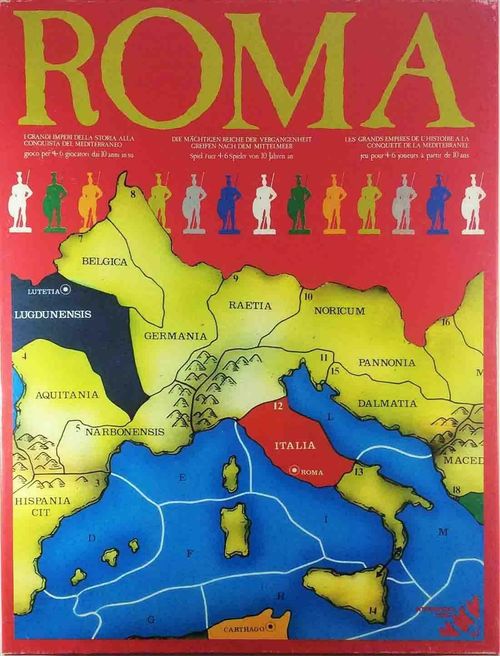
Roma (1986)
Roma (1986) Rulebook
Table of Contents
Table of Contents
Components
1 Rulebook 2 six-sided dice 1 game board showing the ancient Mediterranean basin 24 Province markers in 6 colours 36 Ships in 6 colours 60 Legions in 6 colours 60 Victory Points 1 turn marker 6 Population cards 18 Charisma cards ("C") 18 Assassin cards ("SIC") 19 Naval Military Advantage cards ("CMN") 19 Land Military Advantage cards ("CMT") 18 Military Engineering cards ("CIN") 18 Diplomat cards
The Map
The playing area is divided into territories numbered 1 to 40, and into sea zones marked with the letters A to T. Each territory can hold a maximum of 10 Legions. Naval units may move even though they always start the turn inside a port (a territory). An unlimited number of ships may be in a sea zone, but the number of ships in ports is subject to these limits:
- Capital: 6 Ships
- Province: 3 Ships
- Controlled territory: 1 Ship
Preparing the Game
4.1 Before the game begins, the players must agree on the number of turns that will be played to end the game: 10 turns (about 1 hour 30 minutes of play) or 15 turns (about 2 hours). The turn marker is then placed on turn space 1. All cards that are not Population cards are shuffled together into a single deck.
4.2 Next, the players choose which population, from those available, they wish to play. When playing with fewer than 6 players, the available populations are:
- 2 players: ITALIA and CARTAGINE
- 3 players: as for 2 players, plus GRECIA
- 4 players: as for 3 players, plus EGITTO
- 5 players: as for 4 players, plus LUGDUNENSIS
[The source gives no population list for 6 players.]
The players agree among themselves on how to choose populations; if they cannot agree, the populations are drawn at random.
Once the populations are set, each player receives 10 Victory Points (VP), the 4 Province markers ("tents") of his colour, 5 Legions, 3 Ships and 3 cards.
Note: during the game no player may have more than 3 cards in play or in hand.
4.3 To determine who begins placing pieces, a Population card is drawn from the deck. The drawing continues in this way until all players have placed their pieces.
The first things to place are the Province markers. They must be placed in territories adjacent to the capital or adjacent to another Province of the same population. Once a Province marker has been placed on a territory, it can no longer be moved, and that territory becomes a Province. Legions and Ships may then be placed freely either in the capital or in the Provinces, provided the normal limits are respected.
Game Turn
5.1 At the start of each turn, a Population card is drawn, which determines the player who is to play. That player must then carry out the following phases, strictly in this order:
- Recruitment
- Diplomacy (optional)
- Assassin (optional)
- Military Engineering (optional)
- Land Movement (no combat)
- Naval Movement (no combat)
- Victory Point Collection
5.2 After Victory Point Collection, the player ends his turn. Another Population card is then drawn, and the player who controls it plays his turn. This continues until there are no Population cards left to draw. When the last player has completed the whole sequence, the turn ends and the turn marker is advanced by 1 space.
Sequence of Play
[The source heading "Sequenza di Gioco" is followed directly by the phase rules below; the source has no section 6.]
Recruitment
7.1 During this phase the player may carry out both of these actions:
- Recruit new troops.
- Discard the cards he holds and draw others until he has 3 in hand. When the deck runs out, a new deck is created by reshuffling the discards.
7.2 Recruitment takes place in 2 ways:
- Each Capital controlled (including his own) produces 1 Legion/Ship.
- Every 3 territories controlled (other than a capital) produces 1 Legion/Ship.
- Each Charisma card played produces 2 Legions/Ships. Charisma cards are discarded after use.
Reinforcements may be placed only in the player's own capital, in his own Provinces, or in a captured capital.
Diplomacy
8.1 In this phase the player whose turn it is, if he has Diplomat cards, may conclude Non-Aggression Pacts, form alliances, or break alliances.
8.2 Non-Aggression Pacts: it is enough to play a Diplomat card towards a player. That player may not attack the player who played the card for the whole of his next turn. The pact expires at the start of the next turn of the player who played the card.
8.3 Alliances: it is also possible to form an alliance with the populations towards which a Diplomat card has been played. The only difference is that the consent of both players is also required. In addition, an alliance does not expire when a Non-Aggression Pact expires; it lasts until one of the two parties decides to break it during its own Diplomacy phase.
8.31 Advantages of an alliance: when two populations are allied, they may have their Legions/Ships share the same territories and sea zones. Their Ships may use the allied territories, Provinces and capitals as ports at the end of the turn. When an alliance is broken, combat must be fought immediately in every territory where the former allies' Legions share a space. Allied Ships in port are expelled into an adjacent sea zone (chosen by the controlling player). Finally, in the sea zones where the former allied Ships were together, the normal naval interdictions may be carried out.
Note: in any case, at the end of the game only one population can win, so being allied with the winner does not give an automatic victory.
Assassins
9.1 In this phase Assassin cards may be played to kill a prominent figure of an opposing population.
Only one Assassin card may be played against the same population in a given turn, although the same population may be subject to Assassin cards from several different players in the same turn. The effects of Assassin cards do not stack: if one succeeds, the following ones are ignored. An Assassin card may not be used against an ally, or against a population with which the player has a Non-Aggression Pact in force.
9.2 Warning: assassins may, in some cases, turn against the player who sent them. In that case, the same effects that apply to a successful assassination apply to him. When an Assassin card has been played, roll one die on the following table:
- 1-2: Assassination successful. The victim player may not make any movement or combat during his next turn. He may, of course, continue to defend himself.
- 3-5: Assassination unsuccessful.
- 6: The assassin is arrested and immediately another assassin is sent to kill the one who gave the order. The player who played the Assassin card suffers the effects for the whole of his turn.
Assassin cards are discarded after use.
Military Engineering
10.1 During this phase Military Engineering cards must be declared.
When Legions attack across a mountain range, or by landing, they are normally at a disadvantage compared with the defender. In both of these cases, the attacker rolls only one die to fight, unless he holds a Military Engineering card that allows him to overcome this disadvantage. Each card is valid only for the attack on one given territory, after which the Military Engineering card must be discarded.
Land Movement (no combat)
11.1 During this phase the player may move all of his land forces: each Legion may move into an adjacent territory provided it is empty or occupied by allied forces. Otherwise, the movement must be made in the Combat phase.
11.2 Embarkation: all Legions located in coastal territories at the start of this phase may embark on any ships present there. Up to 4 Legions may embark per ship.
Naval Movement (no combat)
12.1 In this phase the player may move all of his ships up to 2 sea zones (leaving a port costs 1 point of movement).
Ships may enter sea areas where enemy units are present and wait to see whether an interdiction is attempted. If one is, the Ship is considered engaged in combat. If the first sea zone a Ship moves into is empty, or if any interdictions there are unsuccessful, the Ship may continue into the second.
12.2 General rule: whenever a Ship ends its movement in a sea area occupied by enemy ships, a combat must take place in any case.
12.3 Interdiction: interdiction is the only way to force an opposing fleet to stop in an occupied sea zone and possibly destroy it.
When a Ship of another player enters a sea area occupied by Ships of another population and any allies, that player may decide to make an interdiction.
The interdiction succeeds if the modified die roll gives a result of 6.
Modifiers:
- Number of ships attempting the interdiction: -1
- Number of ships that must be intercepted: -1
[The source gives both modifiers with a "+" marker and a "-1" value; the sign convention is reproduced as printed.]
Note: allied Ships may choose not to take part in the interdiction; they are then forced to leave that sea zone immediately. The other allies may also decide to break the alliance with this population immediately.
12.4 As soon as a Ship or fleet is intercepted, it must immediately fight a combat, and if it wins it may end its move (although it may have to fight again in the next sea zone). Several interdictions may take place in the same sea zone. Each Ship or fleet may attempt one interdiction for each Ship or fleet that enters its sea zone.
12.5 Landing of Legions: after its movement, and after any naval combats, the Legions embarked on the Ships may disembark. Disembarkation may take place in an empty or allied territory, in which case everything ends there; or it may be an invasion of a territory occupied by the enemy, in which case a combat must be fought.
Combat
13.1 Naval combat: whenever a naval combat occurs, the following procedure applies.
Combat is fought in rounds. In each round both sides roll two dice; whoever obtains the higher modified score wins the round. In case of a tie, the side that has deployed the higher strength wins [the source reads "spiega il più alto numero di forza", which is ambiguous; the literal sense is "deploys"]. If there is still a tie, nobody wins that round. The player whose turn it is goes first. Before combat begins, both sides declare their Naval Military Advantage cards.
The dice are then rolled and the modifiers counted:
- +1 for each Naval Military Advantage card
- +1 for each numerical superiority ratio (e.g. 2:1 gives +2; 3:1 gives +3, and so on). Fractions are rounded: from 0 to 0.4 round down, from 0.5 upward round up.
The winner of a round makes the opponent lose one Ship of the opponent's choice. Combat continues until one of the two contenders has no pieces left or withdraws. When a Ship is sunk, everything it carries is lost.
13.11 Strike: if a combat is won by a margin of 7 or more points, the winner may choose either to make the loser lose 1 Ship of the winner's choice, or to make the loser lose 2 Ships of the loser's choice.
13.12 Retreat: at the start of each round, each player (the attacker or the interdicted player first) may decide to withdraw his fleet to the nearest friendly port. Also in this case, any allied fleet may decide to withdraw at any moment, but this risks the immediate breaking of the alliance.
13.13 Naval combat together with allied Ships: when fighting alongside allied Ships, losses are chosen by agreement among the allies. If they cannot agree, losses are calculated in proportion to the size of the respective fleets. As for the naval military advantage bonuses, only those possessed by all the allies at the same time count (e.g. if ally A has 3 military advantages, ally B has 2 and ally C has 1, the bonus to use is +1).
13.2 Land combat takes place like naval combat, with the following exceptions:
- Only the Legions of the player whose turn it is may withdraw.
- When attacking across a mountain range, or when invading without Military Engineering, the attacker has the right to roll only one die instead of two.
13.22 Occupation of a territory: when a territory is conquered, any Ship located there passes into the enemy's hands (the Ship is exchanged for one of the conqueror's own). If the conqueror has no Ships available, the captured Ships are destroyed.
Victory Point Collection
At this point the player collects the Victory Points due to him:
- 1 VP for each opposing Province occupied by his troops.
- 2 VP for each opposing capital occupied by his troops.
The Victory Points must be paid by the population whose Provinces or capital are occupied. If a player runs out of Victory Points, he is not required to pay any more for this turn.
End of Turn
When all players have completed their sequence, the turn ends. Before the new turn begins, all Ships must return to the nearest allied port.
Warning: coastal territories conquered during this turn may not yet serve as ports. They become operational ports from the following turn.
End of the Game
When all players have completed their sequence of play in the last turn (fixed at the start of the game), they must add up their accumulated Victory Points. The player with the most is proclaimed the winner, and his people will dominate antiquity!!