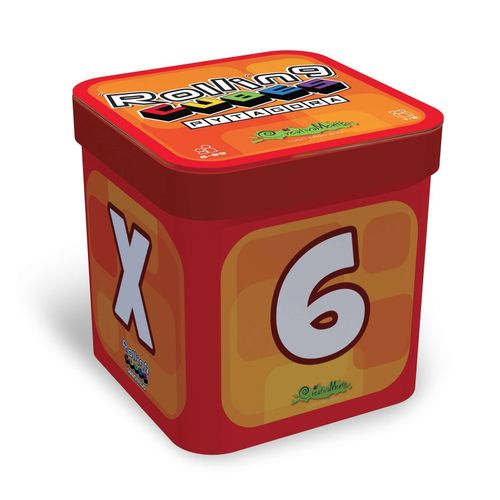
Rolling CUBES Pytagora
Rolling CUBES Pytagora Rulebook
Table of Contents
Table of Contents
Contents
- 13 wooden dice:
- 4 green dice with odd numbers
- 4 blue dice with even numbers
- 4 red dice with the four arithmetic operators
- 1 orange die with the equals sign
- 1 instruction manual
Tournament
Three games are played, one for each Game in this instruction booklet, in the order of this booklet.
At the end of each game, 10 points go to the winner, then 7 points to second place, 6 to third, and so on down to 3 points when playing with 6 players.
No game can end in a draw: exactly one player wins the 10 points for the win. In all three games, places can be shared (tied) starting from second place.
For the tournament, the target scores are lowered: 37 points for the first game, 31 points for the second game and 2 points for the third game.
If there is a tie at the end of the tournament, the player who won Game No. 2 "Tutti insieme" wins.
Game No. 1 — One at a Time
Age 6 and up · 2–6 players
Setup and start
The youngest player starts.
Turn
At each turn, all players roll the dice, one after the other, clockwise.
The first player rolls all 13 dice and creates an arithmetic equality using the numbers and operators shown on the dice, using as many of them as possible.
- Equalities of the type 963=963 are not allowed.
- Zero cannot be used at the beginning of a number (3+6=09), nor can you multiply or divide by zero.
The score is calculated by counting:
- 1 point for each die used.
- Multiplication is worth 2 points and division is worth 3 points, but not when you multiply or divide by 1.
- A number used as tens is worth 2 points; as hundreds, 3 points; and so on.
- 1 bonus point if 12 of the 13 dice are used.
- 2 bonus points if all 13 dice are used.
At the end of the turn, when everyone has made their equality, the bonus for the best score is awarded:
- 2 points if it was achieved by a single player.
- 1 point each if it was achieved by 2 or more players.
The game continues with a new complete turn.
End of game
The first player to reach 47 points wins. In case of a tie, the players with the highest score take a new turn, until a single winner emerges.
Scoring example
Example of scoring: 10 points.
The equality is 7 X 3 = 26 − 5, using 8 dice:
- 7 = 1 point
- X = 2 points
- 3 = 1 point
- = = 1 point
- 2 (as tens in 26) = 2 points
- 6 = 1 point
- − = 1 point
- 5 = 1 point
Total: 10 points.
Game No. 2 — All Together
Age 6 and up · 2–6 players
Setup and start
Each player takes a sheet of paper and a pen.
Turn
All 13 dice are rolled, grouped by colour, and left on the table, well visible to all players. The dice cannot be moved.
Each player creates an arithmetic equality with the best possible score, and writes it on their sheet.
When everyone has finished, all the equalities are checked and their score and bonus are assigned, as in Game No. 1.
End of game
The first player to reach 41 points wins. In case of a tie, the players with the highest score take a new turn, until a single winner emerges.
Scoring examples
The four sheets in the rulebook show these equalities, with their scores:
- 7X8-4=50+2 — 12 points
- 5X8=40 — 8 points
- 750:75=8+2 — 16 points
- 72:4=5X5-7+0 — 17 points, plus 2 bonus points
Game No. 3 — The Last Die
Age 6 and up · 2–6 players
Setup and start
The youngest player starts.
Turn
The first player rolls all 13 dice and creates (A) an equality with the numbers and operators shown on the dice, moving them around to try to use as many as possible.
When the equality is complete, the turn passes to the player on their left, who re-rolls (B) only the dice that are not part of (C) the equality just made, and tries to make a new equality (D), using at least (E) one new die.
Dice used in the previous turn cannot be changed, but they can be moved to any other position (F) in the new equality.
Play continues with a new roll, with always fewer dice, until the player who rolled cannot add any new die.
The player who placed the last die wins the turn and gains 1 point, and a new roll of all the dice begins, always clockwise.
End of game
The first player to reach 3 points wins (5 points if playing with only 2 players).
Example
The rulebook illustrates a turn with the letters A to F:
- (A) The first equality is 3 X 8 = 2 3 + 1.
- (B) The next player re-rolls only the dice that are not part of that equality (C): the 7, the 8, the 6, the ÷ and the X.
- (D) The new equality is 3 X 2 8 = 6 1 + 2 3, which uses the dice of the first equality together with new dice.
- (E) The new dice are the 2 and the 6, which are the dice that were re-rolled.
- (F) The dice marked F are dice from the first equality that have been moved to a different position in the new equality.
Solitaire Yahtzee
Age 8 and up · 1–6 players
It can be played alone or in turns against one or more opponents. It is a reworking of the namesake strategy game with 5 normal dice, of which several variants exist.
There are 5 different combinations. Each player must achieve each one by rolling the 13 dice and creating an arithmetic equality. Once a combination is obtained (for example, poker: 4 dice of the same colour), the player records the score of the equality in that row, which can then no longer be used. The game therefore ends after 5 throws each, even if not all combinations have been achieved.
The dice are thrown only once, but it is possible to re-throw up to a maximum of 5 of them, subtracting from the value of the equality as many points as the number of dice re-thrown.
The score must be recorded in one of the rows still free on the score sheet. If the equality does not correspond to any of the combinations still to be made, you must record zero in one of the empty rows.
The winner is the player who has the most points at the end of the 5 throws.
The 5 combinations
- Blue: the equality contains 3 blue dice. If all 4 blue dice are used, 3 bonus points are added.
- Green: as the Blue combination, but with the green dice.
- Red: as the Blue combination, but with the red dice.
- Poker: contains 4 dice of one same colour.
- 101: contains a number greater than 100.
Examples
- (A) Blue: the equality 9 X 4 = 3 4 + 2 uses 3 blue dice (the 4, the 4 and the 2) and scores 10 points. (In the printed example the 9 is underlined.)
- (B) 101: the equality 32 X 5 = 160 contains the number 160, which is greater than 100, and scores 13 points. (In the printed example the 6 is underlined.)
Score sheet example
The printed score sheet has the rows Blue, Green, Red, Poker, 101 and Total, with three columns for players. The example sheet shows 10 points in the Blue row for the first player (Gabriele) and 13 points in the 101 row for the second player (Valentina).