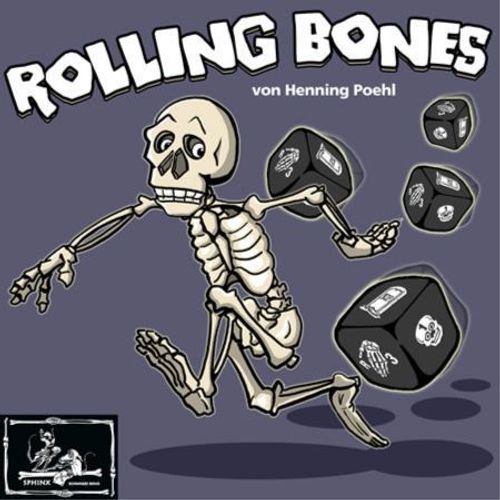
Rolling Bones
Rolling Bones Rulebook
Table of Contents
Table of Contents
Components
Each game comes with 18 dice with faces as follows:
- 6 x left side of the body (with left hand, left forearm, left upper arm, left foot, left leg, left thigh on each dice face)
- 6 x right side of the body (with right hand, right forearm, right upper arm, right foot, right lower leg, right thigh on each dice face)
- 6 x body center (with skull, rib cage, spine, pelvis, hat and gravestone on each dice face)
Important: The number three is listed twice, on two different bone sites (hand and thigh). These are created in different body sections on the skeleton, and must not be confused. The hand goes only in the arm section, and the thigh goes only in the leg section.
The numbers on the dice serve only to help recognize the correct orientation of the bones.
In addition, a pen and a piece of paper are required to record the scores.
Objective
Each player tries to assemble as complete a skeleton as possible from the dice he throws. He then receives points for each skeleton buried. The game is played to 100 points (the players may agree to play to other numbers of points).
Sequence of Play
A player continues to roll until he has buried a skeleton or he can no longer roll.
Then go to the next player to the right.
To start your turn, throw all 18 dice at once. This first throw is called the "pre-op roll". Look to see which of the bones rolled can be assembled together, and separate those bones from the other dice rolled. Try to build the longest chain of bones possible, or even a complete skeleton.
There must not be any gaps in the chain!
Additional rolls that you make in your turn after the pre-op roll are called "post-op rolls". If you wish to or must make a post-op roll, use all the remaining dice that you have not laid out in your skeleton for the roll.
Your post-op rolls do not come free. Each post-op roll costs a number of dice which you must remove from your dice that remain to be thrown in the next post-op roll. This cost rises with each successive post-op roll.
1.) The first post-op roll costs one die, which is removed before the throw.
2.) The second post-op roll costs two dice (altogether then the cost is three dice – one from the first post-op roll and two from the second post-op roll).
3.) The third post-op roll costs three dice (altogether the cost is 6 dice).
You can't make a post-op roll if you can't pay for it. Instead, you must end your turn, and either bury your skeleton if you have a gravestone, or leave the skeleton unburied and forfeit all the points for it.
After each post-op roll, you must lay at least one die on your skeleton, where a gravestone counts as one die. If you have no gravestone and no bones that fit, then you have to lay a bone in the wrong place. You cannot withdraw bones from a skeleton you have laid out.
Once you lay a bone on a skeleton, you cannot take it back. The hat is not a bone, and thus you can remove it at any time to add it to the dice of the next post-op roll.
The hat and the gravestones are special symbols. You may never falsely place a hat; it must be placed only on the skull. You cannot lay out your gravestone as part of the skeleton, since it can only be used to bury your skeleton.
Once you place a gravestone, your skeleton is buried (i.e., you can't install a gravestone and then withdraw it for later use).
After you bury your skeleton, add up its points and write them down.
After the scoring, the next player takes his turn by making an pre-op-throw of all 18 dice.
Scoring
An entire body section counts as 5 points. Body sections include:
- Right or left arm, consisting of upper arm bone (humerus), lower arm bones (radius, ulna), and hand bones (carpals, metacarpals, phalanges).
- Right or left leg, consisting of thigh bone (femur), lower leg bones (tibia, fibula), and foot bones (tarsals, metatarsals, and phalanges).
- Thorax consisting of head, ribcage, spine, and pelvis.
- Note: Body sections are considered complete if they have all of their bones (four bones for the thorax, three bones for arms and legs), even if some of these bones are falsely placed.
- Each bone in the right place in an incomplete body section counts as one point.
- Each bone in the wrong place counts as minus 5 points.
- Double your total score if the skeleton wears a hat.
Scoring example: The following shows the most complete skeleton layout possible after the pre-op roll. Five complete body sections (2 arms, 2 legs, 1 Abdomen) yield 5 times 5 = 25 points. If it wears a hat, double the score (for 50 points altogether).
Example of Play
Example of play (Diagram 1): This shows a beautiful pre-op roll. Many various bones allow him to build a nice-looking skeleton.
If the player chooses to end his turn here, he gets 18 points (one complete body section, namely the left arm = 5 points, and then 4 correctly placed bones in incomplete body sections, and the hat, which doubles his score.) Since he has a gravestone, he can end his turn for these points.
However, he chooses for a post-op roll, and lays the penalty die aside (the L1 in the upper right corner, which is no longer available to him).
Example of play (Diagram 2): This shows the first post-op roll. This roll was worthwhile, because the player rolled a pelvis and further linking bones in the legs. Unfortunately, he did not roll a gravestone so he can't bury his skeleton and get the points.
He must remove two more dice (R5 and L5 in the upper corner), and make a further post-op roll. These dice are also out of the game. The player certainly needs to roll a gravestone.
To improve his chances, he takes the hat off the skeleton (note that the gravestone is found on the same die as the hat.)