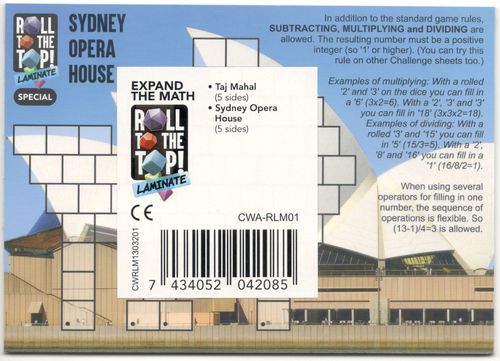
Roll to the Top!: Expand the Math
Roll to the Top!: Expand the Math Rulebook
Table of Contents
Table of Contents
Sydney Opera House Sheet
In addition to the standard game rules, SUBTRACTING, MULTIPLYING and DIVIDING are allowed. The resulting number must be a positive integer (so '1' or higher). (You can try this rule on other Challenge sheets too.)
Examples of multiplying: With a rolled '2' and '3' on the dice you can fill in a '6' (3x2=6). With a '2', '3' and '3' you can fill in '18' (3x3x2=18).
Examples of dividing: With a rolled '3' and '15' you can fill in '5' (15/3=5). With a '2', '8' and '16' you can fill in a '1' (16/8/2=1).
When using several operators for filling in one number, the sequence of operations is flexible. So (13-1)/4=3 is allowed.
Taj Mahal Sheet
In addition to the standard game rules, SUBTRACTING is allowed. The resulting number must be '1' or higher. (You can try this rule on other Challenge sheets too.)
Examples: With a rolled '9' and '6' on the dice you can fill in a '3' (9-6=3). With a '4', an '8' and a '14' you can fill in '2' (14-8-4=2).
When combining ADDING and SUBTRACTING, the sequence of operations is flexible. So (7-6)+2=3 is allowed.