Roll Through the Ages: The Iron Age – Mediterranean Expansion
Roll Through the Ages: The Iron Age – Mediterranean Expansion Rulebook
Table of Contents
Table of Contents
Contents
- 1 Colony Peg Board
- 60 Pegs (15 each in 4 colors)
Setup
- Place the colony peg board in the center play area. It will be used by all players.
- Give each player an additional 15 pegs in their color to use for building colonies.
- Strike thru the Shipbuilding development line on your score sheet.
- Set up the rest of the game as in the Iron Age rules.
Play
Play as in the Iron Age rules, except as noted below.
3a. Resolve Battles, Conquest, and Tribute Demands
Players with Navy may choose to not apply its bonus to a battle (and not lose a ship).
3b. Found Colonies
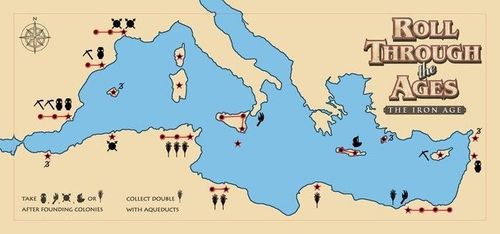
During this step, you may spend population to start and possibly complete colonies. To start a colony, spend population to place pegs in its empty holes, 1 peg for each population spent. Colonies with a 4 next to them are used only in 4 player games. You are limited to 15 colony pegs.
On your turn, you may remove pegs from any of your uncompleted colonies.
To complete a colony you must both place its last peg and spend 1 ship. If you don't have any ships, you may start colonies with more than one hole, but may not complete them.
Pegs of several players can be in the same uncompleted colony (with more than 1 hole). To complete it, spend 1 ship plus 2 population per peg to displace other players' pegs with yours (returning displaced pegs to their owners). You may displace pegs only on the round when you complete that colony. An already completed colony's pegs may not be displaced nor removed.
At the end of this step, if you completed colonies with goods, army, ship, or food symbols next to them, collect the indicated items by adjusting pegs on your peg board. An innovation granted must be spent on this turn towards a development or it is lost. Collect double the food amount shown if you have Aqueducts. A mine symbol provides a scoring bonus if you have Metallurgy; otherwise, it provides no benefits.
4. Build Ships
You may build ships during this step by spending 2 goods apiece. Unlike the standard Iron Age rules, no development is needed (all players effectively begin with Shipbuilding capability).
Scoring
Each completed colony is worth 3 points (+1 apiece with Empire and/or Commerce). If tied, a player's "pegged positions" does not include their colony pegs.
Added from the translation: colonies holding pegs of more than one player score nothing. With Metallurgy, mines in your colonies give their scoring bonus.
Solitaire Rules
(you will need a standard six-sided die, not included)
Play as described above, except:
- Play for 8 rounds, attempting to beat 125 points (or your previous high score). Mark completed rounds on your sheet.
- Starting on round 2, roll a standard 6-sided die (d6) each round, after your turn, to determine if a colony was completed by an "opponent":
- On a result of 5 or 6, your opponent has not founded a colony.
- On a result of 1, 2, 3 or 4, your opponent founds a colony of a size equal to the die result, if available. Fill it with pegs of a different color, displacing any of your pegs present (if you have partially colonized this colony). If more than one colony of that size is available, roll randomly among them to determine which one is built.
- If your opponent founds a colony, roll the d6 again. On a 1 or 2, your opponent founds a second one of this size (1 or 2). An opponent can not found more than two colonies in a round.
Added from the translation: the second roll is not made when the opponent founds Alexandria, the only colony of size 4. The translation places the colony-founding roll after the colony-founding step of the turn and does not mention a start on round 2; the English timing is kept above.
Added from the translation (colony table): when more than one colony of the rolled size is available, choose it with this table. Within each size, colonies are listed left to right as they appear on the colony map. Rusadir, Palma, Rhodes and Antioch (the four one-settlement colonies) are not used in solitaire.
| Size | Colony | Roll |
|---|---|---|
| 1 | Ikosim | 1 |
| 1 | Corsis | 2 |
| 1 | Melita | 3 |
| 1 | Cyrene | 4 |
| 1 | Cyprus | 5 |
| 1 | Arvad | 6 |
| 2 | Barcelona | 1 |
| 2 | Sardus | 2 |
| 2 | Oea |
Good Luck!
Historical Notes
Overview
The Mediterranean peg board depicts colonies of the three major Iron Age Mediterranean powers: the Phoenicians, Greeks, and Romans.
The Phoenician city-states (Tyre, Sidon, Byblos, etc.) were located along the eastern shores of the Mediterranean, in modern day Lebanon. The Greek city-states were in modern Greece. The Roman republic was in the Italian peninsula.
The Phoenicians established colonies across the Mediterranean, forging a commercial empire. They traded dyed cloth, metal goods, olive oil, gems, copper, silver, lead, and tin. They spread Iron Age technology to the Western Mediterranean. Their small colonies were often located on islands or behind massive city walls on easily defended peninsulas.
Rome expanded gradually, province by province, conquering and assimilating peoples. Rome's "manipular" legion formation was superior to the Greek fighting formation, the phalanx. Master engineers, the Romans constructed roads, aqueducts, and irrigation systems. For a long time, they did not engage in much shipbuilding nor trade.
The Greeks combined a mixture of trade and conquest. They planted colonies as far west as Gaul. Inventing coinage allowed them to oust the Phoenicians from the lucrative Egyptian grain trade. Their greatest general, Alexander, forged a huge, though comparatively short-lived, empire.
The Colonies
(from NW to E on the peg board map)
Massalia, originally a Greek colony, became the major port in Roman southern Gaul and, eventually, modern Marseille.
Barcelona was an Iberian/Phoenician settlement occupied by Carthage during the Second Punic War. It combined a good harbor with excellent access to the main coastal route north.
Mastia possessed one of the best harbors in the Western Mediterranean. As a Phoenician colony, it exported silver from this region's mines. After the First Punic War, it became the focus of Carthaginian expansion in Spain and was renamed New Carthage (now, Cartagena).
Palma was a Roman colony founded following the conquest of the Balearic islands in 123 BC. The Balearic islands were earlier settled by the Phoenicians and, possibly, Greeks from Rhodes.
Rusadir was originally a Phoenician trade outpost that passed through many hands until it was conquered by Spain in 1497. It is now the Spanish enclave of Melilla.
Ikosim was a Phoenicia settlement and later Roman city that would become modern Algiers. The region around it, Numidia, supplied cavalry troops to both Carthage and Rome at different times during the Punic Wars.
Corsis, modern Corsica, was colonized first by the Greeks (Aléria in 556 BC) and then the Etruscans, who were allies of Carthage. It was taken over by Rome in 237 BC, after the First Punic War.
Sardus, modern Sardinia, was first visited by Phoenician traders circa 1000 BC. They expanded inward, mined lead, and came into conflict with the native inhabitants in 509 BC. The settlers appealed to Carthage for help, which then conquered the island's southern half, before ceding it to Rome in 237 BC.
Carthage was founded around 800 BC as a colony of Tyre. It gained independence around 650 BC and took control of the Phoenician settlements in the Western Mediterranean. Its growth collided with Rome's growth, resulting in the Punic Wars. After the Third Punic War, it became a Roman province, supplying wheat and olive oil to Rome.
Syracuse, home of Archimedes, was a Greek Corinthian colony founded in 734 BC. It was a powerful city-state until it got caught between the Carthaginian and Roman expansion in Sicily which erupted into the First Punic War. Syracuse allied with Rome, but, after breaking this alliance during the Second Punic War, was besieged and conquered. It then became the capital of Roman Sicily.
Melita, modern day Malta, was a Phoenician and Carthaginian colony whose people revolted during the First Punic War, defecting to Rome. For remaining loyal to Rome in the Second Punic War, it was exempted from paying tribute.
Oea was founded by Phoenicians in the 7th century BC and later was part of a Roman province. It eventually merged with two nearby towns (a "tri-polis") to become Tripoli. This region produced large quantities of wheat until its Roman aqueducts and irrigation systems were destroyed during the Muslim conquest and its fields silted up.
Cyrene was a Greek colony. The most important of five Greek cities, it gave its name to the region known as Cyrenaica.
Crete was the home to the Minoan civilization. Devastated by the volcanic eruption of Thera, Crete was then conquered by the Greeks. The Phoenicians adapted Minoan ship designs into the bireme, which the Greeks later evolved into the trireme.
Rhodes was originally a Minoan colony before being invaded by the Greeks. After Alexander's death, it allied with Alexandria to control Aegean trade. With this wealth, Rhodes built the Colossus, one of the ancient Seven Wonders. Rhodes drew Rome's enmity after the Third Macedonian War and resigned itself to joining Rome as a client state in 164 BC.
Alexandria was founded by Alexander the Great in 331 BC. It was the center of Ptolemaic Egypt until the Muslim conquest of AD 641. It was famous for its library, perhaps the most extensive library of antiquity, and its Lighthouse, one of the ancient Seven Wonders.
Arvad, now Arwad, Syria, was the island half of a pair of Phoenician settlements, Aradus-Antaradus. Located opposite a larger trading port of local peoples, the Phoenician inhabitants of Antaradus and its trade fleet could retreat to Aradus and simply wait out an invading army when threatened.
Cyprus was settled by two waves of Mycenaean Greeks around 1400 BC and 1100 BC. In the 8th century BC, several Phoenician colonies were established to mine its extensive copper deposits. Alexander the Great conquered it in 333 BC. It was annexed by Rome in 58 BC.
Antioch was a Greek settlement, founded by one of Alexander's generals, near the end of the ancient Silk Road that brought goods from distant China. Under Roman rule, it rivaled Alexandria in importance. After the Mongols disrupted the Silk Road, Antioch declined. It now lies in ruins, nearby modern Antakya, Turkey.