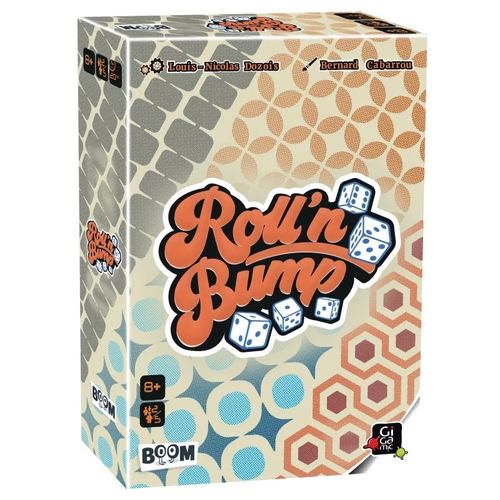
Roll'n Bump
Roll'n Bump Rulebook
Table of Contents
Table of Contents
Contents
- 1 deck of 49 cards (4 sets of 12 cards, each bearing different patterns, 1 Joker card)
- 5 reference cards
- 5 red dice
- 5 purple dice
- 5 green dice
- 5 aqua dice
- 5 black dice
- 1 white bonus die
Setup
Remove the reference cards from the deck and give one to each player. These cards depict the symbols of each dice combination, explain their meaning and show how many points each set of cards is worth.
Place the Joker card — worth 15 points — face up in the middle of the table. The Five of a kind symbol is pictured on the corners of the card.
Then shuffle the remaining 48 cards and divide them as follows:
- 2 players: create 6 piles of 6 cards.
- 3 or 4 players: create 9 piles of 4 cards.
- 5 players: create 12 piles of 3 cards.
These piles must be laid around the central Joker card to form the game layout, also known as the "Tableau". Next, turn over the top card of each pile. Store the rest of the cards in the box. They will not be used for the game.
Finally, hand out a set of 5 dice of the same color to each player and place the white bonus die next to the tableau.
To determine who will go first, each player must roll one of their dice. The player who rolls the highest starts the game. If there is a tie, all the players concerned must roll again.
Goal
You must win the most points! Each card is worth a certain number of points that can be found by looking at their corners. In addition, every card except for the Joker card is part of one of four patterns. Completing sets of two or more cards of the same pattern will get you bonus points at the end of the game.
Gameplay
On their turn, players throw all of their matching dice and complete the three steps described below. Once their turn is over, the game continues clockwise around the table.
- Acquiring — Retrieve all of your dice and any cards successfully claimed during the previous round. This is how you score points at the end of the game. If you have also successfully acquired the white bonus die, you can roll it with your other dice during your turn.
- Rolling — Roll your dice up to three times and try to create the best possible combinations that match the cards that have been placed face up.
- Claiming — Claim the Tableau's cards, bump your opponents' dice and hope that nobody disturbs your own before your next turn.
Detailed Steps
1 - Acquiring
At the beginning of the game, the Tableau has no dice; as such, you can skip this phase on your first turn. During your subsequent turns, you must retrieve both your dice and your valuable acquired cards.
If one or more of your dice are on the Tableau when it is your turn, retrieve them as well as the face-up cards on which they had been placed. This is what is known as "acquiring" a card. Once a card has been acquired, turn over the next card on the pile to replace the card that was just taken. However, if the Joker card is acquired by a player, it cannot be replaced.
Place the cards that you acquire face up in front of you, sorted by pattern, so that you can easily see their point value.
If some of your dice are still placed next to the white bonus die, retrieve your dice AND the white bonus die; you will be able to use all of them during the next phase.
If you claim the last card in a stack (except for the Joker card), the game immediately comes to an end (see End of Game).
2 - Rolling
During this phase, you roll your dice and try to recreate the combinations depicted on the cards of the Tableau.
IMPORTANT: At the very beginning of the game, the first player only rolls 3 dice, the second player only rolls 4 and the following players roll all 5 of their dice. Once this first set of turns has finished, all players must roll their 5 dice until the end of the game.
You may roll your dice up to three times. You may also set aside any of the dice that you wish to keep between rolls. Pay attention to the combinations on the Tableau!
You can re-roll any of your dice, including those you may have put aside, as long as you roll no more than three times per turn.
3 - Claiming
If any of your dice match the combination depicted on one of the face-up cards, claim that card by placing the corresponding dice on it. Each combination is represented by a symbol in the corners of the card.
IMPORTANT: You can bump the dice that another player has placed on a card and/or next to the Bonus die by rolling higher than your opponent (see Bumping and Bonus Die).
The dice combinations, from the reference card, are:
- Single (1 point) — The face of your die must match the face depicted on the card. You can use multiple dice as long as their faces match the face on the card.
- 2 of a kind (2 points) — You must roll two matching dice. For example: two 5s.
- 3 Straight (3 points) — You must roll a consecutive sequence of three dice. For example: 2, 3, 4.
- 3 of a kind (5 points) — You must roll three matching dice. For example: three 4s.
- 4 Straight (7 points) — You must roll a consecutive sequence of four dice. For example: 3, 4, 5, 6.
- 5 Straight (10 points) — You must roll a consecutive sequence of five dice. For example: 1, 2, 3, 4, 5.
- 4 of a kind (12 points) — You must roll four matching dice. For example: four 4s.
- 5 of a kind (JOKER, 15 points) — You must roll five matching dice. For example: five 6s.
You can stake more than one claim during your turn as long as you have rolled the corresponding dice. A die can only be used for one claim. Once a card has been claimed, you can only retrieve your dice at the beginning of your next turn or if they are bumped by another player's dice.
Your turn ends when you have finished claiming cards or if you are unable to do so. The game then continues clockwise around the table.
Bumping
During the game, your opponents may claim cards that you wish to acquire. If this happens, you can bump their dice from those cards and replace them with your own. Bumped dice are then returned to their owner. There are two ways of bumping another player's dice:
a) To bump the dice and claim one of the combination cards (a Three Straight, a Three of a kind, etc.), you will need to use dice that match the combination on the card AND whose total value is higher than that of the dice that you wish to bump. For example, a Three Straight (1, 2, 3) can be bumped by another, higher value, Three Straight (2, 3, 4).
b) To bump the dice and claim a Single card, you will need to place more dice on the card than your opponent.
Example: You have rolled three 2s, a 3 and a 4. They can be used to create a Three of a kind (three 2s) or a Three Straight (2, 3, 4) but not both. No one can bump these dice, as no Four Straight is worth more than 18 points. You have rolled two 4s and as such, you can bump the one 4 that was claiming this Single card.
Bonus Die
During the claiming phase, you can also claim the bonus die that is next to the Tableau. To do so, you must place any of your dice next to it. This is an excellent way to make use of the dice that cannot be used to claim cards.
Remember, other players can bump your dice and stake their own claim if they use higher-value dice!
If you successfully claim the bonus die, you can use it with your other dice the next time you roll. The bonus die can be re-rolled and set aside just like any other die, but cannot be used during the claiming phase. Instead, you can choose to replace the value of ONE of your regular dice with that of the bonus die at the end of the rolling phase. The bonus die is then returned to its former spot and can be claimed by the next player.
IMPORTANT: The bonus die cannot be thrown and claimed during the same turn.
Example: You have claimed the bonus die by using two dice: a 1 and a 3. Another player bumps your dice with a single 6, which beats your total of 4. By replacing the value of one of your regular dice with that of the bonus die, you have created a Four Straight.
Joker Card
The Joker card is placed in the middle of the Tableau and can be claimed just like any other card. To do so, you must combine FIVE dice of equal value.
The Joker is a unique card, as it is worth more than any other card (15 points) AND can be added to ANY incomplete set containing less than 12 cards, regardless of their pattern, to score more points at the end of the game (see Scoring). It cannot be added to a complete set of 12 cards of the same pattern.
Example: Your set of three cards is worth 6 points, but by adding the JOKER card, you have created a set of four cards worth 10 points.
End of the Game
The game ends as soon as the last card in a stack has been claimed (or when two stacks are finished, in a 5 player game). The game does not end when the Joker is claimed.
When the game comes to an end, all players retrieve the dice that they placed as well as the cards they were claiming. If you were claiming the bonus die by using one or more dice, you can retrieve that too.
Example: You, the green player, have claimed the last card of the left central stack. The game has now ended. You finish your acquiring phase by taking the card that depicts a single 6. The aqua and red players acquire the Four Straight and the Four of a kind respectively.
Scoring
Once the claiming phase has finished, each player must add up their points. The points obtained through collecting cards are calculated in two different steps: first, you calculate their value AND THEN you calculate the value of the sets themselves (this is known as a Set bonus).
Your final score is determined by adding up these two totals. Here is how you calculate your points:
Calculating the Value of the Cards
Simply add up the value of each of your cards.
Calculating the Set Bonus
A set is made up of two or more cards of the same pattern. Calculate your bonus by counting the number of cards in each set.
| Number of cards per set | Number of points earned |
|---|---|
| 2 | 3 |
| 3 | 6 |
| 4 | 10 |
| 5 | 15 |
| 6 | 21 |
| 7 | 28 |
| 8 | 36 |
| 9 | 45 |
| 10 | 55 |
| 11 | 66 |
| 12 | 78 |
Now that you have calculated the value of both your cards and your sets, add the two scores together to obtain your final total.
If you have claimed the bonus die, feel free to roll it and add that number to your score.
Did you get the highest score? Congratulations! You have won the game!
Example: your cards are worth 31 points and your set bonus is worth 19, which gives you a total of 50 points!