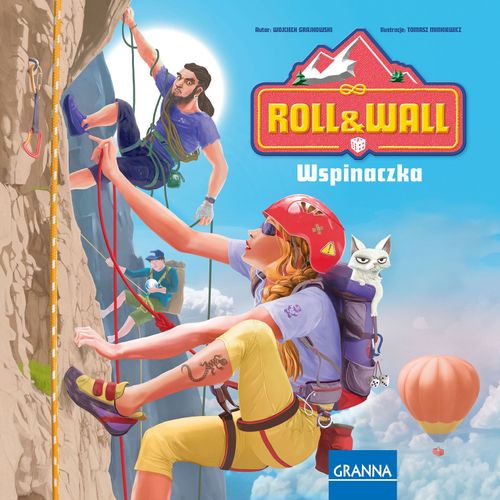
Roll & Wall
Roll & Wall Rulebook
Table of Contents
Table of Contents
Goal of the Game
Players are brave rock climbers racing to the summit (i.e. the highest space on the board). Whoever gets there first is the winner and gains the admiration of the large audience.
Box Contents
- 3 double-sided wall sections
- Board (4 puzzle pieces)
- 35 equipment tiles (green, blue and red)
- 6 wooden flags (2 white, 2 black, 2 orange)
- 20 pitons in 5 colours
- 5 climber pawns
- 1 blue die (4-sided)
- Dice tower
- 6 white dice (6-sided)
- 5 stands (before play, insert pawns into stands)
- 5 backpacks
- 15 triangular flag tokens (5 orange, 5 black, 5 white)
- 1 first player marker
- These instructions
How to Assemble the Dice Tower
Assemble the dice tower by following the five numbered steps in the manual's diagrams.
Note: The assembled dice tower fits perfectly in the box.
Preparation of the Board and Wall Sections
Assemble the board and put it in the middle of the table where all players can easily reach it.
Take the three wall sections and randomly select which sides are face up. Place them in the board frame with the numbers correctly oriented. These are the 3 sections (left, center, right) of a rock wall.
Adjacent wall sections touch each other at their edge. Small numbers on the edges show locations for flags, which are used only in the advanced variant.
Each wall section has 13 spaces, marked with large numbers from 2 to 6. The higher the number in a space, the harder it is to climb and enter that space.
Some fields have rock ledges, marked by a symbol of a rock wall. You can rest on ledges (described later).
Players start climbing in the start space at the bottom of the board, below the three wall sections. The summit is at the top of the board (3 spaces with difficulty 4).
Basic Variant
Game Preparation
Each player receives:
- A climber pawn (in their selected color) which they place on the starting space.
- 1 backpack in their pawn's color, which goes on the table in front of the player.
- 3 equipment tiles: 1 pair of climbing shoes, 1 climbing chalk and 1 energy bar (In the basic variant, the background color of tiles does not matter - they may be green or blue). Tiles have English text on one side and Polish text on the other side, so players can make their preferred language visible.
- A player's equipment goes in their backpack, fitting onto the 3 × 3 square grid. Equipment will be helpful during difficult moments during climbing.
- 3 pitons in their pawn's color, which go in the piton spaces at the bottom of their backpack. During the game, players can put their pitons into the wall; this will protect from falling down to the ground (the starting space).
Younger players can start with a fourth piton as special help. It goes in the piton space on the left side of the backpack. In the advanced variant, a player who packs a quickdraw in their backpack also receives their fourth piton.
Place the blue die in its space on the board.
Place the dice tower and 6 white dice near the board.
Whoever was most recently in the mountains starts the game. That player receives the first player marker.
Return the remaining unused components to the box.
Leave the 3 flag spaces in the backpack empty; they are used only in the advanced variant.
Sequence of Play
Starting with the first player, players take turns in clockwise order.
-
At the start of a player's turn, they say which space they will climb to, e.g. "I'm moving up to the 4 space on the left side." From the starting space, a player can enter the lowest space of any of the three wall sections. In later moves, a player can choose to move up or sideways.
Example: Lucy (the red pawn) is on the starting space. She can enter one of the three lowest spaces (in this case left 3, center 4, or right 3). Ralph (the blue pawn) is on the 6 space on the left. He can move up to the 2 above him, or right to the 2 beside him. Monica (the purple pawn) is on a 2 space in the middle. She can go up to the 4 above her, or right to 6, or left to 4.
-
The player has 6 dice available and decides how many of them to roll to enter the chosen space. To enter a space, the player must get at least one die result greater than or equal to the space's number. To roll the dice, drop them into the dice tower. Then lift the tower without moving the dice. All players check the results on the dice.
Example: Monica says she will enter the 3 space above her pawn, and that she will roll 2 dice. One die result is 1, and the other is 4. Because 4 is not less than 3, Monica succeeds and moves her pawn up to the 3 space.
-
The dice used are set aside (which symbolizes the climber becoming tired). If the player still has dice, they can use them to try moving again during this same turn, again declaring the new space and number of dice rolled. All rolled dice are set aside again. A player can keep climbing this way until they FALL OFF THE WALL or decide to REST.
-
Any time during their turn, a player can put a PITON into their current space. They put one of their PITON markers from their backpack onto the space. A space can have PITON markers from more than one player. In the basic variant, each player has only 3 PITONS. (Younger children have 4 PITONS.) Once a PITON is placed, it stays there until the end of the game.
-
If the player's dice roll is unsuccessful (i.e. all the dice results were less than the space's number), then the player FALLS OFF THE WALL. Their turn ends, even if they still have unused dice. If the player has not placed any PITONS, then they fall to the ground (and their pawn returns to the starting space). If the player has placed a PITON, then their safety rope saves them from falling all the way down. The player's pawn falls down to and stops in that PITON'S space, possibly moving to a different wall section. If the player placed more than one PITON at the same level (which is usually not a good strategy), the player chooses onto which space they fall.
Special case: If a player on the starting space fails their dice roll, then they do not fall and their turn does not end. They simply set aside their rolled dice and continue to try climbing with their remaining dice.
-
Instead of trying to climb further, a player may always decide to end their turn and REST. If a player has no more dice left to roll, then they must REST, or else FALL OFF THE WALL. This decision cannot be made after a failed dice roll. A player can rest only on a space with a LEDGE or one of their PITONS. If the player stops on a space without a LEDGE, then they must place a PITON or (if they cannot or choose not to place a PITON) FALL OFF THE WALL.
-
A player who FALLS OFF THE WALL and lands on the ground (the starting space), puts his piece onto the campsite. In their next turn, they receive hot TEA, i.e. an additional, 4-sided blue die, which they can use during this turn (only), just like the 6 white dice. I.e. they have 7 dice during this turn. The player does their turn from the starting space just like at the start of the game. After their turn, the player returns the blue die back to its special space on the board, so that in later turns they will use only 6 white dice again. This TEA is only for a player who fell to the ground (starting space). A player who fell to a space with a PITON does not receive TEA.
After a player's turn ends, the player on their left takes their turn. The next player has 6 dice to use (or 7, if they FELL OFF THE WALL in their previous turn and landed on the ground, i.e. the starting space).
NOTE: Each space can have multiple pawns and PITONS. A player cannot use another player's PITONS.
Example Player Moves
Ralph, Monica and Lucy are playing.
It is now Ralph's turn; his blue pawn is on the 2 space with a ledge. He declares that he wants to move to the 3 space left of his pawn. He decides to roll 2 dice. The dice results are 2 and 4. So Ralph successfully enters the 3 space. Now he decides to enter the 4 space above his pawn. He decides to roll 2 dice again, but the results are 1 and 2. Ralph no longer has EQUIPMENT (CLIMBING SHOES or CHALK) which he could use after failing his dice roll, so he falls off the wall. His pawn falls down and stops in the 2 space, which has his highest PITON. Ralph will continue moving from this space on his next turn.
After Ralph, it is now Monica's turn. Her purple pawn is in a 4 space, where she can rest because it has her PITON. Monica declares that she wants to enter the 4 space above her pawn. She decides to roll 3 dice. The dice results are 5, 3 and 1. She successfully enters the 4 space. Now she wants to enter the 3 space, above her pawn. She rolls 2 dice. The result is 5 and 5. Monica successfully enters the 3 space. She still has 1 die left, but after thinking about it, she decides to rest there on the ledge. Her turn ends. In her next turn, she will continue moving from this 3 space.
After Monica, it is now Lucy's turn. Her red pawn is in the 2 space with a ledge. Lucy declares that she will try to enter the 3 space to the left of her pawn. She rolls 2 dice. The result is 3 and 4. Lucy enters the 3 space. Then she wants to enter the 4 space above her pawn. She rolls 2 dice again, and the result is 4 and 4. Lucy enters that space. She considers placing a PITON here, but decides to take a risk and immediately climb higher to the 3 space above her. She rolls her last 2 dice, but the result is 2 and 1. She would fall, but she uses EQUIPMENT: CLIMBING SHOES (+1 to a die roll). So she changes her 2 result into a 3, and she succeeds. So she enters the 3 space and now rests on the ledge. She returns her used CLIMBING SHOES to the box.
End of Game
When some player reaches the highest space (difficulty 4) on one of the wall sections, the current round is completed, so that each player has the same total number of turns in the game. Then the game ends. If in this last round, more than one player reached the top, then the winner is the one who used fewer dice in their last turn. If they used the same number of dice, then they tie and share their victory!
Example: Lucy and Alex are at the same distance from the top - both must climb 2 more spaces. It's Lucy's turn now. She successfully climbs twice, rolling 3 dice for each climb, and thus reaches the top, with no remaining unused dice. Now it's Alex's last turn of the game. So he enters the first space, successfully rolling 3 dice, and then rolls only 2 dice to enter the second space - successful! Alex joins Lucy at the top, but Alex used only 5 dice in the last turn, while Lucy used 6. Thus Alex wins the game.
Equipment
During setup, each player puts EQUIPMENT in their backpack. Each tile has an item name and information about when it can be used. Each EQUIPMENT tile can be used only once in the whole game; after use it is removed from the backpack and returned to the box. Each EQUIPMENT tile can be used in the indicated part of a turn. A player can use more than one EQUIPMENT tile in a turn.
Advanced Variant
Game Preparation
Preparation in the advanced variant is like in the basic variant, except for the following changes:
-
Take the 6 wooden flags from the box (2 × white, 2 × orange, and 2 × black) and the 15 flag tokens. Sort them by color and place them near the board.
-
Look at the two middle edges (between wall modules). Each edge has 12 places for flags. These places are divided into 3 sections. Each section has numbers from "1" to "4". A wooden flag (one of each color) will be placed onto a random location in each of the edge's 3 sections.
Roll the 4-sided blue die to determine onto which random location (from "1" to "4") a flag is placed. First place one flag in the top section, putting a flag of any color (players agree together) onto a random space (from "1" to "4") in that section. Place the next flag (in a different color) on the same edge's middle section, on a random space from "1" to "4". Place the last flag (in the third color) similarly onto a random location on the lowest section. Repeat this to place 3 flags on the other edge.
Example: Alex rolls the 4-sided die; the result is 3. Alex puts a white flag into the edge's upper section between the two "3s". Then he rolls the die and gets 1. He puts a black flag into the same edge's middle section, between the two "1s". Then he rolls the die; the result is 2. He puts an orange flag into the same edge's lower section, between the two "2s". Alex repeats the process to place 3 flags on the other edge. It is important that each edge has 3 different colored flags, in whatever order players want.
NOTE: Each edge should have 3 flags in 3 different colors.
The colors on the two edges do not need to match. (E.g. black can be highest on one edge and in the middle of the other edge.)
-
Players take the red and blue EQUIPMENT tiles. Mix them all together and stack them. Determine the first player randomly: each player rolls 3 dice, and the player with the highest total receives the first player marker. Deal 4 random EQUIPMENT tokens to each player, starting with the first player. Remove the unused tiles to the box.
If players want to play without EQUIPMENT which can hurt other players, then do not include the red tiles.
Each player now chooses 1 of the 4 tiles which they were dealt, then passes the other 3 tiles to the player on the left. Then each player now chooses 1 of their 3 received tiles, and passes the remaining other 2 to the left, and so on, until each player has kept 4 tiles. Then players place their tiles in the 3 × 3 grid in their backpacks. Tiles can be rotated to fit, but cannot cover any part of other tiles. If a player cannot fit all their tiles into their backpack, then they must choose to discard one or more of their tiles to the box, so that they can fit their remaining tiles into their backpack. A player's backpack can have multiple copies of the same EQUIPMENT, e.g. 2 ENERGY BARS.
Players are now ready to begin their race to the top.
Sequence of Play
Climbing is exactly the same as in the basic variant. But a player must collect one flag in each of the three colors before moving to the top. To collect a flag, a player moves sideways from one space to another space, through the flag between them. When a player does this (and does not already have that flag's color), they take a triangular flag token of that color and put it into a triangular space on the top of their backpack. The wooden flag on the board stays in place until the end of the game. Thus more than one player can collect flags from the same place.
Example: Monica is on the 4 space. She declares that she wants to move left to the 2 space. She decides to roll 1 die. The die result is 3. So she enters the 2 space. On the edge between the 4 and 2 is a black flag. Since Monica does not yet have a black flag, she takes a triangular black flag marker from the stack and places it in her backpack. Before reaching the top, Monica will also need to collect a white flag and an orange flag. The wooden black flag remains on the board.
NOTE: Players must remember to collect flags of all 3 colors (white, orange, black) before moving to the top. A player who forgets cannot win - it is not possible to move downward!
Catalog of Climbing Equipment
An AXE lets a falling player stop securely on a ledge. It is used immediately after falling off the wall. The player moves their pawn directly down to the closest ledge directly below (on the same wall section) the space from which they fell. If the player was on a ledge when they started falling, then they stay on that same ledge. After using an AXE, a player's turn is finished, even if the player still has unused dice.
CLIMBING CHALK improves the climber's grip, protecting from falling. CHALK can be used after an unsuccessful dice roll. The roll is repeated using the same dice.
CLIMBING SHOES help after an unsuccessful dice roll. SHOES can be used to add 1 to the highest number rolled. Of course, this is only useful if a die result was 1 less than the required number to enter the space.
A CRYSTAL BALL predicts the future. It is used before a player rolls their dice, and it affects all of the player's rolls during this turn. It lets a player roll the dice first, and then decide whether to enter a space and if so, which space. If after seeing the dice result, the player decides not to move, then their turn ends, in which case they rest where they are if the space has a ledge or their piton, or else they fall, as usual.
An ENERGY BAR lets a player regenerate and reduce the effect of tiring climbing. A player can use it after a successful throw. They do not set aside the dice just rolled: they return to the player's available dice and can be used again for further climbing.
Example: Alex has 4 dice available. He wants to enter the 6 space. This is difficult, so he decides to roll all 4 dice. Luckily, he rolled a 6 on one die. Alex uses the ENERGY BAR, so he keeps those 4 dice and can still use them to try to move further this turn.
A GRABBER is used in a space adjacent to a flag which the player needs (directly left or right of the space). It lets a player collect that flag without moving sideways to the space on the other side of the flag.
Example: Monika enters the 3 space. She then uses her GRABBER and immediately collects a black flag token. So she does not need to cross the edge to the 6 space to collect the flag.
A HELMET protects against injuries caused by hitting the wall or the ground. It can be used immediately after falling off the wall. The player's turn does not end, and the player may continue climbing from the space to which they fell (on the wall or ground), using their remaining dice. If the player uses the helmet when falling to the ground, they do not receive TEA.
A QUICKDRAW lets a player attach to someone else's piton. It can be used any time during their turn when the player's pawn is in a space with another player's piton. The player puts one of their pitons in that same space. (During game preparation, a player with a QUICKDRAW added a fourth piton to their backpack.)
A QUIET ZONE forbids climbers to disturb the peace of mountain animals by hammering pitons. It is used at the end of a player's turn. A player may play QUIET ZONE even after falling from the wall due to an unsuccessful roll. Throughout the next round (through the end of this player's own next turn) nobody (including this player) can attach a piton. A QUICKDRAW can still be played.
SAND has historically been thrown into enemies' eyes. It is used at the beginning of a player's turn. The SAND blinds all players below the climber throwing sand (including players on other wall sections). They must set aside 2 of their dice when their next turn starts, so that they have 2 fewer dice available on their next turn. SAND affects only those players who were below the SAND owner at the moment it was played; it will not affect a player who was above the SAND when it was played and then climbs below it during their next turn.
A TALISMAN rubbed against a very difficult part of the route brings good luck. It is used before rolling dice. Instead of considering the highest die result, you add the results of all dice rolled and consider the sum.
Example: Ralph wants to enter a 6 space. He uses his talisman and then rolls 2 dice. The result is 2 and 5. Normally this would have failed, but the talisman lets Ralph add the results, so 2+5=7 succeeds!
A VOODOO DOLL causes bad luck for a chosen opponent. It is used after an opponent's successful roll. The opponent must repeat the roll with the same dice and with the same effects of any equipment they played. (E.g. if the opponent had played TALISMAN to sum their dice, then the TALISMAN's effect will work on their reroll.)
A WIND AMULET unleashes a strong wind in the upper part of the rock. A player can use it at the end of their turn. A player may play WIND AMULET even after falling from the wall due to an unsuccessful roll. The bothersome wind causes all players above the climber using the AMULET (including players on other wall sections), to set aside 2 of their dice when their next turn starts, so that they have 2 fewer dice available on their next turn. The AMULET affects only those players who were above the AMULET owner at the moment it was played; it will not affect a player who was below the AMULET when it was played and then climbs above it during their next turn.