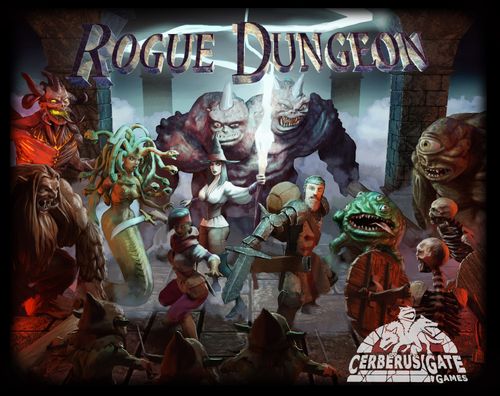
Rogue Dungeon
Rogue Dungeon Rulebook
Table of Contents
Table of Contents
Game Components
- 1 Game Mat
- 42 Monster Cards (8x level I, II & III) (9x level IV & V)
- 4 Boss Cards
- 5 Hero Cards (double-sided, Male/Female)
- 50 Room Cards (15x red, 15x yellow, 5x white, 5x green, 5x blue & 5x purple)
- 7 Map Cards (double-sided)
- 75 Loot Cards
- 18 Specialty Loot Cards
- 35 Starting Loot Cards (7x per Hero)
- 10 Gem Tokens (3x red, 3x yellow, 1x white, 1x green, 1x blue & 1x purple)
- 1 Hero Meeple
- 3 Modifier Tokens (double-sided)
- 9 Health Tokens (double-sided)
- 3 Weapon Damage Tokens (double-sided)
- 4 XP Tokens (double-sided)
- 3 Luck Tokens (double-sided)
- 4 Ability Counters (Strength, Agility, Intellect & Vitality)
- 1 Dungeon Level Counter
- 1 D6
- 1 D10
Playing time: 30-60 minutes. Players: 1. Age: 12+.
Game Setup
-
Monster & Boss Cards: Shuffle and separate the monster and boss cards by level (card-back). Place the level I monster cards on the mat and set the remaining monster and boss cards aside.
-
Dungeon Level: Place the dungeon level counter on I. This is the current dungeon level.
-
Dungeon Map: Randomly choose 5 map cards and place them (either side up) on the mat. Place the hero meeple on the 'upstairs' icon of the top map card.
-
Specialty Deck: Without shuffling, place the specialty loot cards on the mat. Cards from this deck are not drawn, but found and taken in specific situations as directed by other cards.
-
Loot Deck: Shuffle the loot cards and place them face-down on the mat.
-
Room Cards & Room Slot: Shuffle and separate the room cards by gem color (card-back) and set them aside. When room cards are drawn, place them face-up in the Room Slot on the mat.
-
Hero Cards & Hero Slot: Choose a hero card and place it on the mat.
-
Ability Track: Place the 4 ability counters on the matching ability tracks according to the starting values shown on the bottom of your hero card. (Example from the Crusader.)
-
Token Slot: Take Health, Luck and Weapon Damage token amounts shown on your hero card and place them on the mat. (Example from the Crusader.)
Token Pool: Place all additional or unused tokens in separate piles and set them aside.
Discard: When cards are discarded, they go face-up into a discard pile. Other cards may refer to this set of discarded or used cards.
Game Overview
Rogue Dungeon is a solo dungeon crawler reminiscent of old school roguelikes and CRPGs. As heroes explore the dungeon, they will face devious traps and fight dangerous monsters, collecting loot and possible allies along the way. Players will need to figure out how best to use their hero's abilities, skills, items, equipment, experience and luck to survive the dungeon. Gameplay is dictated by exploring the map of each dungeon level and resolving each room card the heroes encounter. Various events such as combat, ability checks, trading and camping can occur, depending on the room card and actions the player takes. Heroes must progress through five levels of the dungeon and vanquish an ultimate enemy boss to win the game.
Heroes
Heroes are unique and have different starting abilities, skills and equipment. Abilities such as Strength, Agility, Intellect and Vitality determine whether heroes can perform skills and how well they can navigate traps, fight or inflict damage. (Abilities are tracked by single counters, whereas Health, XP and Luck may be tracked by multiple tokens.)
- Strength: Ability to bend, break, lift and move heavy or strong objects.
- Agility: Ability to move, run, jump, duck, climb, evade or aim.
- Intellect: Ability to deduce, reason, know or perceive things.
- Vitality: Ability to rest, heal, be resilient or awake. Vitality determines the maximum amount of health your hero can have. (Cannot exceed 11.)
- Health: (HPs) How much damage your hero can take before he dies. This cannot exceed your Vitality. Whenever Vitality increases, Health increases the same.
- Luck: How lucky your hero is. You may spend 1 Luck token to:
- Reroll one of your die rolls.
- Change one of your die rolls by +1 or -1.
Heroes use a primary ability to wield their weapons and it determines how likely they are to hit in combat. Primary abilities appear on hero cards and Weapons (weapon type loot cards), depicted with a splat along with normal ability icons.
-
Weapon Damage: How much damage a hero does in combat from a successful attack. Weapon Damage is the number of Weapons a hero has matching their primary ability, but not exceeding their lowest ability. Weapon Damage is always at least 1 (even with no Weapons).
Example of Weapon Damage: Our hero's primary ability is Strength. She has 4 Weapons but only 3 matching Strength; however, her lowest ability is at 2. Our hero's Weapon Damage in this example would be 2. Even Weapons not matching a primary ability have utility. Most Weapons have a one-shot or discard ability, or they may also be traded.
-
XP: (Experience Points) How much your hero learns and improves during your adventures. Heroes can acquire experience by defeating monsters and traps. At anytime, except during a combat round or ability check, you may spend XP tokens to:
- Spend 5 XPs to gain +1 Vitality.
- Spend 5 XPs to gain +1 Luck token.
- Gain +1 (Strength, Agility or Intellect) paying the cost printed in the next ability track square. (Ex. Increasing Agility from 6 to 7 costs 12 XPs.)
-
Loot cards: There are no restrictions on the number of loot cards heroes can have or where they are placed. Loot cards may be referred to simply by their type: Weapon, Armor, Skill, Potion, Scroll, Equipment, Treasure or Henchmen. This implies a loot card of that type.
Skills
Skills: Heroes start with 3 Skills, having primary ability minimums to use. For example, in order to use the Skill 'Blessed', a Crusader must have at least 5 Strength.
Skills may not be traded, given away, wagered, used as payment, stolen or otherwise discarded due to a room card interaction.
Dice
D10 refers to rolling the 10-sided die numbered 0-9, where '0' is a 10. D6 refers to rolling the 6-sided die numbered 1-6.
One Luck token may be spent to reroll a die-roll or change a roll by +1/-1. More than one Luck may be used on a single die-roll.
Map Cards
- Entrance Stair: Heroes begin a new level here.
- Gem Icon: An unexplored room or is a persistent room (see Exploration page 6).
- Gem Token covering a Gem Icon: A room that has already been explored.
- Corridors: Heroes may move thru freely.
- Walls/Earth: Heroes may not move thru.
- Exit Stair: Heroes proceed to the next level.
Monsters
Monster card anatomy:
- Level: Monster difficulty and how many XPs the heroes gain for defeating it.
- Health: (Hit Points) Amount of starting Health tokens for this monster.
- MAV: (Monster Attack Value) How difficult it is to hit this monster.
- MDM: (Monster Damage) How much damage the monster does when it hits.
- Special Ability: An effect triggered by a combat roll (see page 8) matching the number shown. (See Monster Special Abilities page 10.)
- Weaknesses: Loot that may injure, kill (red) or charm (green) the monster.
Weakness Icons
- Meaty Rib / Hunk of Cheese
- Flute / Speak to Animal Scroll
- Holy Water / Magic Mirror
- Wolfsbane / Turn Undead Scroll
- Garlic / Silence Scroll
- Torch / Transmute Rock to Mud Scroll
Gameplay
Gameplay happens in 3 phases: Exploration, Resolution and Rest phases.
Exploration Phase: The hero meeple indicates where your hero currently is in the dungeon. Colored gem icons on the map card represent unexplored rooms in the dungeon. You may slide the hero meeple, without lifting it, on the map card. You may move thru corridors and already explored rooms, but not thru walls or earth. Once you move over or slightly overlap a gem icon, you must explore that room (you cannot skip it). After moving onto a gem icon, cover the gem icon with a matching gem token. Then draw a room card matching the color of the gem icon, place it face-up in the Room Slot (see page 3.6) on the mat and resolve that room card in the resolution phase.
Explore and draw a room card.
Gem tokens placed on the map card denote rooms that have already been explored and resolved. However, some room cards may be persistent, denoted by a gem icon on the room card. When you draw a persistent room card, place the matching gem token onto the face-up room card instead of the map card. Treat persistent rooms as unexplored rooms and if explored, you must resolve them again.
Example of a Persistent Room.
Exit Stair: If you move the hero meeple onto the glowing red 'downstairs' icon, you may descend to the next dungeon level. Discard the remaining monster cards on the mat from the current dungeon level. Discard the top map card, all gem tokens and all persistent room cards. Advance the dungeon level counter to the next level. Place the hero meeple on the 'upstairs' icon or entrance stair of the top map card and place the new level monster cards on the mat.
Boss Encounter: Once you reach the exit stair on level V and all red gem tokens are placed on the map card, you unlock and encounter the boss monster. Draw a boss card and resolve combat. Once you defeat the boss and any summoned monsters, you are victorious and have won the game! (See End of Game, page 7.)
Resolution Phase: When you draw a new room card or explore a persistent room card again, resolve all the written text and events including combat on the room card (see pages 7 & 8). A room is considered 'Failed' by default unless any 'Pass' conditions are met for rooms that trigger conditional effects (see Gameplay Ex, page 10).
Rest Phase: After resolving a room card, keep persistent rooms face-up with a gem token on them; otherwise, discard the room card and any loot cards on it. During the rest phase, heroes have the opportunity to camp (see Camping, page 7). This allows them to rest and heal, but there's a chance they may come under attack. After the rest phase, proceed to a new exploration phase.
Events
Ability Checks: To make a Strength, Agility, Intellect or Vitality check, roll a D10. If the result is less than or equal to your hero's (or Henchmen's) ability, you have passed the check. If the result is greater, you have failed. A '1' always passes and a '10' always fails. A modified ability check is an ability check with a modifier applied to your hero ability before the roll.
Modified Ability Check Example: Our hero must make a (Vitality - 2) check. If our hero's Vitality is 5 and Vitality is modified by -2 for this check, we subtract 2 from our Vitality and need to roll a '3' or less to pass.
Camping: When a hero discards a 'Camping Gear' card during the rest phase, make a rest roll by rolling a D6. Heroes gain that much Health +1. If the rest roll is less than the dungeon level, you are attacked by a wandering monster unless you are on a stair icon. Draw a monster and resolve combat. Your hero gains Health from camping, regardless of failing the rest roll, and that happens prior to combat.
Trading: Some room cards allow heroes to trade or discard loot cards to possibly gain other loot cards. During trading, Treasures count as two loot cards. Heroes may not trade their Skills.
Trading Example: A Guild Merchant offers 5 loot cards at a rate of 2 for 1. Our hero discards 'Gauntlets' and 'Rope' for a 'Mace', and also discards only a 'Gold Cup' for a 'Healing' Potion. Since the 'Gold Cup' is a Treasure, it counts as two loot cards.
Charming: Heroes may encounter monsters that can be charmed by certain loot cards and become your friend (see Weaknesses, page 5). When you charm a monster, discard that monster from combat, take the corresponding Henchmen from the Specialty Deck and place it on the mat. Also draw a loot card from the Loot Deck (see page 3.5) and gain XP tokens equal to the monster's level.
Charming Example: During combat with a Wolf, our hero discards a 'Meaty Rib'. The Wolf is discarded, then our hero draws one loot card, gains +1 XP and takes the 'Charmed Wolf' Henchmen from the Specialty Deck.
Teleportation: When a hero uses a 'Teleport' Scroll, all combat is ended, at any phase of a combat round, and all face-up monsters are discarded. The current room is immediately resolved and discarded or set aside, in the case of persistent rooms. Skip the rest phase and immediately go to the next exploration phase; however, you must move the hero meeple to any other room (gem icon/token), corridor or stair icon on the map card.
End of the Game: If your hero reaches 0 Health during the game, your hero is dead and you lose the game. If you have defeated the boss and combat has ended, you are victorious and have won the game. You have saved the realm from despair! Many tales of your epic quest will be told and songs sung about your legendary adventures.
Hero Prestige: A measure of how legendary your hero's victory is. After winning the game, Treasures and Henchmen are each worth 1 Prestige.
Example of Hero Prestige: two icons with x2 and x3 total 5 Prestige (the example's icons are not labelled in the text).
Combat
Some room cards specify to draw monsters and some may have monsters directly on the room card instead. Draw monsters from the current level monster cards already on the mat. Then place them face-up in the Battleground. If all the current level monsters have been drawn or discarded, place the next level monsters on the mat (this is rare). Place the starting amount of Health tokens on the monster cards (see page 5). Heroes continue combat rounds until combat is resolved or ended.
Combat Round: One round of combat covers action for both heroes and monsters. This consists of five phases: Choose Target, Combat Roll, Monster Special Abilities, Apply Damage and Loot.
There are not separate monster turns!
- Choose Target: Target a monster by placing a primary ability Weapon on a monster card. Each targeted monster gains a +1 MAV bonus for each untargeted monster in combat.
- Combat Roll: Make a D10 combat roll. After or during the combat roll, any card effect that would inflict damage to a monster is not resolved until the Apply Damage phase of the combat round. Note that Luck tokens may be spent to reroll or modify a die-roll +1/-1.
- MAV: Calculate the monster's attack value. The printed card value (see page 5) plus any bonuses or modifiers.
- HAV: Calculate your hero's attack value. Your hero's primary ability level + combat roll + bonuses or modifiers.
- (HAV > MAV): The monster is considered 'hit'.
- (MAV > HAV): Your hero is considered 'hit'.
- (MAV = HAV): Both are considered 'hit'.
- Automatic hits/misses: On a combat roll of '10', the monster is always hit and the hero is never hit. On a combat roll of '1', the hero is always hit and the monster is never hit.
- Monster Special Abilities: Check if the post-modified or final combat roll matches any of the special ability numbers printed on the targeted monster card (see Monster Special Abilities, page 10) and resolve the effect.
- A monster cannot have more Health than its printed card value.
- Damage to your hero from a special ability is applied during this phase and is considered a separate attack from normal monster damage.
- Card effects that bypass combat, specify 'killing' or 'charming' a monster happen immediately and can circumvent any special effects or damage from the monster.
Combat Example
Ed the Crusader encounters a Ghoul and a Giant Cobra. Ed's primary ability is Strength which is 6. He has 3 Strength Weapons: a 'Sword', a 'Mace' and a 'Dagger'. His lowest ability is 3 so his Weapon Damage is 3. Ed has a 'Shield' Armor, 'Sellsword' Henchmen and a 'Turn Undead' Skill. Ed has 7 Health Tokens.
Round 1
- Choose Target (round 1): Ed targets the Giant Cobra with his 'Sword'. The Giant Cobra gains a +1 MAV bonus from the untargeted Ghoul. Ed gains a +1 HAV bonus from his 'Sellsword'.
- Combat Roll (round 1): Ed rolls a '4'. The Cobra's MAV is 10 + 1 = 11. Ed's HAV is 6 + (4) + 1 = 11. (Tie) Both Ed and the Cobra are 'hit'!
- Monster Special Abilities (round 1): No abilities were triggered.
- Apply Damage (round 1): Ed takes 3 damage, but discards a 'Shield', reducing the damage by 4 so he doesn't lose Health. The Cobra takes 3 damage, now at 2 Health.
- Loot (round 1): No monsters were defeated. Another round of combat begins.
Round 2
- Choose Target (round 2): Ed targets the Giant Cobra again. Ed gains a +1 HAV bonus from his 'Sellsword'.
- Combat Roll (round 2): Ed rolls a '5'. The Cobra's MAV is 10 + 1 = 11. Ed's HAV is 6 + (5) + 1 = 12, the Cobra is 'hit'!
- Monster Special Abilities (round 2): Ed is poisoned by the Cobra so he loses -1 Strength, now at 5 Strength.
- Apply Damage (round 2): The Cobra takes 3 damage and is killed!
- Loot (round 2): The Cobra was defeated. Ed draws one loot card and gains 3 XP tokens. The Ghoul remains and another round of combat begins.
Round 3
- Choose Target (round 3): Ed targets the Ghoul with his 'Mace'. Ed gains a +1 HAV bonus from his 'Sellsword'.
- Combat Roll (round 3): Ed rolls a '3'. The Ghoul's MAV is 11 + 0 = 11. Ed's HAV is 5 + (3) + 1 = 9, Ed is 'hit'! Ed now decides to use his 'Turn Undead' Skill on the Ghoul and rolls a '4' with the D6.
- Monster Special Abilities (round 3): No abilities were triggered.
- Apply Damage (round 3): Ed takes 2 damage, now at 5 Health. The Ghoul now takes 5 damage from Ed's 'Turn Undead' Skill, killing it!
- Loot (round 3): The Ghoul was defeated. Ed draws one loot card and gains 3 XP tokens. Ed is victorious and combat has ended.
Gameplay Example
- Exploration Phase: Our hero, Ed, explores the yellow gem icon without overlapping the white gem icon. We draw a yellow room card and place it in the Room Slot on the mat. The gem icon on the room card signifies this is a persistent room, so we place the yellow 'II' gem token on the room card.
- Resolution Phase: Ed encounters 'Swinging Blades' and must make an Agility check. Ed has 3 Agility and 4 Health. The room text reads: "You dodge your way down a hall of deadly swinging blades. Make an Agility check. Fail: take damage equal to dungeon level. Pass: Your Hero gains +2 XPs (once per game)." Ed rolls a '5' on the D10, which is higher than his Agility, so he 'Fails' the ability check and takes 3 damage, since he is on level 3.
- Rest Phase: We set 'Swinging Blades' aside in case the yellow 'II' gem icon is explored again. Ed now has 1 Health and decides to camp. He discards a 'Camping Gear' and rolls a '2' on the D6 for the rest roll. Ed has 5 Strength and uses his 'Blessed' Skill which adds +1 to the rest roll. The rest roll is now '3' and Ed gains +4 Health, now at 5. The rest roll was equal or greater than the dungeon level, so Ed is not attacked.
This concludes the rest phase and Ed now begins a new exploration phase.
Monster Special Abilities
- Absorb Attack: Instead of taking damage, gain Health equal to hero Weapon Damage.
- Berserk: Gain +2 MDMG until the end of combat (not cumulative).
- Charm: Hero must discard one Henchman.
- Curse: Hero must discard one primary ability Weapon.
- Dragon Scales: Reduce damage taken by 4.
- Drown: Hero loses -1 Health per Armor or Treasure.
- Energy Drain: Gain +3 Health. Hero loses -1 Vitality.
- Ensnare: Hero misses and must pass a (Strength +2) ability check. Hero loses -2 Health for each failed check. A new combat round begins, if Hero escapes.
- Evade: Reduce damage taken by current Health.
- Extra Attack: Hero takes damage equal to MDMG.
- Fear: Hero must discard one Henchman.
- Fire Breath: Hero takes D6-1 damage.
- Flame Strike: Hero takes D6 damage.
- Gain +2 MAV until the end of combat (not cumulative).
Variants
Beginner/Fast Variant: Choose how many dungeon levels you wish to play (I-III). During setup, set aside the 'Tomb of the Lich King' (red gem) room card. If you wish to play to level IV, set aside 'Pit of Despair' (red gem) room card instead. Play as normal until after you resolve the 'Exit Stair' on the last desired level. Once on the next level, in lieu of a final boss encounter, explore and resolve the room card you set aside.
Random Rooms Variant: During setup or entering a new dungeon level, randomize the gem tokens and place them face-down over the gem icons on the top map card. Flip and reveal the gem tokens when you explore them. Draw and resolve room cards matching the revealed gem tokens. Treat all rooms as non-persistent rooms (they always get discarded after they are resolved).
(Multiplayer) 2 or 3 Player Variant: Due to the lack of game resources, this variant requires the additional players to keep track of their own ability levels and amounts of Health, Luck and XP tokens. For example, players could use dice to keep track of everything. Game setup is the same; however, each player chooses a hero along with their starting loot cards. Gameplay is mostly the same with some caveats. Players can trade loot with other players only during trading events or the rest phase. Players may never trade skills. Players can choose to explore the dungeon map separately, but all heroes must exit a level together. Henchmen, and their benefits, are considered common to all players in the same room. During combat rounds, any player can choose to attack or not. Keep in mind that untargeted monsters give a combat bonus. When monsters are defeated, the players can decide on how best to divide XP and loot.
Ascend the Tower Variant: Play as normal, except for dungeon map cards, treat 'downstairs' icons as entrance stairs and 'upstairs' icons as exit stairs during gameplay.
Hero Reference
Turn Overview
- Explore: Move hero meeple on map card.
- Place gem token and draw matching room card.
- Resolve: Resolve all written text on the room card.
- Rest: Discard room card and heroes may camp.
Combat Round
- Target a monster and make a combat roll (D10).
- HAV: Hero's primary ability + combat roll + modifiers.
- MAV: Monster card AV + untargeted monsters + modifiers.
- Resolve monster special ability based on combat roll.
- If (MAV >= HAV) Hero takes MDMG damage.
- If (HAV >= MAV) Monster takes hero Weapon Damage.
Luck
- Spend 1 Luck token to reroll or change any die roll +1/-1.
Ability Checks
- Pass if D10 <= Hero (or Henchmen) ability +/- modifiers.
Spending XPs
- 5 XPs -> +1 Luck token.
- 5 XPs -> +1 Vitality and +1 Health token.
- +1 Strength, Agility or Intellect, see cost below.
XP cost by ability level reached (the cost printed in each ability track square):
| Ability level | 2 | 3 | 4 | 5 | 6 | 7 | 8 | 9 | 10 |
|---|---|---|---|---|---|---|---|---|---|
| XP cost | 1 | 2 | 3 | 5 | 8 | 12 | 16 | 20 | 25 |
Monster Special Abilities Reference
- Absorb Attack: Instead of taking damage, gain Health equal to hero Weapon Damage.
- Berserk: Gain +2 MDMG until the end of combat (not cumulative).
- Charm/Fear: Hero must discard one Henchmen.
- Curse: Hero must discard one primary ability Weapon.
- Dragon Scales: Reduce damage taken by 4.
- Drown: Hero loses -1 Health per Armor or Treasure.
- Energy Drain: Gain +3 Health. Hero loses -1 Vitality.
- Ensnare: Hero misses and must pass a (Strength +2) ability check. Hero loses -2 Health for each failed check. A new combat round begins, if Hero escapes.
- Evade: Reduce damage taken by current Health.
- Extra Attack: Hero takes damage equal to MDMG.
- Frenzy/Invisibility: Gain +2 MAV until the end of combat (not cumulative).
- Hurl Rock: Hero takes 2 damage.
- Insanity: Hero loses -1 Intellect (min 1).