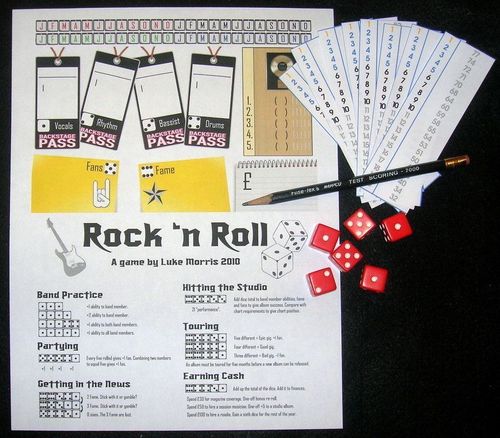
Rock 'n Roll
Rock 'n Roll Rulebook
Table of Contents
Table of Contents
What You Need
- These rules.
- A game sheet (page 1) per player.
- The 8 chart cards (page 2), cut out, shuffled, face down.
- Six dice per budding rock legend.
- One pencil per budding rock legend.
- An eraser, or two, or three.
Getting Started
It's hard at the top, and your brand new rock band is nowhere near. In fact they suck. They have no fans, no fame, no one knows who they are... and even worse, they can barely play their instruments!
The four backstage passes are for your four musicians: vocals, rhythm guitar, bassist and drums. On the line give them all a name. Nice, now they're still useless, but at least the crowd can heckle them by name.
Each musician has an ability of 1. Thankfully this can be improved with practice.
The top of the sheet is the calendar. There are four years, J (January) to D (December). On the right is the list of your album releases, currently empty. Below that is a running total of all your worldly riches: zero. At the bottom are a couple of post-its to keep track of fans and fame. Looks like nobody loves you.
Take five of the six dice, putting the other dice aside. The sixth is your roadie. You can't afford him yet, so for now you're just staring at him longingly from afar.
How a Month Works
Every month you roll the five dice. Then immediately put a check mark through that month before you forget. Have a look at your dice. If you like what you see, then excellent.
You are looking to roll certain combinations depending on what you want to achieve. Sometimes you'll have to go with the flow; sometimes you'll need to keep pushing for something specific.
After this first roll you will need to state what you are trying to achieve: Practice, Fans, Fame, Recording, Touring or Cash. You can then have up to three rolls in order to achieve your aim within that category. However, if you want to take a second or third roll, then you need to check off a second or third month. This means you will have to balance settling for a lesser result with taking up too much time looking for a better result.
When the fourth year is finished, the game is over. Each player tallies up their results, and Rock HoF points are handed out to decide the overall winner.
Band Practice
For band practice you have up to three chances to roll 3 of a kind, 4 of a kind, 5 of a kind or a "full house" (2 of one number, 3 of another) of either 1 (vocals), 2 (rhythm), 3 (bassist) or 4 (drums). You can stop at any point (1 roll, 2 rolls or 3 rolls) to add ability to your musicians.
- Three 1s give 1 ability to the vocalist.
- Four 3s give 2 ability to the bassist.
- A full house of 2s and 4s gives 1 ability to the rhythm guitarist AND 1 ability to the drummer.
- Five of 1, 2, 3 or 4 gives 1 ability to every musician.
Put aside any dice showing the number you want to save, rolling the ones you want to change. If you cannot roll any of these combinations, then no musicians improve and the time was wasted.
For Practice, re-rolling once OR twice takes only one extra month.
Partying
Partying gives you fans. Naturally. For partying you have up to three months. You can stop at any time. Every 5 you roll gives you +1 fan. If you can combine two dice to equal 5, then this also gives you +1 fan. Put aside any dice you want to save during your period of partying.
To some extent, your fan base is limited by your band's actual ability.
- In order to increase your fan base over 20 fans, you need to have at least 10 total musical ability in your group (with one musician having at least a 4 rating).
- In order to increase your fan base over 30 fans, you need to have at least 16 total musical ability in your group (with one musician at least a 6 and one at least a 4 rating).
Getting in the News
Whether it's for charity events or for throwing a TV out of the hotel window, all news is good news. Fame is the only action that only takes you one month whatever. However, it offers another decision.
If you roll the dice and choose Fame, you count the number of 6s you rolled. You can either add this number to your Fame OR roll all the dice again. If you roll 6s again, you add them to the number you rolled before. You can continue rolling and adding all your 6s together, amassing a huge amount of Fame as you go on one huge rock bender.
However, if you don't roll any 6s, then you lose all the Fame from that month's turn. Even worse, if you roll no 6s and at least two 1s, then you must lose an ability from a musician of your choice!
If, by losing an ability, your band drops below the fan requirements (see Partying above), then you lose fans down to the 20 / 30 cut-off point!
Hitting the Studio
The key to success in this game is recording albums. If, after rolling, you choose to record an album, you have up to three months and can stop at any time. Save the dice you want to keep for the album. Add the total dice roll to your musician abilities, Fame and Fans to give your album rating. Mark that on your album list. When an album is recorded, it is then automatically released.
Turn over the top chart card and compare your album rating to the chart position it would achieve. Write the chart position in the brackets.
For example, your album is rated 54. The chart card says that 11th spot is 53 and 10th is 55. Your album will reach number 11 in the chart.
Mark each album release on your calendar in the month it was released.
Touring
Time to get out on the road! You can't tour unless you have an album! You must complete five gigs in the tour before a new album can be released.
For each gig you have up to 3 months and can stop at any time (putting aside dice you want to keep). Five different values on the dice means that you performed an epic rock gig: mark off one tally for that album and also gain a fan! Four different values means that you performed a good gig: mark off a tally. Three different values still allows you to mark off a tally, but it was a poor gig and you will lose a fan. So decide whether to accept that or roll again (if you can) to try and finish the gig with style.
For every different dice value you have at the end of the gig you also receive £3 as your share of the ticket sales from the venue.
Once you have completed a fifth gig for an album, you can't tour any more for that album, but you can record a new album and then start a new tour.
Earning Cash
Dunno what to do with your roll? Playing for the long game? Then make some cash. You can spend up to three months each time making cash and can stop at any time (putting aside the dice you want to keep). Add up the total shown on the dice and add it to your band finances. This money can be spent at any time (not using up a month to spend it) in one of three ways.
- £30: Magazine coverage. A one-off bonus re-roll of up to all of your dice, without spending a month.
- £70: Session musician. Hire a session musician to work on one album. His ability adds +5 to the album rating score.
- £130: The legendary roadie. You can use the sixth dice for the rest of the year (so probably best hiring him early in the year!). From these six dice you still choose your best five for the result.
Hall of Fame Points
At the end of the game, bands score HoF points to decide the overall winners.
- The band with the most fame scores 2 points.
- The band with the best album scores 3 points.
- The band with the best total musician ability scores 2 points.
- The best album each year scores 1 point.
- All number 1 albums score 5 points.
- All top 5 albums score 3 points.
- All top 10 albums score 2 points.
- All top 20 albums score 1 point.
- In a game with 3 or more players, the band with the worst total musician ability scores –2 points.
Any draws result in all drawn players scoring half the points, rounded down.
If there's a draw for the victory, then the band with the most fans wins the tie break. If that's the same, then you can argue over who is the better band in a Beatles/Kinks or Oasis/Blur style.
Solo Play: My Four Years Are Up
If you were playing solo, make a note of your band abilities, fame, album ratings and chart positions. Head over to the Rock 'n Roll page on BoardGameGeek and post your results in the Hall of Fame thread to see how you stack up against other players.
Maybe you could reunite your band for a comeback. You can move your band, with their current abilities, over to a new sheet. However, they lose all the money they saved (spent on gold-plated dolphins and vintage cars) and half of their fans and fame (out of sight, out of mind!). To up the challenge, they could be a little rusty (deduct an ability from each of them), or maybe one musician has split from the band and a brand new 1 rated replacement has taken his place. It's up to you.
Multiplayer
In multiplayer Rock 'n Roll, each player takes a game sheet and fills in their band. Every month is rolled at the same time, with players checking off the months and announcing their plans for the month.
When anyone releases an album, the top chart card is turned over. If two or more bands release an album on the same turn, then the same chart card is used for all releases in that month. If two releases have the same rating, then the band with the most fans takes the higher spot, with the other band taking the one spot lower.
Mark each album release on your calendar in the month it was released.
At the end of the game, bands score HoF points to decide the overall winners (see Hall of Fame Points above).
Chart Cards
There are 8 chart cards. Each card lists a rating requirement for each chart position from 1 to 20. Turn over the top chart card for each release, as described in Hitting the Studio and Multiplayer.
| Position | Card A | Card B | Card C | Card D | Card E | Card F | Card G | Card H |
|---|---|---|---|---|---|---|---|---|
| 1 | 80 | 82 | 79 | 77 | 76 | 83 | 81 | 78 |
| 2 | 78 | 76 | 77 | 74 | 75 | 82 | 76 | 76 |
| 3 | 76 | 72 | 71 | 72 |