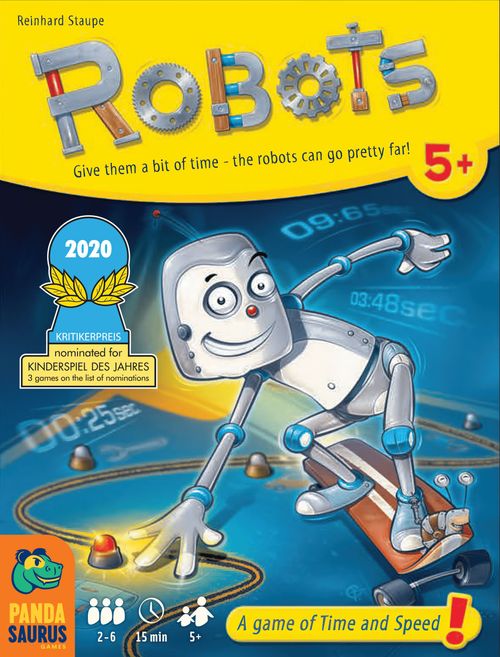
Robots
Robots Rulebook
Table of Contents
Table of Contents
Material
- 12 boards (each with a front, the race track, and a back, the information side)
- 50 wooden discs (chips)
Game concept
One player assumes the role of robot. The robot says "beep" and moves from the starting point along the line in the direction of the arrow, although the robot doesn't really move of course, just in your mind. Then the robot says "beep" for the second time and stops. The question to all players is now: How far did the robot move between the two beeps and which object did they stop at? The other players try to guess the right object.
Note: There are three preset travel speeds for the robot: slow, normal and fast.
Example: Tim is playing the robot. He says beep. The robot starts moving (at normal speed). After about 4 seconds Tim says beep again. How far is the robot likely to have moved? Maybe as far as the hair dryer? Up to the cup? As far as the banana? Or even to the ice cream?
Team version
The 12 boards are mixed and laid in the middle of the table as a stack with the race track face up. The 50 chips are ready to hand at the edge of the table.
Note: All players are one team and try to achieve the best result possible. "Playing against each other" is explained at the end of the rules.
The robot player takes up the top board from the stack so they (and only they!) can see the back of the board - the board in their hand is the information board. The board that is now on top of the stack is the current race track.
The information board indicates which object the robot has to move up to on the current race track and which speed they move at (slow, normal or fast). The player recognises the moving speed from the number which is displayed on the bottom right of the current race track. He announces the speed loud and clearly.
Example: The current race track shows the number 3 in the bottom right corner. The robot player therefore knows from their information board that the robot has to move at a slow speed as far as the apple.
The robot player says "beep" and the robot starts moving. When the robot player says "beep" for the second time, the robot stops.
Very important: If the robot player looks at the current race track and looks for the required object there, they should do so in a way that the other players cannot see the solution from where they look. If, for example, the apple is the target, then the robot player should not obviously look at the apple, they should ideally look everywhere or shield their eyes a bit with their hand, if necessary.
What does slow, normal or fast actually mean? Well, each player has to choose the speed themselves and the other players have to adapt to it. The longer and more often you play, the better you adapt to the other players' speed. That's exactly what it's all about!
Once the robot player has said "beep" for the second time, the other players now have to guess at which object the robot has stopped. The players are a team and may consult each other. Finally, they have to agree on an object and announce it loudly and clearly.
If the guess is correct, the team receives 3 chips. If the guess is one object to the right or left of the correct answer, the team receives 2 chips. If the tip is two objects to the right or left of it, they receive 1 chip. In all other cases, the team does not receive a chip.
The robot player places the info board in the box. Now the next player sitting clockwise to them becomes the new robot player. They also take the top board from the stack in their hand so they (and only they!) can see the back of the board. This board is the new information board. The board that is now on top of the stack is the new current race track.
End of the game
The game is played in the way described (11 rounds) until there is just one board left in the middle. The team counts the chips to see how good it was. Results over 20 are good, over 25 are really great, and anything around 30 is virtually out of this world!
For beginners
If you want to make the game a bit easier you can also ignore the different speeds. You play every round at normal speed. Just ignore the number on the current race track.
Even easier: The robot player does not change in a clockwise direction after each round. One player is designated as the robot player and they complete all 11 rounds, this way you can adapt better to just one player and their sense of speed.
Playing against each other (for 3-6 people)
The game is played exactly as described for the team version with the following difference: when the robot player has said "beep" for the second time, all the other players make their own guess one after another.
If you've guessed right, you get 2 chips. If you guessed next to the object, you get 1 chip. The robot player gets 1 chip each for every player who guessed correctly.
The robot player changes in a clockwise direction after every round. As many rounds are played until each player has been the robot three times. If the stack is used up, the boards are reshuffled and laid out as a stack again. Whoever has the most chips wins.