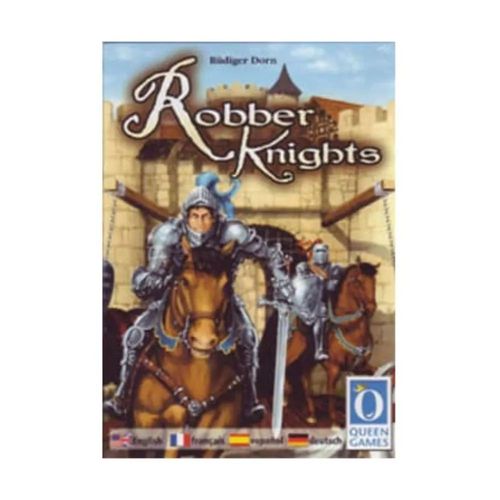
Robber Knights
Robber Knights Rulebook
Table of Contents
Table of Contents
Game Concept
A tactical game for 2-4 people by R. Dorn.
Game Components
- 96 landscape tiles - 24 for each player.
- On their front side, the landscape tiles show one of the four possible landscapes: lake (1 per player), mountain (2 per player), plain (3 per player) and forest (forest tiles always show buildings).
- The reverse side of the tiles shows a shield in one of the player colours together with a letter (A-E), which indicates whether the tile appears early in the game or later.
- On most of the landscape tiles with plain or forest, buildings are also shown: a village (3 per player on the plain, 3 per player in the forest), a castle (6 per player on the plain, 2 per player in the forest), or a town (3 per player on the plain, 1 per player in the forest).
- 120 knights - wooden discs in the four player colours.
Game Preparation
Each player gets the 24 landscape tiles with the shields of his chosen colour on the back, and the corresponding 30 knights in the same colour.
Landscape Tile Setup
Each player shuffles his landscape tiles in separate groups sorted by their letters.
Then he constructs a face down draw pile: right at the bottom go the tiles with the letter "E", then the tiles with the "D", after that the tiles with "C" and finally on top the tiles identified with "B".
Tiles Taken into the Hand
From the four tiles identified with "A", each player takes 1 castle and 1 other tile of his choice into his hand. He places the two remaining tiles face down in the starting area.
The Common Starting Area
The donated tiles are assembled into a rectangle in the middle of the table, as shown in the illustration, and then turned over. The distribution of the colours is unimportant [ie. you needn't stick to the colour patterns shown - it's only the shape that matters].
The oldest player begins, and play then proceeds clockwise.
Note: All of the "A" tiles are now turned over: two are on the table and the player has the other two in his hand.
The topmost tile of each player's draw deck should now show the letter "B".
The starting area is 4, 6 or 8 landscape tiles, depending on the number of players.
Sequence of Play
Lay 1 to 3 Tiles
The player whose turn it is lays one of his two tiles so that it adjoins the display. At least one edge must border an already laid tile. After this the player takes the top tile from his stack into his hand [without revealing it to the other players].
The player can perform the foregoing (his turn action) up to three times when it is his turn in the game. The first action is compulsory, but each of the further two actions is optional.
Corner-to-corner is not a valid placement - it must touch along at least one edge.
Lay a Stronghold and Move Knights
Place a stronghold. If the player places a tile with a stronghold, he may place a stack of up to five of his knights along with it.
Move knights. The player then moves his stack of knights out of his castle in one of the possible directions (not diagonally), in a straight line without corners.
The knights are always moved from one tile to the next, without jumping over any tiles or empty spaces.
The player must leave knights behind on each tile that he crosses, including his stronghold. Depending on the landscape type (plain, forest or mountain), different numbers of knights must be left behind:
- On a plains tile: at least 1 knight
- On a forest tile: at least 2 knights
- On a mountain tile: at least 3 knights
No knights may enter a lake tile.
It is allowed to leave more knights behind on a tile than necessary, but never more than 4 knights per tile [this is what the German appears to say, but what it means is there can never be more than 4 knights on a tile at the end of movement]. If this limit would be exceeded by moving a stack of knights, the tile may not be entered. [So 2 knights in a forest would appear to protect the tiles beyond, because if 2 knights enter, they must remain, and more than 3 cannot enter. However, the example indicates that what the rule should actually say is that, if the 4 knight limit would be exceeded after the minimum number of knights is left behind, then the tile cannot be entered. You thus need 3 knights to block movement beyond a forest.]
Knights may set foot in forests and mountains only if there are enough of them in the stack [ie. the number of knights you must leave behind on a tile is also the minimum number you need to enter it, even if you don't leave].
Knights can be moved only immediately after they are placed, and not later on in the game.
If knights are moved to a tile which is already occupied by one or more knights, the new knights are placed on top.
Note: It can happen that a player has already used all of his knights, but must play one or more tiles with strongholds. In that case, he cannot place any knights on them.
Example: Player "red" puts 4 knights on his just placed stronghold. He decides to move them to the right and leaves 1 knight on the stronghold (plain), 2 knights on the village (forest), and 1 knight on the town (plain).
Example [not a continuation of the previous example]: Player "yellow" has played 4 knights.
Example: After this it is player "red"'s turn and he plays [a stronghold with] 4 knights [and moves them as shown. Note that there must temporarily have been 6 knights on the forest as he moved through it, hence the earlier comment about the stacking limit]. For now he controls these 4 tiles. The tile with the village has reached its maximum number of knights and can no longer be entered.
Size of the Playing Area
The extent of the tile display varies according to the number of players, thus:
- 2 players: a row or column can hold a maximum of 7 tiles and the extent of the display is at most 7 x 7 tiles.
- 3 players: 8 per row or column, 8 x 8 tiles.
- 4 players: 10 per row or column, 10 x 10 tiles.
If all of the tiles have been played, the game ends and scoring occurs.
Example: In a 2-player game, once the borders of the playing area have been defined, further tiles may be laid only within the remaining bounded area.
Note: It can happen that the players do not all play their last tile in the same round.
Game End and Scoring
Victory points are now awarded for the knights in castles, villages and towns.
The player whose knight is on top of a stack gets the appropriate number of victory points:
- For a castle: 1 victory point
- For a village: 2 victory points
- For a town: 3 victory points
Landscape tiles without buildings yield no victory points.
The player with the most victory points in total has won. In the event of a tie, the player with the most unused knights wins. If equality prevails here also, then the contest is undecided.
Examples for the distribution of points: Blue gets 1 point (castle). Red gets 2 points (village). Yellow gets 3 points (town).