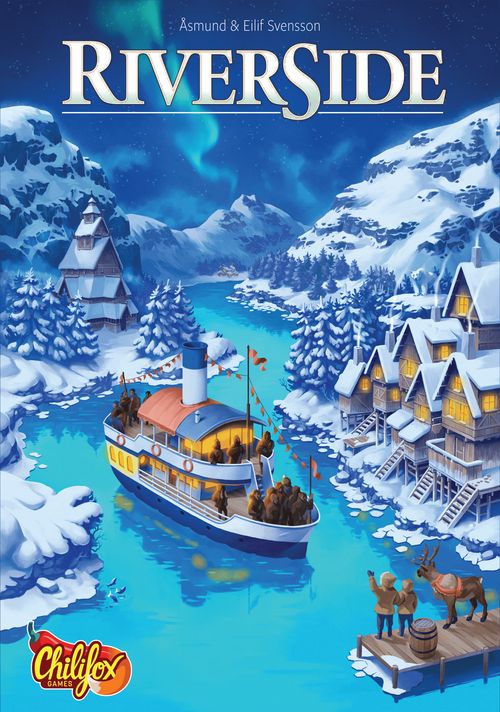
Riverside
Riverside Rulebook
Table of Contents
Table of Contents
Components
- 14 tiles (game board parts): 1 west tile, 1 east tile, 10 river tiles, 2 extension river tiles
- 1 score pad
- 6 pencils
- 1 captain tile
- 1 cruise ship token (with plastic standee)
- 100 double-sided score sheets
- 6 dice: 1 green die, 5 base dice
Setup
Give each player a score sheet from the score pad and a pencil. Return any unused pencils to the box.
Note: Both sides of the score sheet are identical. You can use the other side next time you play.
Create the game board by randomly placing the 10 river tiles face up in two horizontal rows of 5 tiles each. Ensure the tiles in each column are oriented with their rounded edges facing the outside of the board, as shown in the example. Place the west tile connecting to the left end of the river tiles, and the east tile connecting to the right end of the river tiles. The game board is now complete.
Attach the cruise ship token to the plastic standee and place the assembled cruise ship on the designated space on the west tile.
Note: The 2 extension river tiles are only used with the "Extension Variant".
Appoint a captain who will be in charge of rolling the dice and moving the cruise ship at the beginning of every round. This player takes the captain tile and all dice. You are now ready to begin the game!
Overview & Goal
The cruise ship starts in the west, follows the white-dotted line to the east, where it turns and sails back to the west until the game ends on the anchor space.
Each color in the game represents a specific type of excursion:
- White — Northern lights
- Yellow — Polar bear safari
- Brown — Mountain climbing
- Blue — Reindeer trip
- Pink — Ice fishing
- (Stave church) — Local brew house
The goal of the game is to get the most points. You get points from the following:
- Tickets: Fill rows of seats on your score sheet. Do this by choosing dice and crossing out seats on your guide boat of the corresponding color according to the value of the chosen dice.
- Excursions: Take tourists on excursions in villages within 3 spaces of the cruise ship. Multiply the village's value with your number of tickets (filled rows) of the corresponding color to get your excursion points.
- Collecting captain points: Add points from your stave church boat to your lowest scoring guide boat (which is scored twice) to determine your captain points. Players with the most/least captain points get +/- 15 points.
The Score Sheet
The score sheet includes:
- Fire symbols
- "+1" symbols
- 5 guide boats, one of each color (white, yellow, brown, blue, pink)
- Guide boat points (end game points)
- Stave church boat
- Subtotal
- Captain points
- Final score
Playing the Game
Riverside is played over several rounds (typically 8-11). A round consists of 3 phases:
- Roll dice and move ship
- Choose dice and fill seats
- Go on excursions
1. Roll Dice and Move Ship
Roll dice
The captain rolls the green die and places it in the heating area above the captain tile. Then, they roll all base dice.
Find the temperature
Find the median of the base dice: the middle die after sorting them in ascending order. This represents this round's temperature. Place base dice with a higher value than the temperature in the heating area and all other dice below the captain tile.
Note: If at least the 3 highest valued base dice have the same value, all base dice are placed below the captain tile (since the median/temperature will be the same as this value).
Dice represent groups of tourists. Dice with a higher value than the temperature represent groups that think the temperature is too low for outdoor activities.
Dice and temperature example: This round, the temperature is 4. Only the pink die is higher than 4 and is placed in the heating area (with the green die).
Move the cruise ship
The captain moves the cruise ship the same number of spaces as the temperature (median) by following the white-dotted line.
Move ship example: With a temperature of 4, the cruise ship moves 4 spaces.
2. Choose Dice and Fill Seats
This phase is executed simultaneously by all players. Each player performs the following three steps:
Choose dice
Choose one (and only one) base die.
Additionally, you may add the value of the green die to the value of the base die. The sum of your chosen dice is called your dice value.
Note: Do not physically take the dice you choose. Multiple players can utilize the same dice.
Choose dice example: Adam chooses the yellow base die and adds the green die for a total dice value of 6 in yellow.
Fire symbols:
For each die you choose from the heating area (including the green die), cross out fire symbols on your score sheet equal to the value of the die (even if you cannot use its full value — see "Note" under Fill Seats below).
If you have fewer uncrossed fire symbols than the value of the die from the heating area, you cannot choose that die.
Fill seats
Fill seats on the guide boat matching the base die's color equal to the dice value.
Cross out seats from left to right in any given row, however, you do not have to finish a row before starting another.
Note: If you have completed all four rows of a guide boat, any additional crosses for that guide boat are lost.
Fill seats example: Adam has a dice value of 6 in yellow. Adam crosses out 6 seats on the yellow guide boat (4 seats were crossed out in previous rounds).
Cross out bonus seats
For each completed row, cross out the corresponding ticket and bonus seats:
Depending on the bonus, cross out 1 or 2 seats in any row on the guide boat matching the bonus' color (following normal rules). This can result in gaining additional bonus seats.
Note: If you complete several rows in the same turn, you may resolve them in the order of your choice.
Bonus seats example: Since Adam now has completed the top row, he crosses out the ticket and then 1 seat on the blue guide boat. He has also completed the bottom row and crosses out the ticket and then 2 seats on the white guide boat. Adam uses the "white bonus" to cross out 2 seats in the top row, completing this row, too. He crosses out the ticket and gets another 2 bonus seats on the white boat. He uses this last bonus to start on a new row.
Royal seats
Royal seats (purple) count as normal seats. Additionally, once you cross out both royal seats on the same guide boat, activate its royal power by crossing out its activation box. See "Royal Powers" for the use of royal powers.
Royal seats example: Cathrine has crossed out both royal seats on the pink guide boat. She crosses out the activation box and may use this power once during the game.
3. Go on Excursions
This phase is also performed simultaneously by all players.
Each player may (but does not have to) go on excursions by performing the following two steps:
Choose village
Choose one (and only one) village within 3 spaces of the cruise ship. This distance is called range and is determined by counting the shortest distance. Multiple players can choose the same village.
Note: Do not move the cruise ship in this phase! This phase represents your guide boats/stave church boat picking up tourists from the cruise ship and taking them to the desired village.
You may cross out "+1" symbols on your score sheet to increase your personal range. Each symbol you cross out increases your range by 1 this round. You have only 3 symbols to use for the entire game, but you may use more than one in the same round.
Anatomy of a village: A village shows its value (e.g. 10) and color/excursion (e.g. brown/reindeer trip). A village space is symbolized by a pier.
Range example: Players can choose either the brown village or the pink/yellow village; both are within range. In order to choose one of the other three villages (white, yellow/blue, or stave church), they must cross out two "+1" symbols, since each of these villages is 5 spaces from the cruise ship.
Score excursion points
Multiply the value of the chosen village with the number of crossed-out tickets on the matching guide boat. Write your score in the leftmost vacant scoring box for excursion points, provided you meet the following criterion:
Your score must be higher (tie is not enough) than your previous score on the same guide boat. Your first score on a guide boat can be of any value.
IMPORTANT RULES:
- You do not use up tickets. The same ticket can be used for each excursion in villages with a matching color for the remainder of the game.
- In a village with two colors, you may score both colors or only one of them. A scoring box of any unscored color is left blank (but you may score it later).
- You may score the same village several times during the game (strictly obeying the criterion above).
Note: The points shown on the ticket are added at the end of the game, not to your excursion points in this phase.
Village with one color example (11 points per "yellow" ticket): 22 points (2 tickets x 11 points) is higher than 16.
Village with two colors example (9 points per "white" ticket and 4 points per "blue" ticket): 18 points for white (2 tickets x 9 points). No score for blue: 12 points (3 tickets x 4 points) is lower than 14.
Stave church
A stave church village functions like any other village, with the following exception: Multiply the number of tickets on all guide boats (of all colors) with the value of the village and write your score on the stave church boat. This increases your captain points (see "Game End").
Remember: You may score the same stave church village again (as long as you score higher).
Stave church example: Monica has a total of 7 crossed-out tickets (counting guide boats of all colors). Since this village has a value of 2, she gets 14 points.
Game End
The game ends immediately after Phase 1 of a round if the cruise ship reaches (or passes) the anchor space on the west tile. When this happens, each player counts their final score:
Guide boat points:
For each of the five guide boats, add the crossed-out ticket points to your excursion points to get your guide boat points.
Guide boat points example: Adam gets 48 points for the white guide boat (18 ticket points + 30 excursion points). He does the same calculation for the remaining four guide boats.
Captain points:
In the multicolored scoring area, add the stave church points to the lowest of your five guide boat points to get your captain points.
The players with the most/least captain points get +15/-15 points, respectively. Write the net value below Subtotal. In case of a tie for most/least points, the tied players get the full reward/penalty.
In a solo game, you get +15 points if you have at least 50 captain points. If not, you get -15 points (you never get 0).
Add up all points. The player with the highest final score is the winner. In case of a tie, the tied player with the most captain points wins. If there is still a tie, the tied players share the victory.
Full score example (Adam): Adam gets 44 captain points. This is lower than the other players so he gets a penalty of -15 points.
Royal Powers
After you have activated a royal power during phase 2, you may use this power once (and only once) in any subsequent phase of any round. When using a royal power, cross it off to show that you cannot use it again. You may use more than one royal power in the same round.
Note: Following the rules above, "Fan base" and "Warm night" cannot be used in the same round as they were activated.
- Early birds: In phase 3, go on excursions in 2 different villages (instead of 1) this round — in the order of your choice. Both villages must be within range.
- Fan base: In phase 2, add 3 to your dice value this round. Note: Do not cross out fire symbols for this added value.
- Prize ticket: In phase 3, add 1 ticket to one color (or stave church) you score this round. Examples: (A) Score 5 tickets instead of 4, (B) Score 1 ticket instead of 0. Note: You have this extra ticket only this round. Do not cross out a new ticket.
- Warm night: In phase 2, do not cross out any fire symbols when using the green die this round.
- Speed boat: In phase 3, your range is 6 (instead of 3) this round. "+1" symbols can still be used to modify your range.
Using royal power example: Cathrine crosses out this activated power to get 6 in range this round.
Extension Variant
During "Setup", shuffle the two extension river tiles together with the other river tiles and make two rows of 6 tiles.
In one of these villages, you may go on excursions with guide boats of up to 3 colors (pink, blue and brown).
The other tile has no north/south passage, so this village might be harder to reach.
Achievements
You may use this table to check how well you performed, regardless of player count. Beware that the speed of the game, the dice values, and the layout could affect your score.
When you play a solo game, a score of at least 300 points is considered a victory!
Note: When playing with the extension variant, subtract 25 points from your score before checking your achievement.
| Score | Achievement |
|---|---|
| 199 or less | You must explain yourself to the captain. |
| 200-224 | The captain treats you as a trainee. |
| 225-249 | Decent. The captain believes in you. |
| 250-274 | Good. Wear your uniform with pride. |
| 275-299 | Very good! You get a pay raise. |
| 300-324 | Impressive! You get a seat at the captain's table. |
| 325-349 | Fantastic! The captain honors you during dinner. |
| 350-374 | Excellent! You get national attention! |
| 375-399 | Nominated for the best tour guide! |
| 400 or more | You are the attraction! The tour is just a bonus. |