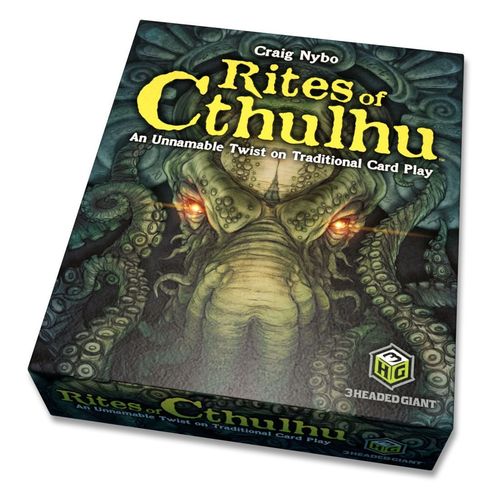
Rites of Cthulhu
Rites of Cthulhu Rulebook
Table of Contents
Table of Contents
The Object of the Game
Compete against other cultists in a series of up to 6 Rites (mini games) to win artifacts. After playing a number of Rites, the player with the most points from artifact cards wins.
Game Components
Rites of Cthulhu comes with the following game components:
- 75 cards, including:
- 56 entity cards
- 13 artifact cards
- 6 power-play reference cards
- 6 Rites Tablets
Game Overview
In Rites of Cthulhu, players play up to 6 mini games, competing for artifacts as rewards for each game. The mini games are called rites. One player acts as the Grand Cultist (dealer). The Grand Cultist deals the cards, selects a rite to be performed, reveals an artifact card (the Coveted Artifact), and takes the first turn.
At the end of a rite (mini game) the winner takes the artifact card and places it in front of him or herself for scoring at the end of the game. The player to the left of the Grand Cultist becomes the new Grand Cultist and play continues.
Players play through a number of rites determined by how many players are in the game. After all of the rites have been performed, players tally points earned from captured artifact cards. The player with the most points wins the game.
Winning the Game
After finishing the final rite (mini game), players add up the elder sign points on their won artifact cards. Whoever has the most points wins.
Game Setup
Divide the cards into 3 decks, the artifacts deck (13 cards), the entities deck (56 cards), and the power-play reference cards (6 cards). Lay all 6 of the Rites Tablets summary side up on the table. Place the artifacts deck facedown on the table next to the Rites Tablets. Give each player a power-play reference card.
Note: The above three artifact cards, when added together, score 6 points.
Each player draws a card from the entities deck and places it face down in front of him or herself. All players simultaneously reveal their cards. The player whose card has the highest elder sign becomes the first Grand Cultist of the game.
Performing Rites
The Grand Cultist shuffles the entities deck and deals 5 cards to each player.
After considering his or her hand, the Grand Cultist selects one of the Rites Tablets (mini games) and reads the summary on the front of the tablet to the rest of the players. If necessary, players may read the back of the tablet for more explicit rules. For further explanation of the Rites' rules, consult the rulebook (see "The Rites Tablets" on page 7). You may also scan the QR codes printed on page 1 of this rule book to watch short videos on how the rites are performed. Make sure to check the privilege of the Grand Cultist section of the Rites Tablets. This gives the Grand Cultists advantages while performing rites.
NOTE: If the Grand Cultist selects the Out of the Aeons Rites Tablet (see "Out of the Aeons" on page 41), it is necessary to re-deal the cards according to the tablet's rules. If the Grand Cultist selects The Dunwich Horror tablet (see "Dunwich Horror" on page 29), then the Grand Cultist must locate the Wilbur Wheatley (elder sign 6, Chorazos Cult - blue) card and The Dunwich Horror (elder sign 6, Chorazos Cult - blue) card, then make sure each player has 5 cards.
After selecting the rite, the Grand Cultist excavates the Coveted Artifact by turning over the top card on the artifact draw pile and reading its power out loud. The artifact's power is a special rule that will affect the current rite. If the Coveted Artifact's power happens before performing the rite, players immediately follow the directions on the artifact card. Otherwise, the artifact's power will happen sometime during the rite.
Each artifact card has a special power written in its rule box located on the bottom third of the card.
All cultists perform the rite (play the mini game) with the Grand Cultist taking the first turn.
When the rite ends, the winner of the mini game takes the Coveted Artifact and keeps it for scoring at the end of the game.
NOTE: Sometimes there will be more than 1 Coveted Artifact. If this is the case, the cultist who wins the rite takes all of the Coveted Artifact cards.
The number of rites (mini games) performed during a game of Rites of Cthulhu is determined by the player count. All players should have equal opportunities to be the Grand Cultist. The rites per game breaks down like this:
- 2 players - play all 6 rites.
- 3 players - play all 6 rites.
- 4 players - play 4 out of 6 rites.
- 5 players - play 5 out of 6 rites.
- 6 players - play all 6 rites.
Although in some games players won't play through all of the rites, put all of the Rites Tablets on the table at the beginning of the game so Grand Cultists have a better selection. Play through the designated number of Rites Tablets for the game's player count and leave the remaining tablets unplayed on the table.
NOTE: You may choose to play through all 6 rites even if there are not equal opportunities for players to be the Grand Cultist. This may slightly skew the balance of the game but sometimes it's more fun to play them all.
The Rites Tablets
There are 6 Rites Tablets. These large cards act as mini-games you play to win artifact cards. Here is a list of the 6 Rites Tablets:
- At the Mountains of Madness (see "At the Mountains of Madness" on page 35)
- The Dunwich Horror (see "Dunwich Horror" on page 29)
- Cthulhu Rises (see "Cthulhu Rises" on page 14)
- Out of the Aeons (see "Out of the Aeons" on page 41)
- The Hound (see "The Hound" on page 45)
- The Tree on the Hill (see "Tree on the Hill" on page 24)
Rites Tablets are 2-sided: summary side and rite detail side. At the beginning of the game, place the Rites Tablets summary side up on the table.
The summary side of each rites tablet gives a high level view of its mini game rules. After getting familiar with each rite, this brief summary will be enough to remind you of the rite's rules.
The detail side of each Rite Tablet gives more explicit rules on how the rite must be performed. If you have further questions about how to perform a particular rite after reading the detail side, more comprehensive rules can be found in this rulebook. You may also scan the QR codes printed on page 1 of this rule book to watch brief videos that teach how to perform them.
Summary Sides Printed in This Book
Page 7 reproduces the summary sides of two of the Rites Tablets. Their text is transcribed here as printed.
The Dunwich Horror (summary side)
The Deal: Find the twin brothers and take them out of the Entities deck.
- Wilber Whately - Chorazos Cult (blue), Elder Sign 7
- The Dunwich Horror - Chorazos Cult (blue), Elder Sign 6
Place the brothers face up in the middle of the table. Build the farmhouse walls by surrounding each brother with 4 random cards face down from the entities deck. Deal 5 cards to each cultist. Place the rest of the entities deck in a draw pile between the two farmhouses. Cultists only draw their hands back to 5 cards at the ends of their turns.
The Play: Cultists play card pairs from their hands in an effort to reveal and capture farmhouse wall cards that surround the twin brothers. Cultists reveal wall cards by playing a card pair whose Elder Signs when added together or one subtracted from the other equals the Elder Sign of one of the twin brothers (6 or 7). After revealing a wall card (turning it face up), the cultist may attempt to capture it by playing a second card pair with a result equal to the wall card's Elder Sign. If the cultist can't capture the wall card, he or she knocks on the table. After he or she knocks, all other cultists may knock. Whoever knocks first may play a card pair to capture the wall card. Otherwise, the wall card stays face up on the table.
The Win: After all wall cards have been captured, the twin brothers are free and the rite ends. Cultists add up the Elder Signs of their captured wall cards. The cultist with the greatest Elder Sign total wins the rite and takes the coveted artifact(s).
Privilege of the Grand Cultist: Occasionally, disputes arise when cultists knock at the same time in an effort to capture wall cards. The Grand Cultist decides which of the vying cultists may play his or her card pair to capture the wall card. If, however, the Grand Cultist is involved in such a dispute, the other cultists get to decide by vote who may play his or her card pair to capture the wall card.
Tree on the Hill (summary side)
The Deal: Deal 5 entities cards to each cultist. Place the rest of the entities deck face down in the middle of the table as a draw pile. Cultists do not draw replacement cards for played cards as the object of the game is to get rid of all in-hand cards.
The Play: Cultists deplete their hands by planting and contributing to trans dimensional trees. All cards are played face up in 4-card tree patterns on the table.
Fully grown trans dimensional trees are comprised of 4 cards with 2 cards placed face up, end-to-end on the bottom and 2 cards placed perpendicularly, face up end-to-end on top. The 4 cards in any trans dimensional tree must be part of a 4-card numerical run but not necessarily played in order. It is not necessary to match cults (frame colors) while creating trees. A trans dimensional tree may not have duplicates of any number.
Cultists play 1 card at a time in turn order. If there are no trees on the table, a cultist may plant a new tree by playing a card face up anywhere on the table. If there are non-completed trees, cultists must either play their cards on an incomplete tree or draw a card from the entities draw pile.
A cultist may score a double-play by either completing a tree or by playing a card on a tree that runs numerically and comes from the same cult (border color) of another card already on that tree. If a cultist scores a double-play, he or she may either play the second card on another incomplete tree or plant a new tree by playing a card anywhere on the table.
The Win: The first cultist to get rid of his or her entire hand wins. If the last card in the entities draw pile is drawn and all cultists still have cards in their hands, the cultist with the fewest cards wins.
Privilege of the Grand Cultist: The grand cultist gets the first turn. He or she plants the first trans dimensional tree by playing any card from his or her hand face up on the table.
The summary sides of the other four Rites Tablets are printed on the tablets themselves and are not reproduced in this book. The full rules for those four rites appear in their sections below.
The Card Decks
Rites of Cthulhu comes with 75 cards divided into 3 decks, the entities deck, the artifacts deck, and the power-play reference cards.
The Entities Deck
You perform rites with the entities deck (56 cards).
The entities deck is divided into 4 cults:
- The Esoteric Order of Dagon (green borders).
- The Chorazos Cult (blue borders).
- The Brotherhood of the Kings (yellow borders).
- The Chesuncook Witch Coven (gray borders).
Each entity card has an elder sign number and a cult symbol printed on its upper left and lower right corners. The cult name is printed in the rule box on the bottom third of each card. The entity name is printed along the top banner.
Each cult consists of 14 cards with elder signs ranking from 0 to 13. Cards with elder sign ranks of 0 are forbidden books. Forbidden books in combination with other cards allow players to initiate power-plays during the game. Forbidden books also offer other powers while performing certain Rites.
The Artifacts Deck
You compete while performing rites to capture artifacts from the artifacts deck (13 cards). Each artifact card has an elder sign number on its upper left and lower right corners. This number is the point value the artifact gives you at the end of the game. The artifact's name is printed on the top banner of each card. Each artifact has a power printed on the bottom third of the card.
Artifact powers are invoked when an artifact is first excavated (drawn from the artifact deck and turned face-up before performing a rite or during a rite as the result of a power-play). Cultists who have captured artifact cards may invoke their powers a single second time during the remainder of the game.
If a captured artifact card has the all cultists symbol, all cultists must follow its written rule both when it is first invoked and when it is invoked a second time by the artifact's owner. If an artifact card has the single cultist symbol, all cultists must follow its written rule when it is first invoked. But only the cultist who owns the artifact card may use its power when it is invoked a second time.
The all cultists symbol means all cultists must perform the artifact's power every time its power is invoked.
The single cultist symbol means all cultists may invoke the artifact's power during the rite in which it is first invoked. Only the cultist who captures the artifact may invoke its power a second time during the rest of the game.
If a cultist invokes the power of a captured artifact a second time, the artifact's elder sign number still counts toward that cultist's final score at the end of the game.
Artifact Powers Shown in This Book
The rule box text of the artifact cards pictured in this rule book is transcribed below. Each entry gives the card's name, its elder sign value, and its cult symbol (all cultists or single cultist). The remaining artifact cards in the deck are not pictured in this book, so their powers appear only on the cards themselves.
- Silver Key (elder sign 1; all cultists symbol): All cultists must immediately pass 2 cards from their hands to the cultist on the right.
- Meteorite (elder sign 3; single cultist symbol): Once during this rite, you may call the Elder Sign and cult (color) of a card in another cultist's hand. If the card is in another cultist's hand, you may trade it for any card from your hand. If a cultist calls for a card, you may call for the same card until the cultist who possesses the card finishes his or her next turn.
- Statuette of Unidentifiable Stone (elder sign 1; all cultists symbol): All cultists must immediately select 1 card from their hands, place them face down in front of them, and pass the rest of their cards to the cultist on the left. Repeat this process until all cultists have replenished their hands to the hand limit.
- Mirror of the Serpent People (elder sign 2; single cultist symbol): Once during this rite, you may look at the top card of the draw pile and trade it for one of your own cards or a randomly drawn card from any other cultist's hand. Place traded card on the bottom of the draw pile.
- Camera Obscura (elder sign 1; single cultist symbol): Once during this rite, you may trade any single card from your hand for a random card from any other cultist's hand.
- Shining Trapezohedron (elder sign 3; single cultist symbol): At any time during this rite, you may trade forbidden book cards (Elder Sign 0 cards) for any cards in the discard pile.
- Henry Akeley's Brain (elder sign 2; all cultists symbol): All cultists must immediately place 2 cards from their hands face down in front of them and draw 2 replacement cards. You may play the 2 face down cards as if they are in your hand during the rite. But you may not look at the cards' identities once the rite begins. Do not replenish the face down cards after playing them.
The Power-Play Reference Cards
Each player is given a power-play reference card during setup. Players can reference their power-play reference cards during play as a reminder of what card combinations can be used to initiate power-plays. The back of each power-play reference card gives a turn order summary.
Power-Plays
At any point during the game, certain combinations of cards allow you to instantly initiate power-plays. To initiate a power-play, reveal and discard the required card combination from your hand and follow the power-play's effects. If the power-play does not end the rite, draw enough cards to replace the discarded power-play cards (unless you are playing the Out of the Aeons Rite, which requires that all cards are dealt out). Here is a list of the 3 power-plays and what card combinations must be used to initiate them.
- Become the Grand Cultist
- 1 card with an elder sign rank of 0
- 1 card with an elder sign rank of 13
- Both cards must be in the same cult (matching frame color)
- Excavate a New Artifact
- 1 card with an elder sign rank of 0
- 1 card with an elder sign rank of 1
- Both cards must be in the same cult (matching frame color)
- Steal the Coveted Artifact
- 1 card with an elder sign rank of 0
- 1 card with an elder sign rank of 1
- 1 card with an elder sign rank of 13
- All three cards must be within the same cult (matching frame color)
Power-Play: Become the Grand Cultist
This power-play instantly promotes you to Grand Cultist.
To initiate this power-play, show all players that you have cards with the elder sign ranks of 0 and 13, both cards from the same cult (color).
The current rite fails immediately. Stop playing the current rite without declaring a winner. All players turn in their entire hands. The current rite and the Coveted Artifact(s) are thrown out of the game. No cultist gains any points from a failed rite.
As the new Grand Cultist, you get to pick the next rite (unless the last rite has been played), deal the cards, and reveal the new Coveted Artifact. After finishing the new rite, the position of Grand Cultist goes to the player on the left and play continues normally.
If this power-play is activated during the final rite of the game, the rite immediately ends with no winner. The Coveted Artifact(s) for the rite are thrown out. The game ends and all cultists tally their artifact card elder sign ranks to determine the winner.
Example: The above 2 cards (a 0 and 13 card of the same color) invoke the Become the Grand Cultist power-play.
Power-Play: Excavate a New Artifact
This power-play adds a new Coveted Artifact to the current Coveted Artifact pile.
To initiate this power-play, show all players that you have cards with the elder sign ranks of 0 and 1, both from the same cult (color). Discard these cards and immediately draw 2 new cards for your hand.
Draw the top card from the artifact deck. Read its rule out loud. The effects of the rule take place immediately. Add the new Coveted Artifact to the Coveted Artifact pile. The winner of the current rite will get all of the artifacts in the Coveted Artifact pile.
Example: The above 2 cards (a 0 and 1 card of the same color) invoke the Excavate a New Artifact power-play.
Power-Play: Steal a Coveted Artifact
This power-play allows you to steal and replace a Coveted Artifact from the artifact pile.
To initiate this power-play, show all players that you have cards with the elder sign ranks of 0, 1, and 13, all 3 cards from the same cult (color). Discard these cards and immediately draw 3 new cards for your hand.
Take an artifact from the Coveted Artifact pile (usually there is only 1 artifact in the Coveted Artifact pile) and add it to your cache of captured artifacts.
Draw the top card from the artifact draw pile and add it to the Coveted Artifact pile to replace the artifact that you have stolen. Read the replacement artifact's power out loud. The new artifact's power is immediately invoked.
Example: The above 3 cards (a 0, 1, and 13 card of the same color) invoke the Steal Coveted Artifact power-play.
The Rites
During a game of The Rites of Cthulhu, players perform a series of rites to compete for Coveted Artifacts. Each rite is a mini-game. The Rites Tablets give rule summaries. But should you have questions about rule details, you will find more comprehensive rules and play examples in this rule book. Don't be intimidated by the thickness of this rulebook. The rites are simple-to-play games. However, for the sake of clarity, this book contains detailed rules for every play contingency.
Cthulhu Rises
Be the cultist who possesses the Cthulhu card at the end of the game or be the cultist to successfully play an over-throw by performing the following actions: 1) Open a gate; 2) Summon and Capture Cthulhu; 3) Close a gate.
The nightmare corpse-city called R'lyeh possesses the runes necessary to release Cthulhu from his death-like sleep. Can you be the one to summon the High Priest of the Great Old Ones to this world?
Object of the Game
Be the cultist who possesses the Cthulhu card at the end of the rite or be the cultist to successfully play an overthrow by performing the following actions:
- Open a gate
- Capture Cthulhu
- Close a gate
NOTE: Although the overthrow actions must be performed in order, they do not need to be performed in 3 consecutive turns.
The Deal
Ensure that the Entities Deck has a number of cards divisible by the number of cultists in the game.
- For 2 cultists, play with the entire entities deck.
- For 3 cultists, discard 2 cards from the entities deck.
- For 4 cultists, play with the entire entities deck.
- For 5 cultists, discard 1 card from the entities deck.
- For 6 cultists, discard 2 cards from the entities deck.
Do not look at the discarded cards.
Deal 5 cards to each cultist. Place the rest of the entities deck face down in the middle of the table.
Cultists always keep their hands at 5 cards by drawing from the entities draw pile after playing cards.
The Play
This rite is played by opening and closing gates until either the conditions of an overthrow are met or until the entities draw pile is depleted to zero cards and all players have played their last cards.
Gates are comprised of cards, 1 played by each cultist, placed in a circular pattern around the entities draw pile and often around the Cthulhu card. After all cultists have played a single card, the gate closes and the cultist with the highest-ranking card in the gate takes the gate cards.
Opening a Gate
The cultist who plays the first card on a gate is said to open the gate. The first card played also designates the gate's dominant cult. The dominant cult is not the same as the Grand Cult. The dominant cult will change throughout the rite. The Grand Cult is set to The Esoteric Order of Dagon (green).
Cultists who have not successfully opened a gate (played the first card on a gate) play their cards horizontally end-to-end in the gate circle. Cultists who have successfully opened a gate play their cards vertically in the gate circle. This visually establishes which cultists are eligible to summon Cthulhu.
NOTE: The dominant cult changes throughout the rite based on the first card played on a gate (the card that opens the gate). The Grand Cult is set to The Esoteric Order of Dagon (green) throughout the rite. Cards from the Grand Cult always out-rank (trump) cards from the dominant cult.
Once a gate opens (the first card is played), all other cultists in turn order play 1 card on the gate. Cultists must, if possible, play a card from the dominant cult (the lead color). If a cultist does not have a card in the dominant cult, she may play any card from her hand.
Example 1: A cultist leads by playing Kamog first on the gate.
Example 2: A cultist leads by playing Yog-Sothoth first on the gate. The cultist who plays Shoggoth closes the gate and takes the cards, since Shoggoth is the highest ranking card in the lead color.
Example 3: A cultist leads by playing Yog-Sothoth first on the gate. The cultist who plays Robert Olmstead closes the gate and takes the cards, because although Robert Olmstead only ranks at 2, his card is the highest ranking card played in the Grand Cult (The Esoteric Order of Dagon - green).
Summoning and Capturing Cthulhu
Cultists may summon Cthulhu (green - elder sign 11) by playing a card from the Grand Cult (green), on a gate. A player may only play a card from The Esoteric Order of Dagon if he does not have a card from the dominant cult (the lead cult) in his hand or if the lead cult is the Esoteric Order of Dagon (green). A cultist is only eligible to summon Cthulhu if she has opened a gate and is able to place her card vertically on the gate circle.
Example: Cultists who are eligible to summon Cthulhu play their cards vertically. Cultists who are not eligible to summon Cthulhu play their cards horizontally. The lead cult (the first card played on the gate) is yellow. Hence, all cultists must play yellow cards if they have them. If not, they may play any cult (color). Hastur is the highest ranking card on the gate (13 of the lead cult - yellow); the cultist who played Hastur closes the gate and takes the cards.
If a cultist plays a card from the Esoteric Order of Dagon (green) and if that card was played by a cultist who is eligible to summon Cthulhu (the card is played vertically on the gate) then a spell to summon Cthulhu has been cast. In this case, one of the following occurs:
- If Cthulhu is in one of the Cultist's hands, even if Cthulhu has been drawn as a replacement card after playing a card on the current gate, the cultist with Cthulhu must place the Cthulhu card face up in the middle of the gate.
- If Cthulhu has been captured by a cultist, the cultist must place Cthulhu back in the middle of the gate.
- If none of the above circumstances are true, then Cthulhu is still in the entities draw pile. In this case, the spell to summon Cthulhu has failed and nothing happens.
Whether or not Cthulhu is summoned to the center of the gate, the cultist who played the highest elder sign card from the Esoteric Order of Dagon (green) takes the gate cards. If Cthulhu is present in the gate and the winning cultist is eligible to summon Cthulhu, the cultist captures Cthulhu's card and places it on the table in front of him.
Example: A cultist leads with The Mad Arab (yellow, 12). All cultists must play a card from the lead cult if possible; this cultist plays the Mindless Flutist. Not having a yellow card, the next cultist plays a card from the Grand Cult (green). This is the highest ranking card (the highest in the Grand Cult). The cultist will take the cards from the gate, but because the cultist isn't eligible to summon Cthulhu (card played horizontally), Cthulhu will remain on the table for the next gate. Another cultist, not having a yellow card, plays a card from the Grand Cult (green), but because that cultist hasn't played the highest ranking card, he will not take the gate cards or capture Cthulhu.
NOTE: Remember that Cthulhu may only be summoned if a cultist who is eligible to summon Cthulhu plays a card from The Esoteric Order of Dagon (green).
A cultist who is eligible to summon Cthulhu may also capture Cthulhu by playing Cthulhu's card as part of a gate. In this case, if Cthulhu is the highest-ranking card in the gate, the cultist takes the Cthulhu card along with the rest of the gate cards. If a cultist who is not eligible to summon Cthulhu plays the Cthulhu card as part of a gate, she takes all of the gate cards except the Cthulhu card. Cthulhu remains in the middle of the table and will be at the center of the next gate.
Cultists may not summon Cthulhu in the first gate of the rite. During the first gate, if a cultist has Cthulhu in her hand, she must keep him until the first gate closes. The Grand Cultist may not open the first gate of the rite with a card from the Esoteric Order of Dagon (green).
If a cultist who is not eligible to summon Cthulhu (hasn't opened a gate) plays a winning card from the Grand Cult (green) onto a gate that contains Cthulhu, he does not take Cthulhu. The Cthulhu card remains on the table and will be in the center of the next gate.
Closing a Gate
The cultist who plays the highest-ranking card on a gate closes the gate. The highest-ranking card in a gate is the card with the highest elder sign within the dominant cult unless a card from the Grand Cult (The Esoteric Order of Dagon - green) is played. If multiple cards from the Grand Cult are played, the card with the highest elder sign from the Grand Cult is the highest-ranking card.
The cultist who closes a gate (plays the highest ranking card) takes the gate cards and puts them in a personal discard pile in front of him.
As an additional reward for closing a gate, the winning cultist may force a card from his hand onto any other cultist. To do this, he selects a card from his hand and slides it facedown to another cultist. Without looking at the forced card, the receiving cultist trades it for any card from her hand. Both cultists put their new cards into their hands. The cultist who closes the gate and takes the gate cards opens the next gate.
Example: Chuck, the Grand Cultist, opens the first gate by playing Nasht (Brotherhood of the Kings - yellow - elder sign 10). The dominant cult for the gate becomes Brotherhood of the Kings (yellow). Since Chuck has opened a gate, he is eligible to summon Cthulhu, so he places his card vertically in the gate circle. Lindi plays Robert Harrison Blake (yellow - elder sign 4). Mark plays Pharaoh Khafra (yellow - elder sign 6). Natalie, the next cultist in clockwise order, must play a card within the dominant cult, Brotherhood of the Kings (yellow), if she has one. She plays Walter Gilman (yellow - elder sign 7). Chuck played the highest-ranking card in the dominant cult (yellow - elder sign 10). He closes the gate. He takes all of the cards from the gate and puts them in front of him in a discard pile.
Example: Having closed the last gate, Chuck opens the next gate by playing Zkauba the Wizard (blue - elder sign 5). This establishes The Chorazos Cult (blue) as the dominant cult for this gate. Because he opened the gate, Chuck places his card vertically in the circle. Natalie plays Lavinia Whateley (blue - elder sign 8). She continues to play her cards horizontally because she has not yet opened a gate. Mark doesn't have a card in the Chorazos Cult (blue), so he plays Pnakotic Fragments (green - elder sign 0). Since this card is in the Grand Cult (Esoteric Order of Dagon - green), a spell to summon Cthulhu has been cast. But since Mark isn't eligible to summon Cthulhu (he hasn't opened a gate), the spell fails. Natalie has the Cthulhu card (green - elder sign 11) in her hand. But since the spell failed, she keeps the Cthulhu card. Lindi doesn't have a card from the Chorazos Cult (blue), so she plays Zadok Allen (green - elder sign 1) from the Grand Cult. Lindi is not eligible to summon Cthulhu, so Natalie again keeps the Cthulhu card in her hand. All cultists have played a card, so the gate closes. Lindi has played the highest-ranking card in the Grand Cult. She takes the gate cards. Since Lindi successfully closed the gate, she can force a card trade. She decides to force Wilbur Whateley (blue - elder sign 7) on Chuck. She puts her card facedown on the table. Without looking at Lindi's card, Chuck gives her Klarkash-Ton (blue - elder sign 4). Chuck then picks up Wilbur Whateley and puts it in his hand.
Example: Lindi opens the next gate with Lobon (green - elder sign 8). Having opened the gate, she is now eligible to summon Cthulhu, so she places her card vertically on the gate circle. Lindi's spell to summon Cthulhu succeeds. Natalie must now place the Cthulhu card from her hand in the middle of the gate. Chuck plays Henry Anthony Wilcox from the Grand Cult (green - elder sign 7). He plays his card vertically as he has opened a gate and is qualified to summon Cthulhu. Natalie plays George Gammell Angell from the Grand Cult (green - elder sign 6). She plays her card horizontally as she has not opened a gate and is not eligible to summon Cthulhu. Mark plays Francis Wayland Thurston from the Grand Cult (green - elder sign 5). He also plays his card horizontally. The gate closes. Since Chuck played the highest-ranking card, he takes the gate cards and puts them in his discard pile. Since Cthulhu was in the center of the gate and since Chuck is eligible to summon Cthulhu, he takes Cthulhu's card and puts it face up in front of him.
Example: Chuck opens the next gate by playing Dagon from the Grand Cult (green - elder sign 13). Natalie plays Mother Hydra from the Grand Cult (green - elder sign 12). Mark plays Deep One from the Grand Cult (green - elder sign 9). Since Lindi does not have a card from the lead cult (the Esoteric Order of Dagon - green), she plays Edward Pickman Derby (gray - elder sign 2). The gate closes. Since Chuck played the highest-ranking card, Dagon, from the Grand Cult (green - elder sign 13), he closes the gate. He takes all of the gate cards. Also, Mark has played an overthrow by opening a gate, capturing Cthulhu (green - Elder Sign 11), then closing a gate. The rite ends with Mark as the winner.
Editor's note: the callout printed beside the final example's board picture labels Chuck, not Mark, as the cultist who has "envoked an over-throw and won the rite." The printed body text names Mark as the winner, and that is transcribed here as written. The Pnakotic Fragments card in the examples is printed as "Poakotic Framents" in one place; it is spelled Pnakotic Fragments here.
Ending the Rite
The rite ends when either a cultist finishes an overthrow or the entities draw pile is depleted to 0 cards and all cultists have played their final cards on the final gate and the final gate is closed.
An overthrow occurs if a cultist performs the following 3 actions in order:
- Open a gate (play the first card on a gate).
- Capture Cthulhu.
- Close a gate (play the highest ranking card on a gate and take the cards).
Although these three actions must take place in order, they do not need to happen in 3 consecutive turns.
Step 2, capture Cthulhu, and step 3, close a gate, may not be done simultaneously as part of the same gate. A cultist must capture Cthulhu in one gate, then close a later gate to finish an overthrow.
The Win
Unless there is an overthrow, the win goes to the player who has the Cthulhu card when the last gate closes. The player who wins takes the Coveted Artifact(s).
If a player wins with an overthrow, the rite immediately ends and the player who successfully played the overthrow may take the Coveted Artifact(s) or trade a Coveted Artifact for any artifact in the artifacts draw pile. If there is more than 1 Coveted Artifact, the winner may only trade 1 of the Coveted Artifacts. Remember to re-shuffle the artifacts draw pile after making the trade.
Privilege of the Grand Cultist
The Grand Cultist takes the first turn and opens the first gate, immediately qualifying to summon Cthulhu and to place cards vertically on following gates.
Tree on the Hill
An obscure tree scrawls its way into the sky from the top of a hill outside the city of Hampden. One afternoon, a photographer armed with his camera obscura visits the tree to take pictures for his personal collection. When he reaches the tree, sights unknown overcome him. His reverie begins with a clear view of the Bitterroot Mountains, a range thousands of miles away from his location. Caught up in his daydream, he beholds a majestic tomb in a land illuminated by three suns on the horizon. A flurry of shadows draws him into the tomb where he finds himself surrounded by sets of flaming eyes watching him. He wakes in panic from his dream and leaves the Tree on the Hill. He discovers in his later developed photographs that the tree casts 3 shadows, the relics of 3 suns on the horizon. Could it be that the tree simultaneously exists in 2 dimensions or are the photographs just tricks of the light?
Object of the Game
To win, either be the first cultist with no cards in his or her hand or be the cultist with the least cards in hand when the final entities card is drawn from the draw pile.
The Deal
Deal 5 entities cards to each player. Place the rest of the entities deck face down in the middle of the table as a draw pile.
The Play
Cultists deplete their hands by planting and contributing to trans dimensional trees. All cards are played face up in tree patterns.
Fully grown trans dimensional trees are comprised of 4 cards with 2 cards placed face up, end-to-end on the bottom (the tree trunk) and 2 cards placed perpendicularly, face up end-to-end on top (the tree branches). The 4 cards in any trans dimensional tree must be part of a 4-card numeric run but not necessarily played in order. It is not necessary to match cults (colors) while creating trees. A trans dimensional tree may not have repeats of any number.
Example: A tree may be built in this numerical order: 4, 3, 5, then 6 of any cult (color). Although these four numbers are played out of order, together they comprise a run of 3 thru 6.
A tree with numbers 4, 5, 5, and 6 is not legal because a tree may not have duplicates of any number (two 5's in this case).
During a turn, if possible, a cultist must play a card from his or her hand. If a cultist can't legally play a card, he must draw a card from the entities draw pile. If the drawn card can be played, the cultist may immediately play it and continue with his turn.
If possible, cards must be played on existing, incomplete trees. If there are no incomplete trees on the table, the card must be played to plant a new tree. Cultists may not plant new trees if there are incomplete trees on the table, unless playing a double-play (see below).
A cultist may score a double play. This is done by playing a card that is both numerically sequential and matches the cult (color) of an existing card in an incomplete tree.
Example: If a cultist plays a Chorazos Cult (blue) card with the Elder Sign of 11 on a tree that has a Chorazos Cult (blue) card with the Elder Sign of 10, that cultist has scored a double play.
You may also score a double-play by completing a tree by playing the tree's 4th and final card.
If a cultist scores a double play, he or she must play another card. The second card may be played on an incomplete tree (possibly with the intention of scoring another double play) or it may be used to plant a new tree.
It is possible to score more than 1 double play by playing multiple cards that are both sequential and the same color as cards in existing trees.
The Win
The first cultist to get rid of his or her entire hand wins. If the last card in the entities draw pile is drawn and all cultists still have cards in their hands, the cultist with the fewest cards wins.
Privilege of the Grand Cultist
The Grand Cultist gets the first play. He or she plants the first trans dimensional tree by playing any card from his or her hand face up on the table.
Play Example
NOTE: You will find a master illustration of this entire play example below. There are 4 cultists: Luke, Jack, Jane, and Susan.
- Luke, the Grand Cultist, plays the first card. He plays Asenath Waite (gray - Elder Sign 3). His hand is down to 4 cards. Play continues in clockwise order.
- Jack plays Klarkash-Ton (blue - Elder Sign 4) next to Asenath Waite, finishing the tree's trunk. His hand is down to 4 cards.
- Jane plays Edward Pickman Derby a double play because Edward Pickman Derby is both numerically sequential to and shares the same cult (color) as Asenath Waite, a card in the tree's trunk. Asenath Waite is Elder Sign 3, gray; Edward Pickman Derby is Elder Sign 2, gray. Jane can either play her second card on the incomplete tree or she can plant a new tree.
- Jane decides to plant a new tree by playing Deep One (green - Elder Sign 9) anywhere on the table. Her hand is now down to 3 cards.
- Susan plays Lobon (green - Elder Sign 8) on Jane's new tree, scoring a double play.
- For her second card, Susan plays Henry Anthony Wilcox (green - Elder Sign 7) on the same tree, scoring another double play.
- For her third play, Susan plants a new tree by playing Nasht (yellow - Elder Sign 10). Her hand is now down to 2 cards.
- It is Luke's turn again. He doesn't have a card he can play on a tree so he draws a card from the draw pile. He draws Mindless Flutist (yellow - Elder Sign 11). He plays his new card on Susan's new tree, scoring a double play.
- For his second card, Luke plays Mother Hydra (green - Elder Sign 12) on the same tree. His hand is now at 3 cards. Jack can't play any of his cards so he draws a new card. He can't play his new card so his turn is over. His hand is now at 5 cards.
- Jane plays Bukrog (green - Elder Sign 10) across from Mother Hydra, scoring a double play.
- Jane finishes her turn by playing Nug (gray - Elder Sign 10) on one of the other incomplete trees. Her hand is now at 1 card.
- Susan plays Zkauba the Wizard (blue - Elder Sign 5), completing a tree and scoring a double play.
- She plays her last card, Pnakotic Fragments (green - Elder Sign 0), to start another tree. Since this is her last card, she wins the Rite.
Editor's note: The printed illustration on page 28 captions the final move of this example as "Jane plays green 10 to plant a new tree and win the rite," while the numbered text above (step 13) has the last card as Pnakotic Fragments (green - Elder Sign 0) played by "She." The step text is otherwise transcribed as printed, except that the card name is printed as "Poakotic Fragments" there and is spelled Pnakotic Fragments here, as on the card.
Dunwich Horror
The mystery of Dunwich, Massachusetts lies in the family of the albino, Lavinia Whateley. Once visited in the night by Yog-Sothoth, she gave birth to twin sons, Wilbur Whateley who matured at an accelerated rate to manhood and his unnamable brother, imprisoned in the Whately farmhouse, kept away from spurning tongues and the public eye. Can you be the one to unlock the mystery of Yog-Sothoth by freeing the two sons of Lavinia Whately?
Object of the Game
Players work together to free the twin brothers, Wilber Whately (blue - Elder Sign 7) and The Dunwich Horror (blue - Elder Sign 6) from their farmhouses. After the brothers are free, cultists tally the Elder Signs of the farmhouse wall cards they have captured. The player with the greatest total wins the rite.
The Deal
Find the twin brothers and take them out of the entities deck. Or if the cards have already been dealt, cultists with the brothers in hand must turn them over to the Grand Cultist (dealer).
- Wilber Whately - Chorazos Cult (blue - Elder Sign 7)
- The Dunwich Horror - Chorazos Cult (blue - Elder Sign 6)
Place the brothers face up in the middle of the table with plenty of space between them. Build the farmhouse walls by surrounding each brother with 4 random cards face down from the entities deck.
Make sure each cultist has 5 cards to begin the rite.
Place the rest of the entities deck horizontally between the two farmhouses as a draw pile.
Cultists wait until the ends of their turns to draw their hands back up to 5 cards.
The Play
Cultists attempt to play card pairs from their hands in an effort to either reveal or capture farmhouse wall cards that surround the twin brothers. After all of the wall cards have been captured, the twin brothers are free and the rite immediately ends. Cultists do not capture the twin brothers.
Cults (colors) do not matter during this rite, only the Elder Signs are considered.
Wall cards may only be captured after they have first been revealed.
To reveal a wall card, a cultist must play a card pair with an Elder Sign sum or difference that equals the Elder Sign of one of the brothers. If this condition is met, the cultist who played the card pair may reveal 1 wall card surrounding the respective brother. To get the sum, add the Elder Signs of both cards in the card pair together. To get the difference, subtract one of the card's Elder Signs from the other.
Example: Harley Warren (Elder Sign 2) + T'yog, High Priest of Shub-Niggurath (Elder Sign 5) = 7, the Elder Sign of Wilbur Whateley. Robert Harrison Blake (Elder Sign 4) and Nasht (Elder Sign 10): 10 - 4 = 6, the Elder Sign of The Dunwich Horror.
If a cultist successfully reveals a wall card, he or she may attempt to capture it. To capture a revealed wall card, without re-drawing his hand back to 5 cards, a cultist must play a second card pair with a sum or difference equal to the revealed wall card's Elder Sign.
The printed page 31 illustrations show one card pair whose Elder Signs add up to a wall card's Elder Sign (+ and = ) and one card pair whose Elder Signs subtract to a wall card's Elder Sign (- and = ). The card numbers in those diagrams are too small to transcribe reliably; the rule above is the rule as printed.
If a cultist successfully reveals a wall card and cannot play a card pair from his hand to capture it, he must knock on the table. All other cultists then have a chance to capture the revealed wall card. The first cultist to knock on the table and produce a card pair from her hand with an Elder Sign sum or difference equal to the revealed wall card's Elder Sign captures the wall card and places it in front of her for scoring at the end of the rite.
If a cultist reveals a wall card and knocks on the table and no other cultists can capture the wall card, it remains face up on the table until a cultist can capture it later in the rite.
Cultists may not draw their hands back to 5 cards until the ends of their turns. This means that a cultist must have 2 qualifying card pairs in her hand at the beginning of her turn in order to first, reveal a wall card, and second, to capture it.
If the entities draw pile depletes to 0 cards, re-shuffle it and place it face down again as a fresh draw pile.
Cultists may choose either to reveal new wall cards or to capture previously revealed wall cards during their turns. Cultists may not capture more than 1 wall card per turn.
A cultist may choose to forego his turn to discard 2 cards and draw 2 new cards from the draw pile.
Play continues in clockwise order until all of the wall cards are captured. Cultists do not capture the twin brothers. They remain face-up on the table at the end of the rite.
The Win
After all of the wall cards have been captured, the twin brothers are free and the rite ends. Cultists add up the Elder Signs of their captured wall cards. The cultist with the most points wins the rite and takes the Coveted Artifact(s).
Privilege of the Grand Cultist
Occasionally, disputes arise when cultists knock at the same time in an effort to quickly capture wall cards. In the event of such a dispute, the Grand Cultist decides which cultist gets to play her card pair and capture the wall card. If, however, the Grand Cultist is involved in such a dispute, the other cultists get to decide by vote who may play his card pair to capture a wall card.
Play Example
After placing Wilbur Whately and The Dunwich Horror on the table and surrounding them with facedown wall cards, Lucy, the Grand Cultist, plays Nug (Elder Sign 10) and Asenath Waite (Elder Sign 3). The two cards create a difference of 7 (Elder Signs 10 - 3 = 7). 7 is Wilber Whately's Elder Sign. Lucy reveals one of the wall cards surrounding Wilber Whateley. It is Robert Harrison Blake (Elder Sign 4).
Lucy still has Abdul Reis el Drogman (Elder Sign 3) and Zadok Allen (Elder Sign 1) in her hand. She plays this card pair. The sum of the pair's Elder Signs equals 4 (3 + 1 = 4). This sum matches Robert Harrison Blake, the revealed wall card's Elder Sign. Lucy takes Robert Harrison Blake's card and puts it in front of her for later scoring. Able to capture only 1 wall card per turn, Lucy ends her turn and play passes to Mark, the cultist sitting on her left.
Mark plays Swami Chandraputra (Elder Sign 1) and Francis Wayland Thurston (Elder Sign 5). The two cards create an Elder Sign sum of 6 (Elder Signs 1 + 5 = 6). 6 is The Dunwich Horror's Elder Sign. Mark turns over one of the wall cards surrounding The Dunwich Horror. It is Edward Pickman Derby (Elder Sign 2). Mark doesn't have a card pair in his remaining hand that will allow him to capture Edward Pickman Derby. So he knocks on the table.
Two other cultists, Reggie and Lucy, immediately knock, but Reggie is slightly faster than Lucy. For his card pair, he plays Nasht (Elder Sign 10) and Lobon (Elder Sign 8). The difference between the 2 cards' Elder Signs equals the Elder Sign of Edward Pickman Derby (10 - 8 = 2). Reggie discards his card pair and takes Edward Pickman Derby's card. He places it in front of him for later scoring.
Play continues in clockwise order until all wall cards have been captured, then the rite ends.
At the Mountains of Madness
William Dyer, geologist, becomes engrossed in matters that transcend human reality when he leads an expedition to Antarctica. When he loses contact with an advance team led by his associate, Professor Lake, he sets out to investigate, only to find Lake's camp devastated. In the camp, he discovers the remains of fourteen alien creatures which he cannot place using provisional age-testing science. Dyer and a student named Danforth advance their search by flying a plane over a range of nearby mountains more vast than the Himalayas. They discover an abandoned cyclopean city. Upon investigating the city, Dyer and Danforth find hieroglyphic murals that depict a monumental struggle between the Elder Things and the Star-Spawn of Cthulhu. Can you be the one to untangle the mysteries of this ancient war by mapping the Mountains of Madness?
Object of the Game
The first cultist to get rid of all of his or her cards wins the rite.
The Deal
Deal each cultist 5 cards. Place the rest of the entities deck face down in the center of the table to use as a draw pile.
The Play
Cultists map the Mountains of Madness by playing as many cards as they can from their hands during their turns.
Cults (colors) do not matter in this rite. Only the Elder Signs of cards are considered.
As cards are played, the map of The Mountains of Madness appears as a ridge, slopes, and cliffs. The ridge is made up of up to 4 cards in a run played side by side. Slopes are made up of neat stacks of numerically sequenced cards placed above and below the mountain ridge. Cliffs are gaps in the numerical sequences of slopes.
First Turn
At the beginning of the rite, the Grand Cultist declares the Elder Sign by playing a card face up in the middle of the table. After declaring the Elder Sign by playing a card, the Grand Cultist may then play as many cards as he can from his hand. He does not draw new cards to replace played cards as the goal is to get rid of all in-hand cards.
Creating the Ridge
Cultists create the mountain ridge by playing up to 4 cards face up and side-by-side, branching out from the Elder Sign card initially played by the Grand Cultist. The ridge cards must be played in a numerical run. The 4-card numerical run may be completed by playing cards to the left or right of the Elder Sign card. The ridge may not exceed 4 cards. Cultists may not play cards on slopes if they can be added to the 4-card ridge. Cultists may not play forbidden books (cards with 0 Elder Sign ranks) as part of the ridge.
Creating the Slopes
Cultists create the slopes of the Mountains of Madness by playing cards face up in neat piles above and beneath cards in the ridge. Slope cards played on slope piles must increment by 1 Elder Sign above or below the cards on which they are played (unless a cultist is playing a cliff - discussed later).
Creating Cliffs
Cultists may play cliffs to create numerical gaps in the slopes. To do so, a cultist must play a forbidden book card (Elder Sign 0) along with any other card from his hand on any slope. After playing a cliff, the cultist must draw 1 card from the draw pile but may continue to play cards (including the drawn card) if possible.
Cultists may play as many cards as possible during their turns. If at the beginning of her turn a cultist cannot play a card from her hand, she must draw a card from the entities draw pile. She may, if possible, immediately play her new card and continue her turn. If she can't play her new card, her turn ends.
Create a gap in the numerical run of a slope by playing a cliff (0 and any Elder Sign rank).
The Win
The first cultist to get rid of all in-hand cards wins the rite. If the cultists play through the entire draw pile and all cultists still have cards in their hands, the cultist with the fewest cards wins the rite. (Printed as "wins the right" in the source; "rite" is the intended word.)
Privilege of the Grand Cultist
The Grand Cultist gets to declare the Elder Sign by playing the first card in the mountain range. The Grand Cultist may then play any other cards from his or her hand as long as they can legally be played.
Play Example
Lynne, the Grand Cultist, declares the Elder Sign by playing Klarkash-Ton (Elder Sign 4) in the middle of the table. He is also able to play Nephren-Ka (Elder Sign 5). He must play Nephren-Ka as part of the ridge, not as a slope card, because the ridge is not complete (a 4-card run). He places Nephren-Ka to the left of Klarkash-Ton, increasing the ridge to 2 cards.
Sidney doesn't have a card in her hand that she can play so she is forced to draw a card from the draw pile. She can't play the drawn card so she keeps it and play passes to the cultist on her left.
Lance finishes the ridge by playing Randolph Carter (Elder Sign 3) to the right of Klarkash-Ton (Elder Sign 4) and Harley Warren (Elder Sign 2) to the right of Randolph Carter (Elder Sign 3). He also has Zadok Allen (Elder Sign 1) so he starts a slope by playing Zadok's card beneath Harley Warren (Elder Sign 2).
Warren doesn't have a card he can play so he draws a card from the entities draw pile. He draws Zkauba the Wizard (Elder Sign 5) and is immediately able to play it above Klarkash-Ton (Elder Sign 4), starting a new slope pile. He can now play Abdul Reis el Drogman (Elder Sign 3) and Pharaoh Nitocris (Elder Sign 2) on top of his newly formed slope pile.
Lynne decides to play a cliff. He plays Liber Ivonis (Elder Sign 0) and Nyarlathotep (Elder Sign 13) to form a new slope pile below Klarkash-Ton. Because he has played a cliff, he has to draw a new card. He draws The Mindless Flutist (Elder Sign 11).
He continues his turn by playing The Mad Arab Abdul Albazred (Elder Sign 12) on top of Nyarlathotep (Elder Sign 13). He plays the Mindless Flutist (Elder Sign 11) on top of Nyarlathotep. He has played all of his cards and wins the rite.
Out of the Aeons
The Cabot Museum in Boston's infamy blooms in 1879 when a freighter ship captain discovers a tomb on an uncharted island. After conducting a search of the tomb, he procures a mummy and a scroll capsuled in a metal container. The sea captain sells both relics to the curator of the Cabot Museum. After further research, the curator identifies the mummy as a man named T'yog in an ancient tale found in the Black Book by Friedrich von Juntz. T'yog in life used the scroll to rise up against Ghatanothoa, one of the gods of Yuggoth. But just before confronting Ghatanothoa, a cultist secretly switched the scroll with a fake. This act caused T'yog to fail in his struggle and disappear from history. The curator of the Cabot Museum orders an autopsy of the mummy's braincase. To his utter madness, he discovers that the brain within the mummy is still alive and aware of its surroundings. Can you be the one to increase the infamy of the Cabot Museum in Boston by procuring the most antiquities to be housed within its walls?
Object of the Game
To win, accumulate the most Elder Sign points by bidding for cards in the Brotherhood of the Kings Cult.
The Deal
Remove the 14 Brotherhood of the Kings (yellow) cult cards from the entities deck. Shuffle the 14 cards and place them in the middle of the table.
Deal the rest of the entity cards evenly to all players, setting aside any remaining cards without looking at them. Make sure all players have the same quantity of cards in their hands.
- For 2 players, deal 14 cards with 14 remainders.
- For 3 players, deal 14 cards with 0 remainders.
- For 4 players, deal 10 cards with 2 remainders.
- For 5 players, deal 8 cards with 2 remainders.
- For 6 players, deal 7 cards with 0 remainders.
The Play
In Out of the Aeons, cultists bid 1 at a time for cards from the Brotherhood of the Kings cult sub-deck.
Only Elder Signs of cards are considered while performing this rite. Cults (colors) do not have any effect.
The Grand Cultist begins each round by turning over the top card on the 14-card Brotherhood of the Kings (yellow) cult sub-deck.
Each cultist bids by placing one card from his or her hand face down on the table. All cultists simultaneously reveal their cards. The player whose card has the highest Elder Sign rank wins the face up Brotherhood of the Kings card. The winner takes the card and puts it in front of him for scoring at the end of the rite. All bid cards are discarded.
Play continues round-by-round until either the players have depleted their hands to 0 cards or the last Brotherhood of the Kings card is captured.
If 2 cultists tie on their bids to capture a card, no cultist gets the card. Put it in the discard pile along with the rest of the used bid cards.
The Win
At the end of the rite, all cultists tally the Elder Signs of the cards they have captured. The cultist with the most points wins the rite.
Each captured card is worth its Elder Sign number. The Book of Azathoth (Elder Sign Rank of 0) may be used to double the point value of any other captured card.
Privilege of the Grand Cultist
The Grand Cultist reveals the cards one-by-one from the Brotherhood of the Kings sub-deck. The Grand Cultist also has the right to discard 1 revealed card before cultists begin bidding. This may only be done once during the rite.
Play Example
Brian, the Grand Cultist, removes all 14 of the Brotherhood of the Kings (yellow) cult cards from the entities deck. He shuffles them and places them as a sub-deck in the middle of the table. With 4 cultists at the table, Brian deals 10 cards to each cultist and removes the remaining 2 cards without looking at them. He turns over the top card on the sub-deck; it's Pharaoh Khafra (Elder Sign 6).
All cultists bid for Pharaoh Khafra by selecting a card from their hands and laying them face down on the table. All cultists simultaneously reveal their cards.
- Jane plays T'yog, The High Priest of Shub-Niggurath (Elder Sign 5).
- Mark plays Lobon (Elder Sign 8).
- Lucy plays Barnabas Marsh (Elder Sign 3).
- Brian plays Yeb (Elder Sign 9).
Brian's card has the highest Elder Sign, so he takes Pharaoh Khafra and puts it in front of him for later scoring.
The cultists continue playing, round by round, bidding on cards from the sub-deck until they have depleted their hands of 10 cards to 0. With 4 cultists, this will leave 4 remaining cards in the Brotherhood of the Kings sub-deck. These will be discarded.
After all cultists have bid with all of their cards, they total their captured card Elder Sign ranks.
- Jane has a total of 8.
- Brian has a total of 15.
- Mark has a total of 12.
- Lucy has a total of 14.
Lucy captures The Pnakotic Fragments (Elder Sign 0). She uses it to double the Elder Sign of Robert Harrison Blake (Elder Sign 4), increasing her final score to 16. Lucy wins the rite.
Lucy uses the Pnakotic Fragments to double the Elder Sign of Robert Harrison Blake from 4 to 8.
Editor's note: The printed example gives Lucy a total of 14 before the doubling and a final score of 16, and its caption shows Blake going from 4 to 8. Those figures do not reconcile with each other under the doubling rule (14 plus Blake's 4 would be 18). The printed numbers are transcribed as printed. The card is printed as "Poakotic" in the example body; it is spelled Pnakotic Fragments here.
The Hound
St. John and his friend have a macabre hobby; they collect relics from the dead. After years of grave robbing, the two men who live in the same house have dedicated the deepest room of their dwelling as a museum for their morbid curiosities. But a visit to an ancient grave in Holland unleashes something that unhinges the two friends' sanity. After uncovering a centuried grave, they happen upon a jade amulet of alien craftsmanship in the depiction of a hound. Ecstatic with their find, knowing of its existence from their studies of the Necronomicon (penned by the Mad Arab Abdul Alhazred), they spirit away with their prize, only to be haunted by the maddening cries of a phantom hound.
Object of the Game
Cultists loot a graveyard made up of facedown cards. After all of the graves are looted (cards captured), the rite ends. The cultist with the greatest total of Elder Sign points from looted grave cards wins the rite.
The Deal
After shuffling the entities deck, deal 5 cards to each cultist.
Create the graveyard by drawing a number of entity cards that equals the total number of cultists in play plus 1 and placing them face down, end-to-end in a circular pattern. Leave plenty of space between the graves. Place the rest of the entities deck in a draw pile in the middle of the graveyard.
Example: A graveyard for a 4-player game consists of 5 graves (the number of players +1) placed face down in a circular pattern around the draw pile.
The Play
Cultists send ghouls to dig up and loot graves. It requires 2 ghouls to dig up a grave. A single cultist can only use 1 ghoul per grave for digging, so cultists must dig together as partners.
Once 2 cultists have used their ghouls to dig up a grave, they each may send a single henchman to double-cross their digging partner and walk away with the loot.
First Turn
The Grand Cultist takes the first turn by placing a ghoul (a single card from his hand) face up next to one of the graves, either inside or outside of the encircled plots. Without revealing the grave card's identity to other players, the Grand Cultist peeks at it and puts it back, facedown on the table.
After learning the identity of the grave card, the Grand Cultist has two options: he may leave his ghoul next to the grave or he may move his ghoul to a second grave. If the Grand Cultist moves his ghoul, he may not look at the second grave card. The Grand Cultist will not have another chance to move his ghoul and will only see the identity of the second grave card if another cultist chooses to dig with him.
After the Grand Cultist finishes his first turn, play commences in clockwise order.
The Grand Cultist takes the first turn by placing a ghoul card from his hand next to any grave. He peeks at the grave then may either leave his ghoul in place or move it to a second grave. He may not peek at the second grave.
Subsequent Turns
A cultist places a ghoul from her hand next to any grave card in the graveyard. The grave card might already have another cultist's ghoul next to it. If this is the case, she places her ghoul card on the opposite side of the grave from the other ghoul.
Whether or not there is already a ghoul next to the grave, the cultist peeks at the grave card and puts it back down. After learning the card's identity, the cultist may either leave her ghoul next to the grave or move it to a second grave. If the cultist decides to move her ghoul, she may not peek at the second grave card. She will not have another chance to move her ghoul and will not know the identity of the second grave card until another cultist decides to dig with her.
If the cultist leaves her ghoul next to the grave and there is not a second ghoul there, her turn ends and play passes to the cultist on her left.
If the cultist leaves her ghoul next to the grave and there is a second ghoul next to the grave, the two ghouls become digging partners. They dig up the grave and one of the cultists loots the treasure (see "Digging a grave" on page 49).
If the cultist chooses to move her ghoul to a second grave and there is already a ghoul on the second grave, the two ghouls become digging partners. They dig up the grave and one of the ghouls loots the treasure.
A cultist places her ghoul on the opposite side of a grave occupied by another cultist's ghoul. The two cultists become digging partners and reveal the grave's identity to all cultists at the table.
Digging a Grave
If there are ever 2 ghouls at a grave and neither cultist moves her ghoul, the 2 ghouls become digging partners. Flip over the grave card to reveal its identity to all cultists.
The cultist whose ghoul has the highest Elder Sign gets to loot the grave unless one or both of the digging partners decide to call in a henchman.
To call in henchmen, the cultists may each select a henchman card from their hands. A henchman card must be from the same cult (color) as the cultist's ghoul card. The two cultists simultaneously reveal their henchman cards.
The digging partner cultists tally the Elder Signs of their ghouls and henchman cards. Whoever has the highest score loots the grave. The winning cultist takes the grave card and puts it in front of her for later scoring. After the grave is looted, both cultists discard their ghoul and henchman cards.
Example: This cultist's ghoul and henchman total at 8 + 9 = 17. With a higher total, this cultist gets to loot the grave (take the grave card). The other cultist's ghoul and henchman total at 6 + 7 = 13.
In the event of a tie after both digging partner cultists have tallied their ghoul and henchmen cards, the cultist who played the ghoul with the highest Elder Sign loots the grave and takes the grave card.
In the rare case of a tie in both the ghoul + henchmen Elder Sign totals and in the ghoul Elder Sign ranks, both cultists discard their ghoul and henchman cards and the grave remains face up on the table. Other cultists may place their ghouls next to the grave later to attempt to loot the treasure. Face up grave cards also require digging partners to loot.
Psyching Out Your Digging Partner
When digging a grave, a cultist might not have a henchman card that matches his ghoul card. Or he might not want to play a henchman card at all. In this case, the cultist may psych out his digging partner by presenting a dummy henchman card face down and at the moment where both cultists are to simultaneously reveal their cards, keep it face down while the opposing cultist reveals his henchman card.
After psyching out his digging partner, he must put his dummy henchman card back into his hand. The psyched out cultist must discard his henchman card.
Should both cultists attempt to psych each other out at the same time with dummy henchman cards, both cultists must discard their dummy henchman cards.
Additional Rules
All cultists immediately draw replacement cards after playing cards to keep their hands at 5 cards at all times.
A cultist may use a card with an Elder Sign Rank of 0 as either a ghoul or a henchman. Cards with an Elder Sign of 0 double the value of the other card played.
For example, a cultist may play The Book of Azathoth (yellow - Elder Sign 0) as her ghoul and Nyarlathotep (yellow - Elder Sign 13) as her henchman. This sets her ghoul + henchman total to 26 (13 x 2 = 26).
Play continues until all graves are looted.
The Win
After the last grave is looted, all cultists tally the Elder Signs of their looted grave cards. The cultist with the highest total wins the rite.
Privilege of the Grand Cultist
Before playing the first turn, the Grand Cultist may peek at any single grave card in the graveyard.
Play Example
Mary, the Grand Cultist, deals 5 cards to all 4 cultists. She then lays out the graveyard by dealing 5 cards (the number of cultists plus 1) on the table in a circular pattern, end-to-end. She puts the rest of the entities deck in the center of the graveyard as a draw pile.
With the cemetery laid out, she goes first by selecting a ghoul card from her hand. She picks Robert Olmstead (green - Elder Sign 2) and places it inside the circle next to one of the graves. She immediately draws another card to keep her hand at 5 cards. She peeks at the grave card. It is Randolph Carter (blue - Elder Sign 3). Since Randolph Carter has a low Elder Sign number and won't score well at the end of the rite, Mary moves her ghoul to another grave. She does not get to peek at the second grave. She will not have another chance to move her ghoul.
It's Jared's turn. For his ghoul, he plays Lobon (green - Elder Sign 8) on the opposite side of the grave at which Mary has moved her ghoul. He picks up the grave card for a peek and learns that it is Dhole (blue - Elder Sign 9). Jared decides he's going to dig. Mary does not get to look at the grave since she has already moved her ghoul card. Mary and Jared become digging partners. Jared flips the grave card over so all cultists can see it.
Both Jared and Mary may call in henchman cards. The henchmen cards must share the same cults as their respective ghouls. Jared and Mary reveal their henchmen simultaneously. Jared plays Mother Hydra (green - Elder Sign 12). Mary plays Deep One (green - Elder Sign 9). Jared loots the grave since the total of his ghoul + henchman cards is 8 + 12 = 20. Mary's ghoul + henchmen cards come in at 2 + 9 = 11. Jared takes the grave card and puts it in front of him for later scoring.
It's now Suzy's turn. She places her ghoul card, Nightgaunt (yellow - Elder Sign 8), inside the circle next to a grave. She peeks at the grave card and discovers that it is Yog-Sothoth (blue - Elder Sign 13), a high-ranking card indeed. She keeps her ghoul where it is and her turn ends.
Felix sees that Suzy is satisfied with her choice, so he decides to play Hastur (gray - Elder Sign 12) as his ghoul on the opposite side of the grave at which she has played her ghoul. He peeks at the grave card and decides to dig, so he flips it over for all cultists to see. Felix and Suzy are now digging partners. They each play a henchman from their hands simultaneously. Felix plays Yeb (gray - Elder Sign 9), making a total ghoul + henchman score of 12 + 9 = 21. Suzy plays Nyarlathotep (yellow - Elder Sign 13) for a ghoul + henchman total of 8 + 13 = 21. Felix and Suzy's scores are tied. To determine who loots the grave, they compare the Elder Signs of their ghoul cards. Felix's ghoul has an Elder Sign of 12. Suzy's has an Elder Sign of 8. Felix wins and loots the grave. He puts the grave card in front of him, leaving 3 more graves on the table.
Play continues until all of the graves have been looted. Then the rite ends.
Game Turn Order
This summary is printed on the back page of the rule book as a quick reference.
- The Grand Cultist deals 5 cards to each player.
- After considering his or her hand, the Grand Cultist selects the rite.
- The Grand Cultist reveals the Coveted Artifact.
- Invoke the power of the Coveted Artifact (play the rule written on the artifact card).
- Perform the rite (mini game) selected by the Grand Cultist.
- After the rite finishes, the player to the Grand Cultist's left becomes the new Grand Cultist.
Power-Play Quick Reference
This summary is printed on the back page of the rule book as a quick reference.
Excavate a Coveted Artifact
If a cultist has the correct combination of cards in hand, he or she may immediately invoke a power-play. Draw an artifact from the artifact deck and add it to the Coveted Artifact pile.
Become the Grand Cultist
Abord the current rite with no winner and become the new Grand Cultist. Discard the Coveted Artifact(s). (Printed as "Abord" on the reference page; transcribed as printed.)
Steal the Coveted Artifact
Steal 1 Coveted Artifact from the Coveted Artifact pile. Replace it with the next artifact from the artifact draw pile. Activate the new artifact's power immediately.