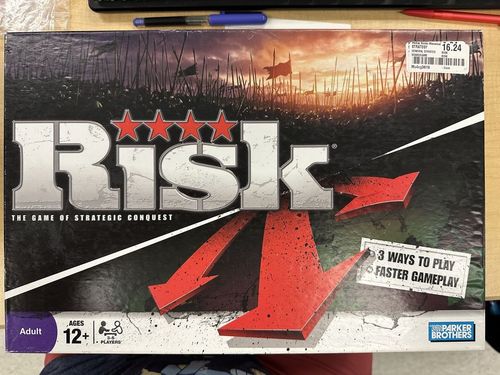
Risk: The Revised Edition
Risk: The Revised Edition Rulebook
Table of Contents
Table of Contents
Basic Training
Basic Training is designed as an introductory version of RISK. Play this version until you are comfortable with the rules, then move on to the Command Room version.
Your Goal
Be the first player to complete 3 Objectives and be in control of your capital. This is not about global domination. Review the Objectives before you start to play.
Getting Started
- Familiarize yourself with the game contents by reading the OVERVIEW OF COMPONENTS card.
- Set up the board and all the pieces as shown on the HOW TO SET UP BASIC TRAINING card.
- Each player rolls a die. High roller chooses a color. Players then, in descending die roll order, choose the remaining colors.
On Your Turn
- At the start of every turn, you draft more troops (read HOW TO DRAFT TROOPS).
- Then you attack your enemies (read HOW TO ATTACK).
- After you finished attacking, collect one Objective if you are eligible (read OBJECTIVES & REWARDS).
- Maneuver your troops and draw a card if eligible (read ENDING YOUR TURN).
Winning
You win if you have completed 3 Objectives and control your capital at the end of your turn.
Command Room
Your Goal
Be the first player to complete 3 Objectives and be in control of your capital.
Getting Started
Familiarize yourself with the materials by reading the OVERVIEW OF COMPONENTS CARD.
Familiarize yourself with the rules in BASIC TRAINING. Playing a game of BASIC TRAINING will make this game easier to play.
Game Setup
Place Cities: Draw 15 random territory cards, and place one city on each territory. Reshuffle all the cards.
Place Objectives: Shuffle all the Objectives and randomly place 4 Minor and 4 Major, face up on the board. Return the remaining 4 to the box.
Place Rewards: Shuffle all the Reward tokens. Place the Minor Rewards, face up, one on each of the Minor Objectives. Place the Major Rewards, face up, one on each of the Major Objectives.
Count Troops: Count starting troops, according to the number of players.
| Players | 3 | 4 | 5 |
|---|---|---|---|
| Troops | 30 | 25 | 20 |
Place Capitals: Each player rolls one die. Whoever rolls highest takes control of their first territory by taking their capital and one of their starting troops and placing them onto an empty territory. Play then passes clockwise. The next player then places a capital and troop into an empty territory, claiming that territory, and so on.
Claim Remaining Territories: When it gets back to the starting player, that player now puts a starting troop into an empty territory and play continues clockwise. Eventually, all 42 territories will be claimed. (Some players may control one more territory than others.)
Reinforce Territories: The next player reinforces a territory by placing one starting troop into a territory controlled by that player. Reinforcing continues clockwise until everyone's starting units have been placed.
Starting the Game
- The player who placed first takes the first turn. Play proceeds clockwise.
- The third and fourth players start with one card.
- The fifth player starts with two cards.
World Conquest
To play an updated version of the classic RISK game of Global Domination, just change one rule: don't stop when one player completes 3 Objectives. Instead play until one player controls all the territories. That player is the winner. Until you play again, you may now demand that all of the losing players call you "sir." Seriously.
On Your Turn
- At the start of every turn, you draft more troops (see HOW TO DRAFT TROOPS).
- Then you attack your enemies (see HOW TO ATTACK).
- After you finished attacking, collect one Objective, and its corresponding Reward, if you are eligible (see OBJECTIVES & REWARDS).
- Maneuver your troops and draw a card if eligible (see ENDING YOUR TURN).
Winning
You win if you have 3 Objectives and control your capital at the end of your turn.
Overview of Components
Contents
- Gameboard
- 7 Dice
- Deck of 42 Cards
- 5 Sets of Units, each a different color
- 15 Cities
- 5 Capitals
- Part sheet
The Gameboard
The gameboard is divided into 42 territories, which are grouped into continents: North America (yellow), South America (orange), Europe (blue), Africa (brown), Asia (green), and Australia (purple).
Some territories are adjacent to each other, meaning they either share a border or have a sea-line connecting them.
Example: The territory of Brazil is adjacent to Venezuela, Peru and Argentina because they share borders. Brazil is also adjacent to North Africa because a sea-line connects them.
Example: New Guinea, Indonesia, Eastern Australia, and Western Australia are territories. Together, these four territories make up the continent of Australia.
Cities
Cities will be placed on the board into different territories. If you control a territory that contains a city, you control that city. The number of cities you control is added to the number of territories you control when drafting troops, and they are also important to achieving some Objectives.
Capitals
Each player will have one capital placed in one of their territories. Capitals have no military function but are important to hold. Capitals cannot be moved during game play.
Troops
Every player will control troops of one color. Troops are represented by two different arrows — the smaller arrow represents 1 troop, and the larger arrow represents 3 troops.
Example: In Eastern United States, Green has 2 small arrows (1 troop each) and 1 large arrow (3 troops) for a total of 5 troops.
Dice
You use the dice when attacking and defending territories: Attack Dice, Defense Dice, Bonus Attack Die, Bonus Defense Die.
Cards
There is one card for each territory on the board. Each card has the name and picture of a territory, and 1 or 2 stars.
Objectives
Objectives are military goals that players will try to achieve.
Rewards
Rewards are linked to Objectives; once achieved, they give a bonus to your troops. Rewards are used only in the Command Room version of the game.
How to Set Up Basic Training
Place Objectives
Place these Minor Objectives on the board:
- Control 8 Cities
- Control North America
- Control Europe
- Control Asia
Place these Major Objectives on the board:
- Take Over 10 Territories in One Turn
- Control 2 Enemy Capitals
- Control 18 Territories
- Control 2 Complete Continents
The remaining Objectives go back in the box - they will not be used in this game.
Place Cities
Place cities in the following territories:
- Western United States
- Ontario
- Eastern United States
- Brazil
- Great Britain
- Northern Europe
- Western Europe
- Southern Europe
- Russia
- Egypt
- South Africa
- India
- China
- Japan
- Eastern Australia
Attention! Set up the board as shown in the appropriate chart (3 player, 4 player, or 5 player).
Setup by Player Count
Basic Training uses a fixed, pre-arranged starting position (rather than the free-claim setup used in Command Room): the reference card prints a full map diagram with every territory's starting troop count, plus city and capital markers, worked out in advance for games of 3, 4, or 5 players. The legible reference data from that diagram is:
3 Players
- Turn Order: 1 Yellow, 2 Green, 3 Blue.
- Blue player starts with one card.
4 Players
- Turn Order: 1 Yellow, 2 Green, 3 Blue, 4 Red.
- Blue and Red players start with one card.
5 Players
- Turn Order: 1 Yellow, 2 Green, 3 Blue, 4 Red, 5 Black.
- Blue and Red players start with one card.
- Black player starts with two cards.
Legend used on the setup diagrams: a numbered circle = amount of troops on that territory, a small building icon = City, a star icon = Capital.
How to Draft Troops
Attention! The number of troops you draft at the start of your turn is a sum of the following:
- The number of territories and cities you control divided by 3.
- Any continent bonus(es).
- Number of capitals you control.
- Troops gained from turning in cards.
1. Territories and Cities
Count the number of territories and cities you control and divide this number by 3 (ignore any remainder). If this number is lower than 3, round it up to 3. Draft that many troops and put them in front of you.
Example: Green controls 13 territories and cities at the start of his turn. 13 divided by 3 is 4. Green drafts 4 troops.
Example: Blue controls 5 territories and no cities at the start of his turn. 5 divided by 3 is 1. However, you never draft fewer than 3 troops, so Blue drafts 3.
2. Continent Bonus(es)
If you control every territory within the continent, then you control the continent. The chart next to the continent shows how many troops you draft. Draft these troops and add them to the pile in front of you.
Example: If you control Africa you draft 3 bonus troops.
Example: Red controls Australia. In addition to the troops she drafted from her territories and cities, Red also drafts 2 troops for controlling Australia.
Example: Yellow controls Europe and Africa. In addition to the troops he drafted from his territories and cities, Yellow drafts 8 troops for controlling these two continents (5 for Europe and 3 for Africa).
3. Capitals
Draft one troop for every capital you control, including your own. Add these troops to the pile in front of you.
4. Cards
How you get cards is explained on the ENDING YOUR TURN card.
Cards have one or two stars. If you have cards containing 2 or more stars you may choose to turn in some or all of them to draft troops. The number of stars determines how many troops you get. You may turn in 2 to 10 stars. Refer to the chart on the board to see how many troops you get for a set of cards. Add these troops to the pile in front of you.
The territories on the cards are irrelevant when drafting troops.
Example: Red has 3 cards containing 4 stars at the start of her turn. She turns in all 3 to draft 7 troops.
| Stars | Troops | Stars | Troops | Stars | Troops |
|---|---|---|---|---|---|
| 2 | 2 | 5 | 10 | 8 | 21 |
| 3 | 4 | 6 | 13 | 9 | 25 |
| 4 | 7 | 7 | 17 | 10 | 30 |
After Drafting
After drafting your troops, place ALL of them into territories that you control. You can choose to put all of these troops into one territory or spread them out across your territories.
How to Attack
Attention! If you are familiar with older versions of the game of RISK, you may skip this part - How To Attack hasn't changed.
On your turn, you can attack adjacent enemy territories in an attempt to take them over. Attacking is optional.
-
Choose one of your territories that contains at least 2 troops. Select 1 troop to "stay behind" and guard your territory. The remaining troop(s) can attack the enemy territory.
Example: Yellow has 3 troops in North Africa and wants to attack Egypt. He sends 2 troops into Egypt. He cannot send all 3 since one troop must stay behind. Blue is defending Egypt and has 3 troops. He can only send 2 out to battle.
-
Choose how many troops will attack. You can send in 1, 2, or 3. Your territory may contain more than 3 troops, but no more than 3 can attack.
-
The defender chooses how many troops will defend — 1 or 2 troops.
-
Each side rolls 1 die for each troop in the battle. This means the attacker rolls 1, 2, or 3 dice and the defender rolls 1 or 2 dice.
-
Both sides put their dice in order from highest to lowest. Compare your highest die to your opponent's highest die. The higher number wins, and the defender wins ties.
-
The loser removes a troop from the territory.
-
Compare your second highest dice. The loser removes one troop.
If there is no die to compare yours to, meaning you rolled 1 or 2 more dice than your opponent, then ignore that die/dice.
Example: Green has 10 troops in East Africa and sends 3 troops to attack Egypt. (Green cannot send more than this, since a maximum of 3 troops can attack at a time.) Blue defends with 2 troops. Green rolls three dice, one for each attacking troop, and Blue defends with 2 dice. Green's highest die, a 6, is higher than Blue's highest die, a 5. Blue removes a defending troop. Blue and Green's second-highest dice are a tie. Since defenders win ties, Green removes an attacking troop. Green's last die, a 3, is not used since there is no defending die to compare it to.
If the Defender Still Has Troops in the Territory
You may attack again if you like and are able, either between the same territories or between new ones.
If the Defender Has No More Troops in the Territory
Move the attacking troops into the territory. You may also move in additional troops from the attacking territory. So even though you can only attack with 3 troops, you can move more than that into a conquered territory. Remember you must leave at least one troop behind - no territory can ever be left abandoned.
If the conquered territory has an enemy capital, leave the capital in the territory.
You may attack another territory again if you like and are able.
Example: Green attacks Blue's one defending troop in Egypt from East Africa, sending in 3 troops. Green wins the battle and moves his 3 attacking troops into Egypt. He then moves five additional troops from East Africa into Egypt. He must leave at least one troop behind.
Eliminating Another Player
You eliminate another player if you defeat his/her last troop on the board. This player is now out of the game. As a reward, you get all of that player's cards (if he/she has any). Add these to your hand. Leave the defeated player's capital on the board.
Objectives & Rewards
How to Collect Objectives
After you finish attacking, look at the Objectives that are face-up on the board. If you have achieved one of these during your turn, you may take that Objective and place it in front of you. Do not put a new Objective on the board. As the game goes on, fewer Objectives will be available.
If you are eligible for more than one Objective on your turn, you choose one - a player can only collect one Objective on a turn.
Once an Objective is achieved, it does not change hands unless a player is eliminated. If you eliminate another player you take that player's Objectives in addition to any cards that player had.
Minor Objectives
- Control Europe — Control all 7 territories in Europe.
- Control North America — Control all 9 territories in North America.
- Control Asia — Control all 12 territories in Asia.
- Control 8 Cities — Control at least 8 cities. These can be anywhere on the board.
- Control an Enemy Capital — Control at least 1 enemy capital. You do not need to be in control of your own capital.
- Take Over 4 Cities in 1 Turn — Take control of at least 4 cities that you did not control at the start of the turn.
Major Objectives
- Take Over 10 Territories in 1 Turn — Take control of at least 10 territories that you did not control at the start of the turn.
- Control 2 Enemy Capitals — Control at least 2 enemy capitals. You do not need to be in control of your own capital.
- Control 18 Territories — Control at least 18 territories anywhere on the board.
- Control 2 Complete Continents — Control every territory on 2 different continents.
- Take Over an Entire Continent in 1 Turn — Take control of a continent where you did not control any territory at the start of the turn.
- Control 11 Cities — Control at least 11 cities. These can be anywhere on the board.
Rewards (Command Room)
In the Command Room version of the game, collecting an Objective lets you also collect the reward on top of it. Unless otherwise stated, put the reward in front of you to remind you of your Reward.
If you eliminate another player you do not get that player's Rewards. Those are eliminated with the player.
Minor Rewards
- Airfield — Take the Airfield token and immediately place it onto any territory you control. As long as you have your Airfield, you add 1 to your highest die roll for any battle waged in that territory or in any adjacent territory. This works on attack and defense. If you lose control of the territory containing the Airfield, then the Airfield is destroyed (but you still keep the Objective it came with). If you place two Airfields so that they affect the same territory, you may only get the benefit from one Airfield.
- Additional Maneuver — You get an additional troop maneuver during your maneuver phase.
- Starting Maneuver — You get a troop maneuver at the start of your turn, after you've placed troops but before you make your first attack.
- Guaranteed Card — You are guaranteed 1 card at the end of your turn, regardless of if you conquer a territory or not, or if you take an Objective.
Major Rewards
- Airfield — This Airfield works the same as the Minor Reward Airfield.
- Attack Die — Take the bonus attack die. When attacking, you now roll the bonus attack die in addition to the normal black dice. After rolling, replace the lowest black die with the bonus attack die (unless the bonus attack die is the lowest) and re-order the dice as necessary.
- Defense Die — Take the bonus defense die. When defending, you now roll the bonus defense die in addition to the normal red dice. After rolling, replace the lowest red die with the bonus defense die (unless the bonus defense die is the lowest) and re-order the dice as necessary.
- 2 Troops — You get 2 additional troops every turn when drafting.
Ending Your Turn
Attention! At the end of your turn, you do two things:
- Maneuver Troops.
- Draw a Card (maybe).
Maneuver Troops
Maneuvering troops is optional.
Take as many troops as you'd like from one of your territories and move them to one other connected territory. (Remember to leave at least one troop behind - you cannot abandon a territory.)
Territories are "connected" if all of the territories in between are also controlled by you. You cannot pass through enemy territories.
This is not an attack; it is simply a movement from one of your territories to another in order to protect your front line or to get into position for your next turn.
Example: At the end of your turn, you can maneuver troops from Indonesia through Southeast Asia, through India, through Afghanistan, and into Russia since you control all of these territories. Since you only went through your own territories, Indonesia and Russia are "connected."
Draw a Card
If you conquered at least 1 enemy territory on your turn, then you get 1 card. Draw it off the top of the deck and add it to your hand. It doesn't matter whether you conquered 1 territory or 40 territories, you only get 1 card.
If you collect an Objective, you cannot also draw a card that turn.
If there are no more cards in the deck, shuffle the discard pile to make a new deck.