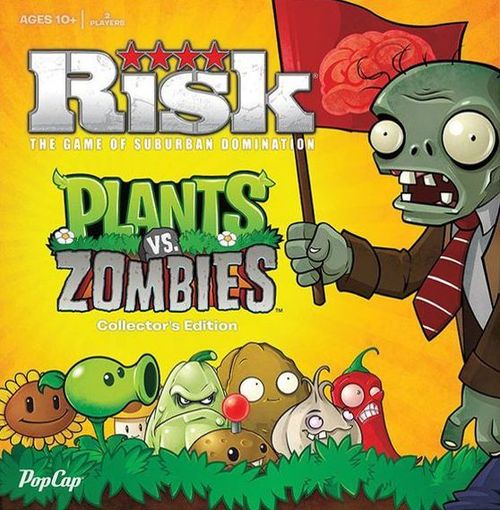
Risk: Plants vs. Zombies
Risk: Plants vs. Zombies Rulebook
Table of Contents
Table of Contents
Introduction and Overview
Ages 10+, 2 players.
Game Modes
There are 3 different ways to play RISK: Plants vs. Zombies.
- Basic Training - Introductory version. Start here for your first time playing.
- Advanced Play - Customize scenarios and attempt Total Domination.
- Front Yard Skirmish - Tower-defense-style game play.
Contents
- Double-Sided Game Board
- 1 Parts Sheet: 40 Garden Gnomes, 12 Objectives, 9 Station Wagons, 7 Reminder Pieces
- 72 Cards: 30-Card Plant Faction Deck, 30-Card Zombie Faction Deck, 6 Plant Upgrade Cards, 6 Zombie Upgrade Cards
- 2 Sets of Pieces: 40 Peashooters, 10 Threepeaters; 40 Zombies, 10 Zombie Mobs
- 6 Dice: 3 Plant (Green), 3 Zombie (Grey)
Game Board
The double-sided game board offers two different maps on which to play RISK: Plants vs. Zombies. One side depicts a map of the island town of Brainsborough, and is divided into 30 territories, grouped into 6 regions: Fancy-Pantsington Parish, Low Headlands, Musty Acres, Sierra Bella, Downtown Brainsborough and Bushwood Golf Course. Some of the territories are adjacent to each other, as they either share a border or have a waterway connecting them. Additionally, 11 territories are covered in fog, which limits how many units can attack these territories (see Invasions and Battles). Finally, 4 territories (Mount Brainier, Davington Island, Breakwind Butte, and Potter's Field) contain Strategic Sites, which do not affect combat but may be important for achieving Objectives and winning the game.
The other side of the game board depicts the front yard of a Brainsborough home, and is divided into 45 territory squares in a 5x9 grid. This side is used for the Front Yard Skirmish game, with its own special set of rules and victory conditions (see Game Mode 3 - Front Yard Skirmish).
Game Mode 1 - Basic Training
Play this first! Basic Training is designed as an introductory version of RISK: Plants vs. Zombies game play. It is recommended that you play this game mode until you are comfortable with the rules and mechanics. Then move on to the more challenging game modes: Advanced Play and Front Yard Skirmish.
Object of the Game
The first player to either complete three Objectives or completely eliminate all opposing Faction units wins the game. You do not have to control all the territories to win.
Set-Up
Choose one of the two Basic Training scenarios to play and set up the Brainsborough side of the game board with all the units and markers, as indicated by the chosen scenario diagram. Then roll a die to determine who will play each Faction and which Faction goes first.
Game Play Overview
On your turn, you will take the following actions:
- At the start of your turn, you gain and deploy additional units to bolster your Faction (see Deployment).
- Then, you may invade opposing and/or Neutral territories (see Invasions and Battles).
- When you have finished invading, collect one available Objective if you are eligible (see Objectives).
- Finally, you may make one Maneuver and draw a Faction card if you are eligible (see Maneuvering Units).
Basic Training Scenarios
Set up the game board as shown by one of the two Basic Training scenarios.
Scenario 1
- Place 25 Plant and Zombie units on the board, setting aside the remainder for reinforcements.
- Place 60 Garden Gnome units on the board.
- Place 8 Station Wagon markers on the board (Gray Matterhorn, Pituitary Glen, Braingolia, Brainsborough High School, Brainsborough Town Hall, Land's End Peninsula, Bushwood Driving Range, Foggy Bottom).
- Place 8 Objective markers on the board (Control Observatory and Graveyard, Control Botanical Gardens, Control Town Dump, Eliminate the Garden Gnomes, Control Six Territories with Fog, Control the Low Headlands Region, Control the Downtown Brainsborough Region, Control Six Station Wagons).
Scenario 2
- Place 25 Plant and Zombie units on the board, setting aside the remainder for reinforcements.
- Place 60 Garden Gnome units on the board.
- Place 8 Station Wagon markers on the board (New Brainswick, Pituitary Glen, Cape Twiddy, Brainsborough High School, Medulla Marshes, Land's End Peninsula, Bushwood Country Club, Sierra Bella Park).
- Place 8 Objective markers on the board (Control Observatory and Graveyard, Control Botanical Gardens, Control Town Dump, Eliminate the Garden Gnomes, Control Six Territories with Fog, Control the Musty Acres Region, Control the Downtown Brainsborough Region, Control Six Station Wagons).
Deployment
At the start of your turn, you deploy additional units. The number of units you can deploy is the sum of the following steps:
-
Add the number of territories and Station Wagons you control, and divide that number by 3, rounding down. For example, if Zombies control 10 territories and 3 Station Wagons, divide 13 (territories plus Station Wagons) by 3 to get 4 Zombie units to deploy.
Note: You ALWAYS gain at least 3 units each turn, so if this number is less than 3, round up to 3 units!
-
Then, determine if you have any region bonuses. If you control every territory within a regional color group, you control that region and earn the region bonus indicated on the map as additional units. For example, if Zombies control all 5 territories that comprise the Musty Acres region, they get 3 bonus units.
-
Finally, you may trade in Faction cards for bonus units. Cards have one or two coins, and you may trade in two to ten coins worth of cards. The number of coins indicated on the cards traded in will determine how many bonus units are gained, by referring to the chart here (and on the game board). For example, if Zombies trade in 3 cards with a total of 4 coins, they get 7 bonus units.
| Coins | Bonus units |
|---|---|
| 2 | 2 |
| 3 | 4 |
| 4 | 7 |
| 5 | 10 |
| 6 | 13 |
| 7 | 17 |
| 8 | 21 |
| 9 | 25 |
| 10 | 30 |
After totaling up and collecting units in steps 1-3, you must deploy ALL of them into territories you control. In the examples above, Zombies would have a total of 14 units. They can choose to deploy all units into one territory or spread them out across multiple territories.
Invasions and Battles
After deploying units, you may invade adjacent territories that you do not control, attempting to conquer them. You may declare multiple invasions during a turn, and may attempt to invade the same territory from more than one of your territories, but each invasion can only come from one of your territories at a time. Declaring an invasion is always optional.
Declare an invasion by choosing a territory you control with 2 or more units. At least 1 unit must remain in the attacking territory to retain control of it, and cannot take part in the invasion. All other units may be used to invade an adjacent enemy territory. An invasion is resolved through a series of battles, by attacking and defending. Follow steps 1-7 to determine the outcome of a battle, continuing as directed until the invasion is resolved:
- Choose how many units will attack. For each battle, up to 3 units may attack, unless you are invading a territory with fog, in which case only up to 2 units may attack (see examples below).
- The opposing player then chooses how many units will defend. The defender may choose either 1 or 2 units.
- Each side rolls a die for each unit in the current battle. This means the attacker rolls 1, 2 or 3 dice and the defender rolls 1 or 2 dice.
- Both sides then put their dice in order from highest to lowest. Compare the highest attack die to the highest defense die. Higher number wins but the defender wins ties.
- The loser then removes 1 unit from the attacking or defending territory.
- Continue by comparing second highest die on each side of the battle, and again, the loser must remove 1 unit.
- If there is no die to compare to, meaning you rolled more dice than your opponent, simply ignore those rolls.
Standard Attack example: There are 3 Zombie units in Harvey's RV Ranch that want to invade Pituitary Glen. Only 2 Zombie units can attack since 1 must stay behind. The Plants defending Pituitary Glen have 3 units, but only 2 can be used to defend in each battle.
Attack into Fog example: There are 5 Plant units in Potter's Field that want to invade Foggy Bottom. Only 2 Plant units can attack since 2 is the maximum number of units that can attack a territory with fog. The Zombies defending Foggy Bottom have 3 units, but only 2 can be used to defend in each battle.
Battle example: The 10 Zombie units in Potter's Field declare an invasion on the 3 Plant units in Cattail Canyon. The Zombies send 3 units to attack, since this is the maximum that can attack, and the Plants send 2 units, the maximum that can defend. Zombies roll 3 dice, one for each attacking unit, rolling 6, 4 and 1. Plants roll 2 dice to defend, rolling 5 and 4. Comparing highest die rolls for each side, the Zombie's 6 beats the Plant's 5, so the Plants remove 1 unit. Then, comparing second highest rolls, both sides rolled a 4, and because the defender wins ties, the Zombies remove 1 unit. The third Zombie die is not used, since there is no defending die to compare.
If the defender still has units in the territory being invaded, the attacker may continue the current invasion from the same territory, but can always choose to stop an invasion after the first battle and declare another invasion from a different territory.
If the defender has no more units in the territory being invaded, move the remaining attacking units into the conquered territory. You may also move in additional units from the attacking territory. So even though you can only attack with 3 units at a time, you may move extra units into the invaded territory. Remember that you must always leave 1 unit behind in the territory that attacked, and no territory may ever be left empty.
When you invade a Garden Gnome (neutral) territory, your opponent rolls the defense dice, always rolling the maximum number of defense dice possible.
If you manage to eliminate all the opposing units from the board, you win the game.
Faction Cards
Faction cards are an important and game changing part of RISK: Plants vs. Zombies strategy. Players can earn Faction cards when they successfully invade an enemy or neutral territory. At the end of your turn, if you've conquered at least one territory, you may draw the top card from your Faction deck. You can only draw one card, regardless of how many territories you conquered.
Each Faction card has two play options. First, cards may be traded in at the start of your turn to gain bonus units to deploy (see Deployment). Second, each card has a special power, which can be played as described by the card. Some cards will grant attack bonuses, while others can be used defensively. To use a Faction card's special power, simply follow the instructions on the card and discard it.
When you use Faction cards (either for bonus units or for special powers), simply discard them face-up in a separate pile beside your deck. If your deck is depleted, reshuffle the discards to form a new deck.
Remember, Faction cards may only be used for one of their two options, so choose carefully when trading in cards. You may play as many cards as you want on each turn.
Objectives
At the end of your turn, you may review the available Objectives to see if you have achieved any. If so, you may choose to collect one of the unclaimed Objectives, placing it face-up in front of you. Once an Objective has been claimed, it cannot change hands and is no longer available to your opponent. Even if you are eligible for more than one Objective, you may only collect one Objective per turn. (Note: if you choose to collect an Objective, you do NOT get to draw a Faction card, even if you are eligible.)
Maneuvering Units
After collecting a Faction card or an Objective, you may make one optional Maneuver. To make a Maneuver, take as many units as you like from one territory you control and move them to one other connected territory. Remember, you must leave at least 1 unit in the first territory, and territories are connected if all the territories in between the two are under your control. You cannot maneuver through enemy or Neutral territories. Maneuvering is not considered an attack, just a way to reinforce a territory.
Example: At the end of the turn, Zombies maneuver 2 of the 5 units from Milliner Mall through Brainsborough High School and into Pituitary Glen since Zombies control all of those territories.
Game Mode 2 - Advanced Play
Once you feel comfortable with Basic Training, you can create unique scenarios using the Advanced Play options. The conditions for winning the game remain the same, with each player striving to achieve three Objectives (or eliminate the opposition), but the starting set-up and particular Objectives can change from one game to the next.
Advanced Play Set-Up
Instead of using one of the Basic Training scenario maps provided, set up the game board as follows:
- Place Station Wagons in 9 random territories. Shuffle one of the Faction decks, draw the top 9 cards, and place a Station Wagon in each of the territories listed on the cards. Then reshuffle the Faction deck for game play.
- Choose 8 of the 12 Objectives at random, and place them on the board.
- Place 6 Garden Gnomes in each of the territories with a Strategic Site (Mount Brainier, Davington Island, Breakwind Butte, and Potter's Field). Neither Faction should start a game with control of any territories with a Strategic Site.
- Choose how many additional territories will begin under Neutral control. (The recommended number is 12 territories, but feel free to try other numbers.) Place 3 Garden Gnomes on the chosen number of territories at random, by shuffling one of the Faction decks, drawing that many cards, and placing 3 units in each of the territories listed (redraw if a territory with a Strategic Site is drawn).
- Roll a die to determine which player will place first. Players will start with 24 units and alternate placing units one at a time on unclaimed territories. After claiming the remaining territories, players continue to reinforce those territories until all 24 units are placed for each Faction.
Once all units are placed, proceed with game play as normal. The player who placed the last unit takes the first turn. Players deploy, invade, maneuver, and collect cards or Objectives. The first player to collect 3 Objectives wins the game! Alternatively, you can choose to play in classic RISK style, and disregard the Objectives. In this case, the first player to control all the territories has achieved Total Domination, and is declared the winner.
Game Mode 3 - Front Yard Skirmish
RISK: Plants vs. Zombies also includes optional game play inspired by the tower-defense-style game you have come to know and love. Using the reverse side of the game board, players can duke it out, with the Plants trying to stop the relentless horde of Zombies from invading their home.
Object of the Game
Unlike standard RISK game play, the way to win a Front Yard Skirmish will vary for the Plants and the Zombies. As the Plants, victory is achieved by eliminating all of the invading Zombies, thereby protecting the house. Playing as the Zombies, victory is achieved when at least one Zombie makes it across the yard, past the defending Plants, to reach the front porch space and get to the delicious brains inside.
Set-Up
Place the game board on the Front Yard Skirmish side. The front yard is divided into a 5x9 grid of square spaces (considered territories for game play and Faction cards). One side shows the front of the house that the Plants will defend. The other side is where the Zombies will begin their assault.
Each player collects 30 units to form their reserves. Note: In Front Yard Skirmish, these are all the units available to each side, and once units are destroyed, they are not returned to reserves. When all reserves are deployed for a side, no more units may be deployed by that player.
Shuffle the Faction decks and place them on their spots on the game board. Each player draws 2 cards from their Faction deck to start the game. Cards may be used either for their special power, or turned in to purchase Upgrades, but cannot be turned in for bonus units.
Each side also takes their 6 Upgrade cards and lays them out face-up near the board. These cards can be purchased to give bonuses during the Front Yard Skirmish. Place the cards on their matching spots on the game board once purchased.
Game Play
The Zombie player takes the first turn, and play alternates between players. Each turn is broken up into a number of steps.
- Roll 2 dice to determine units and actions
- Purchase Upgrades
- Deploy units
- Advance Zombie units (Zombie player turn ONLY!)
- Take Actions
- Draw a Faction card
On Your Turn
1. Roll dice to determine the number of units to deploy and actions available - Roll 2 dice to start the turn, choosing one die as the number of units to deploy and the other die as the number of actions to take. For example, the Zombie player rolls a 5 and a 3 on their turn, and can choose 5 for units to deploy and 3 for actions to take, or take 3 units and 5 actions.
2. Purchase Upgrades - Faction cards may be turned in to purchase Upgrades. To purchase an Upgrade, you must turn in Faction cards with coins equal to the cost shown on the Upgrade card. Discard the Faction cards, and place the Upgrade in its matching spot on the game board. You may now use the power listed on the Upgrade for the rest of the game. Note: Lawn Mower and Dr. Zomboss are One Use Only powers.
3. Deploy units - Deploy units equal to the number on the die chosen in step 1 (plus any bonuses from Upgrades). Up to 3 units may be deployed in any given territory at a time. Plants may be deployed in any territory in the front yard that does not contain Zombies. Zombies only deploy to the 5 sidewalk territories adjacent to the yard. Remember, once your last unit is placed, you won't get any more units to deploy, so place wisely!
4. Advance Zombie units (Zombie player turn ONLY!) - After deploying units, the Zombies advance on the house. This happens before Zombies take any actions, and is a free move for each group of Zombies. Starting with groups of Zombies closest to the house, and going from top to bottom of the board, move each group of Zombies one territory closer to the house if the space is empty. Zombies can't advance into a space occupied by Plants or other Zombies. Note: Unlike standard RISK rules, one unit does NOT have to remain behind in a territory to control it.
If the adjacent territory that Zombies would move into on the advance is occupied by Plants, instead of moving, Zombies will try to eat the Plants! Roll a die for each Zombie unit in the group (to a maximum of 3 dice) and for each roll of 4 or higher, remove a Plant unit. This is NOT an attack, and Plants cannot defend or play cards against this. If all Plants are eaten, the Zombies advance into the territory. However, if Zombies do not manage to eat all the Plants, they remain in their territory but are free to take actions as normal.
5. Take Actions (Zombies) - After deploying units and making their advance, the Zombie player may now take actions with groups of Zombies equal to the die roll selected for actions in step 1. This is in addition to the advance that all Zombies get in step 4. Actions for Zombie units consist of either moving or attacking. Each group of Zombies may only be issued one action each turn. If helpful, use included Reminder chips to help keep track of which groups have already taken actions.
- Move - A group of Zombies may move by advancing one space towards the house into an adjacent unoccupied territory. Zombies may NOT move into spaces occupied by Plants or other Zombies.
- Ground Attack - If the space directly ahead of Zombies is occupied by Plants, they may make a Ground Attack against the Plants. Ground Attacks follow most of the standard RISK combat rules, where the attacker rolls a die for each attacking unit (up to 3 dice) and the defender rolls for each defender (up to 2), die rolls are compared, and a unit is removed for each losing roll (see Invasions and Battles). For example, three Zombies attack two Plants. Zombies roll 6, 4 and 1, while Plants roll 5 and 4. Comparing dice, each side scores a hit and removes an opposing unit. If a group of attacking Zombies defeats all defending Plants in a space, all the attacking Zombies in that group advance into the defending space.
5. Take Actions (Plants) - After deploying units, the Plant player may now take actions with groups of Plants equal to the die roll selected for actions in step 1. Each group of Plants may only be issued one action each turn. If helpful, use included Reminder chips to help keep track of which groups have already taken actions.
In the Front Yard Skirmish, Plants don't move (unless you buy a Shovel Upgrade). Once deployed, Plants will remain in their territory until destroyed. As such, Plants have two options for actions: Ranged and Ground Attacks. First, Plants may take Ranged Attack actions, followed by any Ground Attack actions.
- Ranged Attack - To make a Ranged Attack, the Plant player chooses a group of Plants in a territory to shoot at opposing Zombies. Plants may only make Ranged Attacks against Zombies that are in the same row and in front of them. Plants may shoot past other Plants to attack Zombies, but must always shoot at the closest Zombies in their row. Roll a die for each Plant unit in the attacking territory (to a maximum of 3 dice). For each 6 rolled, a Zombie is hit. No defense roll is made by the Zombie player. For example, a group of three Plants make a Ranged Attack on three Zombies, rolling 6, 4 and 3. They score one hit and remove one Zombie.
- Ground Attack - Instead of a Ranged Attack, Plants may make Ground Attacks against Zombies directly in front of them. Remember, Ground Attacks follow most of the standard RISK combat rules (see above). If attacking Plants defeat all defending Zombies, they do not advance, since Plants don't move in Front Yard Skirmish. If defending Zombies are lucky enough to defeat all attacking Plants, they do not advance into the attacking territory.
Important notes about attacking: Unlike standard RISK rules, in Front Yard Skirmish one unit does NOT have to be left behind in the invading territory, so a single unit can make a Ground Attack. Also, each Ground Attack is just a one-off action, so resolve only one battle for each Attack action taken. If both sides still have units after the Attack action, do NOT continue to battle, as the acting group is done for the turn. Each Ground Attack is still considered an Invasion for playing Faction Cards.
6. Draw a Faction card - After taking actions, the active player draws a Faction card and adds it to his or her hand. Faction cards can be used in one of two ways in Front Yard Skirmish. First, Faction cards may be turned in to purchase Upgrades during step 2. Turn in Faction cards with coins equal to the cost of the desired Upgrade to gain the Upgrade power for the rest of the game.
Additionally, much like in standard RISK game play, cards can be used for the special power listed. To use a Faction card for its power, simply follow the directive listed and discard the card to activate the power. Note: Any card that references an Invasion (for example: Torchwood or Buckethead Zombie) can be played when a Ground Attack action is taken, and just applies to that one Ground Attack. Any card that allows you to move or add units to a territory (Hypno-shroom or Zombie Bobsled Team) DOES allow you to have more than three units in a space.
In Front Yard Skirmish game play, ignore the rules for making a Maneuver. You may not maneuver units at the end of your turn.
Game Play Options
Front Yard Skirmish game play can be customized in a variety of ways to increase or decrease the level of difficulty for each side. One option is to add to or subtract from the number of units each Faction starts with in their reserve. Think Plants have an easy time? Try fighting off even more Zombies! Zombies walking all over you? Start with more Plants! Up the number of rows that Zombie units must successfully breach to enter the house to increase the difficulty. Want more Upgrades and Faction card powers? Draw 2 cards a turn! Feel free to customize to adjust the challenge for either side as you see fit!