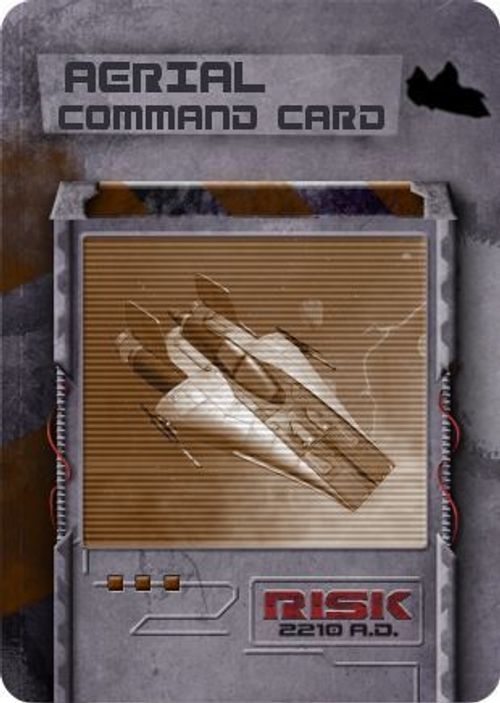
Risk 2210 A.D.: Aerial Assault Command Deck
Risk 2210 A.D.: Aerial Assault Command Deck Rulebook
Table of Contents
Table of Contents
Aerial Command Token
- The major change brought with the Aerial Assault command deck is the introduction of the new Aerial Commander. Unlike previous expansion decks, the Aerial Assault deck comes with two neutral coloured commanders in order to slot directly into game play as and when required. Each of these new commanders, once brought into play, allows the player who owns them to fly a Sortie at the beginning of each of their turns prior to making a standard attack. At any point where the Aerial commander is not flying a sortie it may be moved like any other commander and also receives the standard d8 defensive dice.
- The Aerial Assault card text: "Add an Aerial Command token to any one of your land territories. At the beginning of each turn, prior to declaring an attack, you may choose to fly a 'sortie' with this commander (see rule supplement for further information on flying a sortie)."
Flying A Sortie
Each sortie flight takes part in three distinct stages:
-
Outbound Flight. The player rolls a d6 to establish the maximum number of territories the Aerial Commander may fly, and moves the commander accordingly. The commander can move between neighbouring territories up to the value on the dice. Movement may include both land and water territories, even if they are controlled by another player. Once the commander has come to the end of its outbound flight, the controlling player may choose to commence bombing. This need not be the case if the commander comes to rest in a territory they control. In such a case, the controlling player may simply choose to finish the sortie here, leaving the commander in place within that territory.
-
Bombing. Once the Aerial commander has come to rest above an enemy territory, the controlling player should roll a d6 and follow the appropriate action dependent upon the number rolled:
- 1 & 2: Plane is hit by flak. STOP ATTACK. The Aerial commander receives half d6 roll on the return flight.
- 3: MISS. The commander may continue bombing.
- 4, 5 & 6: HIT. Destroy one army in the territory being bombed. Bombing may continue. A maximum of threee armies may be destroyed in this fashion before making the return flight.
-
Return Flight. The player rolls a d6 to establish the maximum number of territories the Aerial Commander can move, bearing in mind any reductions in movement caused by flak damage in the Bombing stage. If the Aerial commander cannot return to a land territory owned by the same player, or if it ends its flight above a water territory, then it crashes and is destroyed. Once the sortie has ended, that player may continue with the normal run of play.
Spelling note: "threee" (Bombing) and "baring" (Return Flight) are reproduced as printed in the source.
Additional Aerial Commanders
Although only two Aerial Commanders are supplied with the Aerial Assault deck, additional commanders can be obtained from Insurgency Gaming. These additional commanders may be bought by any player during the normal purchase phase of play, for the standard price paid for commanders, and then placed accordingly.
More Than Two Players
Because the Aerial Assault deck is originally supplied with only two Aerial commanders, instead of the five that would ultimately be needed for all players to use them, the two Aerial Assault cards included within the deck come into play. Their inclusion or exclusion from the deck is of paramount importance.
- If only two Aerial commander tokens are available, playing with the standard rules would mean that the first two players to obtain the commanders would have sole use of the Aerial command deck, a hugely unfair advantage over the other players.
- To rectify this, if only two Aerial commander tokens are available, the Aerial command deck becomes open to all players from the beginning of the game, regardless of whether or not a player controls an Aerial commander. Sorties can only be carried out through the use of Aerial commanders, and in this case those commanders can only be brought into play through the respective Aerial Assault cards within the deck.
- If there are enough Aerial commanders for all players, the Aerial Assault cards should be removed from the deck. The purchase of Aerial commanders then follows the standard rules. In such an instance, the Aerial Assault deck is only open to those players with Aerial commanders in play.
Command Cards
The deck is printed with the following cards. Only the play text of the Aerial Assault and Air Raid cards is reproduced from the photographed components. The text of the other cards is not reproduced here.
- Card set (as listed in the item description): 2 Aerial Commanders; 3 Propaganda; 3 Resurrection; 3 Phoenix; 3 Storm Troopers; 2 Kamikaze; 2 Aerial Assault; 2 Air Raid; 1 Dark Angel.
Count note: the item description gives the deck as "20 card deck" and lists the card distribution above, which totals 19 Command cards plus the two Aerial Commanders. The count is transcribed as printed in the source.
Aerial Assault
Play on your turn before your first attack is declared. Add an Aerial Command token to any one of your land territories. At the beginning of each turn, prior to declaring an attack, you may choose to fly a 'sortie' with this commander (see rule supplement for further information on flying a sortie).
Air Raid
Play on your turn before your first attack is declared. Choose one opponent controlled territory with a space station present. Until the end of your turn all armies within that territory lose all defensive benefits offered by the space station.