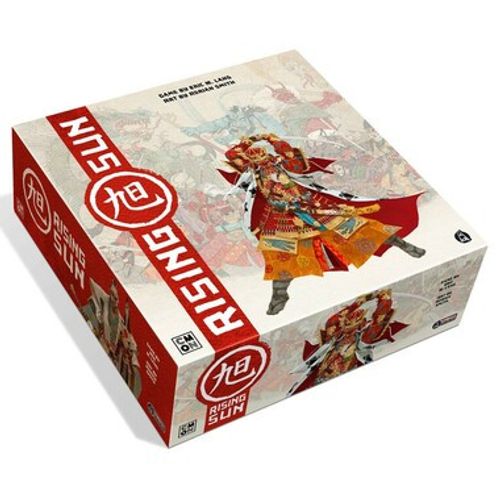
Rising Sun
Rising Sun Rulebook
Table of Contents
Table of Contents
Game Components
1 game board, 5 clan screens, 7 shrine tiles, 10 political mandate tiles, 21 core season cards (7 per Season), 5 Political/War tiles, 24 War Province tokens (8 per Season), season card Sets (Teapot, Horseman, Archway — 15 each, 5 per Season), 5 alliance tokens, 20 stronghold tokens (4 per clan), 20 ronin tokens, 8 war number tokens, 65 plastic coins, 10 clan markers (2 per clan), 50 bonsai/koi/dragonfly/lotus/turtle clan figures (10 each: 6 Bushi, 3 Shinto, 1 Daimyo), 8 monster figures, monster/clan bases.
Basic Concepts
The Game Board
- Map: The heart of the board shows the Map of Japan, divided into 8 Provinces delineated by thick, colored lines. Provinces may be occupied by Figures and Strongholds.
- Borders: If two Provinces are adjacent, a two-colored Border line separates them. Figures may Move between adjacent Provinces by crossing these Borders.
- Shipping Routes: These lines connect certain Provinces across the Map. Figures may Move between two Provinces connected by a Shipping Route as if they were adjacent.
- Rewards: Hexagons attached to a Province display what Reward it grants when Harvested (Coins, Victory Points, and/or Ronin tokens).
- Honor Track: Marks the relative Honor between Clans. A Clan with its marker above another has more Honor.
- Shrine Slots: At the start of each game, 4 random Shrine tiles are placed here. Shinto go to these to worship the Kami.
- Political Track: Indicates the Turns during each Political Phase, including the Tea Ceremony symbol, Kami Turn symbols, and the War Phase symbol.
- Political Mandate Slots: Players place their chosen Political Mandates here, left to right.
- Victory Points Track: Tracks each Clan's VP. If a Clan moves beyond the 50 slot, move its marker back to the 1 slot but flip it upside down (add 50 VP).
- War Province Slots & War Number Slots: At the start of each Season, Battles are randomized by placing War Province tokens on these slots; a War Number token in each such Province marks whether/where a Battle takes place.
Figures
Each Clan has 10 figures: 1 Daimyo, 3 Shinto, and 6 Bushi. Figures are kept in Reserve while not in use and returned there if killed. All figures have 1 Force unless otherwise stated. Attach a black base to Daimyo and white bases to Shinto.
- Bushi: Foot soldiers with no special abilities.
- Shinto: Battle like any Bushi, but when Recruited you may send them to worship a Kami instead of staying on the Map.
- Daimyo: Your leader. Cannot be taken Hostage, cannot be removed by a Betray action, and is immune to other special effects (such as a Monster's ability to automatically kill a figure).
- Monsters: Added via a Train action; attach a Clan base and immediately Summon it to a Stronghold. Each has a special ability (Force is 1 unless stated). No limit to the number of Monsters. A Monster in Reserve counts as the same type as another Monster for Betray purposes.
Season Cards
Season cards are divided into 3 Seasons: Spring, Summer, and Autumn. Types:
- Monster (brown): gives your Clan a Monster figure with a unique ability.
- Enhancement (green): abilities that enhance your Clan or figures/actions.
- Virtue (blue): allow extra Victory Points or benefits triggered by specific conditions.
- War Upgrade (red): special benefits that trigger at the start of each War Phase.
- Winter Upgrade (light blue): bonus Victory Points triggered by conditions at the end of the game.
Core Season cards have no symbol on the back and must be present in every game. Season card Sets have a symbol; each game, players choose or randomly select 1 Set to add to the Core cards.
Honor
The Honor Track keeps track of each Clan's Honor relative to one another. The most crucial aspect: Whenever there is a tie, the tied player with the highest Honor wins. This applies to any tie — Force in a Province during a Harvest or Battle, Force on a Shrine, or Coins on a War Advantage. If there's ever a conflict in the timing of an ability, the involved player with higher Honor decides whether to go first or last.
Gaining/Losing Honor: Honor is always relative; no two Clans occupy the same slot. When a Clan gains Honor, move its marker up 1 slot, moving down the Clan that was above it (no effect if already at top). When a Clan loses Honor, move down 1 slot, moving up the Clan below it (no effect if already at bottom, disregarding empty bottom slots).
Negotiation
Players are encouraged to use diplomacy, negotiation, and bribery. Deals are not binding. Bribery ("tokens of friendship") — giving Coins and Ronin tokens — can only be done during the Tea Ceremony and the Political Phase, not during the War Phase.
Setup
Prepare Your Clan:
- Each player chooses a Clan (place a Clan Screen and a Political/War tile behind it, Political side up). Unchosen Clan materials return to the box.
- Sitting Order: Players sit according to the Starting Honor Rank of their Clan. The Clan with the lowest-numbered Rank plays first; the next Rank sits to their left; play proceeds clockwise. Sitting order stays the same all game.
- Place 1 Clan marker on the first slot of the Victory Point Track.
- Place your other Clan marker on the Honor Track according to your Starting Honor Rank (lowest-numbered Rank on top, no empty slots between markers; empty slots at the bottom depending on player count).
- Take your Daimyo, 3 Shinto, and 6 Bushi (with bases); keep them next to your Clan Screen in your Reserve.
- Take all plastic bases in your Clan's color (for Monsters).
- Take your 4 Stronghold tokens and your Alliance token.
- Home Province: Place 1 Daimyo, 1 Bushi, and 1 Stronghold on the board in your Home Province.
Prepare the Kami: 8. Shuffle the 7 Shrine tiles, draw 4, and place them faceup on the Shrine Slots (first-time players: Amaterasu, Fujin, Hachiman, Tsukuyomi).
Prepare the Season Decks: 9. Create 3 Core Season decks (Spring, Summer, Autumn). Choose a Set of Season cards (first-time: Archway) and add its 5 cards for each Season to the Core decks. Each Season deck should contain 12 cards.
Last Steps: 10. Separate War Province tokens by number (I, II, III). Shuffle into 3 facedown piles of 8. 11. Place War Number tokens next to the board. 12. Shuffle the 10 Political Mandate tiles facedown into a pile. 13. Place all Monster figures next to the board. 14. Place all Coins and Ronin tokens in common piles (both are unlimited).
Playing the Seasons
Rising Sun is played over 4 rounds (Seasons): Spring, Summer, Autumn, and Winter (endgame). The Phases of each Season: 1) Seasonal Setup, 2) Tea Ceremony, 3) Political Phase, 4) War Phase, 5) Seasonal Cleanup.
Seasonal Setup
Prepare for War. Take the current Season's War Province tokens (I-Spring, II-Summer, III-Autumn) and place them faceup on the War Province Slots — equal to the number of players plus 2 (top 5 slots always filled). Place a War Number token in the War Number Slot of each indicated Province. Unused War Number tokens return to the box.
Set Season Cards. Discard any Season cards left from the previous Season. Place all cards of the current Season deck faceup next to the board (identical cards may be staggered).
Seasonal Income. Players should have no Coins. Each receives Coins equal to their Seasonal Income (on their Clan Screen).
Return Hostages. At the start of Summer, Autumn, and Winter, players return any figures they have Taken Hostage to their owners. For each returned hostage, the returning player gets 1 extra Coin.
Tea Ceremony
Each Season starts with a Tea Ceremony to negotiate Alliances. Any Alliances from a previous Season are unmade. Alliances are forged between pairs of players who both agree, joining their Alliance tokens into a circle. Alliances last for the current Season (unless broken by a Betray Mandate); no new Alliances until the next Season.
Effects of an Alliance:
- Allied players grant each other powerful Bonuses from the Political Mandates they play.
- Allied players don't fight each other during the War Phase if they are the only ones in a Province; victory goes automatically to the one with the highest Force.
- In a Battle involving two Allied players and others, if one Ally is victorious, they don't kill their Ally's figures.
- Allied players are still opponents for Season card abilities and other effects.
- If an Allied player plays Betray, they immediately lose Honor and the Alliance is broken.
- If the game ends in a tie between Allied players, they share the victory.
Political Phase
The Political Phase always follows this order: 3 Mandate Turns, Kami Turn, 2 Mandate Turns, Kami Turn, 2 Mandate Turns, Kami Turn, then the War Phase starts.
Mandate Turns. At the start of the game, the Clan at the top of the Honor Track takes the deck of Political Mandates. In following Seasons, the first player is the one to the left of the player who performed the last Mandate Turn.
During a Mandate Turn, the player with the deck draws the top 4 Mandate tiles secretly, chooses 1, and returns the other 3 facedown to the top of the deck (without reshuffling). They place the chosen Mandate faceup on the first available slot. The chosen Mandate is performed by all players, starting with the player to the left of the selector and proceeding clockwise (the selector goes last, except for Train). Except for Betray, all Mandates have 2 components: one part that ALL PLAYERS perform, and one Bonus part that only the CURRENT PLAYER AND THEIR ALLY perform. Then the player passes the deck to the left.
Recruit
- All Players: Summon 1 of your reserve figures to each Province where you have a Stronghold (a number of figures equal to the number of Strongholds there). No limit to figures per Province. Can't Summon if no reserve figures.
- Current Player and Ally: Summon 1 additional figure to any one of your Strongholds (even if already Summoned there).
- Summoning Shinto: When a Shinto is Summoned (and only then), the player may send it to Worship one of the Kami — placed on any of the 4 Shrine tiles. A worshipping Shinto is not on the Map and cannot be Moved to the Map or a different Shrine.
Marshal
- All Players: Move each of your figures on the Map to an adjacent Province (crossing a Border or taking a Shipping Route). Move any number of figures (or none); each figure can only be Moved once per Marshal.
- Current Player and Ally: May spend 3 Coins to build a new Stronghold anywhere on the Map (doesn't have to be adjacent to an existing Stronghold; no limit per Province). Can't build if all 4 Strongholds are placed.
Train
Important: The player who selects Train performs it FIRST.
- All Players: Acquire 1 of the displayed Season cards by paying its Coin cost (some are free). The card's ability is in effect as soon as acquired. A player may acquire more than 1 copy over subsequent Trainings (abilities stack).
- Current Player and Ally: Pay 1 less Coin than listed (minimum 0). Still only one card per Train.
- Acquiring Monsters: Take the Monster figure, attach a Clan-color base, and immediately Summon it to a Province where you have a Stronghold.
Harvest
- All Players: Gain 1 Coin from the common pile.
- Current Player and Ally: Collect the Rewards listed for every Province where you have the most Force (adding each Clan's figures' Force). Rewards: Victory Point (move up 1 on the VP Track), Coin, or Ronin token. Ties broken by Honor.
Betray
Betray only benefits the current player and has no Bonus. If the player is in an Alliance, it is immediately broken and the Betraying player loses Honor (if not in an Alliance, no Honor loss).
The player chooses up to 2 figures on the Map, belonging to 2 different players, and replaces them with figures of the same type from their own Reserve. You cannot replace 2 figures of the same player, replace with a figure already on the board, or replace with a different type. A Monster in Reserve can replace another Monster (same type). Replaced figures return to owners' Reserves (not killed). Daimyo cannot be Betrayed. Shinto on Shrines are not affected. You cannot replace a figure without a same-type reserve figure. Replacing is not a Summon (Shinto cannot be sent to worship).
Kami Turns
After a Mandate Turn, if the next step shows the Kami symbol, resolve a Kami Turn. Resolve each of the 4 Shrine tiles in order (left to right). In each Shrine, compare each Clan's total Force; only the Clan with the most Force gets that Shrine's Kami ability (ties broken by Honor). A Shrine with no Shinto is skipped.
Kami abilities (top worshipper):
- Amaterasu (sun): move your Clan marker straight to the top of the Honor Track (may change the tiebreaker for following Shrines this turn).
- Fujin (wind): perform up to 2 Moves (2 figures once each, or 1 figure twice).
- Raijin (thunder): Summon 1 Bushi to any Province, even without a Stronghold there.
- Ryujin (sea): acquire a Season card from those available, paying its full Coin cost.
- Hachiman (war): gain 2 Ronin tokens.
- Susanoo (storms): gain VP equal to the number of Strongholds you have on the Map.
- Tsukuyomi (moon): gain 2 Coins.
After all 4 Shrines are resolved, the Political Phase continues. If this was the third Kami Turn, the Political Phase ends and the War Phase begins.
War Phase
At the start of the War Phase, players flip their Political/War tiles to the War side and resolve any War Upgrade Season cards ("At Start of War" effects happen at the start of the War Phase of each Season, not each Battle). During the War Phase, players cannot freely give each other Coins or Ronin tokens.
Starting with the number 1 Province and proceeding in ascending order, War is resolved in each Province with a War Number token:
- If nobody has any Force in the Province, discard its War Province token.
- If only 1 player has Force, they take the War Province token.
- If only 2 Allied players have Force, no Battle; the player with the most Force takes the token (ties broken by Honor).
- If at least 2 non-Allied players have Force, a Battle takes place.
Resolving Battles
A Battle involves all players with any Force in that Province (even Allies). Before a Battle, all players clearly display their Coins and Ronin tokens (and must truthfully answer how many they have). Players take their Coins behind their Clan Screen and allocate them simultaneously and secretly to the War Advantage spots on the War tile (any number, including zero). Coins not allocated to a War Advantage are placed below the War tile (and don't count). All players lift Screens simultaneously, revealing bids.
Compare Coins in each War Advantage slot from left to right (Seppuku first). Each War Advantage is won by the player who bid the most Coins (ties broken by Honor). If no one bid, the Advantage is skipped. Only the winner may execute it (and may choose not to). Resolving one Advantage may affect a later one.
- Seppuku: The winner may immediately kill all their figures in the Province. If so, gain 1 Victory Point and gain Honor for each figure killed. They must kill all their figures (still in the Battle even with no figures).
- Take Hostage: The winner may capture 1 figure in the Province belonging to another player (even an Ally). The figure is placed next to the capturer's Clan Screen and returned during the next Season's setup (not killed). The capturer also steals 1 VP from the captured figure's Clan (if that Clan has any VP). Daimyo are immune.
- Hire Ronin: The winner may add their Ronin tokens to their forces: +1 Force each. Ronin are not spent (available again in a following Battle). A winner with no Ronin adds no Force but deprives others.
Battle Outcome (before Imperial Poets): Players compare total Force in the Province (changed by Seppuku, Hostages, Ronin). The Clan with the most Force wins the Battle and takes the War Province token (ties broken by Honor). All figures of losing players are killed — unless a loser is Allied with the winner (their figures are not killed). If no players have any Force left, the player with the highest Honor wins.
- Imperial Poets: The winner gains VP equal to the total number of figures killed in this Battle (regardless of owner or how they were killed).
War Reparations: Losing players discard all Coins allocated on their War tile. The winner gives all Coins they allocated on their War tile to the losing players, distributed equally (winner decides who gets an extra Coin if it can't divide evenly). Then War is resolved in the next Province.
Seasonal Cleanup
- Discard Coins and Ronin: All Coins and Ronin in reserves return to the common pile.
- Return Shinto: All figures on Shrine tiles return to owners' reserves (figures on the Map remain).
- Return Political Mandates: Shuffle the board's Mandates back with the deck, kept close to the player to the left of the one who performed the last Mandate Turn.
Winter Season — Endgame
The start of Winter ends the game. The only Season Setup step executed is Return Hostages. Players gain extra Victory Points for:
- Winter Upgrades: Season cards granting extra VP per their criteria.
- War Province Tokens: Each grants VP by the Season won: Spring = 1, Summer = 2, Autumn = 3.
- War Province Set Bonus: Based on the number of War Province tokens of different Provinces (duplicates don't count): 3–4 tokens = 10 VP, 5–6 = 20 VP, 7–8 = 30 VP.
Tally all VP. The player with the most points wins. Ties broken by highest Honor; if tied players are Allied, they share the victory.
The Clans
- Koi — Eddies in the Stream: At the start of the War Phase, the Koi player discards all Ronin and takes the same number of Coins. When resolving Hire Ronin, all Coins in the Koi player's reserve count as Ronin (if they won Hire Ronin).
- Bonsai — Sacred Bounty: The cost of everything they buy (Season card or Stronghold) is limited to 1 Coin at most (free stays free). Discounts (e.g. Train Bonus) apply after the clan ability, bringing the cost to zero.
- Dragonfly — Gossamer Wings: When Summoning, a figure can be placed in any Province (whether or not they have a Stronghold there; the number Summoned via Recruit is still tied to Strongholds). When Moving, a figure can be placed in any Province, no matter how far; Dragonfly figures never use Shipping Routes.
- Turtle — Shell of the Eternal: When Moving figures, the Turtle player can also Move their Strongholds like figures. Each Turtle Stronghold counts as 1 Force in its Province (affecting Harvest and War). Strongholds may never be killed, Taken Hostage, or replaced by Betray.
- Lotus — Dictate the Flow: On Mandate Turns, the Lotus player places the chosen Mandate facedown (unseen), then announces any Political Mandate they want (Recruit, Marshal, Train, Harvest, or Betray).