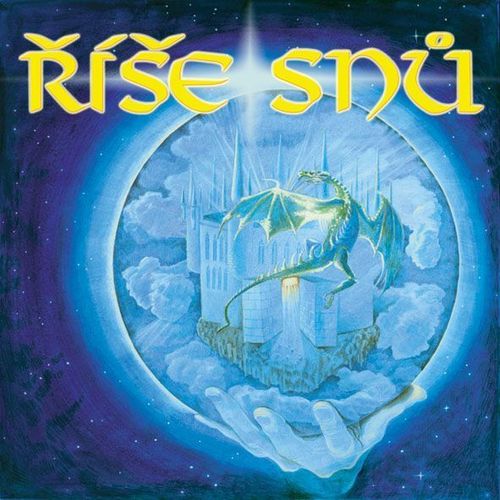
Říše snů
Říše snů Rulebook
Table of Contents
Table of Contents
Rules
The game is for 2–5 players. Each player controls one character – an immortal envoy of the Realm of Dreams or the Realm of Darkness – who explores nothingness and reshapes it by casting dreams or horrors, visits foreign worlds, and tries to win them over as allies by completing the tasks assigned to them. On their travels through mysterious worlds the characters meet many dangers and experience many adventures, through which they gain experience, power and undying glory.
We have prepared two scenarios for you – Clash of Realms (Střet říší) and Trial of Strength (Zkouška síly). We recommend first trying the basic version of Clash of Realms under the simplified rules, designed for two players.
First, however, familiarise yourselves with what both scenarios have in common and with the individual elements of the game.
Die
The game includes an eight-sided die. It is used, for example, for character movement, in combat, and when casting some dreams and horrors. Wherever the rules mention rolling the die, this is the eight-sided die.
Tokens
The box contains glass tokens in various colours. They serve to show numerical characteristics of characters (for example, red tokens represent a character's power and green tokens its lives), to mark cards that have a limited number of uses, and so on. Details are always given at the relevant point in the rules.
Character
A character is represented in the game by a character card, which the player places in front of them on the table, and by a figure bearing the same picture, which is placed in a base and moved across the game board.
Character Types
Characters serving the Realm of Dreams are called heroes; characters fighting for the Realm of Darkness are called demons. The game contains five heroes and five demons.
Heroes
- Barbar (Barbarian) – a mighty warrior who endures a great deal but moves slowly. He can fly into a rage, and woe betide anyone who opposes him!
- Cestovatel (Traveller) – the fastest character in the game. He cannot endure much in combat, but in a flash he can get anywhere.
- Druid – a mystical healer who never forgets anything he has once learned. He can tame animals and make them his helpers.
- Rytíř (Knight) – a very mobile rider on the wings of his pegasus. Through training he constantly improves his combat skills.
- Snový drak (Dream Dragon) – the most powerful being of the forces of Dreams. He can move through nothingness incredibly quickly.
Demons
- Čert (Devil) – a completely unpredictable character with hellish luck in play.
- Rarach – a demon who constantly schemes and plots. He is so cunning that he outwits even the rulers of the worlds.
- Saň – the most powerful character in the game. The terror of all heroes.
- Stín (Shadow) – a very fast and treacherous demon. Nothing can stop him.
- Titán (Titan) – a very powerful but not very mobile character. The blow of his hammer is hard to escape.
Character Card
The character card lists all of the character's starting attributes and special abilities.
Example – the Barbar card: Power 5, Movement +2, Lives 6.
Special ability (Berserk): Your power increases by 3 until the end of the combat. If you lose a combat, you lose 1 more life than usual. If you are attacked by an opposing character, you cannot use this ability.
Translator's note: the Barbar card is printed at low resolution; the wording of the Berserk ability above is the transcriber's best reading of "prohraješ-li souboj" (if you lose the combat).
Character Attributes
Power (Moc) – expresses not only the character's physical strength but also its mental abilities. Power shows mainly in combat and increases with growing experience. A character's power can never fall below its starting value. An increase in power during the game is shown by placing a red token on the character card.
Movement (Pohyb) – expresses the character's ability to find its way through nothingness, dreams, horrors and individual worlds. The number on the character card is added to each movement die roll, giving the number of movement points (BP) the character has available in that turn. Details are given in the chapter Character Movement.
Lives (Životy) – nobody dies in the Realm of Dreams. Characters are immortal envoys of the forces of Dreams or Darkness. The number of lives determines how long a character can fight before it wakes up (see the chapter Combat System). Each life is represented by a green token. The number of lives printed on the character card is the maximum, which may not be exceeded.
Special Abilities
A special ability may be used more than once per turn unless stated otherwise. Use of an ability must always be announced in advance.
Game Board
The game board is the part of the universe where three powerful neutral worlds lie – Iridion (also called Rainbow, Duhovka), Akademus and Filnerin. Representatives of both the Realm of Dreams and the Realm of Darkness travel here, whose aim is nothing less than to bring these worlds over to their side. But getting to the rulers of the worlds is far from easy. Look now at what you can find on the game board.
Nothingness – the unexplored space between worlds. What lurks within it no dream-traveller can guess.
Path (Cesta) – paths came about thanks to wanderers who explored many places of nothingness very well and described them.
Magic spring (Kouzelná studánka) – magic springs are wondrous places in nothingness. Many sages believe that the very light of Netheran flows through them, the forces of creation.
Mysterious place (Tajemné místo) – the mysterious place hides the Gate of Time, which can turn victory into defeat and inevitable defeat into glorious victory. It depends only on the unpredictable will of fate how it behaves.
World (Svět) – a world is an inhabited island in the boundless ocean of nothingness. The game board holds three worlds:
- Iridion (also called Duhovka, Rainbow) – the meeting place of all wanderers and travellers.
- Akademus – the world of sages.
- Filnerin – the giant tree of life.
Each world consists of three areas:
- Gate of the world (Brána světa) – the only space through which one can enter the world and later its hall.
- Outer ring (Vnější okruh) – eight spaces around the central one. It forms the surface of the world, along which characters travel, experience adventures and seek the gate into the hall. Characters move clockwise; this direction is also indicated by an arrow on the gate space.
- Hall (Síň) – inhabited by the basic forces of the world, whose entire power is concentrated in the Crystal. In the hall, characters are given tasks. By completing them they can persuade the rulers of the worlds and thus gain allies.
Card Types
Apart from the characters already described, the game contains several types of cards. Used cards are generally placed on the discard pile and do not return to the game.
Dreams and Horrors
Summoning Dreams and Horrors
Dreams and horrors are usually summoned by means of light, a mystical energy which the rulers of the Realm of Dreams and the Realm of Darkness use to reshape the universe. In the game, light is represented by yellow tokens, where 1 token = 5 points of light. You cast a dream by placing it on the game board and paying the required number of light points, i.e. giving up several tokens. If you do not have enough light points, you cannot cast the dream (unless a specific scenario states otherwise).
Placing Dreams and Horrors
Dream and horror cards are placed face up on spaces of nothingness during the game. Each card occupies four game spaces, and it may not be placed so that it partly overlaps a previously placed dream or horror. The whole card must also be placed on the game board, so it may not overhang the edge. Cards may cover spaces of worlds and of the mysterious place, but on those spaces they have no effect (as if the card were not lying there at all). Dreams and horrors therefore work only on spaces of nothingness, on paths and on magic springs.
Depending on the information on the card, its placement is either exact or random:
- Exact (P – přesné): the player decides for themselves where to place the card.
- Random (% – náhodné): the location is determined by the die. Roll the die twice; the two results together identify a specific space. For example, rolls of 1 and 8 mean the dream (horror) appears on the game space numbered 18. The card's picture is placed on that space, but the card may be rotated as the caster wishes. If the determined space is already occupied by another dream or horror, or the card cannot be placed there without overlapping another dream or horror, the roll is repeated.
Duration of Dreams and Horrors
Duration may be permanent (stálé) or temporary (dočasné).
- A card with permanent duration works continuously, regardless of how many times it is visited.
- A card with temporary duration states how many times the dream or horror can be used. Cards with a duration of 1 action are placed on the discard pile after the first use; cards with a duration of 2 actions (or 3 actions) last for two (or three) uses. For such a card, place as many tokens (of any colour) as the number of actions stated on it. After each use, remove 1 token. Once you remove the last token, place the card on the discard pile.
Dream and Horror Cards
Dream and horror cards are square. Dreams have a yellow-orange back, horrors a red one.
Using dreams and horrors, characters reshape nothingness; players use these cards to influence the environment of the game board. Dream cards usually help heroes or harm demons; with horror cards it is the other way round.
Information on dream and horror cards:
- Light (Světlo): how many light points it costs to summon the dream (horror).
- Placement (Umístění): P – exact, % – random (determined by a die roll), as described above.
- BP: the movement cost for entering a space of the summoned card.
- Duration (Trvání): permanent or temporary.
Example – the card Pták Ohnivák (Fire Bird): Light 10; Placement P; BP 1; Duration permanent. Die roll (applies to heroes only): 1 – the fire bird saddles up for you, permanently +1 power. 2–6 – the fire bird carries you, +4 BP. 7–8 – the fire bird flares up and burns you with its fiery breath, you lose 1 life.
Event Cards
Event cards are rectangular and have a grey back.
Event cards represent the dangers and adventures awaiting you when you visit a world. Before the game, shuffle the event cards and place them face down on the table. Whenever your character ends its movement on a space of a world's outer ring (even when it is leaving the world), take the top card of the event deck and follow what is written on it.
The only other occasion on which you may turn over an event card is a roll of 1–3 when visiting the Gate of Time.
When you draw the last event card, shuffle the discard pile of event cards to form a new event deck.
Types of Event Cards
There are three types of event cards: those with creatures, those with magic items, and those with one-time effects.
Creatures. You usually have to fight a creature; the combat rules are in the chapter Combat System. The card states the experience your character gains for defeating it. Keep such cards. If you lose or draw the combat, place the card on the discard pile – your character gains no experience for it. If no combat takes place (for example, because the creature is hostile only towards some characters), the character gains the experience for the creature anyway.
Example – the card Ohnivé tornádo (Fire Tornado): Fire creature. Power 8; Experience 7. The Fire Tornado attacks only heroes. If you are a Titan or a Barbar, the tornado has joined you, permanently +1 power.
One-time effects. A one-time effect must be used immediately. Unless the card expressly says otherwise, you cannot use it in a later turn. Follow what is written on the card. You may choose an option only if the text expressly allows it, i.e. wording such as "if you wish" or "you may". If an effect moves your character and the specific space is not uniquely determined, choose the space as you wish.
Magic items. Keep the item. Items may be permanent (for example, a Golden Sword) or single-use (for example, a Healing Potion). A character may carry an unlimited number of items. Items may be used at any time. After use, place a single-use item on the discard pile.
Experience from Events
Event cards with creatures state how much experience your character gains for defeating them. Keep these cards. Every ten experience points may be exchanged for one power token. You must give up the exact number of experience points; any remaining experience is lost.
Example: if you have two event cards, the first worth 7 experience and the second worth 5, you may give up both and increase your power by one, but in that case 2 experience is lost.
Task Cards
Snová koule (Dream Sphere) – example: Experience 5. "Visit 5 different dreams or horrors. If that many are not placed, it is enough to visit all of those that are placed."
Task cards are a key part of the game. They are given out in the halls of the worlds. By completing tasks, a character tries to persuade the neutral worlds to become its allies.
The game distinguishes two types of tasks – light and heavy. Light tasks have a green back, heavy tasks a blue one.
A character that visits a world's hall receives one or more tasks. Tasks are assigned at random: the player always takes the top card of the task deck. Whether to take a light or a heavy task, and whether to take both, depends on the specific scenario. A character may never visit the same world again to receive a task until it has completed the tasks it was given there. It is possible to "collect" tasks from different worlds and complete them in parallel.
Each task card states the exact task. Place it in front of you on the table and place a token of the same colour as the one in the world's hall on its upper half (this is how you always know which world the task is for). What must be fulfilled is highlighted in colour on the card. Place the number of tokens matching that colour on the lower half of the card.
Example: on the task Snová koule (Dream Sphere) the words "five dreams or horrors" are in red. Place five red tokens on the lower half of the task card. After each visit to a dream or horror you may remove one token. The task is complete as soon as no tokens remain on it.
Keep the card – the experience gained for completing the task may be exchanged for power tokens.
Experience from Tasks
For completing a light task you gain 5 experience; for a heavy task, 10 experience. As with experience from events, these may be exchanged for power.
Connecting a World
Completing a task is not everything. The hall where the task was given must be visited again. As soon as the character that completed the task visits that hall, the world is connected. Your opponent can no longer gain that world. Your character's power immediately increases by one, so place one power token on your character card. Remove the token from the world so that it is clearly visible that the world is connected. The tasks of other characters given in that world are placed on the discard pile.
Special Ability Cards
Special ability cards are rectangular and have a brown back.
Special ability cards expand the game's options and so are not part of the basic Clash of Realms scenario. When these cards are used, each character gains a new ability written on the card.
Spell Cards
Spell cards are also an expansion element. The game includes two cards with a clear list of all the spells that characters may cast. If you decide to use spells, place the cards beside the game board, each at one end, so that all players can see at least one of them well.
Casting Spells
Each character may attempt to cast a spell only once per turn, at any time during its movement. When attempting to cast a spell, roll the die. The spell succeeds only if the die shows the same number or higher than the number stated in the spell table. A character with the Mage ability adds +1 to this roll. A character standing on a magic spring while casting adds +1 as well.
All spells have unlimited range. Spells printed in bold may be cast only on oneself and act until the end of the caster's turn. The remaining spells may be cast only on opponents. Casting a spell is never considered an attack.
Spell Table
| Roll | Spell | Effect |
|---|---|---|
| 1 | Movement (Pohyb) | +1 BP for this turn. |
| 2 | Slowing (Zpomalení) | Any character has −1 BP during its next movement. |
| 3 | Fling (Odmrštění) | Can be cast only on a character in nothingness. You may move it freely up to 2 spaces, but only to another nothingness space. |
| 4 | Path (Cesta) | All nothingness spaces count as paths this turn (cost 1 BP). |
| 5 | Giant Strength (Obří síla) | +1 power for this turn. |
| 6 | Lightning (Blesk) | Any character loses 1 life. |
| 7 |
Translator's note: the English spell names are the transcriber's translations of the Czech names; the bold rows are the spells that may be cast only on oneself, as the rules state.
Character Movement
Roll the die and add your character's Movement value. This gives you movement points (BP). You may, but need not, use these points to move across the game board. Unused BP are lost; they cannot be saved for later turns.
Each space on the game board has a cost, which determines how many BP you must spend to enter it. If you do not have enough points, you may not enter that space and must wait until the next turn. You may not move diagonally on the game board.
Movement on Dreams and Horrors
Each dream or horror card states a movement cost (BP). Each card occupies four game spaces. The stated cost applies to every space of the card that lies in nothingness (numbered game spaces, including magic springs) or on a path. For example, passing through two spaces of the card Bariéra (Barrier; cost 6 BP) costs 12 movement points.
The character then follows what is written on the dream or horror card. However, a card's effect may be used only once per turn. For example, a character that enters the space of the horror Sopka (Volcano) is injured for 3 lives. If it enters further spaces, it is no longer injured. In the next turn, however, the Volcano may affect it again.
If at the start of its movement a character stands on a dream or horror, it may (but need not) use the card's effect before moving; or it may leave the dream (horror) and thus avoid the card's effect. If it stays on the dream (horror), it is again subject to all its effects.
The effects of cards that cannot harm the character need not be activated. For example, the Portál světů (Portal of Worlds) transports the Knight to any hall. The portal has only three uses, so the player may decide not to use its effect and keep it for later. Conversely, if the Knight enters the horror Sopka, which injures for 3 lives, it cannot avoid the effect. The movement cost, however, always applies, even if the player does not activate a positive effect. In our example, the Knight would therefore have to spend 5 BP to enter the Portal of Worlds.
Entry Costs
| Space | Entry cost |
|---|---|
| Path | 1 BP |
| Nothingness | 2 BP |
| Worlds | 2 BP |
| Hall (vstup do síně) | 0 BP (the character ends its movement) |
| Mysterious place | 2 BP (the character ends its movement) |
| Magic spring | 2 BP |
| Dream | as stated on the dream card |
| Horror | as stated on the horror card |
Movement in Nothingness
Entering a nothingness space costs 2 BP. Magic springs also count as nothingness spaces.
Movement along a Path
Entering a path space costs 1 BP.
Entering a Mysterious Place
Entering any space of a mysterious place costs 2 BP. By entering it, you lose your remaining movement points and end your movement. A character that visits the Gate of Time is subjected at random to one of its effects: roll the die, and the result determines what happens.
Gate of Time (Brána času), roll table:
| Roll | Effect |
|---|---|
| 1 | Turn over 3 event cards. |
| 2 | Turn over 2 event cards. |
| 3 | Turn over 1 event card. |
| 4 | Move to any space. |
| 5 | Move to the nearest dream. |
| 6 | Move to the nearest horror. |
| 7 | Lose 2 lives. |
| 8 | Next turn you gain +5 BP. |
Translator's note: the Gate of Time table is printed in a small, low-resolution image. The rolls 1–3 (turning over event cards) agree with the rule text ("the only other possibility to turn over an event card is a roll of 1–3 when visiting the Gate of Time"); the wording of rolls 1–3 in the table, and of rolls 4 and 7–8, is the transcriber's best reading and should be checked against the printed sheet.
Movement through Worlds
A world's outer ring may be entered only through the gate space (2 BP). After that the character moves along the outer ring clockwise (left to right). Each step costs 2 BP. When the character has gone round the entire outer ring and enters the gate space for the second time, it immediately enters the world's hall, where it is given tasks (see Task Cards and Connecting a World). Entering the hall costs no movement points, but the character loses its remaining BP and may not move again that turn.
A world may be left at any point. On the way back a character need not move right to left, nor reach the gate. For example, it may spend 2 BP, enter any space of the outer ring, spend another 2 BP and enter nothingness. A character may also decide to leave a world before going round the whole outer ring and entering the hall – it simply steps off the outer ring into nothingness instead of onto the next outer-ring space. On its next visit to that world, however, it must again enter through the gate and go round the whole outer ring.
Combat System
In the game, a character may fight another character, or a creature (an event card).
Combat between Characters
If a character moves onto a space where another character stands, it may attack it. In that case both players roll the die and add their power to the roll. The higher result wins. If the results are equal, the combat is a draw. A character may attack only once per turn; after the combat it may continue moving.
The character that loses the combat loses 2 lives. The Eight Rule applies (see below).
Combat with a Creature
If a character meets a creature (by turning over an event card), a combat takes place. The rules are analogous to combat between two characters. If the character wins, it gains the experience stated on the event card; keep the card so that it can later be exchanged for power. If it loses, it loses 1 life and the card is placed on the discard pile. In case of a draw, the card is also placed on the discard pile, but the character does not lose a life. The Eight Rule applies here too.
Eight Rule
If a character or creature rolls an 8 in combat, it wins the combat regardless of the opponent's power. If both sides roll an 8, the result is a draw.
Waking Up
If a character loses all its lives, it wakes up. Move it to the nearest space of a magic spring. The character must give up one power token, if it has at least one. If it has none, it loses all of its experience. After waking, the character again has its full number of lives. Waking also removes any movement points the character had left.
Experience
As stated on the event cards, a character gains experience for defeated creatures, which it may exchange for power.
Playing the Game
Turn Structure
Each game round consists of two parts:
- Dreams' turn (Tah Snů)
- Darkness' turn (Tah Tmy)
After the Darkness' turn, a new round begins.
The Dreams' turn is divided into casting dreams and moving the hero. This order may not be changed. The Darkness' turn is divided into casting horrors and moving the demon. This order may not be changed.
Casting Dreams and Horrors
At the start of the dream-casting phase, the Dreams side adds 5 points of light; at the start of the horror-casting phase, the Darkness side adds 5 points of light. Light is represented by yellow tokens. One token represents exactly 5 light points, so at the start of your casting phase take one token of light.
Whenever you have fewer than five dream (horror) cards in your hand, draw from your deck up to five, provided the deck contains enough cards.
A character has several abilities related to casting dreams (horrors). All of the abilities below may be used only during your dream-casting (horror-casting) phase; for example, you cannot recall a dream during your hero's movement. All of them may be used as many times in one turn as you like, provided you have enough light.
- Casting a dream (horror): casting a dream or horror according to the rules above.
- Recalling a dream (horror): you return the dream (horror) to your hand and regain half of the light needed to place that card. Only dreams and horrors with permanent duration may be recalled.
- Cancelling your own dream (horror): dreams (horrors) with a duration of several actions cannot be recalled, but they can be cancelled. The dream or horror is placed on the discard pile and no light is regained.
- Cancelling an opponent's horror (dream): you may cancel a horror (dream) placed by your opponent. It is removed to the discard pile. Using this ability costs 10 light points (two tokens) more than the casting cost of the card placed.
Moving the Hero and the Demon
Movement follows the usual rules for character movement.
Completing Tasks
In a world's hall the character is given one light task.
Clash of Realms (Střet říší)
The basic version of this scenario is intended for two players only. We recommend trying it before moving on to the more complicated rules, which you will find at the end of the scenario.
Goal of the Game
Both players aim to defeat their opponent. To do so, they must tip the balance of power in their favour. To win, a player must connect two worlds on the game board to their side. The game ends as soon as one character connects the second world.
Setup
Place the game board on the table. One player plays the Dreams, the other the Darkness. Remove the card Džin z lampy (Genie from the Lamp) from the dream deck, and the card Ježibaba (Baba Yaga) from the horror deck.
The Dreams side controls the dream cards and one hero. If you play the Dreams, insert the figure of the Knight into its base and place it on game space 15. Place the character card – the Knight – in front of you. Place as many green tokens on the card as it has lives. Shuffle the dream deck and draw the top five cards into your hand. Leave the remaining cards face down on the table.
The Darkness side controls the horror cards and one demon. If you play the Darkness, insert the figure of the Stín (Shadow) into its base and place it on game space 45. Place the character card – the Shadow – in front of you. Place as many green tokens on the card as it has lives. Shuffle the horror deck and draw the top five cards into your hand. Leave the remaining cards face down on the table.
Shuffle the light task deck and place it on the table face down. Do the same with the event deck.
Place one token in the colour of each world's crystal (yellow, red and green) in the centre of that world at the start of the game. Once a world has been connected, remove its token, so that it is clear the world can no longer be contested.
Playing the Scenario
Tasks. In a world's hall the character receives one light task.
Connecting a world. As described above in Connecting a World.
End of the Game
The game ends as soon as one side connects the second world.
Variants of the Scenario
Other characters. The Realm of Dreams has very many modifications. Before moving on to the extended rules or the scenario Trial of Strength, try playing other characters. The game offers five characters for each side.
Four-player game (Hra ve čtyřech). The players divide into two sides. One player controls one character (the main character), the other a helper character and the dream (horror) cards. Helper characters (helpers) start on magic springs. The Dreams therefore choose another hero, and the Darkness another demon. The helpers' task is to make life as easy as possible for the main character. Helpers may enter a hall, but they are never given a task there, so they cannot complete tasks. They may, however, fight creatures, attack the opponent's characters, activate dreams and so on. Their mission is therefore to defend the main character against the opponent on its way to the halls and to the completion of tasks.
A helper may move before the main character's movement or after it. Once its movement has started, it must finish it. The same applies to the main character. Otherwise the same rules apply to helpers. Dreams (horrors) are cast in the casting phase, i.e. before the movement of any character of the relevant side. The game ends as soon as one main character connects the second world.
Heavy tasks (Těžké úkoly). In a world's hall, a character receives a heavy task (worth 10 experience) instead of a light one.
Long game (Dlouhá hra). In a world's hall, a character receives one light task and one heavy task. A world may be connected only after both tasks have been completed.
Spellcasting (Kouzlení). In a four-player game, the helper character may cast spells.
Trial of Strength (Zkouška síly)
This scenario is for 3–5 players. Each player plays their own character alone. This variant is intended for more experienced players who have already mastered Clash of Realms. It is especially suitable for an odd number of players.
Goal of the Game
The aim of each player is to gain glory to an agreed amount, usually 3–7 points. Glory is gained by connecting worlds. Each player controls one character. Characters complete tasks and connect worlds according to the rules. If all worlds have been connected and nobody has yet won, the worlds open again and can be connected anew. Glory and abilities remain with the characters. The game ends as soon as one player reaches the agreed number of glory points.
Setup
Glory. Before the game begins, the players must agree on the number of glory points needed to win. The more points, the longer the game. We recommend 3 glory points for a shorter game, 4–5 for a medium-length game and 6–7 for a very long game. The length of the game also depends on the number of players.
Choosing a character. Each player chooses one character, and it is up to them whether it is a hero or a demon. However, there may be at most three heroes and three demons in the game. Place the card of the chosen character in front of you. Place as many green tokens on it as the character has lives. Shuffle the special ability cards. Each player randomly draws two of them, keeps one and returns the other to the deck.
Layout of components. Place the game board on the table and, beside it, one spell card from each side. Shuffle the dream deck. From it, each player who plays a hero takes the top three dream cards in turn. Set the remaining cards aside; you will not need them during play. Shuffle the horror deck. From it, each player who plays a demon takes the top three horror cards in turn. Set the remaining cards aside; you will not need them during play. Shuffle the light task deck and place it on the table. Do the same with the heavy task deck and with the event deck.
Place the figure of each character in its base and put it on any path space at the edge of the game board. Characters are placed in order from the slowest to the fastest; if two have the same movement, the character with the greater power is placed first.
Marking the worlds. At the start of the game, place one token in the colour of each world's crystal (yellow, red and green) in the centre of that world. Once a world has been connected, remove its token, so that it is clear the world can no longer be contested.
Order of Play
At the start of the game all players roll the die. The player who rolled the highest begins. Play then passes to the player sitting to their right, and so on. This order does not change during the game.
Each player's turn consists of two parts:
- Casting dreams (horrors)
- Movement of the character, including spellcasting
Casting Dreams and Horrors
Before rolling for movement, you may choose to summon a dream or horror. In one turn you may summon only one dream (or horror). In this scenario, summoning is free – you do not have to spend any light. Instead of summoning a card, you may return one of your placed cards with permanent duration to your hand.
After casting a dream (horror) in this scenario, you never draw another card: no further dream or horror cards can be gained.
Tasks, Connecting Worlds and Glory
After a character enters a world's hall, the player may choose whether to take a light task (5 experience) or a heavy task (10 experience).
For completing a light task whose world is then connected, you gain 1 glory point (yellow token). If you connect a world for which you completed a heavy task, you gain 2 glory points and 1 special ability, which you may choose freely from the deck of special ability cards. Glory can never be lost.
Opening the Worlds
Once all worlds have been connected and no winner has yet been determined, the worlds are opened again. Place tokens of various colours on the worlds again, as at the start of the game. Characters may again be given tasks.
End of the Game
If any player gains the agreed number of glory points, that player wins and the game ends.
Playing Style
We warmly recommend discussing a lot during play, negotiating and intimidating, forming alliances, and changing coats at the right moment.
"He who knows when to attack and when to retreat is the winner!"
Optional Rules
To enrich the game you may try the optional rules below. You may use any rule on its own, or choose several. It is up to your agreement.
Reward for connecting a world. When you connect a world, your power does not increase as usual; instead the following rules apply. If you connect a world by completing a heavy task on Iridion, you permanently gain +1 movement; for connecting Filnerin, you permanently gain +1 life; and for connecting Akademus, you permanently gain +1 to spellcasting. If you connect any world by completing a light task, you gain 1 power token.
Healing springs (Léčebné studánky). If you visit a magic spring at any time during the game, you may immediately heal 1 life. You may use the healing effect only once per turn.
Untrusting worlds (Nedůvěřivé světy). In the halls of the worlds you are given one heavy and one light task. You may connect a world only after you have completed both tasks.
Dream worlds (Snové světy). When the worlds are opened again, each player discards any remaining dreams or horrors to the discard pile. Form new decks of dream and horror cards. Each hero takes three new dreams, and each demon three new horrors, as at the start of the game.
Powerful characters (Mocné postavy). Before the game begins, each character randomly draws two special ability cards. If you draw the same card twice, draw again.